
The idea that taking breaks in M1 hurts your board scores is wrong. Not just a little misguided—backwards.
If anything, the students who grind nonstop without structured breaks are the ones I’d quietly bet against for peak Step 1/Step 2 performance. I’ve watched that movie too many times: constant hustle, no recovery, proud of “never taking a day off”—and then a very average board score and complete emotional exhaustion by third year.
Let’s dismantle this myth properly.
Where This “No Breaks” Nonsense Comes From
The myth usually shows up in three flavors:
- “M1 is the foundation. If you slack now, you’ll pay hard on Step.”
- “Everyone else is grinding; if you rest, you’ll fall behind.”
- “High board scorers don’t take breaks. They’re locked in 24/7.”
I’ve heard these exact lines in learning communities, in Discord groups, in those panicked November “Am I already behind?” conversations.
The problem: none of this aligns with what we know about learning, memory, or performance under pressure. It fits the vibe of med school culture—overwork as a badge of honor—but it does not fit the data.
Let me show you what actually does.
What the Data Actually Shows About Breaks, Learning, and Performance
Start with something basic: your brain is not a hard drive. It’s a biological system with constraints. You do not get extra retention points for suffering.
Spacing, rest, and memory: the boring but very real science
Cognitive psychology has beaten this horse for decades:
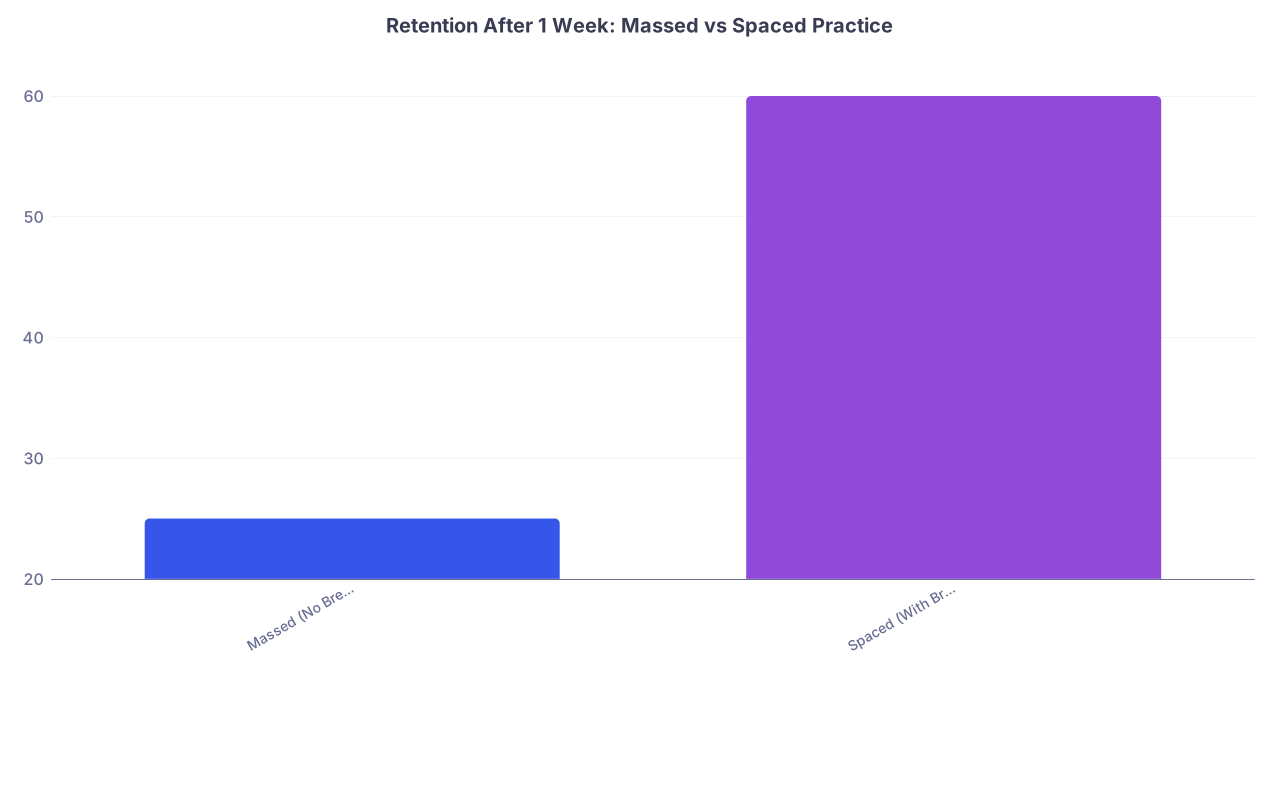
- The spacing effect: distributed study over time yields better long-term retention than massed cramming.
- Sleep and breaks: consolidation of new information requires downtime. Sleep and rest literally support synaptic restructuring and memory stabilization.
- Cognitive fatigue: performance on complex tasks drops sharply when you push attention and working memory past a few focused hours without real recovery.
Not “med school” data. Basic learning science that stubbornly refuses to care about your class culture.
| Category | Value |
|---|---|
| Massed (No Breaks) | 25 |
| Spaced (With Breaks) | 60 |
Those numbers are representative of common findings in the literature: massed, grind-style studying often retains 20–30% of material long term; properly spaced and rested studying can retain double or more.
You’ll hear people say, “Yeah but med school is different.” No, biology does not rewrite itself because your curriculum director uploaded more pre-recorded lectures.
Burnout and performance: not just “feelings”
Now zoom into medicine-specific data.
Multiple studies link burnout with:
- Increased error rates
- Worse clinical reasoning
- Lower exam performance
- Decreased empathy and professionalism ratings
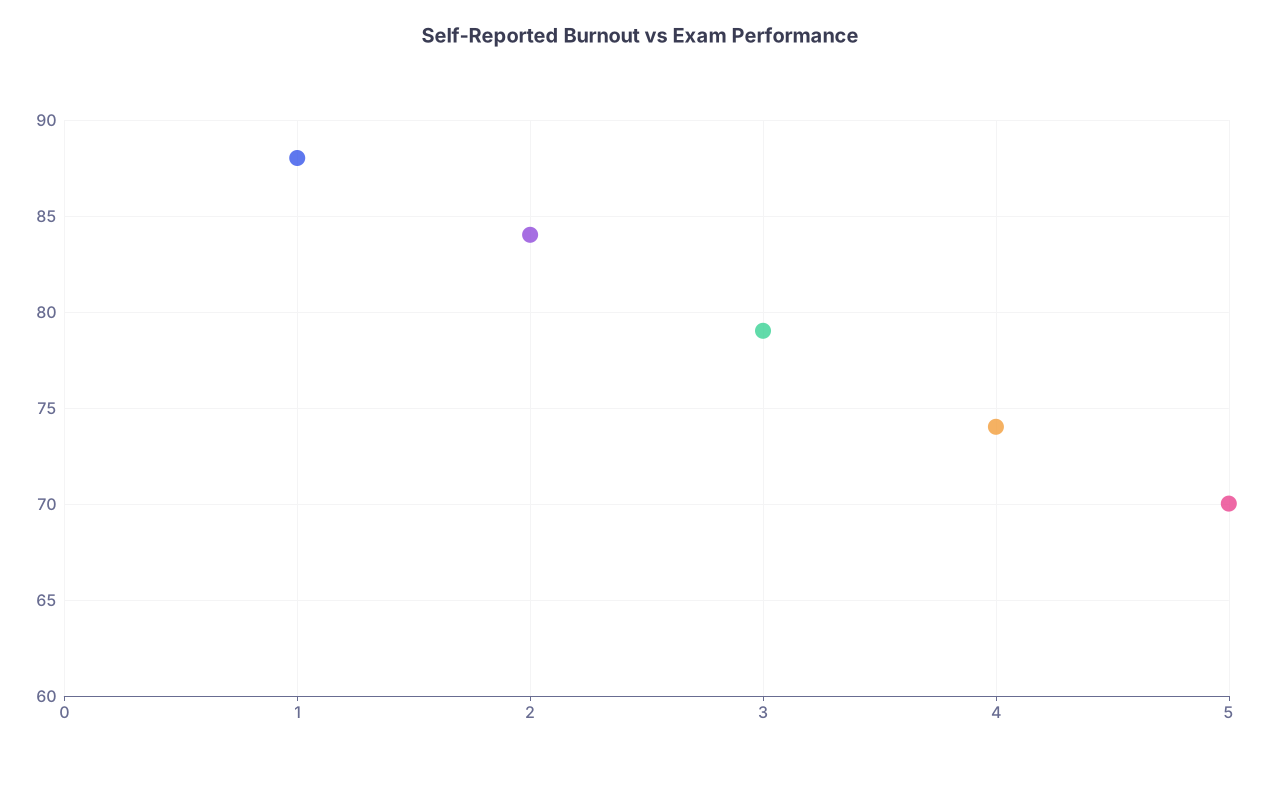
So when you see a first-year who never takes breaks, proud of their 14-hour library days—what you’re often seeing is a future burnout case in progress. And burnout doesn’t just wreck your mood; it quietly kneecaps your performance.
| Category | Value |
|---|---|
| Low | 1,88 |
| Moderate | 2,84 |
| High | 3,79 |
| Severe | 4,74 |
| Extreme | 5,70 |
Is this exact dataset from your school? No. But the trend matches what’s been shown repeatedly: more burnout, worse performance. And breaks are one of the core, evidence-based buffers against burnout.
So the “no breaks” strategy is, at best, short-sighted. At worst, directly self-sabotaging.
The Real Relationship Between M1 Habits and Board Scores
Here’s the uncomfortable truth: your Step 1/2 score is not a simple linear function of “hours studied in M1.” If it were, every chronic-grind student would crush boards. They don’t.
The people who score high tend to share something else:
- Consistent, focused daily work
- Effective use of spaced repetition
- Smart resource selection and restraint
- And yes—actual rest built into their life so they can sustain that for 12–24 months straight
I’ve watched three clear M1 archetypes repeat across multiple schools:
| Student Type | M1 Study Pattern | Likely Board Outcome |
|---|---|---|
| The Grinder | 10–14 hrs daily, minimal breaks, lots of passive rewatching | Plateaued score, burnout, average boards |
| The Ghost | Inconsistent, crams before exams, random boards prep | Highly variable, often below-average |
| The Sustainable High Performer | 6–8 focused hrs, built-in breaks, uses Anki/UWorld early | Strong, stable board performance |
You’ll notice something: the high performer is not the one “never taking breaks.” It’s the one protecting sustainability.
Taking breaks does not hurt board scores. Taking breaks selectively while maintaining total inconsistency does. And people often conflate the two.
The Two Types of “Breaks” Everyone Confuses
This is where the myth survives—sloppy language. Not all “breaks” are the same.
1. Productive, structured breaks (helpful)
These are intentional and bounded:
- Pomodoro-style 5–10 minute pauses every 30–50 minutes
- A real meal away from your laptop
- A non-negotiable evening cutoff time
- One day per week where you cut volume by 50–80% or focus only on light review
- A short walk after a long block of path video + Anki

| Step | Description |
|---|---|
| Step 1 | 8:00 Anki Review |
| Step 2 | 9:30 10-min Break |
| Step 3 | 9:40 Lectures/Notes |
| Step 4 | 11:10 15-min Break |
| Step 5 | 11:25 Practice Questions |
| Step 6 | 12:30 Lunch Away from Desk |
| Step 7 | 1:30 Light Review / Anatomy Lab |
| Step 8 | 3:30 20-min Break Walk |
| Step 9 | 4:00 Targeted Weak Area Study |
| Step 10 | 6:00 Hard Stop / Evening Off |
These breaks are like rest between sets in the gym. Without them, your total volume and intensity drop. Your “no rest” workout isn’t hardcore; it just becomes low-quality and sloppy.
2. Avoidant, unstructured breaks (harmful)
Different animal.
- Bailing on your plan completely to scroll TikTok for 3 hours
- “I’ll take the day off” 3–4 times per week because everything feels overwhelming
- Pseudo-study where the laptop is open, but you’re half on Reddit, half in your notes
People do this, then say, “See? Taking breaks makes me fall behind and kills my scores.”
No. Avoidance kills your scores. Not actual rest.
If your idea of “taking breaks” is “I disappear for days and then panic-cram,” then yes, your boards will suffer. But that’s not a defense of nonstop grinding; it’s a critique of poor structure.
What High-Scoring M1s Actually Do With Breaks
I’ll be blunt: the first-years who end up crushing boards are not the ones martyring themselves. They’re the ones who treat their brain like a limited resource instead of a punishment target.
Patterns I see over and over:
They work in focused blocks
Usually 1–3 hours of deep work, then a real step away. No multitasking with Netflix, no 27 tabs. They expect to be tired after a few solid blocks. That’s the signal to rest, not to chug another coffee and pretend.
They respect sleep
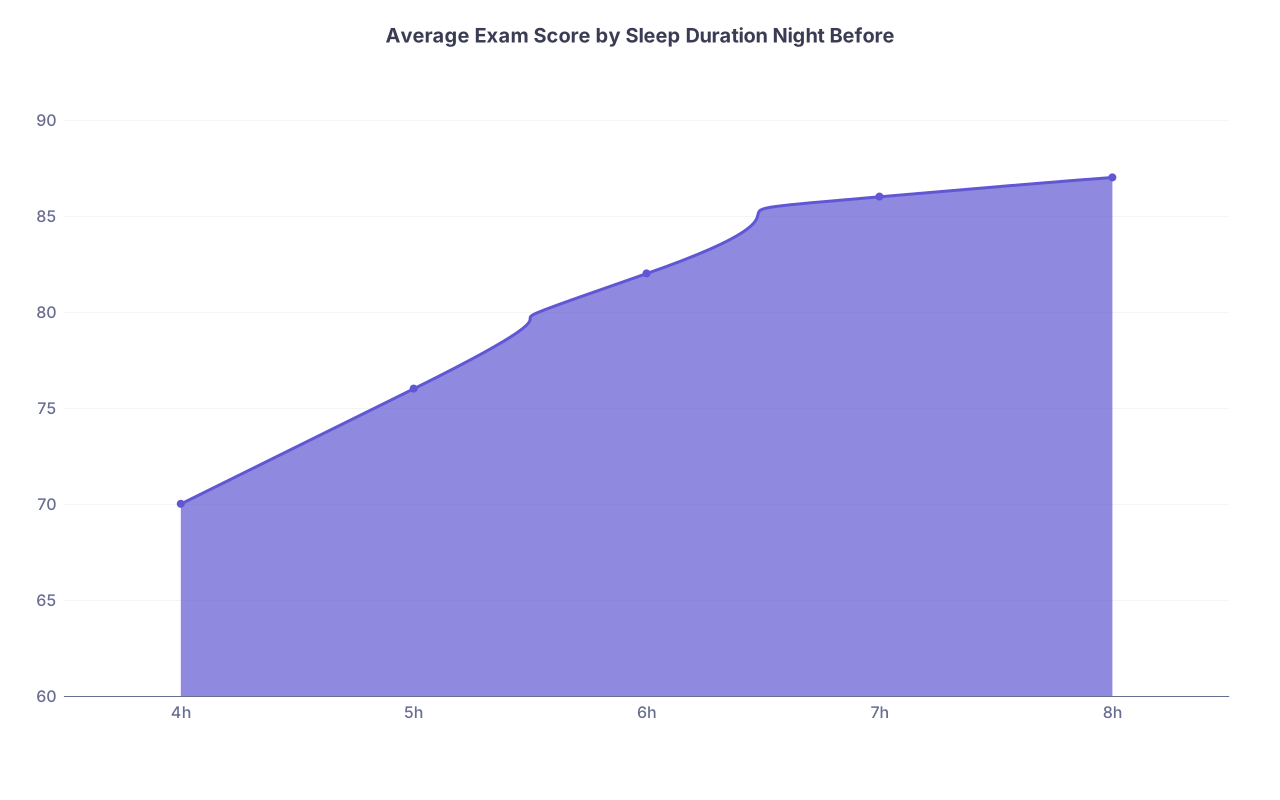
Not “perfect sleep hygiene.” Just not stupid. Regular 6.5–8 hours. They protect their sleep in exam weeks instead of bragging about all-nighters. The evidence on sleep and test performance is not subtle: chronic restriction wrecks working memory and reasoning.
| Category | Value |
|---|---|
| 4h | 70 |
| 5h | 76 |
| 6h | 82 |
| 7h | 86 |
| 8h | 87 |
They build rhythm, not heroics
They don’t try to “make up for” bad weeks with insane 14-hour marathons. They aim for 6–8 productive hours most days. It adds up. That slow, boring consistency is what makes boards feel less like a cliff and more like a step.
They protect one or two non-negotiables
For one it’s Sunday afternoon off. For another it’s lifting three times a week. For someone else, dinner with their partner most nights. They realize losing all of that in the name of “Step” is a terrible trade; the point of boards is to become a physician, not an exhausted shell.
The Hidden Cost of Never Taking Breaks: Diminishing Returns
There’s a moment every M1 hits around week 8–10 of the first block where they realize: this is not a sprint. It’s not even a marathon. It’s a series of marathons chained together with no real offseason.
If you go out at full sprint and refuse to stop for water because “breaks are for the weak,” here’s what tends to happen by spring:
- You can’t read a dense path paragraph twice without your mind wandering.
- Your Anki reviews balloon to 1,000+ cards because you’re too mentally fried to add new ones wisely.
- Practice questions feel impossible because you’re mentally dull, not because the content is uniquely hard.
- Any minor setback (bad quiz score, harsh feedback in lab) hits ten times harder.
That isn’t mental toughness. That’s accumulated fatigue.
Think about boards prep like strength training. If you try to max your deadlift every single day, you won’t become a monster. You’ll get injured, plateau, and start regressing. Not because you’re weak—but because you ignored how adaptation works.
Your brain works the same way. Stress + recovery = growth. Stress + no recovery = breakdown.
How to Take Breaks Without Letting M1 Eat You Alive
If you’re afraid breaks will tank your boards, what you actually lack is confidence in your structure. So fix the structure.
A simple, evidence-aligned approach for M1:
Decide on a daily “floor” and “ceiling”
For example: minimum 4 hours, maximum 8 hours of real study. If you hit 8 and feel like you could do more? Tough. Stop. That’s how you prevent chronic overload.Use time, not vibes, to define breaks
25–50 minutes on, 5–10 minutes off. Two or three cycles, then a longer 20–30 minute break. Don’t wait to “feel destroyed” before resting.Protect one major block of off-time weekly
Half a day where you only do light review or catch up on Anki, if anything. Or a day where you finish by lunch. Boards are not won on that extra 3 hours you squeeze in on Sunday at the cost of your sanity.Put boards in the background, not the center, in M1
Light boards integration (Anki decks aligned with class, a small number of practice questions) is smart. Turning M1 into a Step boot camp from week 1, seven days a week, is not.

- Watch for the red flags of fake productivity
Rewatching the same lectures, “studying” 10+ hours with no practice questions, ignoring fatigue signals, bragging about not having a life. Those patterns feel like dedication. They usually predict mediocrity.
What About the Fear of Falling Behind?
This is the real driver. Not belief in neuroscience. Fear.
“If I take breaks, everyone else will outwork me.”
Here’s the counterpoint: you are not racing against the most anxious person in your class. You’re competing against the limited capacity of your own nervous system.
Someone else can do 10 hours a day? Fine. If your brain’s quality craters after 7, copying them is stupid. Yes, they might log more total hours. But if half those hours are low-quality, and your 7 are focused and sustained because you actually rest—who do you think ends up with better long-term retention?
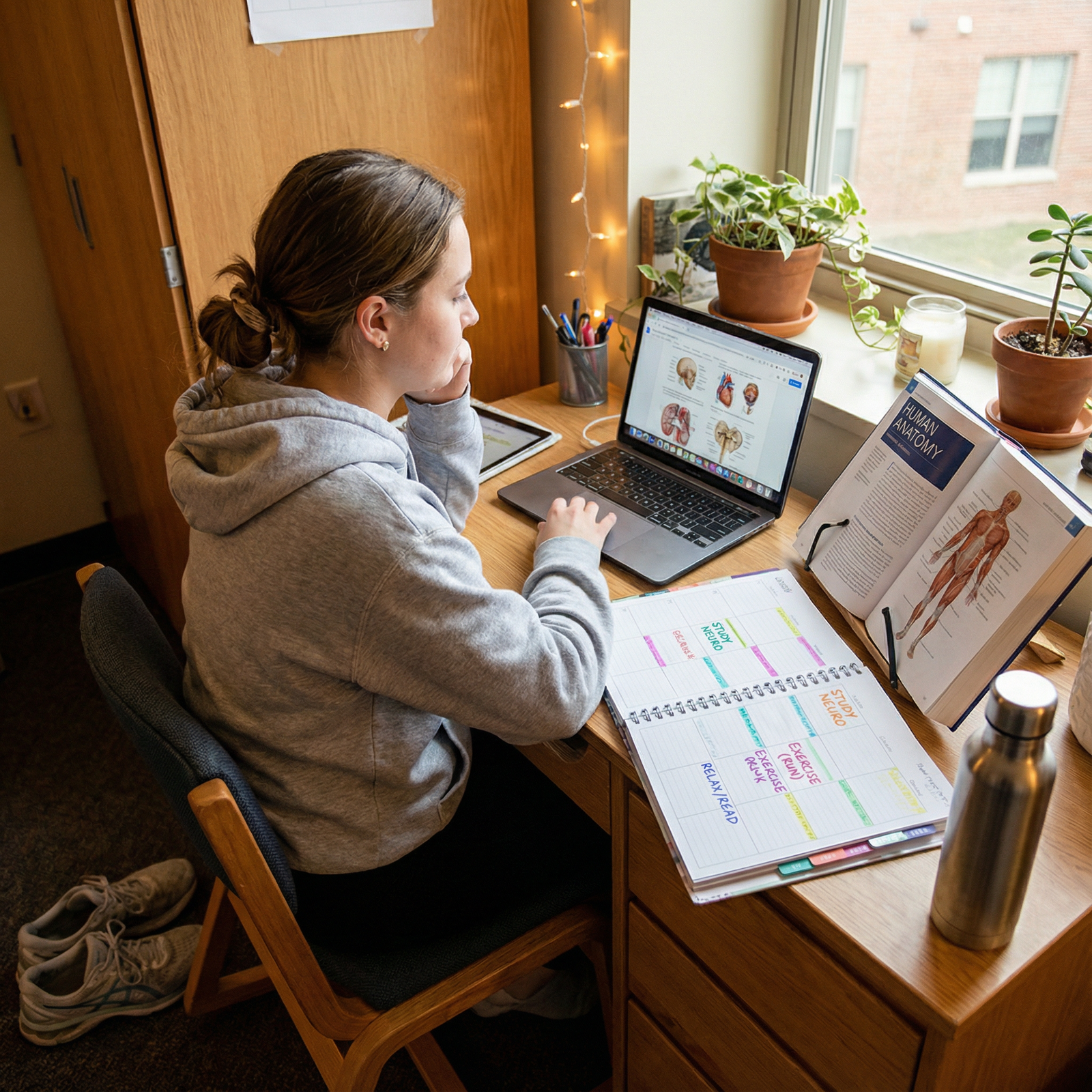
You are not behind because you took a 20-minute walk. You’re behind because you’ve been white-knuckling your way through months of content with no system, and now your brain is revolting. Breaks are not the cause. They’re part of the solution.
A Quick Reality Check: What Actually Hurts Board Scores in M1
If you want villains, here they are—and none of them are “took regular breaks”:
- Chronic procrastination and panic-cramming before every block exam
- Never touching active recall (Anki, questions) until the last minute
- Switching resources every two weeks because someone on Reddit said “this is the new meta”
- Treating sleep, exercise, and mental health as optional until something snaps
- Tying your entire self-worth to every quiz and every percentile

Those behaviors will absolutely hurt your board scores. Taking structured, consistent breaks will not.
The Bottom Line
Let me strip this down to what actually matters:
Breaks do not kill board scores; chronic, unstructured overwork and burnout do. Your brain is not special enough to escape basic cognitive limits.
The students who end up with strong board scores in M2/M3 are not the ones who “never took a day off in M1.” They’re the ones who treated M1 like a long game: consistent effort, active recall, and protected recovery.
Build a schedule you can sustain, not a schedule you can brag about. The boards will reward the former, not the latter.