
The hero worship of the “gunner who outworks everyone” is toxic nonsense.
Not because hard work is bad. Because the specific version of “grind” medical culture glorifies is incompatible with how human brains and bodies actually function over a 4-year (plus residency) timeline.
Let me be blunt: if your survival strategy for M1 is “I’ll just grind harder than everyone else,” you’re already losing. You might not feel it in September. You will feel it by February. And the data on burnout, depression, and performance backs this up.
This isn’t a motivational speech. This is: here’s what the evidence shows about performance, sleep, hours studied, and burnout—and why the “gun over grind” identity is a long game you cannot win.
The Grind Fantasy vs How People Actually Perform
There’s a story you see on every med school class GroupMe:
- Someone posts that they’re doing 500 Anki reviews a day, 3 question blocks, and pre-reading for three lectures ahead.
- People react with “gun,” “machine,” “teach me your ways.”
- Quiet conclusion most first-years draw: “To be competitive, I have to do that.”
Except the research on learning and fatigue doesn’t support that story at all.
What the data shows about hours and performance
In cognitive psychology and education research, the relationship between hours worked and performance is not linear. It looks closer to an inverted U: too little effort is bad, too much effort without recovery is also bad.
Studies on residents and sleep are the clearest example:
- Chronic sleep restriction (around 5–6 hours/night) for 1–2 weeks impairs reaction time and cognitive performance to the level of being legally intoxicated on standardized tests.
- People feel like they’re adapting. Performance data says they aren’t.
Now translate that to M1:
You’re trying to retain biochem pathways, pharmacology mechanisms, and anatomy details with a brain running at the cognitive equivalent of 0.08 BAC. But you think you’re “outworking” others because you’re awake.
Here’s the uncomfortable truth: the well-rested classmate doing 6–7 focused hours and then going home is very likely learning more efficiently than the person chained to a desk for 12 half-conscious hours.
The research on sleep and memory is brutal and very consistent:
- Sleep consolidates memory.
- Sleep deprivation selectively impairs the exact functions exams rely on: working memory, attention, and higher-order reasoning.
So the grind myth confuses time spent suffering with time spent learning.
What Burnout Actually Looks Like in Med School (Not the Instagram Version)
Everyone thinks burnout is: “I cry once before an exam and say I’m burnt out.” No.
Burnout has specific, measurable patterns. And medical students are not dodging them.
Multiple studies in US med schools show:
- Around 50% of medical students report burnout during training.
- Symptoms correlate with worse academic performance, higher rates of depression, and increased thoughts of dropping out or self-harm.
- Burnout is driven by workload, loss of control, and lack of recovery—not lack of moral fiber.
And the “gun over grind” mindset feeds all three:
- Workload inflation – If you benchmark yourself against the most extreme grinder in the class, your “baseline” becomes unrealistic by definition.
- Loss of control – You start to feel like you should always be doing more. There’s no “enough.” That’s textbook burnout psychology.
- No recovery – Rest feels like weakness. So you don’t actually recover, you just slow-bleed your capacity.
I’ve watched M1s slide into the same pattern every year:
- First 2–3 blocks: hyperscheduled, always “on,” pulling late nights to “keep up”.
- By mid-year: they start forgetting simple things, need multiple passes over material, question blocks become torture. They double down on hours.
- By spring: their studying gets slower and more scattered, not sharper. Some start failing quizzes or barely passing blocks despite “studying more than ever.”
That’s not lack of discipline. That’s an overloaded system.
The Cognitive Science the Grind Crew Never Talks About
If the grind worked the way it’s marketed, chess grandmasters, elite musicians, and top athletes would just do “more hours” and call it a day. They don’t. Because they understand something med students routinely ignore: cognitive load, spacing, and fatigue.
Your brain has a bandwidth cap
Working memory is limited. There’s classic work showing most people can hold 4–7 items at once. Medical school content is designed to overwhelm that unless you structure it.
So what happens when you “just grind” 12–14 hours/day?
- You massively increase input (lectures, Anki, question banks).
- But your ability to encode and consolidate is bottlenecked by attention and sleep.
Result: a big pile of half-encoded facts that feel familiar but are not accessible under exam conditions. You get that sick feeling of “I’ve heard this before but I can’t quite place it.”
That’s not because you didn’t “want it” enough. It’s because you tried to brute force past human cognitive constraints.
Spaced repetition is powerful—until you overload it
Everyone loves to say “I do 800 Anki reviews a day.” As if that sentence doesn’t also say: “I’ve made my deck so bloated that my reviews are now a full-time job and I’m drowning in low-yield noise.”
The actual evidence-based principles from learning science:
- Spacing beats cramming.
- Retrieval beats passive review.
- Interleaving related topics helps transfer.
- Focused sessions beat long, unfocused marathons.
What does not appear in the literature: “Simply doing more total cards/questions per day, regardless of sleep and cognitive freshness, guarantees better outcomes.”
There’s always a marginal point where each extra unit of effort yields less learning per minute. Grind culture pretends that point doesn’t exist.
Why “Outworking Everyone” Fails Over a 10+ Year Timeline
First year of med school is not the finish line. It’s the first hill on a very long course:
- 4 years med school
- 3–7 years residency
- Possibly fellowship
- Then an actual career with real responsibility and limited control over hours
The “I’ll just grind harder” identity doesn’t survive that.
Look at residency and see your future if you don’t change
Residents live the extreme version of the grind fantasy: 60–80 hour weeks, night shifts, emotional trauma on top of fatigue.
What do the data show?
- Residency burnout rates hover around 50–60% in many specialties.
- Burnout is associated with increased medical errors, lower empathy, worse patient satisfaction.
- Chronic sleep deprivation leads to more needle-stick injuries, car accidents post-call, and major decision errors.
If your long-term strategy is to be the person who always takes on more, sleeps less, and “pushes through,” residency will chew that up. Not in a romantic, warrior way. In a “you are now dangerously impaired and don’t realize it” way.
Thinking you can out-grind that system indefinitely is like thinking you can out-caffeine liver failure. You’ll feel ‘fine’—right up until you absolutely aren’t.
The Numbers Everyone Ignores: Efficiency vs Hours
Let’s put some structure on this. Very simplified, but it makes the point.
Say two M1s are prepping for the same exam.
- Student A (Grind): 12 hours/day, 6 days/week
- Student B (Focused): 7 hours/day, 6 days/week
Assume this very conservative model:
- A starts at 70% efficiency (70% of time actually encoding useful information), but due to sleep loss and fatigue, drops 5 percentage points every extra 3 hours after hour 6. Realistically, it’s worse than this, but let’s be generous.
- B holds ~85% efficiency by sleeping more and taking breaks.
Calculation over a study day:
Student A:
- First 6 hours: 70% efficiency → 4.2 “effective hours”
- Next 3 hours: 65% → 1.95 effective
- Last 3 hours: 60% → 1.8 effective
- Total: ~7.95 effective hours
Student B:
- 7 hours at 85% → 5.95 effective hours
On paper, A “studies” 12 hours vs B’s 7. In actual learning gained, A’s advantage is only about 2 effective hours/day while paying a massive sleep and mood tax.
Now extend this over weeks with cumulative fatigue. A’s efficiency doesn’t just drop within a day, it drops across days. B’s doesn’t.
The real shape over a semester looks more like:
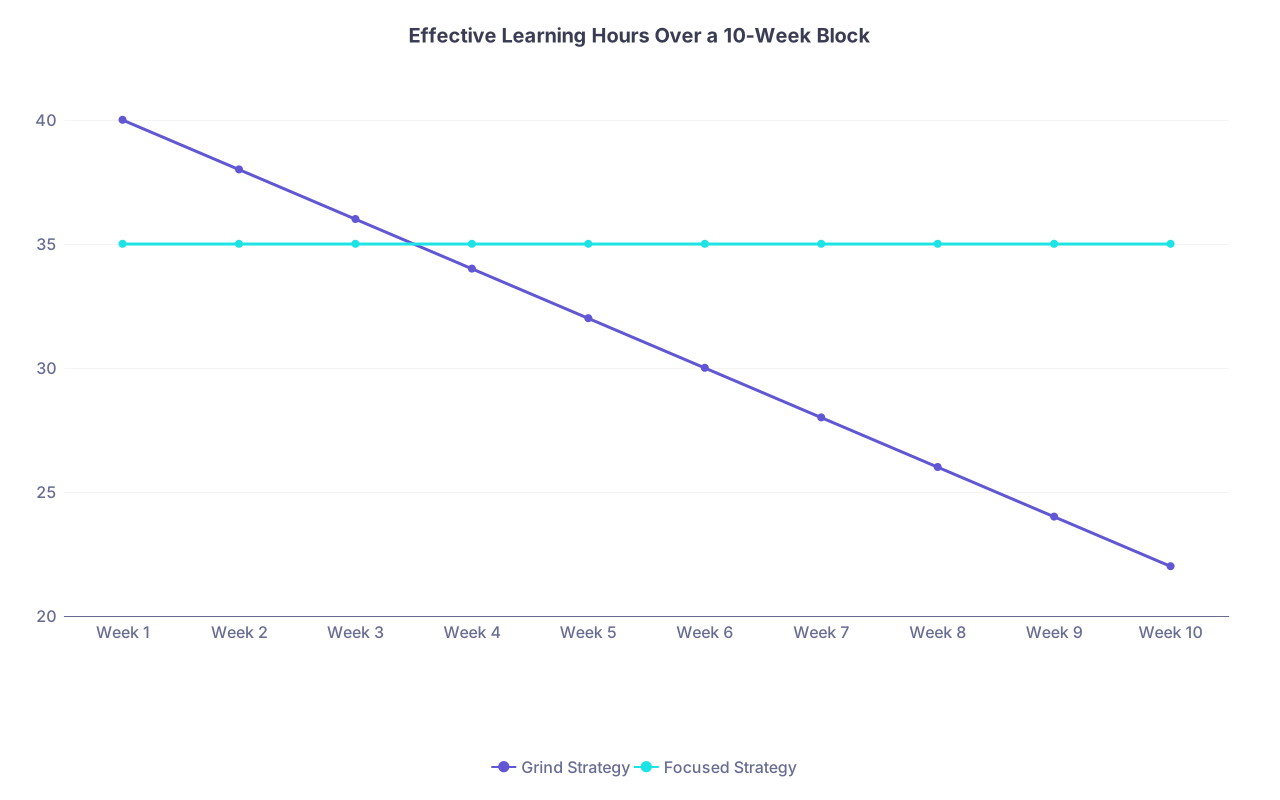
| Category | Grind Strategy | Focused Strategy |
|---|---|---|
| Week 1 | 40 | 35 |
| Week 2 | 38 | 35 |
| Week 3 | 36 | 35 |
| Week 4 | 34 | 35 |
| Week 5 | 32 | 35 |
| Week 6 | 30 | 35 |
| Week 7 | 28 | 35 |
| Week 8 | 26 | 35 |
| Week 9 | 24 | 35 |
| Week 10 | 22 | 35 |
That’s how people crash. Not all at once. Slowly.
What Sustainable “Gunning” Actually Looks Like
Let’s kill another myth: I’m not saying be chill, do nothing, and trust the vibes. No.
Being serious and ambitious in med school is fine. Good, even. But the students who win long-term look nothing like the 2 a.m. library martyrs.
They tend to share three patterns:
Caps on hours, not floors
They say things like “I’m done at 7, no matter what.” This forces prioritization. They pick high-yield content, active recall, and crucial weaknesses. They drop the illusion that they can “do everything.” Because they can’t—and neither can you.Aggressive sleep protection
They don’t brag about 4-hour nights. They treat sleep like Step prep. Consistently 7–8 hours. Boring. Unsexy. Incredibly effective.Periodic “audit and cut” behavior
Every couple weeks they look at what’s giving returns and ruthlessly cut what isn’t.- Decks that generate 400 reviews/day and still don’t show up on NBME questions? Trimmed.
- 3 different review books for the same organ system? Pick 1.
- Study group that devolves into shared anxiety and no actual work? Left.
They are not lazy. They are efficient and slightly ruthless with their energy.
The Social Part No One Admits: Grind Is Often Performance
One more uncomfortable point: some of the loudest grinders are performing anxiety, not modeling success.
I’ve heard this line more times than I can count in M1 lounges: “I was here until 2 a.m. again, I’m dying.” Said with half-pride, half-misery.
When you look at their practice scores or block results, they’re…fine. Not off-the-charts. Often not even top of the class.
You almost never hear from the person who quietly:
- Leaves by 6 p.m.
- Turns off GroupMe during study blocks
- Scores in the 80s/90s on practice exams
Because they’re busy living their life and don’t need the identity of “the hardest worker in the room.”
You’re seeing noise, not signal.
So How Do You Survive M1 Without Worshipping Grind?
Practical, not fluffy.
1. Set a hard daily ceiling, not a vague goal
Decide: “My max is 8–9 real hours of study input/day.” Not 13. Not “until I finish everything.”
Within that ceiling:
- Block your day into 60–90 minute focus chunks with 10–15 minute breaks.
- Protect 7–8 hours of sleep like it’s part of the exam.
Your brain will feel underused at first if you’re used to chaos. Then your recall will improve.
2. Measure outcomes, not time
Track:
- Practice question percentages
- NBME-style self-assessments
- How often you blank on things you “reviewed 3 times”
If more hours aren’t moving those numbers, the solution is not “more hours.” It’s “different strategy.”
| Factor | Grind Strategy | Sustainable Strategy |
|---|---|---|
| Daily study time | 10–14 hours | 6–9 focused hours |
| Sleep | 4–6 hours, variable | 7–8 hours, consistent |
| Question performance | Plateaus or declines | Gradual upward trend |
| Burnout risk | High by mid-year | Lower, more stable |
| Long-term viability | Fails in residency | Compatible with residency |
3. Stop benchmarking against the loudest 5% of the class
You don’t need to emulate the person rewriting all of First Aid by hand. You need to:
- Hit your school’s benchmarks
- Build Step/Level prep slowly
- Arrive at M3 with your brain and mood intact
That’s success. Not “I lived in the library more than anyone else.”
The Mental Shift: From “Outworking” to “Outlasting”
Think of M1 like the first 5 miles of a marathon. You absolutely cannot tell who will finish strong based on who sprints the hardest at the start.
You’ll see classmates peaking now who are wrecked by M3.
You’ll see classmates who looked “average” M1 become excellent residents because they kept a steady pace.
Stop trying to win the “who suffers the most” contest. Nobody hands out a separate Match Day envelope for that.
You need a strategy that lets you:
- Perform well
- Stay functional
- Still be a human being
That means rejecting the myth that you can always fix academic anxiety by pouring more hours on the fire.
The gun over grind myth is seductive because it flatters your ego: if you suffer enough, you’re special. Reality is colder. Your brain doesn’t care about your ambition. It cares about sleep, spacing, and a workload it can actually process.
Years from now, you won’t brag about how many nights you left the library at 2 a.m. You’ll remember whether you still liked medicine—and yourself—enough to keep going.