
You are not “just stressed.” You are running a failing system. The good news: systems can be rebuilt.
If you are a first‑year med student already burned out before even touching Step 1/Level 1, that is not a personal weakness. That is a mismatch between your current habits, your workload, and your physiology. You fix it with design, not with more willpower.
Let me walk you through a practical recovery plan that I have seen work for real students who were ready to quit before Christmas and ended up passing boards comfortably.
Step 1: Diagnose Your Burnout Like You’d Diagnose a Patient
Stop calling everything “stress.” You need a clearer picture. Burnout usually shows up in three main domains:
- Exhaustion
- Cynicism / detachment
- Drop in performance or sense of effectiveness
You do not fix what you have not named. Spend 15–20 minutes and be honest.
Do a 10‑Minute Self‑Assessment
Grab a piece of paper. Divide it into three columns: “Body,” “Mind,” “Performance.”
Under each, list what has been true for the past 2 weeks.
Body
- Falling asleep in lectures even after “sleeping” 7+ hours
- Waking up tired no matter what
- Headaches, GI issues, racing heart, chest tightness
- Sugar and caffeine doing more harm than good
- Getting sick repeatedly
Mind
- Dread when you open Anki or the LMS
- Irritability at classmates, attendings, even patients in standardized encounters
- Feeling numb—no excitement about medicine at all
- Thoughts like “I do not care anymore” or “I will never catch up”
Performance
- Grades dropping despite similar or more study hours
- Watching lectures without remembering anything
- “Studying” for hours but unable to get through more than a few cards
- Procrastinating until the night before quizzes or practicals
Now quickly rate each domain from 1–10:
- 1–3: Minimal problem
- 4–6: Concerning
- 7–10: Red zone
If any category is ≥7, you are not dealing with a simple time‑management issue. You need an active recovery plan, not just better flashcards.
Step 2: Stop the Bleeding – Immediate 7‑Day Stabilization Plan
You cannot “optimize” while you are in free‑fall. First, stabilize.
For the next 7 days, your only goal is this: reduce your physiological and cognitive overload enough that your brain can actually start learning again.
1. Set a Hard Daily Time Cap
You are going to hate this, but it works.
- Set a daily study cap of 9–10 hours total (including lecture, review, Anki, etc.).
- Yes, even if you are behind.
- Because those extra 3–4 hours at night are not making you learn more. They are just deepening the burnout.
Structure it roughly like this:
| Time | Activity |
|---|---|
| 7:00–8:00 | Wake, breakfast, light walk |
| 8:00–10:00 | Focused study block 1 |
| 10:00–10:20 | Break |
| 10:20–12:20 | Focused study block 2 |
| 12:20–13:00 | Lunch, no study |
| 13:00–15:00 | Lectures / required sessions |
| 15:00–15:20 | Break |
| 15:20–17:20 | Focused study block 3 |
| 17:20–18:00 | Dinner |
| 18:00–20:00 | Light review / Anki only |
After your cap: you stop. No “just one more video.” You are rebuilding capacity, not chasing perfection.
2. Ruthless Content Triage (What You Can Ignore This Week)
You are not going to master everything this week. That is fine. Boards are not next Tuesday.
For the next 7 days:
- Priority 1: Upcoming graded exams / quizzes
- Only the material that will actually be tested soon.
- Priority 2: Core systems and high‑yield concepts
- Big picture physiology, not every last detail in some 70‑slide immunology tangent.
- Ignore (for now):
- Optional readings unless your school is sadistic and tests them
- Extra resources you “heard were good” (Pathoma, B&B, etc.) unless directly needed for this week’s topics
- Perfect Anki completion if your deck is bloated
Tell yourself clearly: “I am not trying to be ahead this week. I am trying to not break.”
3. Sleep: Non‑Negotiable Parameters
You cannot study your way out of burnout while sleeping 4–5 hours.
For 7 days, treat sleep like a prescription:
- Target: 7–8.5 hours in bed
- Fixed wake time every day, even weekends
- Cut caffeine after 2 pm
- The last 30 minutes of the night: no phone, no laptop—read something stupid and light, or just lie in the dark
If you say, “I do not have time to sleep 7 hours,” what you really mean is “I am sacrificing my brain function to protect my anxiety.” That trade is killing your scores.
4. Brief, Forced Physical Reset
You do not need a gym habit. You need blood flow.
For the next 7 days:
- Minimum twice daily: 10 minutes of walking
- Once in the morning
- Once mid‑afternoon or early evening
- If you have more energy: 20–30 minutes brisk walk or light jog, 3x/week
The goal is not fitness. The goal is nervous system down‑regulation. Students who do this almost always report that their evening study becomes less pointless.
5. Immediate Tech & Distraction Control
Right now, your brain is fried. Social media and constant notifications are lighter fluid.
Concrete rules for 7 days:
- Phone stays in another room during focused blocks
- Disable notifications for: email, WhatsApp/GroupMe, social apps
- No YouTube, Reddit, TikTok during study breaks—only after your daily cap
- Use a simple timer (Pomodoro 50/10 or 45/15) and respect it
You are not “relaxing” when you doomscroll between Anki cards. You are fragmenting your attention and worsening the burnout.
Step 3: Rebuild a Sustainable Study System (Not Perfect. Sustainable.)
Once you stop the hemorrhage, you redesign your workflow so it does not put you right back in the same hole.
Here is the truth: most burned‑out first‑years are not actually studying too little. They are studying in ways that produce terrible returns.
1. Fix Your Input: Stop Transcribing, Start Encoding
I have seen this pattern a hundred times:
- You watch the 1.5x speed lecture
- You handwrite or type 10–20 pages of notes
- You “review” those notes before the exam
- You retain very little and feel exhausted
That is not learning. That is manual labor.
Replace it with this:
Before lecture (5–10 minutes):
- Skim slides or syllabus
- Write down 3–5 questions you expect to be answered
- That is it. No pre‑reading marathons.
During lecture:
- Do not try to capture every word
- Write only:
- Definitions
- Mechanisms
- Clinical correlations
- Anything that sounds like, “This is important” from the lecturer gets a star.
Immediately after class (15–20 minutes):
- Open notes
- Summarize the lecture in 5–10 bullet points
- Convert the highest‑yield points directly into active recall questions (Anki, QBank, or paper)
If your school offers recorded lectures and attendance is optional, consider this:
- Skip live lecture for topics you can handle from vetted resources (e.g., Boards & Beyond, Osmosis)
- Watch at 1.5x–2x, pausing only to create questions or cards
- Keep a running list of “ask the professor” questions for office hours
You are aiming for less time spent copying, more time spent retrieving.
2. Use Anki and Question Banks Like an Adult, Not a Completist
Anki does not cause burnout. Abusing Anki does.
Common self‑destructive habits I see:
- 800+ reviews/day because you added 200 new cards daily for 2 weeks
- Using 5 different shared decks while also making your own
- Refusing to suspend garbage cards because “one day they might be important”
Here is a sane approach:
Daily caps:
- New cards: 30–60 max (during preclinical heavy blocks)
- Total reviews: Aim to keep it under 250–300/day regularly
Prune relentlessly:
- Suspend:
- Cards that are too long or contain 3+ distinct facts
- Low‑yield minutiae that your exam history shows are not tested
- Edit:
- Make big cards into 2–3 smaller, more targeted cards
- Add:
- Only cards from:
- Missed QBank questions
- Concepts your professors clearly emphasize
- Repeat exam topics
- Only cards from:
If completing Anki takes more than 2–2.5 hours most days, your deck or method is broken.
For question banks (e.g., UWorld, AMBOSS, Rosh):
- During M1:
- 10–20 questions/day, tied to your current system/block
- Timed but untimed review
- Focus your review on:
- Why the right option is right
- Why each wrong option is wrong
- What concept you actually missed (not the superficial detail)
Step 4: Integrate Boards Preparation Without Destroying Yourself
You are burned out partly because Step 1/Level 1 is this giant ghost haunting every lecture. You need a bounded relationship with boards prep, not a constant anxiety drip.
1. Accept This: You Do Not Need to “Start Boards” Full‑Throttle in M1
The fantasy:
- “If I start heavy UWorld + 6 resources in M1, I will be relaxed in M2.”
Reality I have watched:
- Student burns out, learns nothing deeply, limps into dedicated with exhaustion and shallow understanding.
Here is what actually works for most first‑years:
- Use 1 primary video/text resource that matches your curriculum (Boards & Beyond, Sketchy, or a strong in‑house resource).
- Use 1 flashcard system (Anki, well‑curated).
- Add low‑volume, board‑style questions gradually.
Not six resources. Not everything your upperclass friends listed in a 45‑item “Step 1 guide.”
2. Set Explicit Boards‑Prep Limits as an M1
You protect yourself with boundaries.
Example rule set:
- During systems blocks:
- Max 60 minutes/day of board‑focused work (videos or questions)
- Everything must align with your current school content
- During lighter school weeks:
- Increase to 90 minutes/day if you are feeling stable—not exhausted
- Once a week:
- 1 × 20–40 question set of mixed topics to cross‑pollinate knowledge
You want to gently familiarize yourself with board‑style thinking, not run a mini‑dedicated every week.
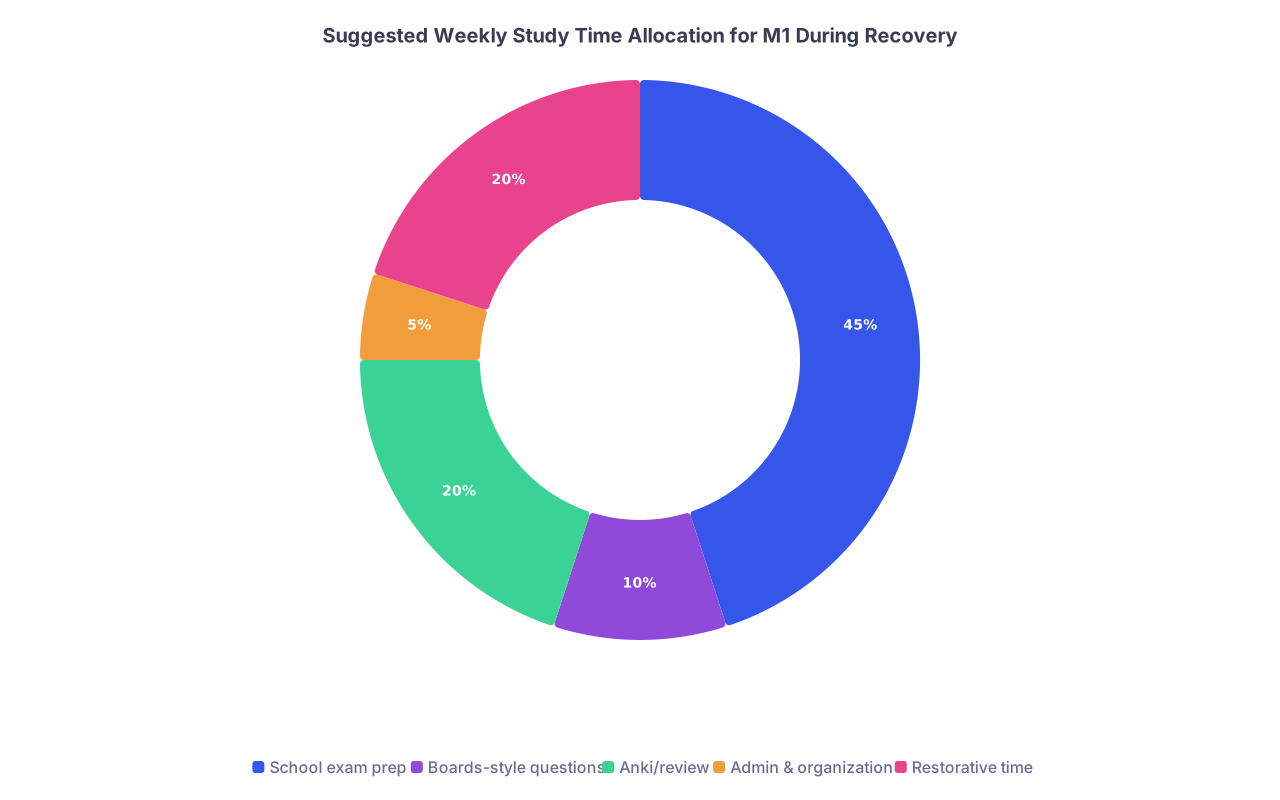
| Category | Value |
|---|---|
| School exam prep | 45 |
| Boards-style questions | 10 |
| Anki/review | 20 |
| Admin & organization | 5 |
| Restorative time | 20 |
Notice that only ~10–15% of your time is Step‑oriented in this phase. That is enough for early exposure without burning your circuits.
Step 5: Fix the Two Things Med Students Consistently Neglect – Body and Mind
Burnout is not purely academic. You cannot spreadsheet your way out if your nervous system is shot.
1. Minimal Physical Protocol That Actually Fits Med School
No, you do not need a 5‑day lifting split and a half‑marathon training plan.
Use a 3×/week “bare minimum” protocol:
Option A – Gym available (30–40 minutes):
- 5–10 min: Brisk walk or light cycling
- 15–20 min:
- Day 1: Squats + pushups + rows
- Day 2: Deadlifts + overhead press + planks
- Day 3: Lunges + bench press or dips + pull‑ups/assisted
- 5–10 min: Stretching
Option B – No gym (20–25 minutes):
- 10 min: Brisk outdoor walk
- 10–15 min circuit, 2–3 rounds:
- 10–15 squats
- 10 pushups (incline if needed)
- 20‑second plank
- 10 hip hinges or good‑mornings
Schedule these like mandatory labs. If you “fit them in when I can,” they vanish.
2. Mental Hygiene: Two Tools That Actually Move the Needle
You do not need a perfect mindfulness practice. But you do need something to discharge the mental static.
Tool 1: 5‑Minute Daily Offload
Once a day, preferably afternoon or evening:
- Open a blank page or notebook
- Set a 5‑minute timer
- Write, without editing: all worries, tasks, fears, annoyances
- When timer ends:
- Circle anything that is an action item
- Put those into a simple list for tomorrow (max 5–7 items)
This stops your brain from recirculating the same open loops at 2 a.m.
Tool 2: 7‑Minute Downshift Before Bed
Every night:
- 3 minutes: slow breathing—inhale 4 seconds, exhale 6 seconds
- 4 minutes: body scan from head to toes, noticing tension and letting it drop
Does this cure depression or severe anxiety? No. But for day‑to‑day burnout, it lowers baseline activation enough to actually fall asleep and stay asleep.
If your thoughts are dark (hopelessness, frequent “everyone would be better off if I disappeared,” or any version of self‑harm planning), this is not for DIY. You talk to someone licensed. Now, not “after this block.”
Step 6: Academic Triage Conversation – How to Talk to Your School When You Are Drowning
Most students wait far too long to involve faculty or administration. They show up after failing multiple exams, failing a block, and being on the edge of dismissal.
You want to get in front of that.
1. Who to Talk To First
Prioritize in this order:
- Course director or block director
- Academic support / learning specialist (if your school has one)
- Dean of students or equivalent
You are not going in to “confess failure.” You are going in to adjust strategy based on data.
2. What To Bring To the Meeting
Show that you are trying, not flailing. Bring:
- A 1–2 week sample schedule (even if it is ugly)
- Your scores from recent quizzes/exams
- A short list of what is hardest:
- Example: “Conceptually I can follow cardio physiology, but I am getting crushed by details and time pressure on exams.”
And be explicit: “I am burned out and my current system is not sustainable. I need help designing a realistic plan that lets me recover while staying on track.”
Specific questions to ask:
- “If I have to prioritize, which components of the course are most predictive of exam success?”
- “Can I safely de‑emphasize certain resources or sessions?”
- “Are there previous students’ study plans you found effective who struggled early?”
- “What is the actual threshold I need to meet to avoid remediation in this block?”
You want clarity, not vague encouragement.
3. Reducing Load Without Blowing Up Your Future
In severe burnout, you may need to adjust your academic load. That is not career suicide if you do it early and deliberately.
Reasonable options to explore:
- Taking one fewer elective or optional seminar this term
- Requesting a temporary reduction in extracurricular commitments
- If your school allows it, spreading a block over a longer time (e.g., decelerated curriculum)
Do not self‑decide to repeat a year or withdraw without talking to:
- Administration
- A trusted attending or mentor
- Financial aid (loans matter here)
Step 7: Rebuild Identity – From “I Am Failing” to “I Am Running an Experiment”
Burnout is not just physiological. It is identity‑level.
A lot of first‑years fall into this internal script:
“If I were meant to be a doctor, this would not feel so hard.”
That is nonsense. I have seen people who barely scraped through M1 become excellent residents. And I have seen “naturals” flame out because they never built systems.
You need to shift how you interpret struggle.
1. Define Success Narrowly for the Next 4–6 Weeks
For now, your success metrics are:
- Did I respect my daily study cap?
- Did I sleep ≥7 hours in bed?
- Did I do my 2 walks or 1 exercise session today?
- Did I complete the highest‑yield work for my next exam?
- Did I stop after X minutes of boards prep?
Notice what is not on that list: “Did I feel in control all day?”
You are building capacity. The emotional stability comes later.
2. Build a Simple Weekly Review Ritual
Once a week, 20–30 minutes:
- List:
- What worked this week
- What clearly did not
- Look at your calendar and scores
- Choose exactly one change to test next week
- Example: “Move QBank questions to morning when I am fresher”
- Or: “Cut my Anki new cards from 60 to 40 per day”
You are running experiments on yourself. That framing alone reduces shame.
Step 8: A Concrete 4‑Week Recovery Blueprint
Let me put this together into an actual month‑long plan. Use this as a template. Adjust for your school calendar.
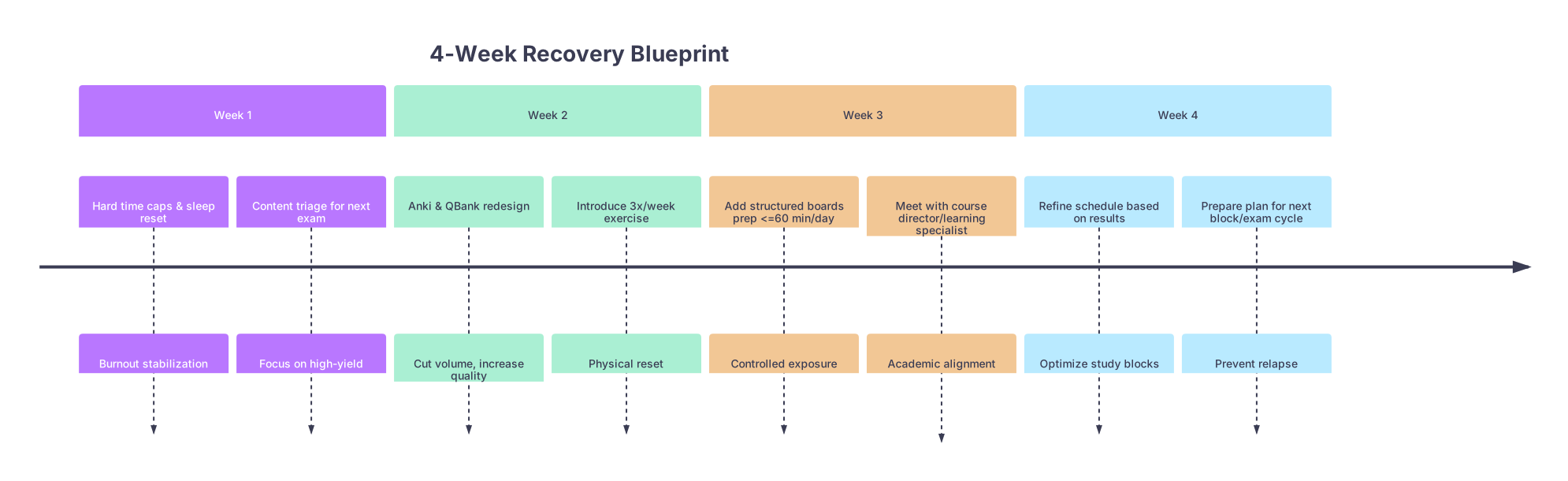
| Period | Event |
|---|---|
| Week 1 - Hard time caps & sleep reset | Burnout stabilization |
| Week 1 - Content triage for next exam | Focus on high-yield |
| Week 2 - Anki & QBank redesign | Cut volume, increase quality |
| Week 2 - Introduce 3x/week exercise | Physical reset |
| Week 3 - Add structured boards prep <=60 min/day | Controlled exposure |
| Week 3 - Meet with course director/learning specialist | Academic alignment |
| Week 4 - Refine schedule based on results | Optimize study blocks |
| Week 4 - Prepare plan for next block/exam cycle | Prevent relapse |
Week 1 – Stabilization
- Implement:
- 9–10 hour cap
- Sleep protocol
- Two 10‑minute walks daily
- Triage:
- Focus on the next exam only
- Delay non‑urgent long‑term projects
- Tech:
- Disable non‑essential notifications
- Use a timer for all focused blocks
Week 2 – Study System Overhaul
- Anki:
- Cap new cards
- Suspend trash cards
- Keep daily reviews manageable
- Questions:
- 10–15 questions/day tied to current block
- Careful review, not volume
- Start minimal 3x/week exercise routine
Week 3 – Controlled Boards Prep + Faculty Involvement
- Boards:
- 30–60 minutes/day max, aligned with your current topics
- Meet with:
- Course director and/or academic support
- Bring your data and schedule
- Adjust:
- Confirm what is truly high‑yield
- Clarify what can safely be deprioritized
Week 4 – Consolidate and Plan Forward
- Review:
- Grades from any recent exams
- Subjective fatigue level from 1–10
- Refine:
- Keep what clearly improved performance and energy
- Drop what added stress without improving scores
- Plan:
- Write a one‑page “Operating Manual for Next Block”
- Daily schedule template
- Max hours
- Exercise plan
- Boards prep limits
- Write a one‑page “Operating Manual for Next Block”
From here, you are not “fixed forever.” You are just in a position where normal adjustments actually work again.
When You Need More Than a Plan
If any of the below applies, you need professional support in addition to structural changes:
- Frequent thoughts of self‑harm, wishing you would not wake up, or fantasizing about accidents
- Panic attacks or severe anxiety episodes that interfere with basic functioning
- Inability to get out of bed or perform basic tasks for multiple days
- Using alcohol, stimulants, or sedatives regularly just to get through normal study days
Every medical school has some combination of:
- Student health services
- Counseling / mental health services
- An ombudsperson or dean for student affairs
Use them. Needing help during the most intense academic period of your life is not a sign you chose the wrong career. It is a sign you are human in a system that often pretends you are not.
The Bottom Line
Three points to keep:
- Burnout before boards is a systems failure, not a personal verdict. You fix it by changing inputs, limits, and workflows—not by yelling at yourself to “try harder.”
- Stabilize first, optimize later. Cap your hours, protect sleep, move your body, trim your study methods down to what actually moves grades. Then layer in reasonable boards prep.
- Do this as an ongoing experiment, not a one‑time rescue. Review weekly, adjust one variable at a time, and pull in faculty and mental health support early, not after a crisis.
You are not behind because you are broken. You are behind because nobody ever taught you how to do this sustainably. Now you have a working plan. Use it.