Test anxiety in M1 is not a personality trait. It is a conditioned response. And conditioned responses can be retrained.
If you are an M1 who knows the material but melts down on exam day, you do not need more “motivation,” more coffee, or yet another Anki deck. You need a structured exposure plan. Real, behavior-level rewiring.
Let me walk you through it.
1. Stop Treating Test Anxiety Like A Character Flaw
Test anxiety in medical school is almost never about intelligence. It is about wiring.
You have:
- A trigger: exams, question stems, timer, proctor, NBME interface
- A physiological response: heart racing, sweating, shallow breathing, nausea
- A cognitive spiral: “I am going to fail → I will fail Step → I will not match → I should not be here”
That loop gets repeated 10, 20, 50 times. The brain learns: “Exam environment = threat.” So it fires up your threat system every single time.
If you keep studying harder without changing the loop, you strengthen the association:
“The more it matters, the worse I feel.”
That is why:
- Your practice questions alone in your room feel okay
- But the moment you see “Exam opens in 5 minutes,” your brain detonates
You cannot fix this with positive vibes or a new high-yield resource. You fix it by systematically changing the association between test conditions and your internal response.
That is what exposure therapy does. You deliberately expose yourself to the trigger, in a controlled way, while teaching your body and brain a different response.
And yes, it works for medical students. I have seen people go from crying in the bathroom pre-exam to calmly scoring above average on NBME-style tests within one semester—because they finally treated this like a behavioral problem, not a moral failing.
2. Core Principles Of A Test Anxiety Exposure Plan
Before I hand you the step-by-step protocol, you need the rules of the game. Ignore these and the plan falls apart.
Principle 1: Gradual, not heroic
White-knuckling full exams in maximum-stress conditions from day one is dumb. It usually backfires.
You need a ladder:
- Start with mildly triggering situations
- Climb toward full exam conditions systematically
- Never jump more than one or two “rungs” at a time
Principle 2: Stay in the discomfort until it drops
Avoidance is the fuel of anxiety.
- If you stop a practice block because you are anxious, you just rewarded the anxiety.
- If you leave the testing room at the first hint of panic, your brain learns: “Panic saved me.”
During exposure, you stay there long enough for your anxiety to start to fall on its own. Even a small drop. That is what rewires the association.
Principle 3: Change your physiology first
You cannot “logic” your way out of fight-or-flight. When your heart is pounding and your vision is tunneling, motivational quotes are useless.
You need a go-to protocol to calm your body:
- Slowed exhale breathing
- Muscle release
- Visual anchors
- Brief cognitive reframe
We will script that out later. But key point: you apply those in the exposure, not only “later at home.”
Principle 4: Frequency > intensity
Doing one heroic 8-hour exam simulation per month is worthless compared to tiny daily exposures.
Think like physical therapy, not a once-a-month marathon.
- You need reps, not drama.
- 15–30 minutes per day of structured exposure beats 4 hours once a week.
Principle 5: Data over feelings
Anxious brains lie. They tell you:
- “I always bomb exams”
- “I never finish on time”
- “I cannot handle timed blocks”
You will track:
- Anxiety level (0–10)
- Performance (percent correct, time used)
- Conditions (alone / library / school exam room, etc.)
The data will make it very obvious that your narrative is exaggerating.
3. Build Your Personal “Exposure Ladder”
You are going to list situations related to testing, from least to most anxiety-provoking. Then you will climb them.
Step 1: Brain dump triggers
Write down test-related situations that spike your anxiety. Examples:
- Opening the exam portal
- Seeing a countdown timer on screen
- Sitting in the actual school exam room
- Doing 40 questions timed with classmates around
- Finishing a block and seeing your score
- Getting an email: “Exam schedule updated”
Be specific. “Exams” is useless. “Full-length NBME-style block in school testing center with proctor walking around” is useful.
Step 2: Rate each from 0–10
0 = no anxiety
10 = full-blown panic / meltdown
Example:
- 2/10 – Doing 10 untimed questions at home
- 4/10 – 20 questions, timed, at home
- 5/10 – Going to the testing room when it is empty
- 7/10 – 40 questions, timed, in the library with noise
- 9/10 – Actual school exam in testing center
Step 3: Make an ordered ladder
Sort from lowest to highest anxiety. You are going to start in the 3–5/10 range and work up.
| Step | Situation Description | Anxiety (0–10) |
|---|---|---|
| 1 | 10 untimed questions at home, no timer visible | 2 |
| 2 | 10 questions timed, soft timer (phone, no countdown) | 3 |
| 3 | 20 questions timed at home, visible countdown | 4 |
| 4 | Sit in empty testing room for 15 min, no exam | 5 |
| 5 | 20 timed questions in library with mild noise | 6 |
| 6 | 40 timed questions in library, strict timing | 7 |
| 7 | 40 timed questions in exam room, exam-like setup | 8 |
| 8 | Full school exam under real conditions | 9–10 |
You will customize this to your school and your own triggers. The structure stays.
4. The 4-Week Structured Exposure Plan (M1-Friendly)
Now the part you actually need: a concrete, four-week protocol you can plug straight into your schedule.
Assumptions:
- You have at least 4 weeks until a major exam (block exam or NBME-style test).
- You can spare 25–40 minutes on most days.
- You are doing content study separately. This plan is specifically for anxiety and performance.
Global rule for all weeks
- Do exposure sessions 5–6 days per week.
- Track each session:
- Situation (what you did)
- Pre-anxiety (0–10)
- Peak anxiety during (0–10)
- End anxiety (0–10)
- Performance (if questions)
- Do not stop an exposure because of anxiety. If you must stop, mark it and downgrade a step next time.
Week 1: Training Your Body’s Response (Low to Moderate Exposure)
Goal: Teach your nervous system that testing-like conditions are not lethal.
Target ladder range: 2–4/10.
Daily session (25–30 minutes)
2-minute pre-check
- Rate anxiety (0–10).
- Quickly write: “Anxiety is a body response, not a verdict on my ability.” (Yes, actually write it.)
10–15 minute mild exposure
- Example options:
- 10 untimed questions in exam-style interface, at your desk.
- Sit at your school testing center (when not in use) or a similar quiet room, laptop open, exam portal login screen up, but no exam started.
- Open your exam schedule and look at upcoming exam dates for 5 minutes while breathing slowly.
- Example options:
5-minute physiology protocol (during exposure) Use this simple cycle:
- Inhale through nose for 4 seconds
- Exhale through mouth for 6–8 seconds
- Do that for 6–8 breaths
- Notice 3 visual details in the room (color of the wall, shape of the clock, light reflection on the screen)
- Drop your shoulders deliberately and unclench your jaw
The signal here is: “Yes, I see the trigger. No, I am not running away. And I am physically safe.”
5–10 minutes light-timed questions
- 5–10 questions, gentle time constraint (e.g., 1.5–2x normal time; 2 minutes/question is typical, so you might give yourself 3–4 min/question initially).
- Use whichever Qbank you are already using (AMBOSS, UWorld, Rx, etc.).
- Do not chase a high percentage. You are training tolerance, not flexing mastery.
2–3 minute debrief
- Rate peak anxiety and ending anxiety.
- Note: “Was there a moment it dropped even slightly?” That moment is gold. That is the brain rewiring.
By end of Week 1, you want:
- Testing cues to feel familiar, not exotic
- A clear “I can calm my body in the middle of this” experience
Week 2: Real Timers, Real Questions, Still Controlled
Goal: Link real-timer testing with your new calmer physical response.
Target ladder range: 4–6/10.
Daily session (30–40 minutes)
2-minute pre-check
- Anxiety (0–10).
- Identify specific fear thought: “I will run out of time” / “I will blank out.” Write it. Do not argue with it yet.
20–25 minute moderate exposure Choose one:
- 15–20 questions timed at standard pace (e.g., 1.5 min/question) at home, countdown visible.
- Sit in a busier library area, headphones in, and do 15 timed questions.
- Go to the actual testing room (if allowed) at a time there is moderate foot traffic and do 10–15 questions timed.
During this set:
- Anxiety spikes? You keep going.
- Use the same breathing protocol in the middle of the block without pausing the timer. That matters. You are training “I can feel anxious and still think.”
Scripted cognitive response (2 minutes) After finishing the block, write a short response to your earlier fear thought.
Concrete examples:
- Fear: “If I feel anxious, I will fail.”
Response: “Today I felt anxious and still completed 20 questions with X% correct. Feeling anxious did not stop me from performing.” - Fear: “If I see a hard question, I freak out.”
Response: “I flagged 3 hard questions, moved on, and came back. I did not freeze. That is different from last month.”
- Fear: “If I feel anxious, I will fail.”
Review performance (5–10 minutes)
- Quickly review missed questions.
- Do not obsess about percentage. Track it, but do not worship it.
- The objective this week is: “I can function with real timing under semi-real conditions.”
Week 3: High-Fidelity Practice Under Stress
Goal: Simulate real exam conditions, with anxiety present, and demonstrate functional performance.
Target ladder range: 6–8/10.
You are now doing near-exam conditions 2–3 times per week, and lighter sessions on the other days.
Heavy days (2–3 days/week, 50–60 minutes)
5-minute pre-brief
- Rate anxiety.
- Write 1–2 sentences of intent:
- “My goal today is not to feel calm. My goal is to complete the block while anxious and still use my strategies.”
Single full block (40-question or exam-equivalent)
- Conditions:
- Timed at realistic pace
- In a place that resembles exam conditions as much as possible:
- Quiet library carrel
- Empty classroom
- School testing center if you can access it
- No phone. No mid-block breaks beyond what your exam would allow.
- Use your breathing and body-release strategies only in micro-bursts between questions or when flagging.
- Conditions:
5–10-minute debrief
- Rate:
- Peak anxiety
- Ending anxiety
- Note:
- How many questions did you actually blank on? (It is usually fewer than your brain claims.)
- Did anxiety decrease at any point? Where?
- Track your score.
- Rate:
Light days (2–3 days/week, 25–30 minutes)
- 15–20 timed questions, moderate conditions (home or quiet space).
- Emphasis on:
- Quick breathing reset when you notice tension
- Simple self-talk: “I have done harder practice than this.”
By the end of Week 3, you should have:
- At least 4–6 full blocks under near-exam conditions
- Data showing that anxiety ≥ 6/10 does not equal zero performance
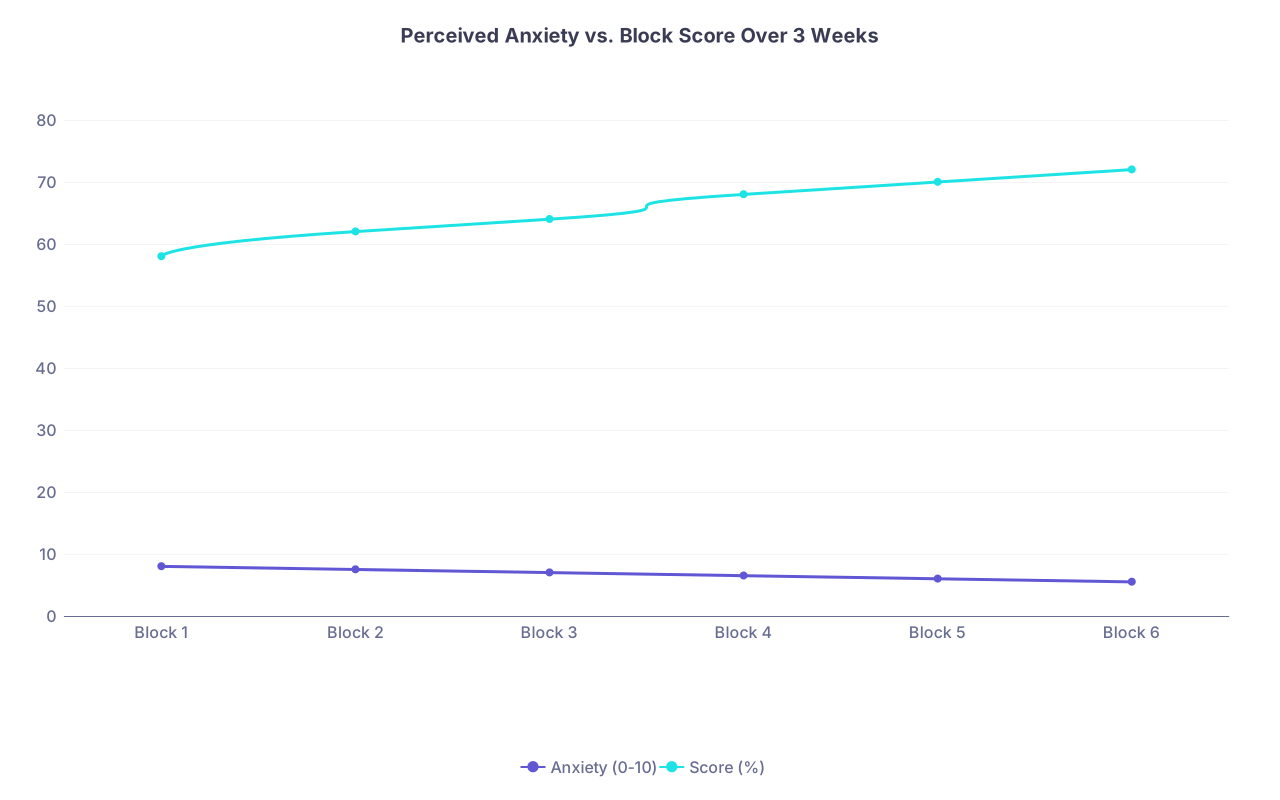
Here is how progress often looks:
| Category | Anxiety (0-10) | Score (%) |
|---|---|---|
| Block 1 | 8 | 58 |
| Block 2 | 7.5 | 62 |
| Block 3 | 7 | 64 |
| Block 4 | 6.5 | 68 |
| Block 5 | 6 | 70 |
| Block 6 | 5.5 | 72 |
Anxiety falls gradually. Scores creep up. The main shift is: “I can perform while anxious.”
Week 4: Dress Rehearsal And Refinement
Goal: Conduct at least one full “dress rehearsal” under near-identical conditions to your actual exam.
You will now:
- Run 1–2 full exam simulations (same number of questions and timing as your real deal).
- Use lighter exposures in between as maintenance.
Full simulation day (once, maybe twice)
Night before
- Replicate sleep and prep you plan to use for the real exam.
- No last-minute massive cramming.
- Prepare:
- Clothes
- Snacks
- Water
- Earplugs if you use them (and if allowed)
Morning-of routine Create a simple, repeatable routine:
- Wake at your planned exam-day time.
- Light breakfast you know sits well.
- 5–10 minutes of light movement (quick walk or mobility, not a workout).
- 5 minutes of slow breathing + visualizing yourself staying in the room even if anxiety hits.
Simulated exam
- Same number of blocks and breaks as your real exam.
- Same location type (ideally the actual exam site if possible).
- Full timing rules enforced.
During the test:
- Expect anxiety in the first 5–15 minutes. Do not interpret it.
- Focus on your micro-strategies:
- Scan stem → identify the actual question → eliminate 2 wrong answers.
- If you stare at a question > 45 seconds with no progress, flag and move on.
Post-exam processing (later that day, not immediately)
- Log:
- Block-by-block anxiety (start, middle, end)
- Performance per block
- Write 3 sentences:
- “What surprised me”
- “What actually went better than I feared”
- “What I will do the same on the real exam”
- Log:
Keep 1–2 light exposure days after this (short timed blocks) just to keep the system from snapping back into “avoid exam conditions” mode.
5. The In-Exam Anxiety Protocol (What To Do When It Hits)
You will have anxiety on real exam day. The difference after exposure training is that you will know exactly what to do with it.
Here is the protocol I have used with students who panic:
When you feel the wave rising:
Anchor your body – 30–60 seconds
- Feet flat on the floor.
- Uncross legs.
- Press toes into shoes firmly for 5 seconds, then release.
- Drop shoulders intentionally.
Breath reset – 5–6 cycles
- Inhale 4 seconds through nose.
- Exhale 6 seconds through mouth like you are slowly blowing out a candle.
- Do not exaggerate; you are not hyperventilating, you are lengthening the exhale.
Visual anchor – 10–15 seconds
- Pick one fixed point: corner of the screen, edge of the desk, a screw in the chair.
- Silently name 3 physical facts:
- “Screen is black around the border.”
- “Desk is light wood.”
- “The clock says 8:23.”
This pulls you out of the fear story and back into sensory reality.
Cognitive cue – 1 sentence Use one short sentence; do not give yourself a TED Talk mid-exam.
Options:
- “I have practiced this feeling.”
- “Anxiety is loud, but it is not in charge.”
- “I only need to answer this one question.”
Behavioral reset – return to the test
- Go back to the current question.
- If it is a mess, flag it, guess if needed, and move on.
- The win is: you stayed and you resumed behavior consistent with your goals.
You rehearsed this in your exposures. Exam day you are just replaying it.
6. Fix The Hidden Habits That Keep Anxiety Alive
If you keep doing the things below, exposure will only get you halfway. You have to stop feeding the monster.
1. Last-minute binge studying
Cramming until 2 a.m. does three things:
- Wrecks your short-term memory
- Amplifies baseline anxiety
- Teaches your brain: “The night before an exam is a crisis”
For M1s, I recommend:
- Last full study day ends by 8–9 p.m. the night before.
- Night-before tasks:
- Light review: key formulas, pathways, big-picture tables
- No new topics
- Short walk, shower, prepped exam bag
2. Catastrophic self-talk
You do not need to be “positive.” You need to stop being actively abusive to yourself.
Catch and chop these:
- “If I fail this, my career is over.” – No, it delays, complicates, frustrates. It does not erase your entire future.
- “Everyone else is handling this better than me.” – You have no data. You have curated Instagram stories and one or two loud classmates.
Replace with neutral-thoughts:
- “This exam matters, but it is one data point.”
- “I am training a skill set that usually improves over several exams, not one.”
3. Over-sharing with the wrong classmates
You know the type:
- The one who flexes their Anki streak and UWorld percentages.
- The one who tests “for fun” on weekends.
- The one who sends 12 messages about how underprepared they are and then gets a 95.
Limit exposure. Before exams, protect your brain from this noise.
Set a rule: For 48 hours before major exams, you do not compare:
- Number of practice questions
- NBME practice scores
- Study hours
You can talk logistics. Not performance.
7. What If You Are Already Deep In The Hole?
Maybe you are reading this 5 days before your exam. You are already panicking. Fine. You cannot run the full 4-week plan, but you can still apply the structure in a compressed way.
5-day crash exposure plan
- Day 1–2
- 2 short timed blocks per day (10–15 questions each) under moderate conditions.
- Practice the full breathing + visual + cognitive cycle every block.
- Day 3–4
- One longer block per day (20–30 questions) timed, ideally in a different environment (library, classroom).
- Keep track of anxiety and performance.
- Day 5
- One exam-length block or two shorter blocks back-to-back, under as realistic conditions as possible.
- Night: no cramming past 9 p.m., brief review only.
Is this as good as the full month? No. But it is miles better than hiding from questions until the night before, then trying to brute-force your way through panic.
8. When To Get Professional Help (And How To Make It Actually Useful)
Sometimes test anxiety is part of a broader anxiety or trauma pattern. Sometimes panic attacks are severe enough that you are blacking out portions of the exam.
Red flags that you need professional help on top of this plan:
- You have panic attacks more days than not.
- You routinely cannot finish exams because of physical symptoms.
- You are having intrusive thoughts about self-harm if you fail.
- You have a history of anxiety disorders, OCD, PTSD, or eating disorders.
If so:
- Use your school’s counseling service. They see this constantly.
- Be specific in what you ask for:
- “I want CBT-style work focused specifically on test anxiety and exposure-based strategies.”
- Bring your exposure ladder and your tracked data. That makes sessions far more effective.
Medication can also be part of the plan for some students (SSRIs, sometimes beta-blockers in narrow, supervised cases). That is between you and your physician. What matters: meds are not a substitute for exposure. They are a support while you retrain your system.
9. Quick Reality Check
A few hard truths:
- Plenty of brilliant M1s have tanked early exams from anxiety, then stabilized once they treated it as a trainable skill.
- Your classmates are not as calm as they look. The ones who “never stress” are often privately spiraling.
- You will not eliminate anxiety. The goal is to function with it.
You are not fragile. You are trained in scientific thinking. This is just applied behavioral science, directed at your own nervous system.
Use it.
Key Takeaways
- Test anxiety in M1 is a conditioned response, not a sign you do not belong. You can retrain it with structured, graded exposure.
- Build and climb an exposure ladder over 4 weeks: small, frequent, realistic practice under increasing exam-like conditions. Track anxiety and performance.
- Combine exposure with an in-exam protocol (breathing, body reset, brief cognitive cue) and basic lifestyle guardrails (no night-before cramming, limited toxic comparison) to make your brain stop treating every exam like a house fire.