
The Real Reason Some M1s Burn Out by Spring While Others Gain Influence
Most M1 burnout is not about workload. It is about power—who quietly gains it, and who never realizes the game has started.
You all walk in August thinking you’re on the same track: same lectures, same exams, same gross lab. By March, the differences are brutal. Some of you are barely holding it together, doom-scrolling in the back row, behind on every lecture. Others are suddenly “that person” everyone asks for notes, tutors, gets looped into committee meetings with the dean, invited to dinners with visiting faculty.
Same curriculum. Same hours. Completely different trajectory.
I’m going to tell you what actually separates those two groups. It’s not “self-care” and it’s not who color-codes their Anki decks. Directors and faculty will never say this out loud at orientation, but they talk about it in offices and closed-door meetings all the time.
Let me walk you through what really happens.
What Burnout Looks Like From the Faculty Side
You see your life collapsing. Faculty see a pattern they’ve watched for ten years.
The typical M1 burnouts by spring look very similar:
- They’re still trying to brute-force every slide by reading and re-reading.
- They study alone, or only with one equally overwhelmed friend.
- They try to match what the top students appear to be doing on the surface, not what they’re actually doing behind the scenes.
- They keep chasing perfection long after the game has shifted to “good enough for where you want to end up.”
There’s a running joke in curriculum meetings: by February, every class unofficially splits into three:
- The “running the place” group
- The “keeping up” group
- The “getting swallowed” group
No one writes that on a slide, but everyone at the school can see it.
The tragedy is that people in group 3 often work harder than group 1. They just work stupid. And alone. And on the wrong things.
The students who gain influence don’t have more hours. They have better leverage.
And that leverage comes from three things you’re never explicitly told to optimize: information, positioning, and energy.
The Information Gap: Why Some M1s Always Feel Behind
The biggest lie of M1 is that if you “do all the material” you’ll be fine.
The students who rise don’t do all the material. They do the right 60–70% and ruthlessly ignore the rest. And they figure out what’s “right” shockingly early.
Where does that information come from? Not from the syllabus. Not from the recorded lectures. It comes from upstream.
- Second-years who survived the exact same exams.
- TAs who know which questions are recycled and what style each professor favors.
- Admin and course directors who drop hints to “engaged” students about what’s clinically relevant vs what’s academic fluff.
You know who never burns out by spring? The M1 who, by October, has a clean, prioritized list for each block:
- What’s always tested.
- What’s occasionally tested.
- What’s there for “completeness” but never actually tested.
They don’t publicly flaunt this. The smart ones act like, “Yeah, I just really try to understand everything,” while running a completely different playbook.
Here’s what I’ve seen happen repeatedly:
- One M1 starts going to office hours not to ask content, but pattern questions: “What skills are you really trying to assess on this exam?”
- They quietly build rapport with a course director, who mentions offhand, “We’re really de-emphasizing minute enzyme details this year; focus on mechanisms and big picture.”
- That student passes this perspective to 4–5 people they like. Those 4–5 people suddenly start crushing blocks with less effort.
- By winter, those people are the ones others ask, “How are you keeping up?” and now they control the information flow.
The burnt-out group usually never forms these upstream links. They do what undergrad rewarded: get the PowerPoints, review sessions, YouTube, and grind. They think “bothering faculty” is for gunners. You know who loves that phrase? Other overwhelmed students. Not faculty.
The truth: faculty adore students who ask meta-questions about the course. Those are the students they remember when positions, letters, and leadership roles open up.
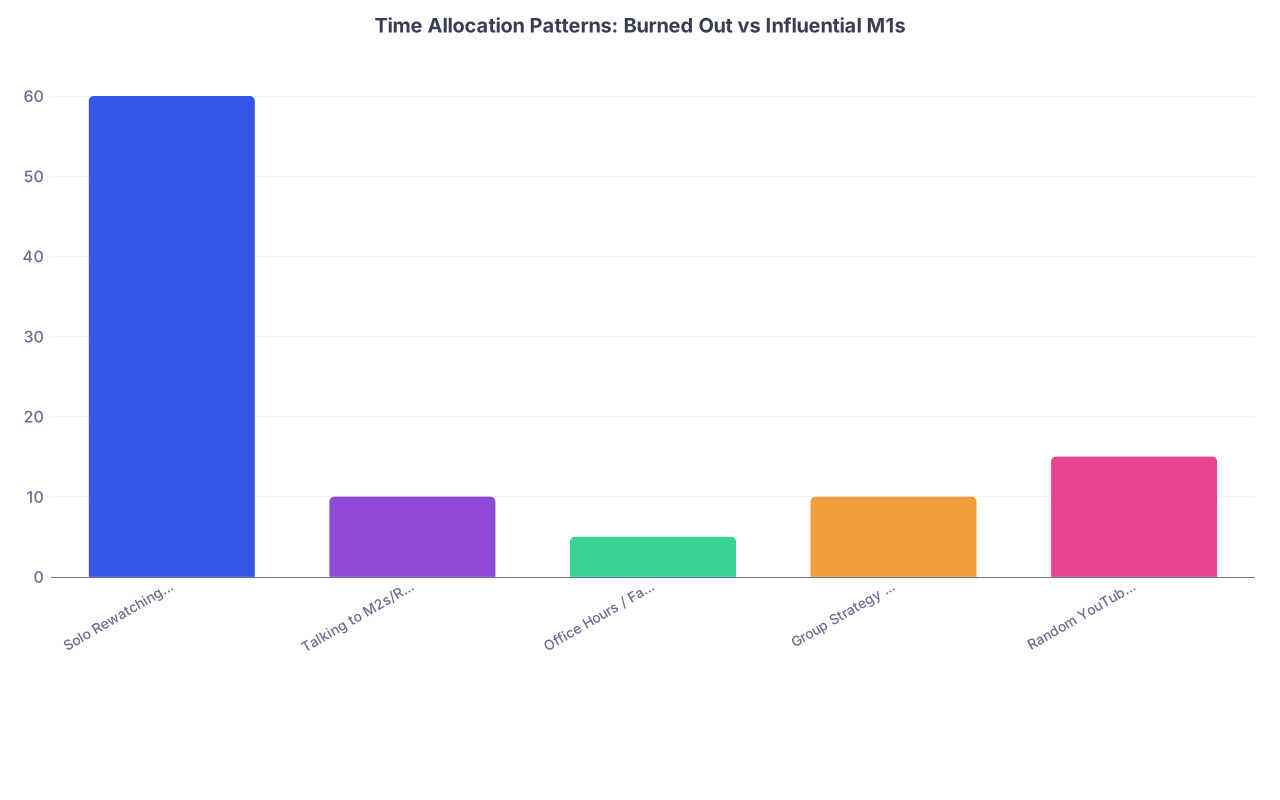
| Category | Value |
|---|---|
| Solo Rewatching Lectures | 60 |
| Talking to M2s/Residents | 10 |
| Office Hours / Faculty Contact | 5 |
| Group Strategy Sessions | 10 |
| Random YouTube Deep Dives | 15 |
The above is roughly how burned-out M1s spend their “study” time (in percent). The influential ones flip those middle three categories way up and slash “rewatching” and random rabbit holes.
Positioning: How Influence Actually Starts in M1
You think influence comes from titles. “Curriculum committee rep,” “class president,” “interest group officer.”
That’s backwards. Titles follow from perceived value. And perceived value is earned early and quietly.
Here’s what people running the place actually notice:
- Who sends the one email that summarizes a confusing schedule change to their small group clearly and helpfully.
- Who creates a simple, well-organized doc of practice questions and just shares it without fanfare.
- Who asks sharp, concise questions in small group that move the discussion forward instead of flexing knowledge.
By mid-fall, names start coming up in faculty conversations:
- “That M1 in my small group, Sarah, she’s always prepared and helps refocus the group. She’s really good.”
- “There’s a first-year who emailed me about the final—great questions, not complaining, just trying to understand priorities.”
The M1s who gain influence by spring are almost never the ones trying visibly to be leaders. They’re the ones solving small, annoying problems for people around them without demanding attention.
Contrast that with the burnout path.
The classic future-burnout M1:
- Overcommits to 6 interest groups, 3 “leadership” positions, and a research project, within the first 2 months.
- Uses titles as a Band-Aid for insecurity about grades.
- Tries to impress everyone at once, instead of becoming indispensable to a few key people.
Faculty see this instantly. We joke about the “CV maximalists” who burn out, then disappear from half their commitments by spring. No one gives them real responsibility later because they’ve already signaled unreliability.
Influential M1s do something very different:
They choose one or two lanes and go deep. Not wide.
- One becomes “the person who always has the cleanest, most logical pathophys summary before the test,” shared with 10–15 classmates.
- Another quietly becomes the go-to for tech things—recordings, note-sharing, calendar sync—so course directors eventually start emailing them first.
- Another consistently participates in a low-drama, high-value way in one student group, then gets tapped end-of-year for a real role, not a vanity one.
By spring, those patterns are obvious to anyone paying attention. And when an M1 spot opens on a school-wide committee, guess whose names get floated?
Not the loudest. The most reliable and useful.
Energy Management: The Quiet Divider Between “Done” and “Done for”
Here’s the harsh truth about spring burnout: it rarely comes from one horrific week. It comes from six months of operating above your sustainable ceiling because you were terrified to be average.
I’ve seen M1s flame out the same way residents do: they never learn to use “good enough” as a tool.
There are three stupid, common energy traps that destroy M1s:
Trying to Master Pre-clinical Content Like It’s Step Material
Some of you are trying to memorize boards-level detail for things your curriculum barely grazes. You think this makes you “serious.” It just makes you exhausted. The students who last learn quickly where their school’s exams consistently live on the depth spectrum and study to that, with some Step prep piggybacked—not the other way around.Studying in Panic Mode Instead of Planning Mode
Burnout M1s study like they’re running from a fire: constant motion, no structure. They rewatch lectures because it feels like progress. They keep 18 Anki decks half-active. Their schedule is reactive, not designed.
Influential M1s might study the same total hours—but they do it with intention. They pick one primary resource per block, build a predictable daily loop, and protect it.Sacrificing All Non-Med School Identity
This one is ugly. Students drop everything that isn’t medicine: gym, hobbies, relationships, even sleep beyond minimal survival. For a few months, scores look decent. Then the cliff.
The ones who gain influence do something counterintuitive: they protect 1–2 non-negotiable pieces of their identity. Rock climbing twice a week. Choir on Sundays. Dinner with a partner most nights. You think you don’t have time. They prove you do, and their performance holds up longer because they haven’t turned themselves into a hollow flashcard machine.
Let me be blunt: schools quietly track who is unraveling. Chronic emails about accommodations without documentation. Constant missed small group. Emotional fragility in every feedback session. These patterns get remembered.
The students who manage their energy well get a totally different label attached to their name: “steady.” “Resilient.” “Professional.” Those words are gold when letter season comes.
The Social Architecture of Surviving M1
You’ve heard a million platitudes about “finding your people.” Let’s talk about the part no one says out loud.
Your study group will make or break your spring.
From the inside of faculty conversations, here’s how we categorize M1 social ecosystems:
| Group Type | Typical Outcome by Spring |
|---|---|
| Panic Echo Chamber | Universal burnout |
| Solo High Performer | High scores, low influence |
| Quiet Power Cluster | Strong scores, rising influence |
| Social-Only Clique | Average scores, low reliability |
The Panic Echo Chamber is the group where everyone is always behind, always anxious, always adding resources. They share doom. They reinforce overstudying the wrong things. People in these groups are exhausted and underperforming. Total trap.
The Solo High Performer is the person who can grind alone and ace everything. They exist. But the hidden cost is this: by the time they hit clinical years, they’re unknown to faculty and peers beyond “smart.” That doesn’t translate to leadership or opportunity nearly as much as people think.
The Quiet Power Cluster is who you want to find—or build. This group typically:
- Keeps membership small (3–6 people).
- Shares clean, edited resources rather than raw brain dumps.
- Talks about strategy as much as content (“What’s fair game for this block?” “What did the M2 say about this exam style?”).
- Doesn’t meet to “study together” for 8 hours. They meet briefly to align, then execute.
Faculty learn these names indirectly. Someone will say, “Yeah, our little group has this shared doc that’s really helpful.” Same names come up over and over. That’s the cluster that becomes class officers, orientation leaders, peer tutors.
The Social-Only Clique looks fun until they collectively bomb a block because no one is willing to say, “We’re not actually learning anything when we ‘study’ together.” These groups are great for sanity, terrible for efficiency—if you confuse them with academic support.
The M1s who gain influence by spring almost always live inside or adjacent to a Quiet Power Cluster. The burned-out students often live between Panic Echo Chambers and erratic solo days.
How People Actually Get Picked for Roles and Opportunities
Here’s the secret pipeline nobody spells out in orientation:
By spring of M1, certain names are already being tagged for:
- School committees
- Summer research
- Peer tutoring next year
- “Special” projects with deans or course directors
Those names don’t come from some formal application scoring system. They come from a simple, human process that looks like this:

| Step | Description |
|---|---|
| Step 1 | Need Student for Role |
| Step 2 | Faculty/Dean Emails Small Group Leaders & Course Directors |
| Step 3 | Who Has Been Reliable & Sharp? |
| Step 4 | 2-5 Names Suggested |
| Step 5 | Quick Check: Professionalism Issues? |
| Step 6 | Invite 1-2 Students |
If your only strategy is “get the highest grades possible,” you’re playing checkers on a chessboard.
Who gets mentioned at step C?
- The M1 who always showed up prepared and on time to small group, contributed thoughtfully, and didn’t derail the session.
- The one who once emailed, “Here’s a list of errors we noticed in the slides, in case it’s helpful for next year,” in a polite, solutions-oriented way.
- The one who asked to meet with a course director not to complain, but to ask: “If I want to be really solid clinically, is there anything you think students underemphasize in this block?”
These people get labeled in faculty minds as “mature,” “engaged,” “good representative of the school.” That label is vastly more powerful than a 95 vs 88 on an exam.
Meanwhile, the burnout-prone student might have slightly higher raw scores but:
- Constantly sends panicked emails 24 hours before exams.
- Asks low-yield questions in lecture that waste everyone’s time.
- Flakes on small responsibilities because they’re “so busy.”
No one wants to put their name on that student for anything important.
The Internal Script That Drives Burnout vs Influence
Here’s the ugliest, most honest distinction: different students are running very different stories in their heads from day one.
The burnout script sounds like this:
- “If I’m not top 10% I’ve failed.”
- “Everyone else gets this; I’m behind.”
- “I don’t want to bother faculty until I’m more on top of things.”
- “I’ll fix my schedule after this block.”
The influence script sounds more like:
- “My job is to become competent and reliable, not perfect.”
- “Grades matter, but relationships and reputation last longer.”
- “Faculty are resources, not judges standing between me and success.”
- “My future self has to live with how I’m treating my body and mind right now.”
You can feel the difference. One script leads to hoarding, hiding, and grinding alone. The other leads to asking, sharing, and building a role in the ecosystem.
Schools don’t say this explicitly, but they are absolutely evaluating you on that internal script—through your behavior.
A Realistic Spring Recalibration Plan (If You’re Already Tired)
If you’re already in March-level exhaustion in October, you don’t need more motivational quotes. You need to quietly reset your trajectory.
Here’s a blunt, realistic three-part reset that I’ve seen work, even mid-year.
1. Ruthlessly Simplify Academics
Pick:
- One main resource for content per block (school material or a vetted board resource, not both fully).
- One primary question bank or practice source.
Then set a hard limit. You will not chase anything beyond those unless you’re consistently finishing them with time to spare.
And you will stop rewatching full lectures unless you failed that content area on the last exam.
2. Build One Upstream Connection This Month
Not ten. One.
Options:
- Ask an M2 you respect: “If you were restarting this block, what would you do differently?” Then actually follow their advice.
- Go to one office hour and ask a meta-question: “For students who do especially well in your course, what do they typically do differently?”
Your goal is not to impress them. It’s to let them see you as a thoughtful, coachable adult. That’s it.
3. Protect One Piece of Your Non-Med Life
Choose:
- A consistent bedtime you defend like an exam time.
- A physical activity you do 2–3 times a week.
- One weekly social connection that has nothing to do with med school.
Influence doesn’t come from martyrdom. It comes from being one of the few people who still looks functional and focused in March.
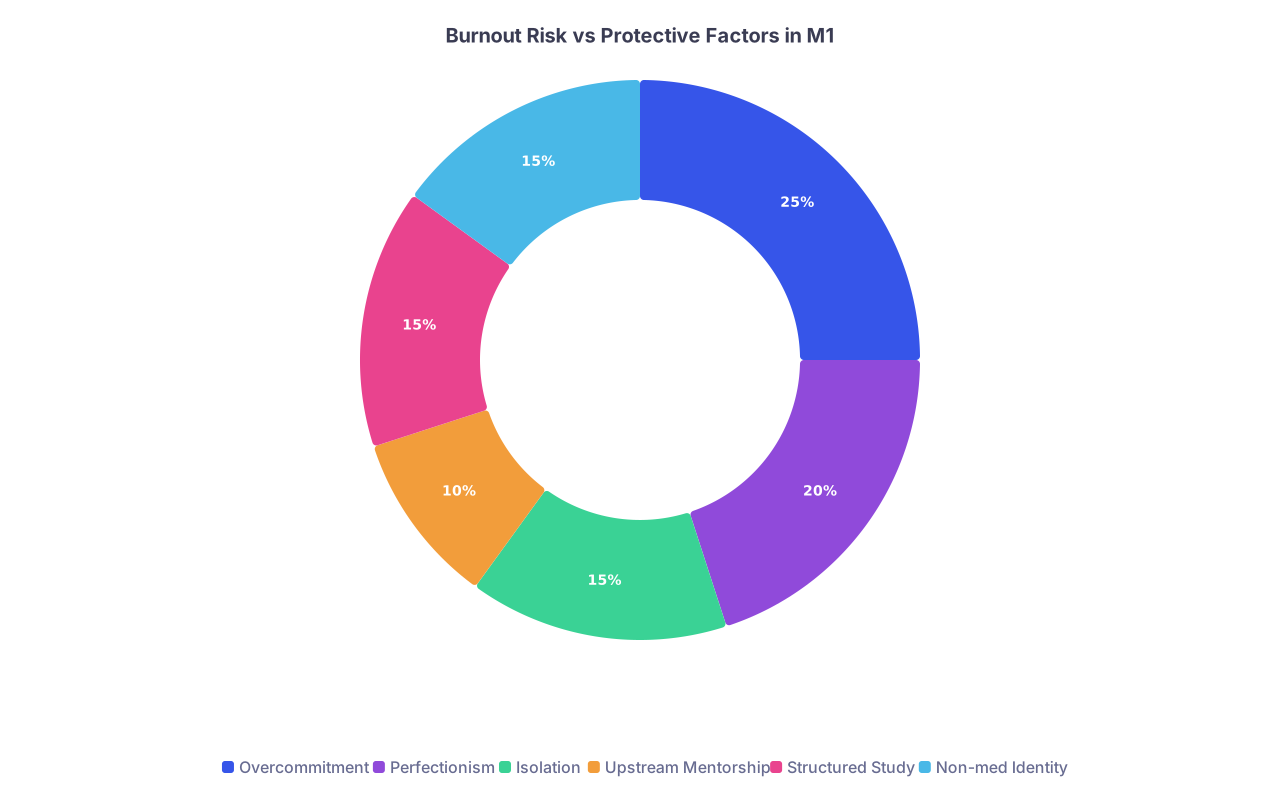
| Category | Value |
|---|---|
| Overcommitment | 25 |
| Perfectionism | 20 |
| Isolation | 15 |
| Upstream Mentorship | 10 |
| Structured Study | 15 |
| Non-med Identity | 15 |
Most students over-invest in the first three and under-invest in the last three.
What Program Directors Remember About Your Pre-clinical Years
You think no one will care how you handled M1 once you hit clerkships. That’s wrong.
When residency applications come in, program directors will quietly email back to your med school:
- “How was this student during pre-clinicals?”
- “Any concerns about professionalism, resilience, or working with others?”
They do not ask, “Did they honor every block of M1?” They ask if you were solid. Steady. Coachable. Someone people liked working with.
The M1s who gained influence by spring are the ones whose names trigger a, “Oh yeah, they were great from the beginning.” Path of least resistance. No drama. Those are the people PDs love.
The M1s who burned out publicly, fought the system, or constantly operated on the edge of collapse? They get described politely. But not enthusiastically.
Over two, four, ten years, your pattern becomes your reputation.