It’s 6:45 a.m. on a Thursday. You're a first-year who somehow ended up shadowing on the wards before class. The team is rounding, the attending is talking fast, everyone seems to know what’s happening except you. You’re standing there clutching your cheap stethoscope, trying to decide:
Do you say something? Ask something? Just disappear into the wall and hope no one notices you?
Here’s the problem: they do notice you. And what you do in these tiny, awkward moments is exactly what attendings and residents remember later.
Not your preclinical grades. Not which Anki deck you used. Your behavior.
Let me be blunt: there’s a reputation game running in the background from the moment you show up as an MS1. Most of your classmates won’t realize it until third year. By then, some of the damage is already done.
I’m going to walk you through what actually sticks in attendings’ heads. The stuff they talk about in the workroom after you leave. The stories that quietly shape who gets taken seriously, who gets pushed, and who gets ignored.
This is the part no one explains in orientation because it makes people uncomfortable. But it’s how the system really works.
The Quiet Scorecard: What Attendings Clock Immediately
Most attendings will tell you, “Oh, I don’t remember first-years.”
That’s half-true. They don’t remember everyone. But they absolutely remember the outliers: the ones who impressed them and the ones who annoyed them.
The internal scorecard kicks in within the first 5–10 minutes of meeting you. It’s not formal, but it’s real. I’ve heard the comments in workrooms, sign-out rooms, and call rooms.
Comments like:
- “That MS1 actually read about the patient—keep an eye on them.”
- “That kid is already acting like a gunner. Going to be exhausting later.”
- “She doesn’t say much but she’s always watching. She’ll be good when she’s a clerk.”
Let me walk you through the categories they judge you on, because they’re not what students think matters.
1. How You Enter a Room (and a Team)
This starts before you open your mouth.
Attendings and residents unconsciously grade how you enter the space.
You walk into the workroom at 6:55 for 7:00 rounds. Here’s what they notice:
- Do you quietly say “good morning” to the room, or slink in and stare at your phone?
- Do you introduce yourself to the nurse who walks in?
- Do you act like you’re imposing, or like you’re part of the team?
Nobody’s expecting a polished performance. But the baseline expectation is simple: you look awake, present, and minimally engaged with humans.
Behaviors attendings remember:
- The student who always sat in the corner silently on their phone “because I didn’t want to be in the way.” Residents later: “I keep forgetting they’re here.” Translation: dead weight.
- The student who introduced themselves to everyone—nurses, case manager, RT—without being awkwardly extra. That student gets talked about: “They’re already acting like a doctor.”
You don’t need to be charismatic. Just act like you belong in the room and you respect that others do too.
2. Prepared vs. Performing: The Questions Game
Let me tell you how attendings categorize students’ questions:
- Genuine curiosity
- Strategic interest
- Performance
You want to mostly live in the first two.
An attending presents COPD on rounds and pauses. The MS1 says, “Can I ask a question about the inhalers?” That’s fine. If it’s related and not something you could have Googled in 10 seconds, attendings like that.
What they remember negatively is the student who asks a long-winded “question” that’s really just them flexing what they learned in path.
You’ve seen this person: “Well, from what I remember from the GOLD criteria and the FEV1 cutoffs, wouldn’t it be more appropriate to…”
Everyone in the room silently: Please stop.
Here’s what attendings actually register when you ask questions:
- Are you listening to the patient’s story or just waiting for a teaching moment to impress?
- Do your questions show you’re trying to understand this patient, not recite First Aid?
- Do you ask basic questions at appropriate times—or derail the flow of rounds?
I’ve seen attendings remember a first-year for years because of one sharp, humble question that showed they were paying attention.
One example burned into my head: MS1 on rounds, cardiology. The patient with decompensated heart failure had been readmitted multiple times. Everyone was talking meds, diuresis, echo, labs. The student asked, “Has anyone talked to her about how she’s managing meds at home? It sounds like she’s overwhelmed.”
The attending stopped. Looked at the student. Later in the workroom: “That kid is going to be good. They’re actually thinking.”
Not a high-yield pharmacology question. A human one.
3. The Micro-Behaviors Around Nurses and Staff
If you want the real blunt truth: attendings listen to nurses more than they listen to you about… you.
I’ve sat in on conversations like:
- “How was that student?”
- “They’re nice. They actually offered to help me move the patient.”
- Or: “They seemed annoyed when I asked them to step out for a dressing change.”
That’s game over for your reputation on that floor.
Here’s what nurses and staff quietly report to residents and attendings:
- You said “thank you” when they helped you with something minor.
- You moved out of the way when they obviously needed to get to the patient.
- You didn’t argue about PPE.
- You didn’t touch anything you shouldn’t be touching.
And the flipside:
- You rolled your eyes because you were asked to step aside.
- You stood in the doorway blocking a code cart.
- You tried to “teach” something to a nurse as an MS1. (Yes, this happens. Yes, they all talk about it.)
I remember a surgery attending asking the scrub tech about a student:
“How was that med student in the OR?”
Tech: “They didn’t know much, but they were respectful. Didn’t contaminate anything.”
Attending later: “That’s all I need from an MS1. That’s someone I’ll take again.”
Another tech about another student: “He kept trying to grab instruments and ask questions during critical parts of the case.” That kid got quietly blacklisted. No dramatic blowup. Just: “Let’s not have him back for the big cases.”
4. Your Relationship With Not Knowing
First-year is built on not knowing. The question is how you carry it.
Attendings remember three types of students:
- The honest learner
- The defensive bullshitter
- The ghost
The honest learner says:
“I’m not sure about that, but I can read about it and get back to you.” And then they actually do it.
The defensive bullshitter tries to fake it:
- Half-answering questions with vague, meandering nonsense.
- Throwing out buzzwords instead of saying “I don’t know.”
- Guessing aggressively and then doubling down.
Residents hate this. Attendings hate this. And they remember it.
Because if you’re already bullshitting as an MS1 when nothing is on the line, what are you going to do as an intern with a crashing patient?
The ghost? That’s the student who never answers, never asks, never shows their thinking at all. Zero risk. Zero vulnerability. They’re forgettable. And “forgettable” is not neutral—when letter season comes, no one fights for forgettable.
I watched an attending ask an MS1: “What do you think is going on with this patient’s shortness of breath?”
Student: “I’m really not sure, but I know differential for dyspnea includes cardiac, pulmonary, anemia, and anxiety. If I had to pick, I’d lean cardiac because of the orthopnea and leg swelling. I don’t know the next best test though.”
That’s gold. They admitted limits but showed structure. That attending 100% remembered them.
5. The “Too Keen” vs “Checked Out” Balance
This is the line most first-years trip over.
Yes, attendings know the stereotypes: the gunner, the shadow, the “I’m just here for the grade” student. And they’re grading you without saying it out loud.
There are behaviors that scream “I’m trying too hard to impress you”:
- Volunteering for everything loudly in front of others.
- Trying to stay way past when the team clearly wants you to go home.
- Showing up to everything, every single time, even when you’ve been explicitly told, “You don’t need to come to this.”
Residents start saying things like: “They’re exhausting.” And that label sticks.
The sweet spot is: consistently present, occasionally extra.
Meaning:
- You’re there when you said you’d be there.
- You show up prepared (read a little about the service or common conditions).
- Once in a while, you do something slightly above expectation: read about a patient at home and mention one thing you learned next day.
Then there’s the other end: “checked out.”
It’s not always laziness. Sometimes it’s anxiety, or not wanting to bother anyone. But it looks the same: you stand in the back, don’t ask to see patients, don’t ask how you can be useful, disappear when things get busy.
I watched a chief resident describe two MS1s on the same service:
- “She didn’t know much, but she showed up, held the iPad on rounds, looked up a couple questions, and improved.”
- “The other one I literally forgot was on the team until the last day.”
Guess which one got an email later about research and early mentorship.
6. Reliability: The Invisible Currency
This one is brutally simple.
Attendings and residents remember: “Can I trust you to do the thing you said you’d do?”
You say:
- “I’ll read about that.”
- “I’ll be there at 7.”
- “I’ll follow up with that lab and let you know.”
Do you?
Because the first time you say you’ll do something and then disappear without closing the loop, you go into a mental box: unreliable.
And that box is hard to climb out of.
Here’s how the internal narrative sounds:
- “He’s nice but kind of flaky.”
- “She’s smart but keeps forgetting things.”
- “Don’t give that student anything critical to do.”
Meanwhile, the student who quietly does what they say? That’s the one people trust early. That’s the student who gets:
- “Do you want to help with this procedure?”
- “Want to see an interesting case in the ED?”
- “Want to join this research project?”
Every attending and senior has a mental list of “students I’d work with again.” Reliability is what puts you on that list.
7. How You Handle Feedback and Embarrassment
You will get corrected in front of people. You will say something wrong on rounds. You will mispronounce a drug or mis-state a fact and someone will fix you.
The question is not if. The question is: then what?
Attendings remember the students who:
- Get visibly annoyed or defensive when corrected.
- Sulk and shut down for the rest of the day.
- Blame their schedule, school, or someone else for not knowing something.
Versus the ones who:
- Say “Got it, thank you” and move on.
- Ask one clarifying question if they’re confused.
- Later quietly look it up and occasionally circle back with, “I read about that thing from earlier; it makes more sense now.”
One story that circulated for months: MS1 on inpatient medicine misread a lab and confidently said “The potassium is 6.3, that’s fine.” Attending corrected them, a bit sharply. The student turned red, nodded, and stayed engaged.
Next day, student shows up with a one-page handwritten summary: “hyperkalemia basics” and asks, “Can I run this by you quickly to make sure I didn’t miss anything?”
That attending mentioned that interaction to multiple colleagues. Not the mistake—the response.
Contrast that with the student who, after a mild correction, leaves early “because I wasn’t feeling well,” then doesn’t come back to the service. People remember that too.
8. Professionalism in the Background: Email, Timing, and Digital Footprint
You know what faculty complain about more than anything?
Things attendings absolutely remember:
- The student who emails with a subject line: “Hey.” And an empty body with an attachment.
- The 2 a.m. email asking for a letter of recommendation by next week.
- The “sorry I’m late, overslept” text ten minutes after rounds started.
These sound small, but they generate disproportionate irritation. Because what they’re really thinking is: “Is this what you’ll be like as a resident?”
Compare:
Email A:
“hey, are you on service next month? wanted to shadow if possible. thx”
Email B:
“Subject: MS1 interested in shadowing on [Service]
Dear Dr. X,
My name is [Name], I’m a first-year at [School]. I’m interested in learning more about [specialty/field]. If you’re taking students, I’d appreciate the chance to shadow you for a half day or full day sometime in [timeframe]. I understand your schedule is busy and am flexible with dates.
Thank you for your time,
[Name], MS1
[School]”
Guess which one they reply to first. And which one they forward to a colleague with, “This student seems on top of things; can you take them on your service?”
9. The OR, ICU, and “High-Stakes” Settings: Where Reputations Crystalize
Certain environments magnify your behavior: OR, ICU, ED.
In these spaces, attendings and staff remember:
- Do you respect the gravity of the situation?
- Do you read the room?
- Are you still trying to impress people while someone is actively decompensating?
I watched this play out in an ICU:
Patient crashing. Lines, pressors, alarms going off. An MS1 tries to ask: “So what’s the mechanism of action of norepinephrine again?” in the middle of it.
No one yelled. The attending just said, “Not now.” But you better believe they remembered.
That same week, another MS1:
- Stood out of the way.
- Helped hold the iPad so family could FaceTime.
- Handed gloves and gowns when people needed them.
- Asked their questions after the situation stabilized.
Guess which one the nurses later said: “That student actually helped.”
In the OR, the basics:
- Don’t talk during critical moments.
- Don’t touch anything unless told.
- Don’t try to teach the med student next to you. You are both at the bottom of the food chain.
One attending said it best: “I don’t remember what they knew as an MS1 in the OR. I remember whether they were safe and not annoying.”
10. What Actually Sticks in Their Minds
Let me show you how attendings really remember first-years. It’s usually not by name at first. It’s by story.
Comments I’ve heard:
- “That’s the student who stayed to help that elderly patient find her hearing aid after rounds.”
- “That’s the kid who owned up to mixing up sodium and potassium on day one, and never made that mistake again.”
- “That’s the one who tried to teach the nurse how to do her job.”
- “That’s the one who emailed me a thoughtful thank-you and a question about a paper we discussed.”
These stories pile up. Then, when someone asks:
“Do you know any good students for [research / mentorship / early clinical elective]?”
Those stories turn into opportunities—or warning labels.
To make this more concrete, here’s how a lot of attendings loosely bucket first-years, even if they’d never say it this bluntly.
| Category | What They Look Like Early On |
|---|---|
| High-ceiling | Curious, reliable, humble, engaged |
| Solid citizen | Shows up, learns, not flashy but steady |
| High-maintenance | Smart but exhausting, attention-seeking |
| Ghost | Barely present, forgettable |
| Red flag | Disrespectful, dishonest, unreliable |
You want to live in “solid citizen” with glimpses of “high-ceiling.” No one expects greatness as an MS1. They expect reliability and trajectory.
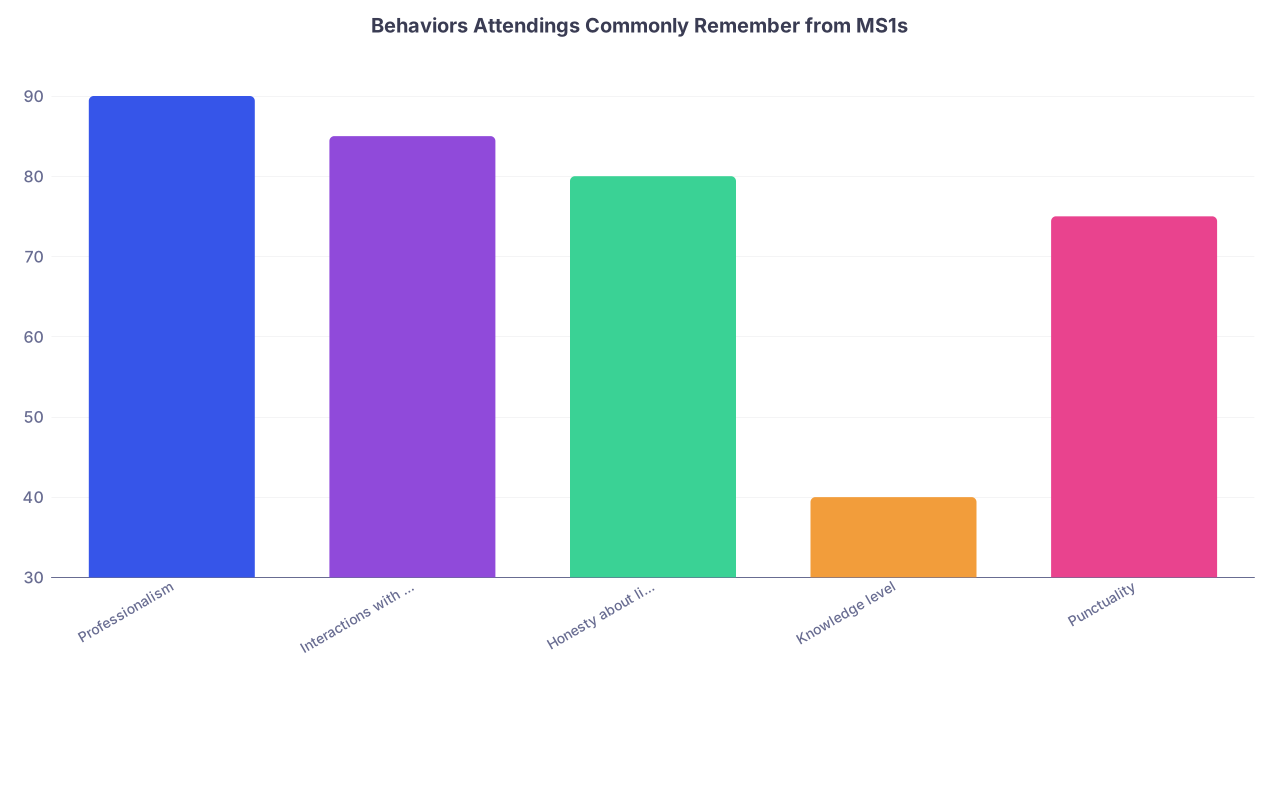
| Category | Value |
|---|---|
| Professionalism | 90 |
| Interactions with staff | 85 |
| Honesty about limits | 80 |
| Knowledge level | 40 |
| Punctuality | 75 |
How to Play the Game Without Losing Your Soul
Let me be clear: I’m not telling you to become some calculated robot who treats every interaction as transactional.
But pretending this reputation game doesn’t exist is naive. It does. It’s running whether you opt in or not.
You do not need to:
- Impress everyone.
- Be the smartest person in the room.
- Know all the answers.
You do need to:
- Show up when you say you will.
- Treat everyone—nurses, housekeeping, unit secretaries—like they matter.
- Admit when you do not know something, and then actually go learn it.
- Ask questions that show you’re thinking, not performing.
- Read the room and understand when you’re helping vs. when you’re in the way.
The attendings who will shape your career are watching for those patterns. Quietly. Long before you ever ask them for a letter.
Here’s the part students underestimate: first-year is one of the lowest-risk environments you’ll ever have in medicine. You’re allowed to not know. You’re allowed to be clumsy. What you’re not allowed to be, long-term, is careless about how you show up.

| Step | Description |
|---|---|
| Step 1 | Initial Behaviors |
| Step 2 | Team Perception |
| Step 3 | Opportunities Given |
| Step 4 | More Exposure |
| Step 5 | Reputation Strengthens |
If you remember nothing else, remember this:
- They don’t remember your test scores. They remember how you behaved when no one “had” to be nice to you.
- Your reputation starts the moment you walk onto a ward, not the day clerkship begins.
- Being reliable, respectful, and honest about your limits will carry you farther than being the smartest MS1 in the room.
Play that game well, and doors you do not even know exist yet will quietly start to open.