
The way most medical students try to “fix” their focus is backwards. You do not start with more apps, more coffee, or more hours. You start with a protocol.
You are not “bad at focusing.” You are running a high‑demand brain on a garbage operating procedure. Let us fix that.
Below is a step‑by‑step attention protocol designed specifically for medical school: heavy content, high stakes, and constant fatigue. This is not generic productivity fluff. It is built around how your brain actually works under chronic stress, sleep debt, and information overload.
Step 1: Diagnose Why You Cannot Focus (In 10 Minutes)
You do not treat a symptom without knowing the cause. Same here.
Run this quick self‑assessment. Be honest, not aspirational. Circle or jot what describes you most days:
Sleep / Fatigue
- Struggle to wake up; hit snooze multiple times.
- Need caffeine just to feel baseline human.
- Micro‑nodding off during lectures or Anki.
- Brain feels “foggy” even when sitting to study.
Anxiety / Mental Overload
- Heart rate jumps when you open Anki or boards-style questions.
- Constant thought: “I am falling behind.”
- Switching between apps/resources every few minutes.
- Procrastination driven by dread, not laziness.
Digital Distraction / Dopamine Overload
- Check your phone without realizing you did it.
- Study with 10+ tabs open, notifications on.
- “Study breaks” become 20–40 minutes of scrolling.
- Watching YouTube at 2x speed while also on your phone.
No Plan / Overwhelm
- Sit down and do not know where to start.
- Bounce between lecture, Anki, and random videos.
- End of day: worked a lot, finished almost nothing.
- Feel guilty but also weirdly unclear what you actually did.
Environment / Systems
- Study in bed or on the couch most days.
- Room is cluttered; desk is a mess.
- Constant interruptions (roommates, family, notifications).
- No dedicated “focus zone.”
How to use this
- If 3+ in any category = primary driver of your focus problem.
- You still follow the full protocol, but you target your main driver first.
You are not broken. You are just expecting ICU‑level performance from a brain running on hallway‑monitor resources.
Step 2: Hard Reset Your Study Environment
You will not rebuild attention in the same environment that destroyed it.
Change where and how you study before you change what you study.
2.1 Create a “Focus Station”
You need one primary physical spot where your brain learns, “When I sit here, we work.”
Minimum spec:
- A desk or table (not bed, not couch).
- A respectable chair (no back‑destroying stools).
- Good light (desk lamp if overhead light is lousy).
- Only the following on the surface during a focus block:
- Laptop or tablet
- One notebook or whiteboard
- One pen
- Water bottle / coffee, nothing else
If your current space is chaos, give yourself 20 minutes today:
- Clear the desk completely.
- Put back only what you need for today’s study block.
- Box the rest. Out of sight. You can sort later.
You are building a mental association: this space = focus, not scrolling.
2.2 Kill the Attention Leeches (Phone, Tabs, Notifications)
Your phone is not just “distraction.” It is an attention extraction device. Treat it accordingly.
During any serious study block (30+ minutes):
- Phone protocol
- Put it in another room, face down, on Do Not Disturb.
- If you “need it for 2FA/WhatsApp,” you do this:
- Airplane mode + Wi‑Fi off.
- Place it out of arm’s reach, screen down.
- Laptop protocol
- Close all non‑study tabs. Yes, all.
- One browser window for:
- Anki or question bank
- Lecture notes
- Reference (UpToDate/AMBOSS) only if needed
- No email, no messaging app, no social media in that window.
If you want a crutch at the beginning, use a blocker (Cold Turkey, Freedom, FocusMe). But do not let “finding the perfect app” become the new procrastination.

Step 3: Stabilize Your Physiology (The Boring, Non‑Optional Part)
Most first‑years try to out‑willpower their biology. That works for about 6 days. Then they fall apart.
If you want stable attention, there are three pillars you do not get to negotiate.
3.1 Sleep: The Non‑Sexy Focus Drug
You already know sleep matters. You probably still treat it as optional.
Target: 7–8 hours in bed, minimum 6.5 hours actual sleep. Every night you go below that, you tax your focus and working memory.
Protocol:
- Set a fixed wake time that you can maintain 6–7 days per week.
- Count back 7.5–8 hours. That is your target “in bed, lights off” time.
- The last 30–45 minutes before bed:
- No Anki, no questions, no intense lectures.
- Low light, maybe light reading (non‑med), stretching, or mindless TV.
- Phone out of bed. Use a cheap alarm clock if you have to.
You want your brain to stop associating bed with panic scrolling about pharm.
3.2 Caffeine: Use Like a Drug, Not Like Water
Your current caffeine strategy is probably: “More.”
Better:
- First dose 60–90 minutes after waking. Let cortisol wake you up first.
- Cut off caffeine at least 8 hours before bedtime.
- Cap at 2–3 cups coffee or equivalent per day.
- No energy drinks at 10 pm “just for one more lecture.” That price shows up three days later when you cannot focus on anything.
If you are deep into dependence, do not try to quit cold‑turkey during exam week. Titrate down over 1–2 weeks.
3.3 Blood Sugar & Hydration: Quiet but Real Issues
You do not need a perfect diet. You do need predictable fuel.
- Avoid:
- Giant carb‑only lunches (big burritos, huge pasta bowls) before long study blocks.
- Studying 5–6 hours straight on nothing but coffee.
- Aim:
- Some protein + some fat each meal (eggs, yogurt, chicken, tofu, nuts).
- 1–2 L water spaced through the day.
You are not “unfocused.” You are hypoglycemic, under‑slept, and over‑stimulated.
Fix that foundation or the rest of this protocol will feel like pushing a boulder uphill.
Step 4: Install a Structured Focus System (3‑Block Day)
Now the part you probably wanted from the beginning: how to actually sit and focus on the firehose of content.
You do not need a fancy scheduler. You need a simple, repeatable structure that your brain can predict.
4.1 The “3‑Block” Framework
Break your day into three intentional work blocks:
- Block A (Deep Learning) – 60–90 minutes
- New lectures, concept building, pathophys, mechanisms.
- Use when your brain is freshest (usually morning).
- Block B (Reinforcement) – 60–90 minutes
- Anki reviews, key diagrams, consolidation.
- Block C (Application) – 60–90 minutes
- Question banks, practice problems, practice exams.
You will not hit all three every single day in M1, but this is the template.
Between blocks: 15–30 minute breaks. Real breaks. Stand up, walk, snack, bathroom, short chat. Not 25 minutes of TikTok.
4.2 The 25–5 or 50–10 Focus Cycles
Inside each block, you use small cycles.
Pick based on your current attention span:
- If you are severely scattered: start with 25–5
- 25 minutes deep work, 5 minutes break, repeat 2–3 times per block.
- If you have some baseline focus: 50–10
- 50 minutes work, 10 minutes break, repeat 1–2 times per block.
During the work interval:
- One task only.
- If your brain screams “Check your phone!” you write it down on a scrap paper: “Check message from X.” Then keep going.
- If you realize you forgot something (“I need to look up that enzyme”), jot it, keep moving. Investigate during the break.
You are training your brain that urges are not commands.
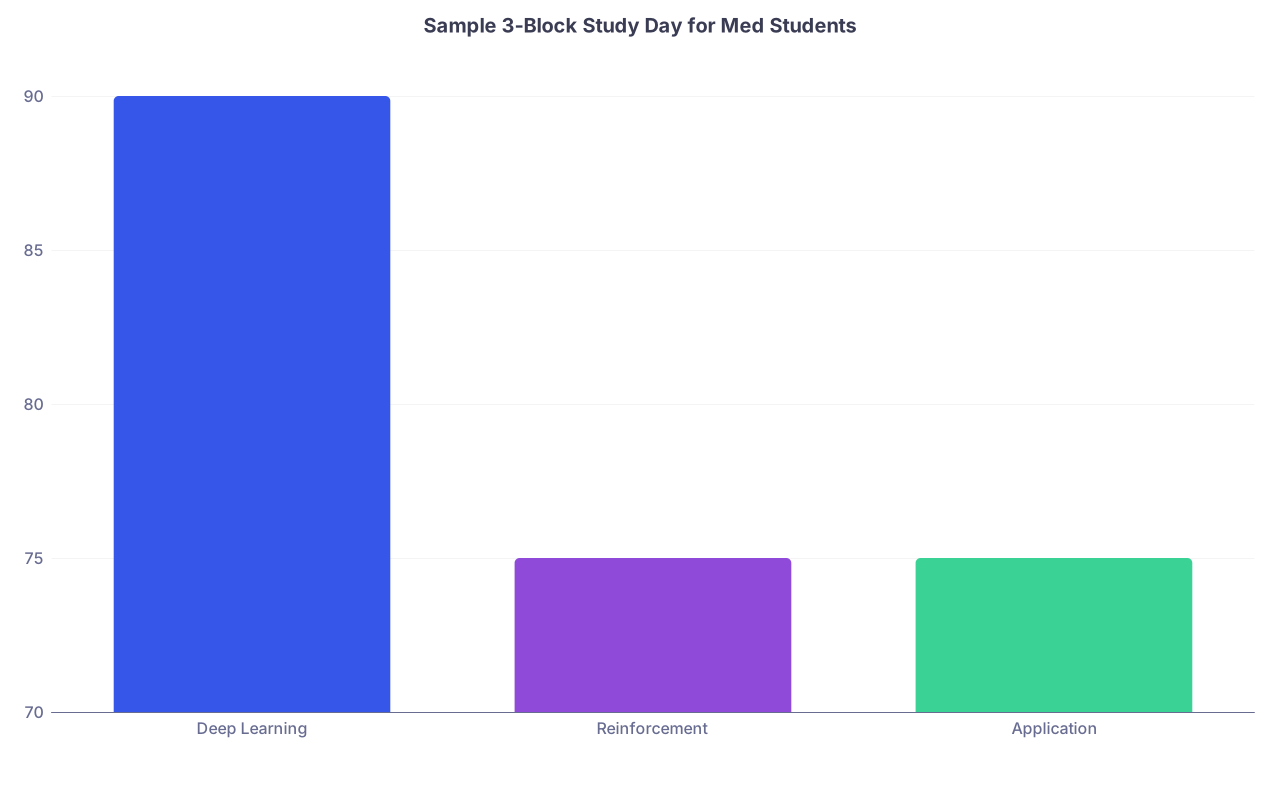
| Category | Value |
|---|---|
| Deep Learning | 90 |
| Reinforcement | 75 |
| Application | 75 |
Step 5: A Concrete Attention Protocol for Each Study Mode
Different study tasks chew up attention in different ways. Treat them differently.
5.1 For Watching Lectures
Most students passively watch at 1.75–2x and retain almost nothing. Then wonder why they cannot focus during review.
Protocol:
- Never “just watch.” Always have:
- A simple outline doc or notebook open.
- For slides‑heavy courses, annotate the slides directly.
- Before hitting play:
- Skim the lecture title and objectives (1–2 minutes).
- Write 2–3 questions you expect the lecture to answer.
- While watching:
- Use active pausing:
- Pause every 5–10 minutes.
- Summarize the last chunk in 1–3 bullet points or a quick diagram.
- Flag true “I have no idea what this means” moments with a symbol (e.g., “??”) instead of spiraling into Google for 20 minutes.
- Use active pausing:
- After finishing:
- Spend 5 minutes rewriting your notes as:
- One simple diagram, or
- A short “teach it to a friend” summary.
- Spend 5 minutes rewriting your notes as:
You are converting passive time into active encoding. That is what engages attention.
5.2 For Anki / Spaced Repetition
If Anki feels like getting punched with 600 tiny facts, your focus will shatter.
Daily Anki protocol:
- Cap total review time
- M1 target: 60–90 minutes / day, split across 1–2 blocks.
- If you are above that, you are over‑suspending and under‑deleting garbage cards.
- Use focused intervals
- 25–5 or 50–10 cycles work well here.
- Zero multitasking
- No lecture videos in the background.
- No chatting, no music with lyrics if it distracts you.
- Strict card hygiene
- If you cannot answer after 2 honest attempts, edit the card. Make it:
- Shorter
- More concrete
- One idea per card
- Delete or suspend trash cards that are duplicates or low‑yield.
- If you cannot answer after 2 honest attempts, edit the card. Make it:
Your goal is not to be a hero who can grind 1200 cards. Your goal is to build a deck that does not destroy your attention every time you open it.
5.3 For Question Banks (Your Attention Gym)
Boards‑style questions are cognitively heavy. That is precisely why they are the best training tool for sustained focus.
Question session protocol:
- Decide before you start:
- How many questions (e.g., 10, 20).
- Mode: timed or tutor.
- During the set:
- Full screen the Qbank window.
- No random Googling mid‑question. If you must look something up, do it after finishing the block.
- After the set:
- Spend at least as long reviewing as you spent answering.
- For each question, ask:
- Did I misread the stem due to rushing or distraction?
- Did I know the concept but lose it under mental fatigue?
- The second case is an attention problem; treat it like reps in the gym, not a sign you are “stupid.”
You want to reach a point where your brain knows: “When we open the Qbank, we are in game mode.” That association itself improves focus.
Step 6: Manage Anxiety So It Stops Hijacking Your Focus
A lot of “I cannot focus” in medical school is not ADHD. It is performance anxiety.
You sit down to study and your brain launches this soundtrack:
“You are already behind. Everyone else is ahead. If you fail this block, you are done.”
Hard to pay attention to renal physiology with that running.
6.1 Shrink the Time Horizon
Stop trying to “study for boards” at 8 AM on a random Tuesday in October of M1. Your brain cannot act on a 2‑year threat.
Instead, define today’s winnable target:
- Example:
- 2 lectures: cardiac action potentials and ECG basics.
- 250 Anki reviews.
- 10 cardiology questions.
Write that on an index card or sticky note. When anxiety spikes, look at the card and ask:
“Is this thought helping me complete the next 25 minutes of this card?”
If not, it is noise. You do not need to defeat anxiety. You need to stop negotiating with it during focus blocks.
6.2 60‑Second Reset When Your Brain Starts Spinning
Here is a fast nervous system reset you can actually use in the library without looking ridiculous:
- Sit back, feet flat on the floor.
- Inhale through the nose for 4 seconds.
- Hold for 2 seconds.
- Exhale through the mouth for 6–8 seconds.
- Repeat 5–6 times.
While you do this, keep your eyes on one fixed point on the wall or desk.
You are not “meditating.” You are dropping your sympathetic tone a notch so your prefrontal cortex can come back online.
Do this between 25–50 minute intervals, or whenever you catch yourself doom‑spiraling instead of reading.

| Step | Description |
|---|---|
| Step 1 | Wake Up |
| Step 2 | Hydrate & Light Exposure |
| Step 3 | Block A: Deep Learning 60-90 min |
| Step 4 | Short Break 15-20 min |
| Step 5 | Block B: Anki & Review 60-90 min |
| Step 6 | Lunch & Walk |
| Step 7 | Block C: Questions 60-90 min |
| Step 8 | Wrap Up & Plan Tomorrow |
| Step 9 | Wind Down Routine |
| Step 10 | Sleep |
Step 7: Build Attention Like a Muscle (Not a One‑Day Fix)
You do not walk into the gym, bench 300, and walk out “strong for life.” Same with attention.
The first week of this protocol might feel uncomfortable. You might only manage:
- 2–3 real 25‑minute focus intervals per day.
- Constant urge to check your phone.
- Mental fatigue after 60–90 minutes total.
That is fine. You track it like training.
7.1 Weekly “Attention Audit”
Once a week (Sunday works):
- Look back at your last 7 days.
- Ask:
- How many true focus blocks did I complete? (25–50 minute phone‑free intervals.)
- What derailed me most often? (Phone? Anxiety? Random interruptions?)
- Pick one variable to improve next week:
- Example:
- This week: phone in another room during Block A.
- Next week: add Block C (questions) 3 days per week.
- Week after: push 25‑minute intervals to 35 minutes where possible.
- Example:
You do not fix your focus in one heroic weekend. You compound small wins.
Step 8: Handle Common Med School Situations That Destroy Focus
There are specific scenarios in M1/M2 that reliably blow up attention. Let us pre‑empt them.
8.1 “I Am Already Behind; I Cannot Catch Up”
Classic first‑year spiral.
Protocol:
- Stop trying to “catch up on everything.” That phrase is useless.
- Identify:
- This week’s live content (what is currently being taught).
- The last 1–2 weeks of “backlog.”
- For the next 5–7 days:
- Priority 1: Stay current with this week’s content (even if imperfectly).
- Priority 2: Schedule 1 block per day for backlog triage (not perfection).
- For backlog:
- Triage into:
- Must‑learn core topics (e.g., cardiac cycle, key bacterial pathogens).
- Nice‑to‑have depth (fine details and side tangents).
- Hit core topics using high‑yield resources (Boards & Beyond, Osmosis, Pathoma) rather than rewatching every old lecture.
- Triage into:
Your focus improves the second your plan becomes realistic.
8.2 “I Study for 8 Hours and Remember Nothing”
You are probably doing low‑yield, low‑engagement work. Your attention is not failing; your method is.
Fix:
- Replace:
- 3 hours “watching lectures in the background” with
- 2 hours: 90 minutes active lecture + 30 minutes Anki
- Replace:
- Endless highlighting with
- Question‑first sessions: do 10 questions, then fill gaps via lecture/notes.
Learning that feels slightly effortful is exactly what anchors attention and memory.
8.3 “Group Study Always Derails Me, But I Feel Guilty Studying Alone”
Group study is a tool, not a duty.
Rule:
- Use group study for:
- Teaching each other concepts.
- Running practice questions together.
- Quick review before exams.
- Avoid group study for:
- First‑pass learning.
- Anki reviews.
- Anything where you are already distracted.
If a “study group” is actually 60% gossip, 20% complaining, 20% work, you cannot afford it. You are not antisocial. You are protecting your focus.

A Simple Daily Focus Protocol You Can Start Tomorrow
Here is a plug‑and‑play template. Adjust times to your schedule, but keep the structure.
Morning
- Wake at consistent time, drink water, light exposure.
- Light breakfast with some protein.
- Block A (Deep Learning 60–90 min)
- One or two new lectures, active note‑taking.
- 25–5 or 50–10 cycles.
- Phone in another room.
Midday
- Short walk or light movement (5–15 minutes).
- Block B (Anki / Review 60–90 min)
- Anki reviews only; focused intervals.
- Edit bad cards; delete trash.
- Lunch. No “study while eating” if you are already burned out. Give your brain 20–30 minutes off.
Afternoon / Early Evening
- Block C (Questions 60–90 min)
- 10–20 questions + full review.
- 15 minutes to:
- List what you finished.
- Choose tomorrow’s 3 priorities (lectures / Anki / questions).
Late Evening
- No new intense material last 45–60 minutes before bed.
- Light wind‑down routine, screens dimmed.
Follow this 4–5 days per week and your attention capacity will be visibly different in 3–4 weeks.
| Behavior Type | High-Yield for Focus | Low-Yield for Focus |
|---|---|---|
| Lectures | Active pausing + summarizing | Passive 2x watching with phone in hand |
| Anki | 25–50 min focused intervals | Random cards between notifications |
| Questions | Timed sets + full review | Doing stems while chatting or multitasking |
| Environment | Desk-only, phone away | Bed/couch study with TV or roommates talking |
| Planning | 3 clear priorities per day | Vague “study all day” with no structure |
Final Reality Check
Your focus is not a moral failing. It is a system problem.
Three key points to walk away with:
- Attention follows structure. A clean environment, 3 daily blocks, and short intervals beat vague 10‑hour “study marathons” every time.
- Physiology sets the ceiling. Sleep, caffeine control, and basic fueling are not optional extras. They are prerequisites for sustained focus.
- You train focus like a muscle. Track your real, distraction‑free intervals, and increase slowly. Ignore the fantasy of overnight transformation.
Run this protocol for 14 days. Not perfectly. Just consistently enough. Your brain will remember how to lock in again.