The fastest way to tank a promising medical school career isn’t Step scores or hard exams. It’s choosing the wrong peer group in your first few months.
People obsess over Anki decks, board resources, and “best” study schedules. Then they walk blindly into the biggest hidden variable in med school performance: who they sit next to, text with, and copy habits from.
I’ve watched strong students get quietly wrecked by friend circles that looked harmless — or even impressive — on the surface. You cannot afford to treat your early social choices as random. They will shape your grades, your mental health, your specialty options, and sometimes whether you even finish.
Let’s walk through the red flags. I’ll show you the patterns that should make you slow down, step back, and, if needed, change who you spend your time with before it’s too late.
The “Chill” Group That’s Actually Failing
There’s a very specific trap in the first semester: the group that loudly brags, “We don’t care about grades,” while secretly doing poorly.
They say:
- “Bro, it all becomes pass/fail residency-wise.”
- “Nobody remembers pre-clinical.”
- “You don’t want to peak too early.”
- “You’re doing Anki already? Relax, it’s just orientation.”
You think they’re laid back and mentally healthy. In reality, many of them are:
- Behind on lectures
- Guessing through exams
- Hiding low grades
- Rationalizing their underperformance as “balance”
The red flag isn’t hanging out or grabbing drinks. It’s the norms they’re pushing.
Watch for:
- Mocking people who study consistently
- Eye-rolling at people who use question banks “this early”
- Acting like doing well is embarrassing, but telling stories about partying is cool
- Reassuring each other after every exam, “Grades don’t matter anyway”
Let me be blunt: early med school does matter. It sets:
- Your baseline knowledge for Step 1/Step 2
- Who you end up studying with long-term
- Your comfort with clinical material later
- Your identity: “I’m solid” vs “I’m always scrambling”
You don’t need to be a robot. But if your group makes it socially awkward to care, you’re in the wrong group.
The High-Performer Clique That’s Quietly Toxic
On the other side, there’s another danger: the “gunner-lite” group. They’re not the cartoon villain gunners people meme about. They’re subtler. They seem sharp, organized, driven. You’re impressed. You want to tag along.
Then you realize:
- They withhold real help, but share surface-level tips.
- They say, “I didn’t study much,” then you find out they did 6 practice exams.
- They “forget” to tell you about review sessions, old exams, or small-group pearls.
- They only talk scores, ranks, and who did “worse than expected.”
You’ll know you’re stuck with this group if, after hanging out, you feel:
- Behind
- Anxious
- Kind of ashamed for asking questions
- Afraid to admit you’re struggling
They’re not all bad people. Some are just insecure and competitive. But that environment will twist you. You start playing games:
- Downplaying your own studying
- Hiding when you need help
- Measuring self-worth in percentiles
That is a fast way to burn out, develop imposter syndrome, or both.
Simple test
After a week of interacting with them, ask yourself:
- Do I feel more supported or more judged?
- Can I admit I don’t understand something without worrying they’ll think I’m dumb?
- Do they share how they studied, or just their scores?
If you can’t be honest and human, you’re not in a peer group — you’re in a quiet arms race.
The Perpetual Crisis Crew
Every class has them. The people always in some form of meltdown:
- “I’m going to fail this exam.”
- “The school is disorganized, they’re screwing us.”
- “These questions are unfair.”
- “We’re the worst-treated class in school history.”
Sometimes they’re right about a few things. Admins do mess up. Curricula can be chaotic. But a constant crisis mindset is contagious — and poisonous for your focus.
Red flags:
- Group chats that explode with panic the night before every exam
- Endless complaining with zero problem-solving
- People obsessively calculating worst-case scenarios: “If I fail this, I’ll have to remediate, then I won’t get XYZ specialty”
- They send screenshots of every weird question and spiral about how “none of this was covered”
You don’t have to be cold and emotionless. But if your main social circle spends more time catastrophizing than studying, you will:
- Waste mental energy you need for actual learning
- Start believing you’re doomed
- Confuse shared anxiety with real connection
You need peers who can say, “Yeah, that exam was rough,” and then pivot to, “Okay, what are we going to adjust for next time?”
Not people reenacting a group therapy session after every quiz.
The “Shortcut” Hunters (Who Never Build Real Skills)
Be very careful around the people who are always hunting for the angle instead of doing the work.
You’ll hear:
- “There’s a drive with all the old exams — you don’t really need lectures.”
- “Just memorize this list, they recycle questions.”
- “No one actually reads that; we just study the ‘high-yield’ screenshots.”
Do old questions and high-yield resources help? Yes, absolutely. But there’s a line between being efficient and being hollow.
If your group:
- Never reads explanations, just memorizes answers
- Only wants summaries of someone else’s outline
- Literally never looks at primary material
- Brags about “hacking” the system each block
They might pass exams. But they’re building a house on sand. Later:
- Shelf exams expose the holes.
- Step 2 punishes shallow understanding.
- Clinical rotations reveal who actually understands pathophysiology vs who just memorized flashcards.
Here’s the real danger: when you’re tired, their shortcuts sound appealing. Especially in October/November of MS1 when fatigue hits. That’s when you’re most at risk of copying bad habits that feel smart in the moment but hurt you in 12–24 months.
Use efficient tools. But if your group laughs at the idea of actually learning to think through problems, you’re attaching yourself to the wrong orbit.
The Drama-Centered Social Circle
You didn’t come to med school for high school-level drama, but somehow it still shows up.
The drama group’s favorite hobbies:
- Rehashing who said what in small group
- Ranking professors and trash-talking them
- Picking apart classmates’ presentations, outfits, or awkward comments
- Turning minor conflicts into massive narratives
The academic damage is sneaky:
- Your focus keeps getting yanked toward nonsense.
- You start worrying how you’re perceived instead of what you’re learning.
- You waste study time mentally replaying social weirdness.
Most harmful: drama crowds often use gossip as their version of “bonding.” So if you step back, you feel like you’re losing your only social support. That keeps students stuck.
Here’s the filter:
- After hanging out, do you feel lighter or heavier?
- Did you leave with more clarity about your life… or more noise in your head?
If your brain is cluttered with who’s supposedly dating who and who “probably cheated” on an exam, you’re feeding the wrong beast. Distance yourself. You can be polite, even friendly — but do not let them become your core people.
The “Everything Is a Group Activity” Trap
Another early-year trap: the group that turns every academic task into a social event.
Group study and accountability can help. But if you:
- Can’t start a lecture without waiting for others
- Spend half your “group study” time setting up snacks, chatting, rearranging seats
- Keep attending “review sessions” that are actually 70% tangent, 30% content
- Feel uncomfortable studying alone
You’re in trouble.
I’ve watched students:
- Join a group that meets daily “to keep each other on track”
- Fall behind because the group moves slower than they need
- Not realize how bad it is until exam week when they try to study solo and their brain doesn’t know how
Red flags:
- No one is willing to say, “We’re off track; let’s refocus.”
- They equate “we spent 6 hours together” with “we studied for 6 hours” (you didn’t)
- People get offended if you skip a session to work alone
You need both:
- Time with others for explanation, discussion, and accountability
- Time alone for deep, efficient, distraction-free learning
If your group treats solo work as antisocial or “overly intense,” they’re not respecting your reality: med school is not undergrad. You cannot coast on social momentum.
The Identity Shift You Do Not Want
The subtle, scariest part of a bad peer group: how it quietly rewires your identity.
Pay attention to the phrases that start showing up in your own mouth after a few months:
From the lazy group:
- “I’m just not a gunner.”
- “I’m not really an Anki person.”
- “I don’t care that much about honors.” Translation: “I’ve accepted underperforming as my personality.”
From the ultra-competitive group:
- “They only got that grade because they had the old questions.”
- “If I don’t get [prestige specialty], what’s even the point?”
- “I can’t believe I only got an 85%.” Translation: “My worth is my percentile.”
From the crisis crew:
- “Our class got screwed the worst.”
- “This school doesn’t teach us anything.”
- “We’re so behind other med schools.” Translation: “Responsibility for my learning lives elsewhere.”
You don’t notice the shift right away. It sneaks in.
One day you look up and you’re not just someone in med school; you’re someone:
- Who shrugs off low performance as inevitable
- Or who believes anything less than perfect is failure
- Or who always sees themselves as a victim of the system
Your peer group can drag you into one of these identities without your consent, just by repetition and social pressure. That’s the real danger.
What Healthy Peer Groups Actually Look Like
Let’s flip it around. Here’s what you should be looking for. Not perfection. Just some solid green flags.
Healthy groups usually:
- Respect different goals. Someone aiming for derm and someone aiming for FM can still support each other.
- Normalize effort. “I studied a lot this weekend” is just a fact, not a confession.
- Share resources without drama. Old questions? They send them. Tips? They explain them.
- Admit when they’re struggling. No shame in saying, “I bombed that quiz. I need to tweak my approach.”
- Talk about life outside school…but don’t use “life” as an excuse to give up on their standards.
Conversation topics are a tell:
- Problems are met with, “Okay, what can we try?” rather than endless venting.
- People can be happy for others who did well, not just quietly resentful.
- There’s room for non-med-school talk that isn’t petty gossip.
Healthy doesn’t mean everyone’s crushing it. It means the group tendency is upward:
- Toward growth
- Toward honesty
- Toward responsibility
You’ll feel it. You’ll leave interactions a little more focused and a little less chaotic.
How to Course-Correct Without Burning Bridges
Maybe you’re reading this and realizing, “I’m already in one of these unhealthy groups.”
Fine. That happens. The mistake isn’t accidental association. The mistake is staying once you see the pattern.
You do not need to:
- Confront everyone
- Deliver a speech about “toxic vibes”
- Blow up your group chat
You do need to quietly reclaim your time and direction.
Practical moves:
- Start blocking off solo study blocks on your calendar and treat them as non-negotiable.
- Say “I can’t today, need to catch up on [topic]” without over-explaining.
- Show up late to the social part, leave before the unproductive part.
- Seek out 1–2 individuals you respect academically and ask to review together, away from your current circle.
You’re allowed to have different circles:
- A social group you hang out with occasionally
- A couple of serious study partners
- Mentors/older students you go to for strategy
Don’t tie your entire academic future to the people you happened to sit next to at orientation.
A Simple Peer Group Audit You Can Do This Week
Let’s make this concrete.
Over the next 7 days, pay attention and answer honestly:
After I spend time with my usual group, do I:
- Feel clearer about what I need to do?
- Or feel more stressed, drained, and confused?
How do they react when someone does well?
- Genuine congratulations?
- Or jokes, minimizing, or subtle digs?
How do they react when they do poorly?
- “Okay, I need a new plan.”
- Or “The exam was unfair/the faculty are clueless/everyone probably failed.”
What’s our default mode?
- Planning, problem-solving, teaching each other?
- Or venting, gossiping, and procrastinating together?
Do I hide parts of myself with them?
- My real effort level
- My real goals
- My real struggles
If most of your answers make you uncomfortable, that’s a signal. Not to panic. Just to adjust. Grow sideways into healthier connections.
A Reality Check About Loneliness
One last thing people don’t like to admit: sometimes, for a while, choosing the right path means being a bit lonelier.
If your current group is unhealthy and you start pulling back:
- Your phone might be quieter.
- You may miss a few invites.
- You’ll have nights that feel a bit empty.
That’s not failure. That’s the cost of re-aligning your life.
The students who end up solid by M3 and M4 are rarely the ones who chased maximum social comfort in MS1. They’re the ones who:
- Protected their energy
- Chose a few good people over big chaotic groups
- Learned to be okay studying alone when necessary
Let everyone else dramatize and rationalize. You’re here to actually become a competent physician. That requires a different level of discipline in who you let influence you.
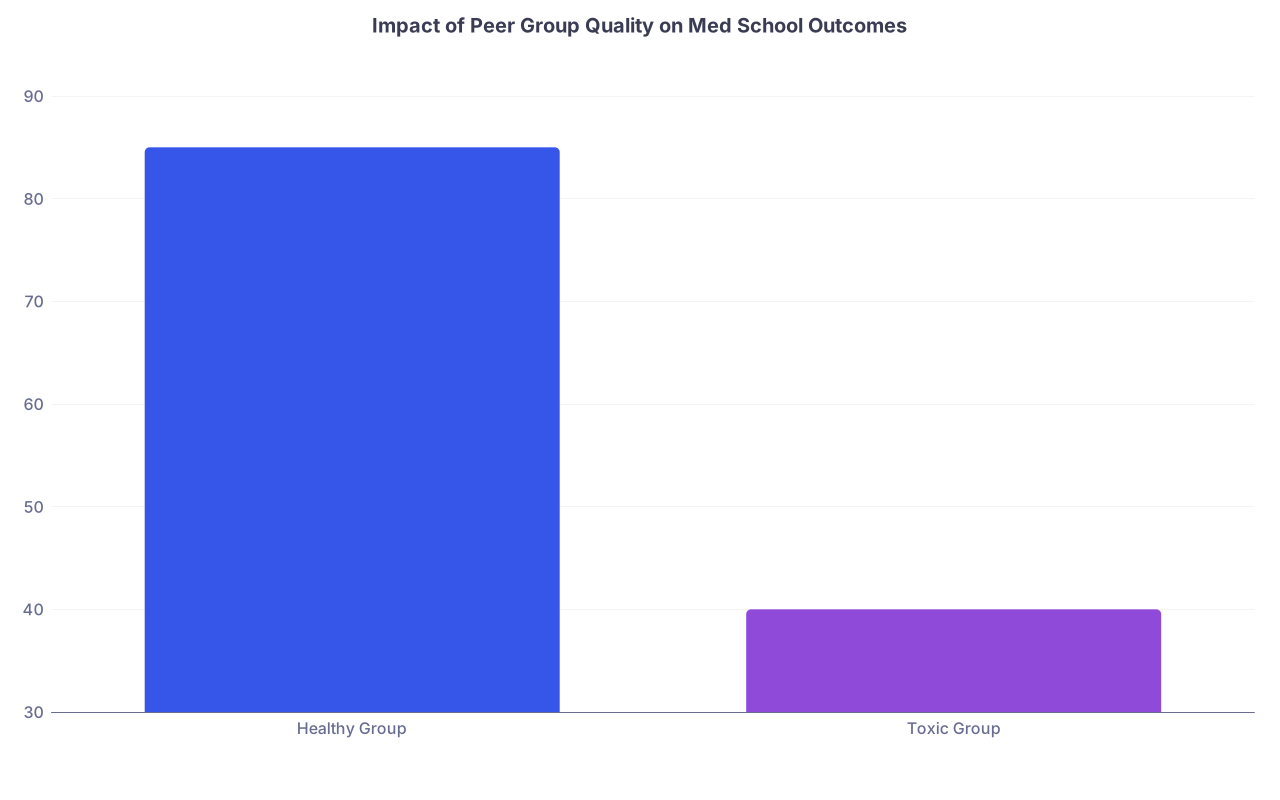
| Category | Value |
|---|---|
| Healthy Group | 85 |
| Toxic Group | 40 |

| Step | Description |
|---|---|
| Step 1 | Meet New Classmates |
| Step 2 | Limit Time |
| Step 3 | Keep Social, Not Core |
| Step 4 | Adjust Boundaries |
| Step 5 | Make Them Core Group |
| Step 6 | Supportive & Honest? |
| Step 7 | Normalize Effort? |
| Step 8 | Leave You Focused After? |

Open your messages right now and scroll through your last week of group chats. For each main thread, ask yourself: “Does this space make me better or worse as a future doctor?” Then mute one thread that consistently drags you down — and use that reclaimed time today to study, reach out to a healthier classmate, or plan your next week with intention.