Your M1 Instagram can absolutely cost you a residency spot four years from now.
Not “might.” Can. I have watched program directors pull up a screenshot, shake their head, and move an applicant from “maybe” to “no” in under ten seconds. All because of something posted in first year that the student barely remembered.
You are not “just a student” online. You are future Dr. You. Programs are already acting like that is true, even if you are not.
Let me walk you through the social media mistakes M1s keep making—and how to avoid being the cautionary example in someone else’s residency meeting.
The Big Lie: “I’ll Clean It Up Before ERAS”
The most dangerous belief M1s have about social media is this:
“I can post what I want now. If I need to, I’ll just delete or clean it up before I apply to residency.”
That is fantasy.
Here is what you are up against:
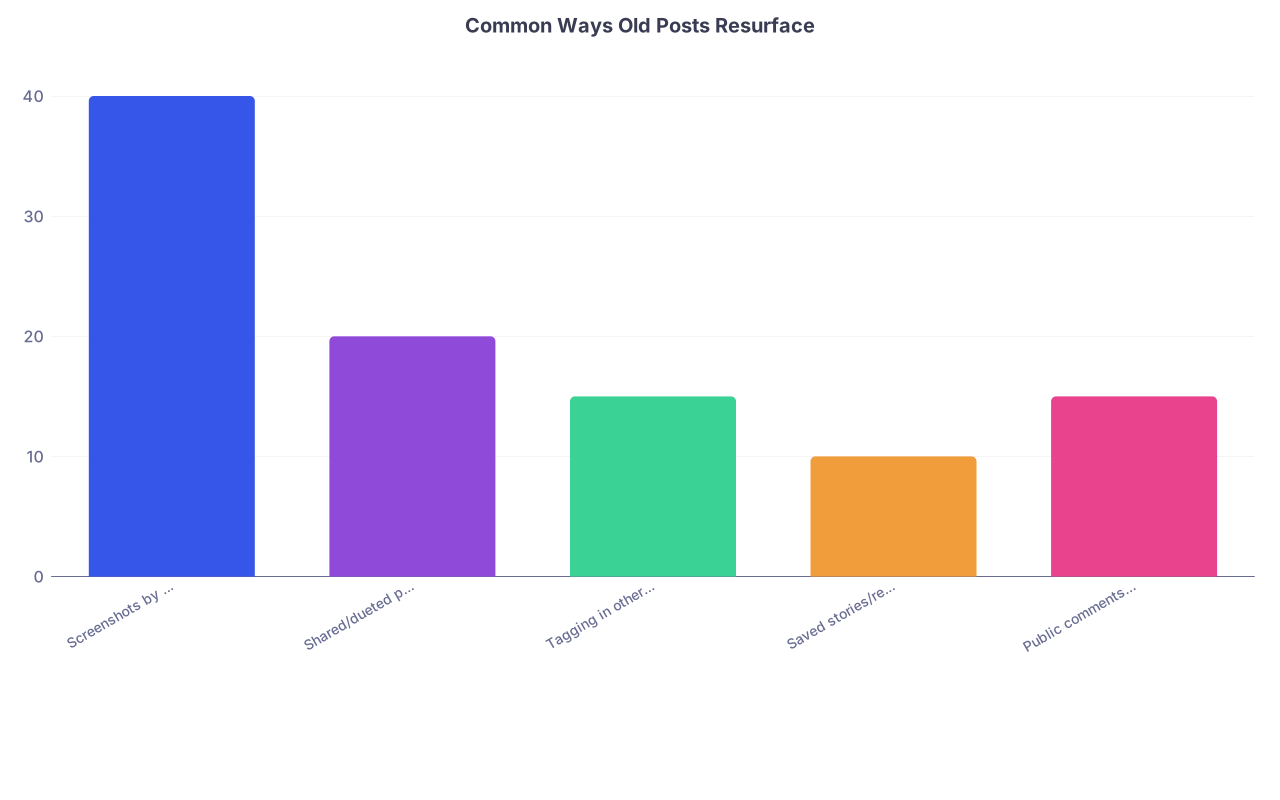
| Category | Value |
|---|---|
| Screenshots by classmates | 40 |
| Shared/dueted posts | 20 |
| Tagging in others’ content | 15 |
| Saved stories/reels | 10 |
| Public comments/likes | 15 |
Once something is out:
- Classmates screenshot it.
- Someone shares or duets it on TikTok.
- You are tagged in someone else’s mess.
- A “funny” Story gets saved and re-shared later.
- Your comment under someone else’s post is searchable even if your own account is private.
I have seen:
- A student who deleted a meme account in M2. A classmate still had dozens of screenshots. One of those screenshots ended up forwarded to the dean when there was a professionalism issue in clerkships.
- An applicant whose TikTok dance with a half-joking pharma sponsorship from M1 was found by a program’s chief resident. It became a ten-minute debate in the selection meeting about judgment and conflict of interest.
You cannot “clean up” screenshots you never see. You cannot untag yourself in a group chat. You cannot out-run Google’s cached content if someone shared something in a public forum.
The only safe approach in M1: behave like everything you post will be read aloud to:
- Your dean
- Your parents
- A room of residency program directors
Because some year, it might.
Mistake #1: Posting Anything That Touches Patients or Clinical Settings
Even in M1, you will see patients—early clinical exposure, OSCEs, shadowing, free clinics. This is where people get reckless.
Types of posts that get students into real trouble:
Photos in clinical spaces
- In scrubs with patient rooms visible in the background.
- White coat selfies in hallways with patient doors and signage.
- Group photos in OR corridors or ED bays, even “with no patients visible.”
“De-identified” stories that aren’t
- “Interesting case today: 34-year-old woman with rare X at [Hospital Name]. Unreal.”
- “My first time seeing a code on the peds floor… still shaking.”
- “Had a patient with [very rare condition] who said the funniest thing…”
Screenshots of EMR / vitals / imaging
- Crop a little bit, think it is anonymous, post it to Twitter or Reddit.
- Later realize the MRN, date, or unique combination of data was visible.
You think: “I did not say their name. HIPAA is fine.”
Wrong. HIPAA is not your actual standard here. Professionalism is.
The standard is: Would a reasonable person recognize this setting, case, or patient? Could someone at your institution connect dots? Does it look like you are cavalier with privacy?
And more importantly: Does a program director trust you with their hospital’s reputation after reading that?
If there is any patient, any identifiable location, any clinical detail—do not post it. Not in Stories, not in a “close friends” list, not in anonymous accounts that are “totally unlinked” to you. That supposed anonymity almost always cracks.
Mistake #2: “Private” Accounts That Are Not Actually Private
The second big myth M1s cling to: “My account is private. I am safe.”
You are not.
Here is how “private” fails in real life:
- You accept follow requests from classmates you barely know. They screenshot.
- You join group chats or group Stories that include one unstable person—who saves everything.
- Someone you trust gets into a messy conflict with you or someone else. Suddenly, your posts are “evidence.”
- A faculty member, resident, or administrative staff is allowed into the circle, or sees your content on a shared device.

Common disasters from “private” accounts:
- Drunk party photos that get forwarded to administration after an incident on a rotation.
- Rants about attendings or preceptors screenshotted and shared with those exact people.
- “Jokes” about cheating, prescribing, or drug use that become professionalism or conduct investigations.
Effective rule:
If it would seriously damage you if it leaked: do not post it. Not even “privately.” Not even to close friends. Say it in person if you must. The internet keeps receipts.
Your privacy is only as strong as the least stable person who can see your content.
Mistake #3: Trashing Your School, Faculty, or Classmates Online
You will be frustrated in M1. The curriculum will feel disorganized. Exams will seem unfair. Some classmates will be lazy or toxic.
If you vent this publicly online, you hand people a weapon they can use against you later.
I am not talking about thoughtful, constructive criticism:
- “I wish we had more small-group teaching in this block.”
- “Step 1 pass/fail changes how we think about pre-clinical grades.”
I am talking about:
- “This school is a joke. Total scam.”
- “Our admin is incompetent. They do not care about students at all.”
- “If Dr. X lectures one more time I will drink bleach.”
- “I cannot believe they let [Classmate Name] in. Nepotism much?”
Programs absolutely see this kind of thing. Deans talk. Students report each other. Screenshots circulate for years.
Residency faculty ask:
- Will this person trash our program online the moment something does not go their way?
- Will they damage our reputation publicly if they feel wronged?
- Do they understand professional disagreement vs. public character assassination?
Criticize thoughtfully. In the right channels. With your name attached in appropriate internal settings. Do not do drive-by defamation on Twitter, Instagram, or TikTok. That kind of thing follows you.
Mistake #4: Posting About Substances, Sex, and Illegal or Unprofessional Behavior
You are an adult. You can drink and have a social life. Programs know that.
What they do not tolerate:
- Visible binge drinking, blackouts, or dangerous behavior.
- Illegal drug use or casual drug dealing “jokes.”
- Sexually explicit content that ties directly back to your real identity.
- Weapons, threats, or anything that smells like violence.
Examples that have burned people:
- TikToks of “post-exam blackout challenge” with students vomiting, falling, or passed out—with school sweatshirts fully visible.
- Instagram captions: “Study Adderall not working, time to try the real stuff” followed by a photo of pills and alcohol (even as a “joke”).
- Public posts bragging about driving home after drinking.
- “Funny” videos simulating sexual activity in white coats or scrubs, tagged with the med school location.
Does that mean you need to be a monk? No.
It means:
- Do not post proof of conduct that your school or a hospital could discipline you for.
- Do not share anything that suggests impaired judgment or substance misuse.
- Do not mix overtly sexual content with your real-life medical identity.
Residency programs worry about:
- Malpractice risk
- Patient trust
- Media scandals
If your social media raises questions in those areas, you are asking for trouble.
Mistake #5: Political and “Hot Take” Content with No Professional Filter
This one is subtle. You do not need to be apolitical. You are allowed to have opinions. But there is a difference between:
- “I support reproductive rights; here is why as a future physician.” and
- “If you disagree with me you are a monster and I hope you never get care.”
Medical issues are often political. COVID, vaccines, reproductive health, gender care—all of it sits in the overlap between ethics, science, and politics. That does not mean every take you post is wise.
Common pitfalls:
- Dehumanizing language about any group (patients, religious groups, political leanings).
- Mocking or insulting people for weight, disability, mental illness.
- Absolutist statements that leave no room for nuance or professionalism.
- Joining dogpiles or harassment campaigns online.
You might think, “My politics are correct. Any program that does not like this is not one I want.” That sounds principled. Until you realize:
- The person reading your file might strongly agree with your policy position.
- But still worry that your hostility, judgment, or rigidity will hurt patients.
You are allowed to be outspoken. But learn the skill of separating:
- Evidence-based advocacy from
- High-school-level screaming into the void.
Ask before posting:
Would I be comfortable explaining and defending this, word for word, to a residency program director in an interview?
If the answer is no, then do not assume “but I am right” will save you.
Mistake #6: Productivity Flexing and Burnout Glorification
Less obvious, but still a problem: the “grindset” content.
M1s love to:
- Post 4 a.m. study selfies with captions like “Sleep is for the weak.”
- Brag about 16-hour study days, no breaks, triple booked commitments.
- Make TikToks mocking classmates who study less or honor boundaries.
You may think this looks motivated. It often looks unhealthy, arrogant, or both.
Residency committees already fight a culture of burnout and overwork. They are starting to value:
- Sustainability
- Self-awareness
- Team-mindedness
If your public persona screams:
- “I am superior because I destroy myself and judge everyone who does not” then you raise red flags about:
- Future burnout
- Poor teamwork
- Inflexibility
Show diligence. That is fine. But do not turn your feed into a shrine to self-destruction or contempt for people with a balanced life.
Social Media Red Flags Programs Actually Care About
Let me put this clearly. In residency selection conversations, the following patterns are serious strikes:
| Red Flag Type | How Programs Interpret It |
|---|---|
| Patient-related content | Poor judgment, privacy risk |
| Harsh attacks on school/faculty | Potentially toxic resident |
| Visible heavy substance misuse | Impairment, professionalism risk |
| Illegal or unethical “jokes” | Integrity concerns |
| Dehumanizing political rhetoric | Patient care and team risk |
This is not theoretical. I have heard comments like:
- “If this is what they post publicly, what are they like on the wards?”
- “I do not want to be calling PR because of this resident’s social media.”
- “If they talk about their med school like that, they will trash us next.”
You do not want to be the applicant who forces that conversation.
What To Do Instead: A Simple Social Media Rule Set for M1
You do not need to delete everything and disappear. You do need rules.
Here is a minimal, realistic set:
-
- Not photos. Not stories. Not “de-identified” anecdotes.
- If it happened with a patient, it stays offline.
Separate “professional-ish” and truly private spaces.
- Have one account you would not be ashamed to have an attending find.
- Any truly private communications: move them to encrypted, small group chats with people you trust offline too. Even then, assume screenshots exist.
**Never post:
- Anything you would not want seen by:
- Your dean
- Your future program director
- A journalist
- Anything involving illegal activity, cheating, or substance misuse.
- Direct insults toward identifiable individuals in medicine (faculty, classmates, staff, specific programs).**
- Anything you would not want seen by:
Use a delay rule for hot takes.
- Write the post.
- Save it in drafts.
- Re-read it 24 hours later.
- If you still think it is wise and you would calmly stand by it in an interview, then post.
Audit your accounts now, not in M4.
- Search your name + school + platform.
- Check tagged photos, comments, likes on controversial content.
- Remove or untag anything that would make you sweat if it was on a residency slide.
Assume nothing “disappears.”
- Stories are screenshots waiting to happen.
- “Anonymous” posts can often be back-traced by time, context, or small details.
- Closed groups leak constantly.
A Quick Reality Check: Program Directors’ Perspective
To make this concrete, here is roughly how program leadership thinks about applicants’ social media:
- They do not expect saints.
- They do expect:
- Basic common sense.
- Respect for privacy.
- No obvious integrity problems.
- No glaring unprofessionalism that will embarrass the hospital.
They are looking for reasons not to fight for you in a pile of very competent applicants. A bad online footprint is an easy reason. One they do not have to justify much.
If you force them to choose between:
- A strong applicant with a squeaky-clean or unknown online presence, and
- A strong applicant with screenshots of dubious posts,
they will choose the first every time. Why invite risk?
FAQ (Exactly 3 Questions)
1. Do residency programs actually look at applicants’ social media, or is that exaggerated?
Some do it formally, many do it informally. The bigger issue is not organized “social media checks” but incidental discovery. Classmates, residents, or faculty stumble on content and pass it along. Or your name is unique enough that a quick Google search surfaces your accounts. You do not need every program to check; you only need one key person to see something damaging at the wrong moment.
2. Should I delete all my accounts during medical school to be safe?
Deleting everything is overkill for most people and can even look odd if you have zero online presence in 2026 and are applying in 2030. A better approach is controlled, boringly professional content: normal life, hobbies, maybe some neutral med school posts. If you have old accounts with clearly problematic material (illegal activity, patient content, overt harassment), remove or lock them down now and stop posting there.
3. Is it safe to run an anonymous meme or vent account about med school?
No. It feels safe; it is not. Anonymity cracks all the time—through time stamps, location hints, inside jokes, or one person in your circle connecting the dots. If the account regularly insults faculty, mocks patients, or shares exam details, it can be traced back to you and trigger academic or professionalism consequences. If you would be terrified to be outed as the owner, you are already too close to the line.
Remember three things:
- You are building your professional reputation in M1 whether you admit it or not.
- Nothing online is truly private once another human can see it.
- If a post would be hard to defend calmly in an interview, do not post it.