
The worst summer after M1 is the one you drift through without a plan.
You only get one real “free” summer in medical school. If you waste it, you pay for it during M2, during boards, and frankly during residency applications. If you overpack it, you burn out before step 1/Level 1 even starts. You are walking a narrow line between strategic rest, research, and early board prep.
Here is how to decide, week by week and month by month, where you should be on that line.
Big-Picture: Decide Your Summer Structure First
At this point (late spring of M1, March–April), you should be making one core decision:
What is the dominant theme of your summer?
You are essentially choosing among three primary modes, with some blending:
| Summer Type | Primary Focus | Typical Time Split | Best For |
|---|---|---|---|
| Rest-Dominant | Recovery | 60% rest / 20% research / 20% boards | Burned-out students, uncertain specialty |
| Research-Dominant | CV-building | 20% rest / 60% research / 20% boards | Academic/competitive specialties |
| Board-Prep-Dominant | Exams | 30% rest / 20% research / 50% boards | Weak preclinical foundation or early Step/Level date |
You do not need to choose only one lane. But you must pick a priority.
If you tell yourself “I’ll rest, do research, and prep heavily for boards,” you will likely:
- Half-rest (never mentally off)
- Half-produce for research (no real output)
- Half-prepare for boards (forget most of it by fall)
So, first decision: which of these describes you best?
You are exhausted, barely held it together in M1, and feel fried.
→ Rest-dominant summer with light, structured productivity.You are eyeing dermatology, ortho, plastics, neurosurgery, radiation oncology, or academic internal medicine.
→ Research-dominant summer, with controlled rest and short board touchpoints.You struggled in systems, anatomy crushed you, or your school is compressing M2 with an early exam date.
→ Board-prep-dominant summer with focused review, plus short breaks and perhaps small-scale research or shadowing.
Once you pick that, your month-by-month and week-by-week decisions fall into place.
Timeline Overview: From End of M1 to Start of M2
Let me lay out the skeleton first. Then we will drill into each phase.
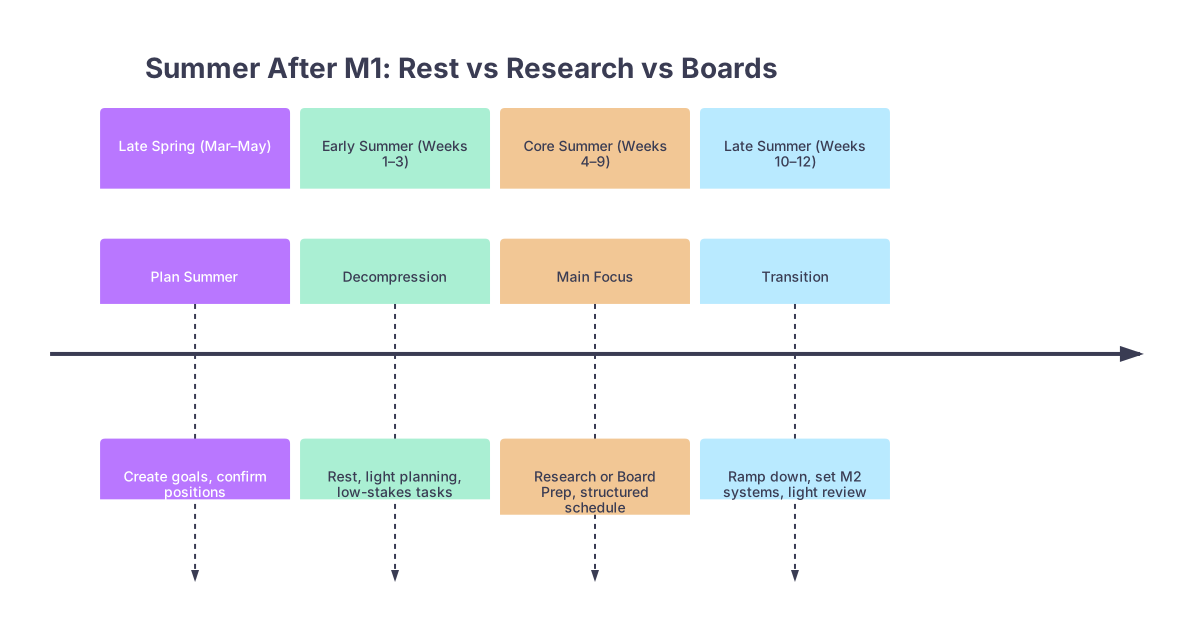
| Period | Event |
|---|---|
| title Summer After M1 | Rest vs Research vs Boards |
| Late Spring (Mar–May) - Plan Summer | Create goals, confirm positions |
| Early Summer (Weeks 1–3) - Decompression | Rest, light planning, low-stakes tasks |
| Core Summer (Weeks 4–9) - Main Focus | Research or Board Prep, structured schedule |
| Late Summer (Weeks 10–12) - Transition | Ramp down, set M2 systems, light review |
Now, we go phase by phase.
Phase 1: March–May (Late M1) – Set the Course Before Finals
At this point you should not be “figuring it out later.” By April, you need clarity.
By End of March
Your tasks:
Clarify your realistic competitiveness (for now).
- Look at your class rank or rough performance deciles.
- Be honest: Are you average? Above average? Struggling?
- Weak preclinical performance pushes you more toward strategic board prep and strengthening fundamentals.
Check your Step/Level timing and school policies.
- Is Step 1 still required? (For most, yes, but pass/fail.)
- When do your M2 courses end?
- How long is your dedicated period?
- Do most students from your school start Step prep during M1 summer? Ask MS2s.
Informal specialty reflection.
- If you are remotely interested in derm, ortho, ENT, neurosurgery, plastics, urology, ophtho, or radiation oncology, you need to assume you might be heading for a competitive field. That makes research more important.
First Half of April
By mid-April, you should:
Lock in or actively pursue a summer research position (if research is even 20–30% of your plan):
- Email faculty. Not generic emails. Something like:
- “I read your recent paper on X. I am an M1 with basic stats skills and am comfortable with Excel/RedCap. I am seeking an 8–10 week project with potential for a poster or manuscript.”
- Target:
- Department aligned with your top 1–2 interests.
- One primary mentor with actual publications in the last 2–3 years.
- Email faculty. Not generic emails. Something like:
Confirm any funding or formal programs:
- NIH-funded summer research programs.
- Institutional M1 summer fellowships.
- Stipends from departments.
If money is an issue (it usually is), this must get sorted early.
Outline your preferred summer mode in one page:
- 3 bullet goals for:
- Rest (e.g., “Sleep 8 hours,” “Take a 1-week off-grid trip”).
- Research or projects (e.g., “One abstract submitted,” “Data analysis done for X study”).
- Board prep (e.g., “Finish one full pass of Anki for M1 content,” “Complete 400 UWorld questions”).
- 3 bullet goals for:
Late April–Early May (Around Finals)
You are busy with exams, so keep it simple:
Finalize dates:
- Start and end dates for any research position.
- Planned trip/vacation dates.
- Board prep windows (don’t schedule around them vaguely; mark start and end weeks).
Acquire resources:
- Board books: UWorld, AMBOSS, Boards & Beyond/Sketchy/Pathoma depending on your school culture.
- Software: Anki deck (like AnKing), question bank subscriptions.
- Research access: IRB clearance status, dataset access, EMR training dates (if needed).
By the time you finish M1 exams, your summer calendar should not be blank. It should already be structured, even if lightly.
Phase 2: Weeks 1–3 of Summer – Controlled Decompression
When M1 ends (usually May or early June), you will want to either:
- Do absolutely nothing for a month, or
- Panic and start grinding UWorld.
Both extremes are bad.
Week 1: Full Decompression Week
Yes, take one real week off. No guilt. But make it intentional.
What Week 1 should look like:
- No Anki. No question banks. No lab meetings.
- Sleep in. See family. Go outside. Move your body.
- If you must “be productive,” read fiction or do something completely non-medical.
What to avoid:
- Half-opening First Aid “just to skim.”
- Half-signing into a new research project Slack and pretending you can start immediately.
- Committing to long-term obligations during this week when your brain is still scrambled.
Week 2: Light Re-entry + Admin
At this point you should start turning the engine back on, slowly.
If research-dominant:
- Onboarding:
- Meet your PI and immediate supervisor.
- Clarify expectations:
- Days/hours per week.
- Concrete deliverables by August (e.g., “dataset cleaned,” “first draft of manuscript,” “poster abstract submitted to conference X”).
- Get logins, IRB training done, EMR training.
If board-prep-dominant:
- Set up systems, not volume:
- Install or clean up Anki. Decide on deck and tagging strategy.
- Connect your resources:
- For example, link B&B or Sketchy videos in your notes.
- Do a diagnostic, not a grind:
- One half-length NBME-style exam or 40–80 UWorld questions to map weaknesses.
- Write a realistic study schedule:
- For example:
- 2–3 hours per day, 4–5 days per week in June.
- Building up to 3–4 hours per day by late July if needed.
- For example:
If rest-dominant:
- Keep it extremely light:
- 1–2 days this week where you:
- Organize your notes.
- Set up Anki syncing.
- Write 3 specific “maintenance” actions you will do all summer (e.g., “50–100 Anki cards 4 days per week,” “One board video per weekday, max 1 hour”).
- 1–2 days this week where you:
Week 3: Stabilize Your Weekly Template
By the end of Week 3, you should have a weekly template that will define your core summer. For example:
Example weekly structure – Research-dominant:
- Mon–Thu:
- 9:00–3:00 research work (6 hours).
- 4:00–5:00 light board review (Anki, 20–40 questions).
- Fri:
- 9:00–1:00 research.
- Afternoon free.
- Sat:
- 1–2 hours of catch-up or reading.
- Sun:
- Off entirely.
Example weekly structure – Board-prep-dominant:
- 4 days/week:
- Morning: 2–3 hours of question bank (40–60 questions).
- Afternoon: 1–2 hours reviewing weak areas with videos or First Aid.
- 1–2 days/week:
- Unstructured – social, hobbies, rest.
- 1 day/week:
- Zero medicine.
Lock this in now, not “later.”
Phase 3: Core Summer Block (Weeks 4–9) – Execution Mode
Here is where most students either build real value or just…drift.
I will break this down into three tracks, but you can hybridize.
Track A: Research-Dominant Core (Typical 6–8 Weeks)
If research is your priority, at this point you should:
Have a concrete project definition by Week 4.
- Question is clear.
- Your role is defined (data collection, chart review, stats, writing).
- Timeline is mapped:
- Week 4–5: Data cleaning / chart review.
- Week 6: Initial analysis.
- Week 7: Draft results, figures.
- Week 8: Draft abstract or manuscript intro/discussion.
Work hours:
- 30–40 hours per week is typical for a “real” research summer.
- You are not an undergrad intern. You are a medical student; act like a junior colleague.
Protect short, consistent board touchpoints:
- 3–4 days per week:
- 20–40 UWorld questions or:
- 30–45 minutes of Anki (no more).
- Goal is maintenance, not maximal gains.
- You are preventing decay of M1 material and building familiarity with the exam style.
- 3–4 days per week:
Guard rest fiercely:
- One full day off per week.
- Evenings after ~7 pm mostly protected.
Concrete weekly goals:
- Week 4–5:
- Complete X% of data collection.
- Finish at least 150–200 board-style questions total (or equivalent review).
- Week 6–7:
- Have preliminary figures/tables.
- Refine board weaknesses.
- Week 8–9:
- Submit abstract or solid draft to your mentor.
- Keep board activity steady, not ballooning.
Track B: Board-Prep-Dominant Core
If your primary concern is Step/Level, this is where the heavy lift happens.
Weeks 4–5: Solidify M1 Content
Daily structure (4–5 days/week):
- Morning:
- 40–60 questions (random, system-based, or subject-based depending on your school).
- Immediate review with detailed reasoning.
- Afternoon (1–2 hours):
- Targeted review of weak topics from that morning.
- Use Pathoma/B&B/Sketchy or equivalent.
- Morning:
Anki:
- 200–300 reviews/day is realistic if you already use it.
- If new to Anki, keep it lower (100–150 per day) to avoid burnout.
Goals by end of Week 5:
- 400–800 questions done (depending on intensity).
- You have re-touched nearly all major M1 organ systems or subjects.
Weeks 6–7: Integrate M2-style thinking
Adjust your strategy:
- Shift some questions to mixed-mode blocks to simulate the exam.
- Start integrating multi-system reasoning (e.g., endocrine + cardiology + renal in one block).
Add one longer exam:
- NBME-style practice test or a 4-block UWorld self-assessment.
- Use it primarily for:
- Timing.
- Stamina.
- Identifying big blind spots.
Maintain 1–2 light days per week:
- You are not in dedicated yet. Do not act like you are.
Weeks 8–9: Consolidate and Slow the Climb
At this point you should not be ramping up intensity indefinitely. That is how burnout happens in October.
Focus:
- Close obvious gaps: biostats, ethics, micro details, pharm mechanisms that repeatedly trip you.
- Refine approaches:
- How you read stems.
- How you manage time per question.
Scale back slightly:
- If you were doing 5 heavy days, drop to 4.
- Insert 2 true off days across Weeks 8–9.
Remember: This is pre-season training. The actual season is M2 + dedicated.
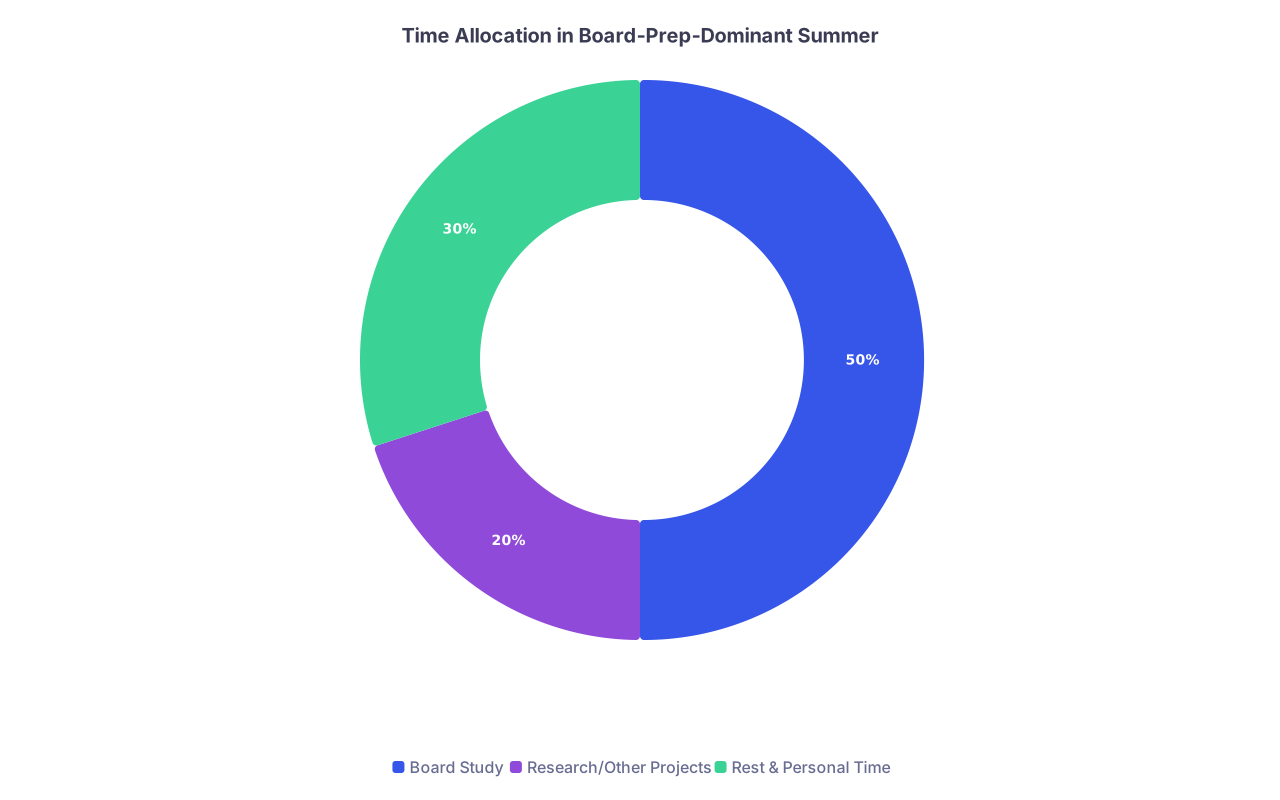
| Category | Value |
|---|---|
| Board Study | 50 |
| Research/Other Projects | 20 |
| Rest & Personal Time | 30 |
Track C: Rest-Dominant Core (But Not “Do Nothing”)
If you are prioritizing rest, that is fine. But rest does not mean mental atrophy.
Weeks 4–9 rest-dominant plan:
Non-negotiables:
- 3–4 days per week:
- 30–60 minutes of light board-maintenance:
- 50–100 Anki reviews.
- Or 10–20 questions from a Qbank.
- 30–60 minutes of light board-maintenance:
- One small longitudinal project:
- Could be:
- Very light research.
- Shadowing 4–6 half-days over the entire summer.
- A teaching/tutoring gig for undergrads or MCAT.
- Could be:
- 3–4 days per week:
Major life tasks:
- If you have family obligations, children, or need to work for income:
- This is the window to address those without guilt.
- Just keep a toe in the water academically so August does not hit like a truck.
- If you have family obligations, children, or need to work for income:
By end of Week 9:
- You should feel actually rested.
- You should not feel academically “cold.”
Phase 4: Late Summer (Weeks 10–12) – Transition Back to M2
If you coast right up until orientation, you will hate your first month of M2.
These final 2–3 weeks should feel different. At this point you should intentionally pivot from “summer mode” into “ramp-up mode.”
Week 10: Wind Down Projects
Research:
- Hand off cleanly:
- Organized spreadsheet.
- Clear documentation on what you did and what remains.
- A short bullet summary email to your PI:
- What was accomplished.
- What is pending.
- How you can remain involved (or not) during M2.
- Hand off cleanly:
Board prep:
- Do one more practice block or short exam to:
- Benchmark where you are.
- Identify content you absolutely must shore up during early M2.
- Do one more practice block or short exam to:
Rest:
- Plan one last “bigger” day or two of non-medical life: trip, family, something that signals the end of summer to your brain.
Week 11: Systems Reset
This week is your “setup for M2” week.
Tasks:
Course materials and logistics:
- Download or organize syllabi, lecture notes templates.
- Set up a calendar with all major M2 exam dates and, if known, your dedicated period.
Board integration plan for M2:
- Decide:
- How many questions per day will you do during M2 (typical: 10–20 on weekdays at the start, slowly increasing).
- Which decks you will maintain and how many Anki reviews per day is realistic with your course load.
- Decide:
Physical and mental prep:
- Normalize sleep schedule to something close to your school routine.
- Cut down on late nights, alcohol, anything that will wreck your re-entry.
Week 12: Simulated “M2 Lite” Week
Run a trial week that mimics your planned M2 balance.
For example:
- Morning:
- 1–2 hours of “lecture” (pick an M2-style resource—pharm, path, systems-based videos).
- Midday:
- 40-question block.
- Afternoon:
- 1 hour review + Anki.
You are not doing this at full intensity. You are testing:
- Can your schedule work in real life?
- Are your Anki and Qbank workflows smooth?
- Where are you overcommitting already?
Tweak now, not the second week of M2 when the exam calendar hits.
How Different Profiles Should Adjust This Timeline
Three quick profiles I see over and over:
The Burned-Out High Achiever
- Strong grades, exhausted, terrified of “wasting” the summer.
- Prescription:
- Rest-dominant first 3–4 weeks.
- Then research-dominant or board-touchpoints only.
- Hard cap on daily academic hours (no more than 4–5).
The Mid-Pack, Unsure Specialty Student
- Average performance, no clear specialty.
- Prescription:
- Mixed summer:
- 6–8 weeks of moderate research (20–30 hours/week).
- 2–3 hours/week of scheduled board prep.
- Use summer to test specialty interest via research and occasional shadowing.
- Mixed summer:
The Struggling but Motivated Student
- Below-average scores, worried about Step/Level.
- Prescription:
- Board-prep-dominant.
- Still take that first full week off. Then:
- 4 solid study days/week.
- 2 light days.
- 1 full day off.
- Focus more on conceptual understanding and question reasoning than on volume.
One Thing You Should Do Today
Open your digital or paper calendar right now and block off:
- One full decompression week after M1 ends.
- A 6–8 week “core” block labeled with your chosen priority: REST, RESEARCH, or BOARDS.
- A 2–3 week “ramp-up” period before M2.
Then, under that core block, write three bullet points: one rest goal, one research or project goal, and one board-prep goal. That is the spine of your summer. Everything else attaches to that.