You are here
It’s the week before Thanksgiving of your M1 year.
You’ve got:
- A stack of lecture recordings you “definitely” meant to watch
- A looming anatomy exam right after the break
- Three Friendsgivings invitations
- A vague idea you should “use the time to reset”
You’re torn between collapsing on the couch for five days and grinding nonstop so you don’t drown in December.
Here’s the truth: Thanksgiving sets the tone. Students who handle this week and the break well usually roll into December with momentum. The ones who either overwork or fully check out spend the next four weeks clawing back.
We’re going to walk this chronologically—from two weeks before Thanksgiving through the week after—so you know exactly what to do at each point to build sustainable habits instead of a one‑week sprint.
Two Weeks Before Thanksgiving: Set the Foundation
At this point you should stop hand‑waving and actually look at the calendar.
Step 1: Map your reality (20–30 minutes)
Sit down with your syllabus, exam schedule, and social commitments.
Make a quick table like this:
| Item | Date/Status |
|---|---|
| Anatomy Unit 3 Exam | Monday after break |
| Biochem Quiz | Wednesday after break |
| Thanksgiving Travel | Thurs–Sun (4 days) |
| Required Sessions | Mon–Wed of that week |
Then answer, in writing:
- What’s due or tested the week after Thanksgiving?
- What content will be covered between now and the break that will be on those assessments?
- How many real study days do you have during the break (not travel days, not full family days)?
You can’t build sustainable habits on vibes. You need numbers.
Step 2: Decide your non‑negotiables
At this point you should choose your minimums for three things:
- Sleep (e.g., 7 hours minimum, no heroic “4 hours and vibes”)
- Movement (e.g., 10–20 minutes daily walk/stretch)
- Maintenance studying (e.g., 60–120 minutes per day during the break)
Write them down. Not as aspirational goals—rules.
Because when you’re on your aunt’s couch on Friday night with pie in your hand, you won’t make a rational plan. You’ll do whatever’s easiest. Your pre‑commit here is what saves you.
Step 3: Front‑load the chaos (right now to Thanksgiving week)
Over the next 10–14 days, your job is simple: reduce the academic debt you drag into Thanksgiving.
Focus on:
Clearing backlogs
- Unwatched lectures > extra question banks.
- “I’ll catch up over break” is usually a lie.
Building your daily maintenance habits before the break
Pick one from each bucket:- Content: 30–45 minutes of active review (Anki, concept maps, whiteboard summaries)
- Questions: 10–20 practice questions / day in your toughest course
- Organization: 5–10 minutes nightly to plan the next day
Practicing short study blocks
You’re going to need this over Thanksgiving where your days are chopped up by meals, family, and travel. Start now:- 25 minutes focused, 5 minutes off (Pomodoro, but don’t obsess over the name)
- Two focused blocks can beat three hours of half‑scrolling, half‑studying
By the end of this “two weeks out” window, your goal is not perfection. It’s to have:
- No vast backlog of untouched lectures
- A realistic understanding of your post‑Thanksgiving exams
- Daily habits already in motion
One Week Before Thanksgiving: Build Your Break Blueprint
At this point you should shift from vague intention to an actual Thanksgiving week plan.
Step 4: Create a Thanksgiving Week Gantt in your head (or on paper)
Let’s lay it out visually.
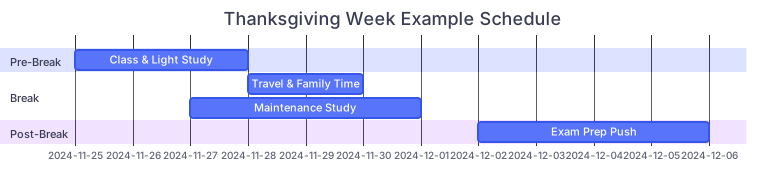
| Task | Details |
|---|---|
| Pre-Break: Class & Light Study | a1, 2024-11-25, 3d |
| Break: Travel & Family Time | a2, 2024-11-28, 2d |
| Break: Maintenance Study | a3, 2024-11-27, 4d |
| Post-Break: Exam Prep Push | a4, 2024-12-02, 4d |
Now translate that into reality for you:
Identify your high‑study days of break
- Maybe Wednesday and Friday are open.
- Maybe Thursday is a full zero. Good. Make it actually zero.
Identify your low‑study days
- Travel days, intense family days, or days you’re hosting.
- Commit to only your minimum maintenance on these days (e.g., 30–60 minutes total).
Protect one full recovery block
- Half‑day or full day with no school.
- If you “rest” by doom‑scrolling with guilt, that doesn’t count.
Step 5: Pre‑decide your Thanksgiving study menu
At this point you should know exactly what kind of work you’ll do over break. Not just “study anatomy.”
Break it into buckets:
- Core review
- Example: “Re‑review anatomy Unit 3: limbs + clinical correlates”
- Practice questions
- Example: “Do 60 anatomy questions total, 20 per real study day”
- Light/portable tasks
- Example: “Anki review + 10 questions on the iPad each low‑study day”
Then assign them to days.
| Day | Focus Task | Time Target |
|---|---|---|
| Wed (travel) | Anki + 10 questions | 45–60 min |
| Thu (holiday) | OFF (only Anki if you want) | 0–20 min |
| Fri | Anatomy Unit 3 + 20 questions | 2–3 hours |
| Sat | Biochem review + 20 questions | 2–3 hours |
| Sun (return) | Light review + planning | 1–2 hours |
This is how sustainable habits look: small, specific, repeatable actions—not heroic 12‑hour “catch‑up” sessions that you hate and then abandon.
Thanksgiving Week: Monday–Wednesday (Pre‑Break)
At this point you should be tightening, not adding.
Step 6: Tie off loose ends (Mon–Wed)
Your goals for the first three days of Thanksgiving week:
Finish all lectures and required content that will be on post‑Thanksgiving assessments
- Do not drag new content into the break if you can help it.
- If something must be left, keep a list: “Leftover: 1 renal path lecture, 1 biochem.”
Make condensed tools for break studying:
- Skeleton outlines for big topics
- Screenshot/print critical diagrams
- Pre‑made Anki custom decks (e.g., “Anatomy Unit 3 – high yield only”)
Clarify all admin junk:
- Know when your first day back actually starts
- Confirm exam locations/times
- Email any faculty if you have logistics questions now, not from your parents’ couch
By Wednesday night, you want to have:
- A clear, realistic study plan for break
- All key materials accessible offline (or on tablet/laptop)
- No confusion about what’s coming after
Thanksgiving Day and the Long Weekend: Daily Habits in Practice
Now we’re in it. This is where most first‑years either overcompensate or surrender.
Step 7: Thanksgiving Day (Thursday) – Lean into the break, but don’t erase momentum
At this point you should not be grinding. You should be honoring the fact that your brain is, in fact, attached to a human body.
My recommendation:
Commit to 15–30 minutes max of low‑intensity studying
- Anki reviews
- Re‑reading your own condensed notes
- Absolutely no new lectures
Focus on life habits instead:
- Get outside for a walk
- Actually enjoy the meal
- Step away from screens for at least a couple of hours
Why? Because sustainable habits respect cycles. You’re not a machine. You need days that are intentionally light.
Step 8: Black Friday (Friday) – First real study push
At this point you should treat Friday like a “normal but shorter” study day.
Structure it in 2–3 focused blocks:
Example plan:
- Block 1 (60–90 min):
- Review high‑yield anatomy topics (e.g., brachial plexus, lower limb injuries)
- Break (30–60 min):
- Walk, help clean up, coffee run
- Block 2 (60–90 min):
- 20–30 anatomy questions, review thoroughly
- Optional Block 3 (30–45 min, evening):
- Light Biochem path or memorize structures
Key rule: When you’re studying, you’re actually studying. No Instagram. No “chatting while kind of looking at notes.” You earn free time by being focused, not by sitting at a desk for hours.
Step 9: Saturday–Sunday – Repeatable rhythm, not a cram
At this point you should be repeating a simple pattern each day:
- 1–2 substantial blocks (60–90 min each) on your primary post‑break exam
- 1 smaller block (30–45 min) on secondary courses or catch‑up
- Brief nightly plan for your first 3 days back
If you keep it this simple, you walk into Monday not panicked, not burnt out, and not ashamed of having “wasted the break.”
The Hidden Habits You’re Actually Building
Let me be blunt: the content you study over Thanksgiving matters less than the skills you build.
Over this week, if you follow the plan, you’re building:
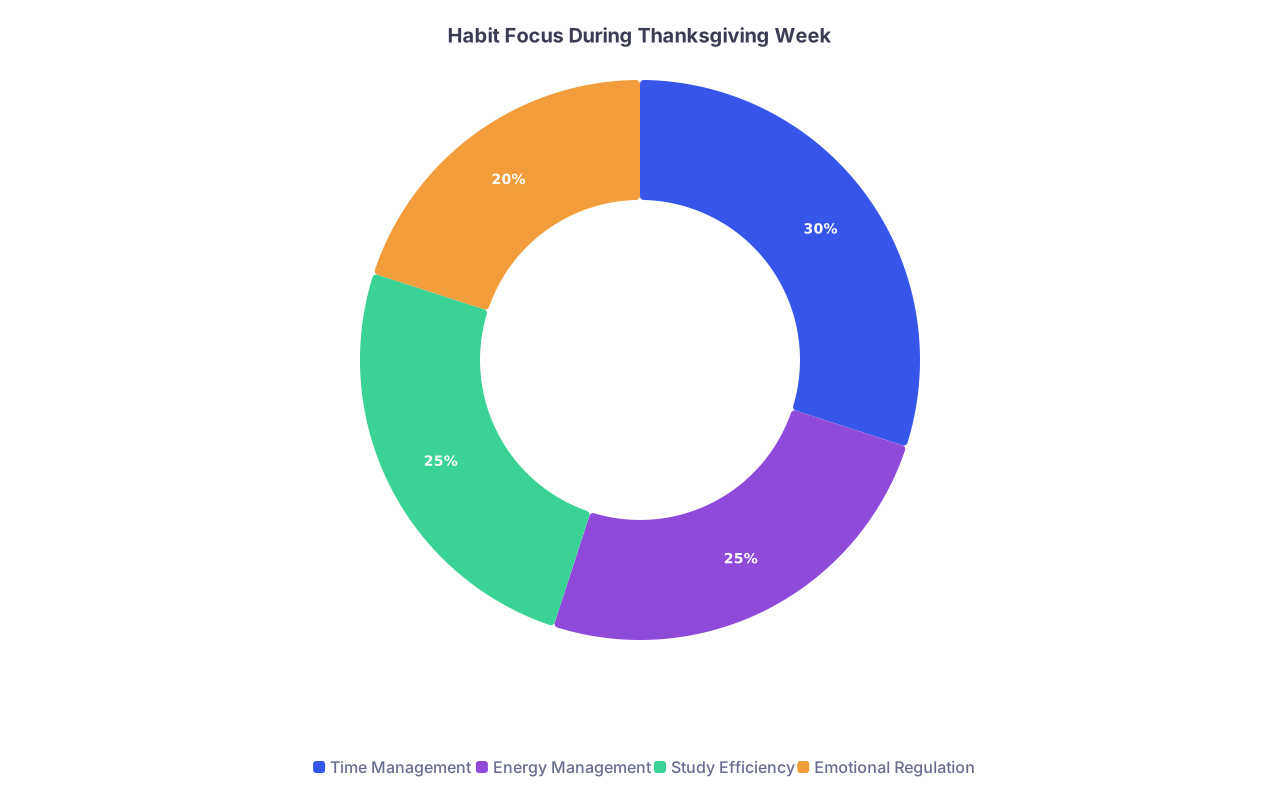
| Category | Value |
|---|---|
| Time Management | 30 |
| Energy Management | 25 |
| Study Efficiency | 25 |
| Emotional Regulation | 20 |
Time management
- Planning around non‑negotiable life events (meals, travel).
- Learning to use weird 30–60 minute pockets.
Energy management
- Studying when your brain works (often mornings), resting when it doesn’t.
- Notice you’re useless at 3 pm in a house full of relatives? Great. Stop forcing it.
-
- Shorter, more focused blocks.
- Prioritizing high‑yield over random completionism.
Emotional regulation
- Choosing some work instead of all‑or‑nothing.
- Tolerating the feeling of “I could do more” without panicking and doing nothing.
These are exactly the muscles you’ll need for boards, for clerkships, and for the rest of your career.
The Week After Thanksgiving: Lock in Sustainable Habits
Most students blow this part. They either:
- Slam themselves with 10‑hour days to “make up for lost time,” or
- Keep operating at break‑mode intensity while the course firehose reopens
You’re going to do something different.
Step 10: Monday–Wednesday after break – Re‑entry protocol
At this point you should run a tight three‑day system.
Morning of Monday: 20‑minute reset
- List your exams, quizzes, and big assignments between now and winter break.
- For each, write the minimum daily work needed to be prepared.
- Decide how many hours per weekday you’re honestly willing to commit.
Now map the next three days:
- Morning: highest‑priority exam content
- Midday: required sessions, admin, group work
- Late afternoon: questions + review
- Evening: light materials or nothing, depending on fatigue
Do not try to “catch up” on twelve things at once. Pick your top one or two.
Step 11: Re‑establish your daily floor
Whatever minimum habits you had pre‑Thanksgiving, re‑commit.
Examples of a realistic daily floor:
- 30–45 minutes of Anki
- 15–20 practice questions with review
- 5 minutes planning tomorrow before bed
If the day explodes—code blues in sim lab, surprise small group assignment, whatever—you still hit the floor. That’s how habits survive chaos.
Longer-Term: Turning Thanksgiving into a Template
Thanksgiving is actually a small‑scale version of winter break, spring break, and, eventually, Step study periods: disrupted routines, family pressure, FOMO, and exams on the other side.
If you’re smart, you’ll treat this as a template to refine.

After the dust settles (the weekend after Thanksgiving or once your exam is done), spend 10 minutes on a brutally honest debrief:
- What worked? (e.g., “Two 75‑min blocks were perfect, more was unrealistic”)
- What failed? (e.g., “Tried to watch full lectures at my parents’ house. Zero chance.”)
- What will you keep exactly the same for winter break?
- What will you change?
This is how you build sustainable habits: short cycles of plan → test → adjust. Not by waiting for “a better time” to suddenly become a different person.
Very Common Failure Patterns (And How to Course‑Correct)
Just so you can see them coming:
The “I’ll Catch Up Over Break” Mirage
- Symptom: You leave 8–10 lectures to “binge later.”
- Fix: Right now, choose one course. Clear that backlog before Thanksgiving. The rest gets triaged.
The All‑or‑Nothing Thanksgiving
- Symptom: Either full grind (10 hours a day) or zero school.
- Fix: Commit to 1–3 focused hours on 3 days. The rest is truly off.
The Guilt Spiral
- Symptom: You scroll on your phone “taking a break” but never actually rest or study.
- Fix: Use timers. When you’re off, you’re off. When the 25 minutes starts, you’re on.
The Post‑Break Crash
- Symptom: You come back wrecked, overcaffeinated, and behind.
- Fix: Prioritize sleep first three nights back. Yes, even over extra study. A functional brain learns faster.
What Sustainable Actually Looks Like
Let me be clear: sustainable doesn’t mean painless or easy.
It means:
- You’re not constantly yo‑yoing between 0 and 100
- Your default day has some school, some life, some rest
- You can have a major holiday without detonating your exam prep
A first‑year who handles Thanksgiving well usually:
- Scores solidly (not necessarily perfectly) on the first post‑break exam
- Feels less resentful about school invading every corner of their life
- Heads into December tired but not destroyed
And that’s the bar. Not perfection. Stability.
Do This Today
Right now, before you click away:
- Open your calendar for the Thanksgiving period.
- Write down three things:
- The date of your first major exam after Thanksgiving
- The exact number of real study days you’ll have during the break
- Your daily minimum for the break (e.g., “45 minutes + 10 questions”)
Then block off one completely school‑free half‑day during Thanksgiving weekend.
If you can protect that half‑day and still hit your daily minimums, you’re not just surviving M1. You’re learning how to build a career you can actually live with.