
The “10‑hour study day” myth is wrecking more med students than anatomy ever will.
Let me give you the real answer.
So… how many hours should a first‑year med student actually study?
For most first‑year med students, the honest, evidence‑from-real-humans answer is:
On a normal weekday (non-exam week): about 4–6 focused hours of actual studying.
On a weekend day: 3–5 focused hours.
That assumes:
- You’re going to lecture (live or recorded)
- You’re using spaced repetition (Anki or similar)
- You’re not in one of those schools that firehose 60+ new slides per hour with daily high‑stakes quizzes
If you want a tight guideline:
| Day Type | Reasonable Study Hours | Absolute Upper Limit* |
|---|---|---|
| Regular weekday | 4–6 focused hours | 8 |
| Light weekend | 3–5 focused hours | 6 |
| Exam crunch day | 6–9 focused hours | 10 |
| True emergency | 10–12 (short bursts) | 12 |
*Upper limit = beyond this, you usually get worse returns, more burnout, and more dumb mistakes.
If someone tells you they “study 12–14 hours every day,” either:
- They’re counting everything (walking between buildings, snack breaks, scrolling Reddit with First Aid open), or
- They’re on track to burn out hard.
The better question isn’t “How many hours?”
It’s “How many focused hours can I consistently hit without wrecking my brain, sleep, and sanity?”
For most normal human brains, that’s ~5 solid hours on school days, ~4 on weekends, with short sprints up to 8–9 around exams.
The 3 factors that actually determine your number
You’re not a generic med student. Your “right” number depends heavily on three things:
1. Your school’s curriculum style
Here’s the part people forget: the school changes everything.
| Curriculum Type | Typical Load | Expected Daily Study |
|---|---|---|
| Pass/Fail, systems‑based, recorded lectures | Moderate | 4–6 hours |
| Pass/Fail, problem‑based (PBL-heavy) | Lower–Moderate | 3–5 hours |
| Graded, lecture-heavy (old school) | High | 5–8 hours |
| Frequent quizzes, mandatory attendance | Very High | 6–9 hours |
If your classmates say stuff like:
- “We get 40–60 new slides per class”
- “We have daily or every‑other‑day quizzes”
- “People fail blocks every semester”
You’re in a high-intensity curriculum. Expect your normal to be closer to 6–8 focused hours on weekdays.
If instead you hear:
- “It’s true pass/fail, 70% to pass”
- “Most people use boards-style resources early”
- “Attendance isn’t strictly enforced”
You’re probably closer to the 4–6 hours range.
2. Your baseline knowledge and learning speed
Brutal truth: someone who majored in biochem and lived in a lab is not going to need the same hours for M1 content as someone who’s coming from, say, engineering or humanities.
If you:
- Already took advanced physiology, biochem, immunology
- Used Anki or spaced repetition in undergrad
- Have been casually watching Boards & Beyond / Sketchy for fun (yes, those people exist)
You can probably hit the lower end of the ranges and do just fine.
If you:
- Haven’t seen this stuff in years
- Never really learned how to study efficiently
- Are translating from a different language or academic background
Then you’ll want the upper end of the range for at least the first few blocks while you build systems.
3. How efficient your study method is
Two students both “study 6 hours.”
One passes comfortably.
One fails.
Because what they’re doing in those hours is completely different.
Here’s a harsh but accurate breakdown of bad vs good 6-hour days:
Bad 6-hour day:
- 3 hours watching lectures at 1x speed, pausing constantly
- 2 hours rereading or re-highlighting notes
- 1 hour passively scrolling a lecture PDF telling yourself “this makes sense”
Good 6-hour day:
- 2 hours doing new Anki cards (active recall + spaced repetition)
- 2 hours on practice questions or board-style questions for your current block
- 1 hour rapidly reviewing lecture slides with a focus on “what could they test?”
- 1 hour of making / reviewing high‑yield diagrams or organizing info
Same “hours.” Totally different learning.
So if you’re studying 8+ hours most days and still feel lost, your problem is almost never insufficient hours. It’s inefficient methods.
What a sane first‑year weekday can look like
Let me give you a concrete, realistic daily structure. Adjust the exact numbers, but keep the proportions.
Assume you’re in a pass/fail, lecture-based curriculum, not right before an exam.
Sample regular weekday schedule (target: ~5 hours of real study)
8:00–12:00 – Class / recorded lectures
Count this as learning time, but not all of it is “study time.”12:00–13:00 – Lunch + brain break
13:00–15:00 – Anki / spaced repetition
That’s your non‑negotiable block. Old and new cards for that day.15:00–15:30 – Short break, walk, snack
15:30–17:00 – Review today’s material
Speed through slides, clarify confusions, make 1–2 summary diagrams or notes max.17:00–18:00 – Questions (if you’re a bit ahead) or lab prep / small group prep
That’s 4–5 focused hours after class, plus whatever mental effort you spent in lecture. For most people, that’s plenty for a normal day.
What about exam weeks?
Sample heavy exam prep day (target: 7–9 hours of real study)
No lectures or minimal lecture load:
- 8:00–10:00 – Anki + targeted review of weak topics
- 10:00–10:30 – Break
- 10:30–12:30 – Practice questions (block + review explanations)
- 12:30–13:30 – Lunch
- 13:30–15:30 – Second pass at high‑yield content (videos, notes, diagrams)
- 15:30–16:00 – Break
- 16:00–18:00 – More questions / group review / explaining concepts out loud
That’s a big day. You can’t live like this every day of the year. But for 3–5 days before a big exam? Very reasonable.
Signs you’re studying the wrong number of hours
You don’t need a complex tracker. Just watch for these patterns.
You’re probably studying TOO LITTLE if:
- You’re constantly “surprised” by exam questions that were from lectures
- Your Anki reviews routinely pile up to 500+ and you keep ignoring them
- You have to cram entire blocks in the last 48 hours before exams
- You “kind of remember the lecture” but can’t answer a simple recall-level question about it
If that’s you, increase your daily focused time by 1–2 hours and protect it like a shift on call. No phone, no multitasking, no half‑watching Netflix.
You’re probably studying TOO MUCH (or too inefficiently) if:
- You’re regularly “studying” 9–12 hours and still feel constantly behind
- You haven’t had a real non‑study evening in weeks
- You’re exhausted, irritable, and your sleep is trashed
- You reread the same content 3–4 times and still feel like nothing sticks
That’s not a discipline problem. That’s a strategy problem. You’re trying to brute‑force what you should be designing more cleverly.
The 4:1 rule: a better way to think about study hours
Instead of obsessing over “How many hours?”, use this ratio:
For every 4 hours you’re in class / lecture / lab, aim for ~3–5 hours of focused solo study spread across the day.
So if you have:
- 2–3 hours of lecture: 3–4 hours of study
- 4–5 hours of lecture + lab: 4–6 hours of study
- 0–1 hour of official contact time (light day): 4–6 hours of study and then go live your life
That’s usually enough to:
- Keep up with spaced repetition
- Review the day’s material
- Do a small but consistent amount of questions
If your school has almost no mandatory time, don’t go crazy and fill the entire day with 12 hours of “study.” You still cap out around 6–8 high‑quality hours before your brain fries.
How to adjust your hours block‑by‑block
Here’s a simple month‑to‑month calibration method that actually works.

| Step | Description |
|---|---|
| Step 1 | Finish Block |
| Step 2 | Increase Study 1-2 hrs/day |
| Step 3 | Reduce 1 hr/day or 1 day/wk lighter |
| Step 4 | Keep Same Schedule |
| Step 5 | Reassess After Next Block |
| Step 6 | Exam Result OK? |
| Step 7 | Too Burned Out? |
Every block, ask yourself:
- Did I pass comfortably or barely scrape by?
- Barely passed or failed → add 1–2 focused hours on weekdays, 1 on weekends
- Did I feel completely fried the entire time?
- Yes → cut 1 hour on 2–3 days per week, or protect a half‑day totally off
- Did my scores match the time I put in?
- If you studied 8–9 hours daily and still barely passed, the problem isn’t hours. You need different methods or resources.
Do this each block. Your number should change as:
- You get better at active recall
- You build a long‑term Anki deck
- You get more efficient with boards-style resources
If your study hours look identical in October and in May, you’re probably not optimizing.
What almost everyone underestimates: breaks and life
Here’s the part almost no one factors into “How many hours should I study?”:
You’re not a brain on a stick. You’re a human.
If you’re trying to study 8–10 hours daily but:
- Sleeping 5–6 hours
- Eating garbage
- Never exercising
- Constantly stressed and socially isolated
Your effective study time isn’t 8–10 hours. It’s more like 3–4 mediocre ones.
You’ll learn 10x faster with:
- 6 focused hours + 8 hours sleep + 30–45 min of movement
Than with: - 10 “study” hours + chronic sleep debt + zero real rest
Protect:
- One evening per week completely off
- One half‑day per weekend where you’re doing minimal/light review
- Non‑negotiable sleep on non-exam nights
That’s not “self-care fluff.” That’s performance maintenance. Same way you wouldn’t run your car at redline RPMs every day and be shocked when the engine explodes.
Quick visual: where your weekly effort should go
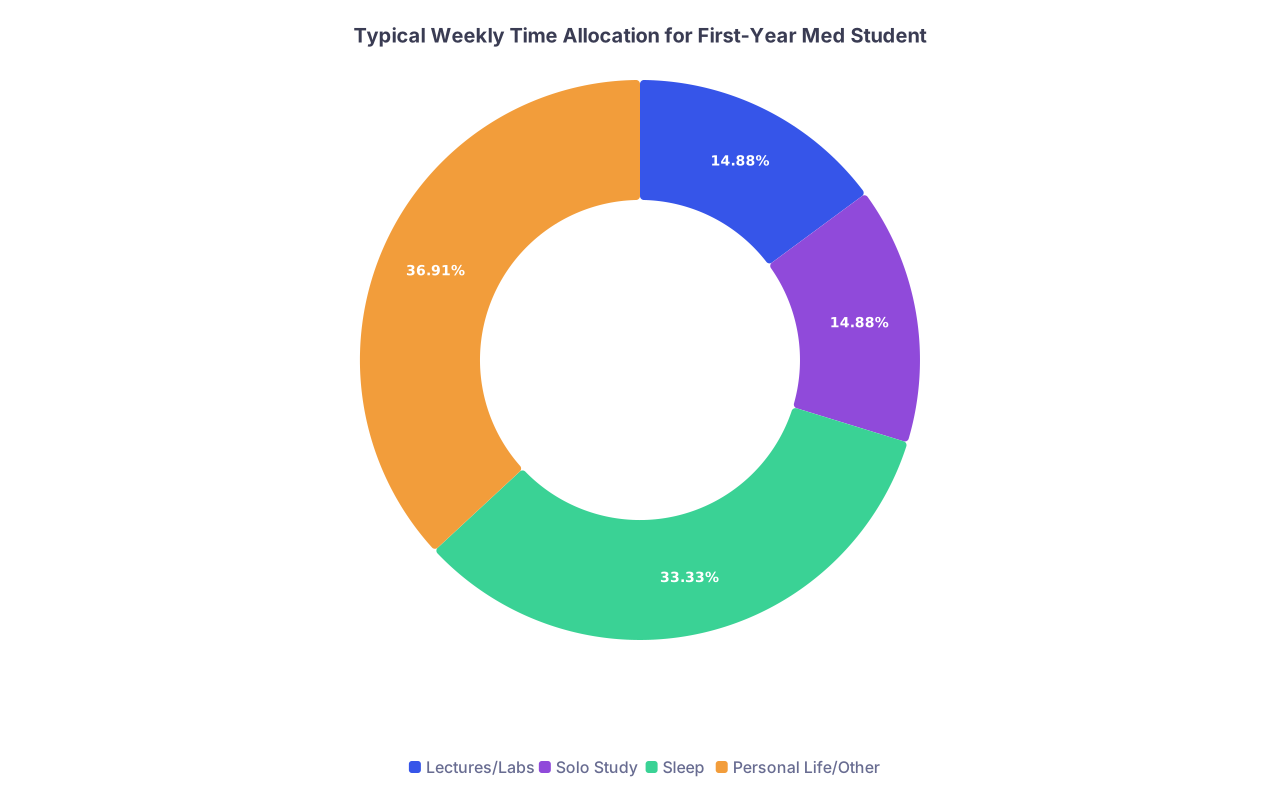
| Category | Value |
|---|---|
| Lectures/Labs | 25 |
| Solo Study | 25 |
| Sleep | 56 |
| Personal Life/Other | 62 |
(That’s a rough breakdown: ~25 hours class, ~25 hours focused study, ~8 hours sleep per night, and the rest split between meals, commute, exercise, chores, and actual life.)
If your “Solo Study” slice is swallowing personal life and sleep, you’re tipping into unsustainable.
Bottom line: what you should aim for
If you remember nothing else from this:
- Most first‑year med students do well on 4–6 focused study hours on regular weekdays, 3–5 on weekends, with short 7–9 hour sprints around exams.
- If you’re constantly drowning, it’s almost always your study strategy and not that you “need 12 hours a day.”
- Your number should evolve. Start within the reasonable range, then adjust up or down each block based on performance and burnout.
FAQ (6 questions)
1. Is 3 hours of studying a day enough in first year?
Usually no, unless:
- Your curriculum is unusually light or PBL-heavy, and
- You’re extremely efficient with active recall and spaced repetition, and
- You’re far ahead (e.g., using board resources early and already pre‑learned a lot)
For most people, 3 hours/day on weekdays is on the low side and will turn into late‑block panic.
2. Is it normal to feel guilty when I’m not studying?
Yes, and it’s one of med school’s more toxic “features.” The fix isn’t to study 24/7, it’s to set clear planned hours (e.g., 13:00–18:00 most days, extra time pre‑exam), hit them hard, then give yourself explicit permission to be off. If you met your target, you’re done. Guilt at that point is just noise.
3. How many hours should I study the summer before M1?
Zero mandatory. If you must do something:
- Light anatomy overview if your school is anatomy-heavy
- Get comfortable with Anki or another spaced repetition tool
- Maybe watch a few videos on how to study for med school
Do not try to “pre‑learn” the entire first year. It almost never pays off long term.
4. Do top students study more hours than everyone else?
Sometimes, but not always. The top 10–15% usually:
- Start earlier for exams
- Use questions and Anki aggressively
- Have very tight, distraction‑free study blocks
Some actually study fewer total hours but use them much better. Don’t copy their hours; copy their methods.
5. Should I count lecture as study time?
I treat it separately. Think of:
- Lecture = exposure time
- Study = active work (Anki, questions, teaching the material, summarizing)
When people ask “How many hours should I study?”, they almost always mean outside of lecture. But yes, lecture still costs brain energy, so you can’t just tack 8 extra hours on top of a 6‑hour lecture day forever.
6. How do I know if my 6 hours are actually “focused”?
Ask yourself:
- Can I tell you, in 1–2 sentences, the main idea of what I just studied without looking?
- Did I spend at least half the time retrieving info (questions, flashcards, teaching) instead of just rereading?
- Did I have my phone out / switch tabs constantly, or was it mostly uninterrupted?
If the answers are no, your “6 hours” probably contain 2–3 hours of real studying and 3–4 hours of friction and fluff. Fix that first before adding more time.