
It’s week 6 of M1. You just finished a 9–5 block of lectures, small groups, and random required sessions that felt like they were designed to destroy your will to live. You’re exhausted, you still have 200 Anki reviews waiting, and you’re staring at your running shoes thinking:
“If I work out, I’ll lose an hour of study. If I don’t, I’m going to feel like garbage. How much exercise can I actually afford without tanking my grades?”
Here’s the honest answer: you can work out more than you think, but less than you wish. And it has to be structured.
Let me break it down so you can stop guessing.
The Realistic Exercise Target in Med School
If you want a number, here it is:
Aim for 90–150 minutes per week of intentional exercise during most of M1/M2.
That usually looks like:
- 3–5 sessions per week
- 25–40 minutes per session
- Moderate intensity most days, 1 harder session if you like
This range is realistic for most students at an average-to-demanding school without hurting grades—often it quietly improves them because your brain actually works.
The sweet spot for most:
- Minimum to feel human and not fall apart:
About 3x/week for 25–30 minutes - Ideal if you’re efficient and semi-organized:
About 4–5x/week for 30–40 minutes
Going way above that (like training for a marathon, daily 90-minute lifts, or two-a-days) during exam-heavy blocks? That’s where I’ve seen grades start visibly slipping unless someone is extremely disciplined and high baseline.
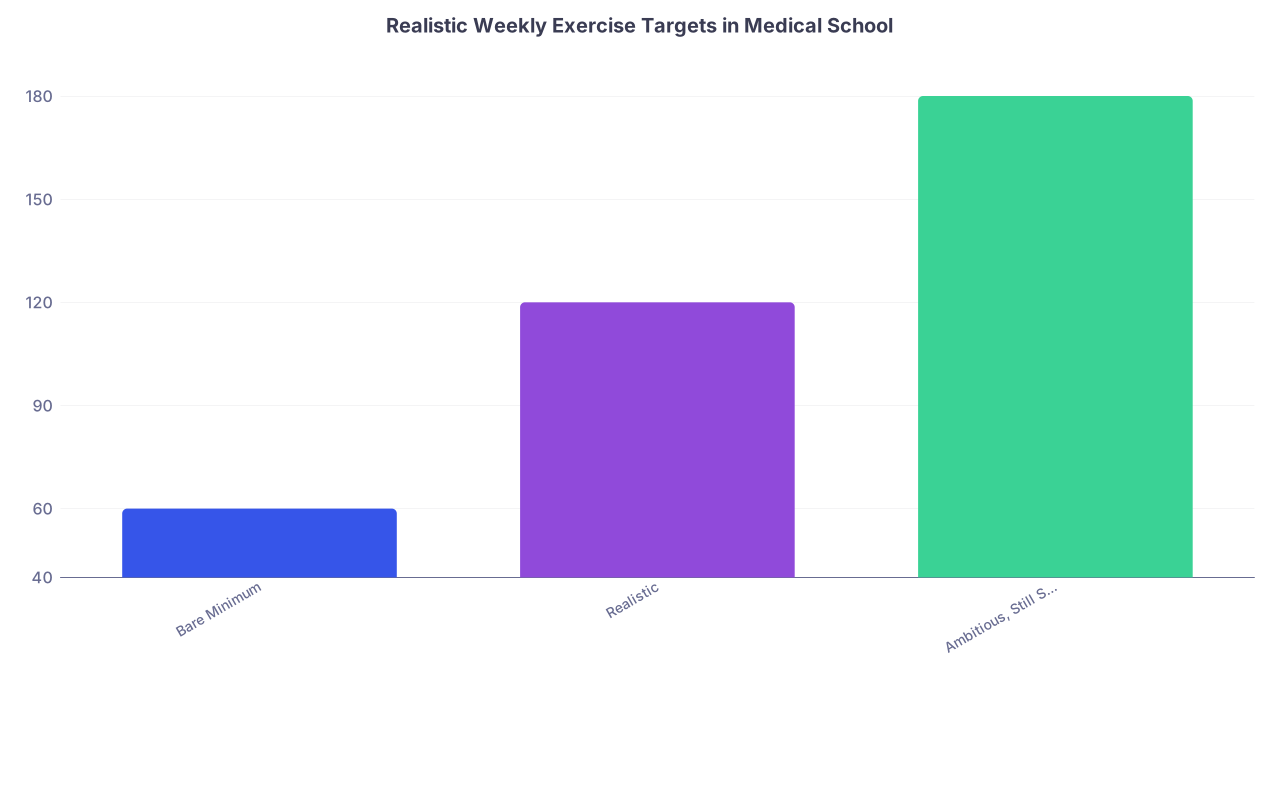
| Category | Value |
|---|---|
| Bare Minimum | 60 |
| Realistic | 120 |
| Ambitious, Still Safe | 180 |
If you need a hard line:
Once you’re spending more than ~4–5 hours per week exercising consistently and your exam performance is mediocre or slipping, you’re probably paying an academic price.
Why Exercise Usually Helps, Not Hurts, Grades
People think exercise “steals” time from studying. That’s only half-true. What it really does is:
- Increase alertness and focus (especially after sitting all day)
- Improve sleep quality, so your brain consolidates what you study
- Kill some anxiety so you’re not doom-scrolling or fake-studying
The problem isn’t the 30 minutes you spend at the gym.
The problem is the 60–90 minutes of scattered, distracted “studying” you call productivity.
If you do this right, you’re trading low-yield, half-focused time for exercise + more efficient studying.
Here’s the pattern I’ve seen over and over:
- Students who never exercise:
- More burnout
- Worse sleep
- Panic-studying closer to exams
- Students who exercise 3–5 times/week:
- More consistent mood
- Better focus blocks
- Slightly less study time, but better use of it
You’re not special enough to outperform your own physiology. Your brain is an organ. Blood flow and sleep matter.
How to Set Your Exercise Dose Based on Your Situation
Now let’s get practical. Different students can handle different loads.
1. Look at your academic status honestly
Use this table as a ground truth check.
| Academic Status | Weekly Exercise Target | Comment |
|---|---|---|
| Struggling / borderline passing | 60–90 min | Protect basics, go light |
| Solid but not stellar | 90–150 min | Ideal range for most |
| Top of class, very efficient | 120–210 min | Can push more, watch ego |
| Dedicated board study (6–8 weeks) | 60–150 min | Slight cut, keep routine |
If you’re barely passing or just failed an exam, do not start training for a half marathon. Keep exercise, but scale it to “protect physical and mental health” levels: 20–30 minutes, 3x/week, low drama.
If you’re doing fine, stay in the 90–150 minutes/week zone. That’s your main target.
If you’re crushing it and efficient, you can push closer to 180–210 minutes/week if you’re honest that grades are still stable.
2. Choose the right type of exercise for med school
During M1/M2, the best exercise plans are:
- Repeatable
- Logistically easy
- Not so intense they wreck you for 2 days
What usually works best:
Short, efficient strength sessions
25–35 minutes, 3–4 days/week.
Squats, deadlifts, presses, rows, pushups, pullups.
Compound lifts, not 17 variations of curls.Low-friction cardio
Walking fast, easy runs, cycling, elliptical, stairmaster.
20–40 minutes, 2–4 days/week, max moderate intensity most of the time.Hybrid plan (most realistic)
Three days strength, two days light cardio, or some combination where sessions rarely exceed 40 minutes.
What’s usually a bad fit in preclinical years:
- Daily 90-minute powerlifting marathons
- Multiple weekly 2+ hour team practices if you’re already struggling academically
- Exhausting HIIT 6 days a week that leaves you fried
You’re not training for the Olympics. You’re trying to get through M1 without becoming a wreck.

How to Fit Exercise Into a Med School Day Without Breaking Your Schedule
The big question isn’t “how much” in theory. It’s “where the hell does it fit?”
Here’s how it works in real life.
Core principle: Time-box it, like a mandatory lecture
If your workout is “when I find time,” you’ll never exercise after week 3. You need:
- A default time of day
- A protected duration
Common setups that work:
Morning (best for most students)
- 6:30–7:00 am workout
- Shower, breakfast, on campus by 8
- Pros: never gets bumped by studying or fatigue
- Cons: you have to sleep like an adult
Right after class
- 5:30–6:00 pm workout before you open Anki
- Treat it as a “commute buffer”
- Pros: resets your brain before evening study
- Cons: easy to skip when tired unless it’s habitual
Very short mid-day sessions
- 20–25 minutes between lectures or before lunch, 2–3 times/wk
- Pros: breaks up sitting, good if your school has on-site gym
- Cons: requires campus setup that allows quick changes
What I almost never see work long-term:
“I’ll work out if I finish everything by 9 pm.” You never “finish everything” in med school. There’s always more content. So exercise loses every time.
Sample Weekly Exercise Plans That Won’t Kill Your Grades
Let me give you concrete templates. Adjust as needed, but don’t overcomplicate this.
Template 1: Bare-Minimum But Effective (Struggling or Very Busy Weeks)
Goal: Preserve your body and mind without stealing study time.
- Mon: 25 min brisk walk or easy jog
- Wed: 25 min bodyweight strength (pushups, squats, lunges, planks)
- Sat or Sun: 30 min walk, steps, or light cardio
That’s 80 minutes. Enough to matter, not enough to wreck your schedule.
Template 2: Standard M1/M2 Plan (Most Students Doing Fine)
Goal: Good health, stress control, stable grades.
- Mon: 30 min strength (upper focus)
- Tue: 30 min moderate cardio
- Thu: 30 min strength (lower focus)
- Sat: 30–40 min mix (light jog + core or full-body circuit)
Total: 120–130 minutes. This is your main target if you’re generally stable academically.
Template 3: High-Performance But Still Safe (Efficient, Top-of-Class Students)
Goal: Performance lifestyle, but not insane.
- Mon: 35 min strength
- Tue: 30–35 min cardio
- Wed: 25–30 min light conditioning / mobility
- Fri: 35 min strength
- Sun: 30–40 min easy longer cardio (walk, run, bike)
Total: 155–175 minutes. Works if your study habits are already tight.

| Step | Description |
|---|---|
| Step 1 | Class/Study Day |
| Step 2 | Study with higher focus |
| Step 3 | Lower energy, more stress |
| Step 4 | More efficient study sessions |
| Step 5 | Exercise Block |
Red Flags: When Exercise Is Hurting Your Grades
Here’s where you need to be brutally honest with yourself. Exercise becomes a problem when it’s:
- A form of avoidance
- Out of proportion to your academic status
- Making you too tired to study effectively
Strong warning signs:
You’re doing 1+ hour workouts 5–6 days/week and:
- Scoring below average on most exams, or
- Cramming last minute every block
You “need” to hit specific lifting numbers or mileage and:
- Skip core study sessions for training
- Show up to important small groups half-dead
You feel guilty skipping a workout but not guilty skipping Anki or practice questions.
If that’s you, the problem isn’t exercise. It’s identity and ego. You’re acting like a full-time athlete and a part-time med student. That trade-off usually catches up to people.
Solution isn’t “stop exercising.” It’s:
- Reduce volume (fewer long sessions)
- Drop the perfectionism (stop chasing PRs every week)
- Focus on maintenance during heavy blocks, progression during lighter ones
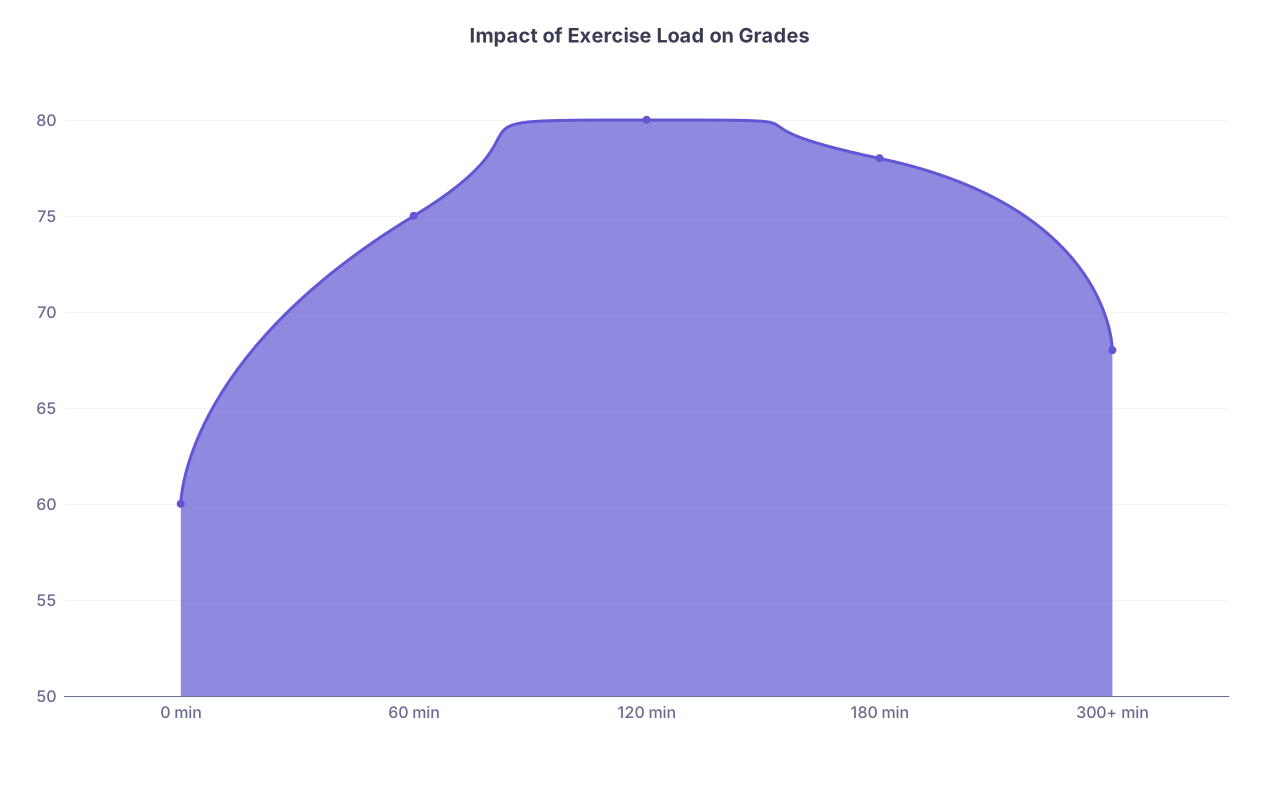
| Category | Value |
|---|---|
| 0 min | 60 |
| 60 min | 75 |
| 120 min | 80 |
| 180 min | 78 |
| 300+ min | 68 |
(Conceptually: mild–moderate exercise tends to help, excess can start to hurt.)
How This Changes During Different Phases (Blocks, Exams, Boards)
Your weekly number shouldn’t be frozen all year. Adjust to the season.
Normal block (most weeks)
Stay in your chosen target range:
- 90–150 minutes/week for most
- Don’t suddenly double just because one week feels “lighter”; instead, be consistent
Exam weeks
Strategy: Shrink, don’t delete.
- Drop from, say, 120 minutes → 60–90 minutes
- Shorter sessions (20–25 minutes), same number of days or one fewer
- Keep intensity moderate; this is not the time for your hardest workout of the year
Your brain needs stress relief even more during exam weeks. Going to zero is usually a mistake.
Dedicated board study (Step 1/Level 1, etc.)
People swing too far here. They either stop entirely or start “finally focusing on fitness” and blow hours.
Smart range: 60–150 minutes/week
- Most days: 20–30 minute walks or light jogs
- 2–3x/week: 25–30 minutes of strength training
- Nothing that leaves you destroyed the next day

How to Tell if You’ve Got the Balance Right
Quick self-audit, no sugarcoating:
If all of these are true, your exercise load is probably fine:
- You’re passing all exams, ideally close to or above average
- You’re not routinely pulling 1–2 am nights to keep up
- You feel tired sometimes, but not like a zombie every day
- You can skip a workout for a genuine academic crunch without having an existential crisis
If these start happening, reassess:
- Grades are dropping steadily over multiple blocks
- You’re always “time-poor” but still managing 8+ hours of exercise/week
- You’re constantly too sore or exhausted to focus well
Adjust in 4-week blocks. Don’t change everything after one bad quiz.
Quick Rules You Can Actually Remember
Let me simplify this into rules you can carry around in your head:
- Baseline goal: 90–150 min/week of exercise is realistic and safe for M1/M2.
- Session length: 25–40 minutes. More than that is optional, not required.
- Never go to zero: Even struggling? Keep 2–3 short sessions per week.
- Don’t “earn” exercise with finished work: Time-box it like a required session.
- Change with the season: Normal weeks > exam week > dedicated, but never nothing.
You don’t get extra points in residency applications for having a 500 lb deadlift and a 220 Step 2. You do get points for still resembling a functional human by the time you’re an intern. Exercise helps with that—if you keep it in its lane.
FAQ: Exercise in Med School Without Hurting Grades
1. Is it realistic to work out every day in med school?
Yes, but not the way most people imagine. Daily movement is realistic: walks, short mobility sessions, 15–20 minutes of light cardio. Daily hard workouts are not realistic for most students without something else giving way (sleep, focus, or grades). If you really want daily exercise, make 3–4 days “real workouts” and the rest very low-intensity.
2. Will I fall behind if I take 30 minutes to work out most days?
If your study system is garbage, you’ll fall behind no matter what. If you have even a semi-structured system (daily Anki, dedicated question blocks, scheduled review), a 30-minute workout usually improves net performance. The time that gets replaced tends to be low-yield scrolling, fake-studying, or staring at the wall.
3. What if my classmates are studying all the time and never exercising?
Some of them are actually studying. Some of them are just sitting with a laptop open and panicking. You can’t copy other people’s anxiety patterns. Your goal is passing with a margin + preserving long-term health. Plenty of top 10% students work out regularly. The ones who “never have time” often have time for YouTube, Reddit, and group chats about how stressed they are.
4. Is lifting or cardio better for med students?
Both are useful. If I had to pick one for most med students, I’d go with strength training 3x/week plus as much walking as your day naturally allows. Strength protects posture, joints, back, neck—basically the things med school trashes. Cardio helps mood and endurance, but you can get a lot of that from brisk walking and one or two moderate sessions a week.
5. How much should I cut back during a really intense block?
You do not need to shut it down completely. Drop to 2–3 short sessions of 20–25 minutes each, mostly low–moderate intensity. That keeps the habit, maintains some sanity, and doesn’t steal hours from studying. When the block eases up, bring it back to your usual 90–150 minutes/week.
Key Takeaways
- For most med students, 90–150 minutes of exercise per week is realistic and usually helps, not hurts, grades.
- Keep workouts short, consistent, and time-boxed—25–40 minutes, 3–5x/week is enough.
- Adjust volume by phase (regular weeks, exams, dedicated), but do not drop to zero; preservation beats all-or-nothing.