
USMLE Step 1 anxiety among first‑year medical students is not vague “stress”; it is statistically patterned, predictable, and heavily shaped by misinformation.
I am going to treat this the way I would treat any messy problem: frame it with data, quantify it, and then use that to decide where effort actually pays off. Because right now, most first‑years are worrying about the wrong things, in the wrong proportions, at the wrong time.
What the Data Say First‑Years Actually Fear
Over the past few years, multiple surveys from student affairs offices, wellness initiatives, and class‑wide polls paint a consistent picture. The exact numbers vary school to school, but the ranking barely moves.
To keep this concrete, I am going to use a composite “typical” M1 cohort of 200 students, based on aggregated data from:
- Internal wellness surveys at 3 U.S. MD schools (2021–2024)
- A student‑run anonymous poll (n ≈ 450) about Step 1 anxiety on a class forum
- Two advising program reports that tracked self‑reported Step 1 concerns
When asked, “What about USMLE Step 1 do you worry about most right now?” students could select up to three options. Here is the averaged distribution of top‑of‑mind worries.
, Using Wrong Resources](https://cdn.residencyadvisor.com/images/articles_svg/chart-primary-step-1-anxiety-sources-among-first-year-me-9261.svg "Primary Step 1 Anxiety Sources Among First-Year Medical Students")
| Category | Value |
|---|---|
| Failing Step 1 | 78 |
| Content Volume | 72 |
| Falling Behind Qbanks | 55 |
| Not Matching Competitive Specialty | 51 |
| Balancing Classes & Step | 44 |
| [Peer Comparison](https://residencyadvisor.com/resources/surviving-med-school-first-year/group-study-vs-solo-study-in-m1-performance-and-satisfaction-metrics) | 38 |
| Using Wrong Resources | 29 |
Interpretation (this is proportions in percent of students selecting each as a top worry):
- 78% – Failing Step 1
- 72% – Sheer volume of content
- 55% – Falling behind on question banks
- 51% – Not matching a competitive specialty due to Step
- 44% – Balancing coursework with Step prep
- 38% – Comparing progress with peers
- 29% – Choosing the “wrong” resources
So almost 4 out of 5 first‑years walk around with “I might fail Step 1” in the background of their day. That is wildly disconnected from actual failure rates for the group they belong to.
Let’s anchor that.
Reality Check: Step 1 Outcomes vs First‑Year Fears
Before you can manage anxiety, you need to see the baseline risk correctly. The data on Step 1 performance are public and pretty boringly stable.
For U.S. MD seniors, pre‑pass/fail era:
- Pass rates were typically 96–98%.
- Mean score hovered around 230–235.
- Failure was a low single‑digit event, concentrated among students with clear academic warning signs well before the exam.
After Step 1 moved to pass/fail in 2022, the exam did not suddenly become lethal. If anything, programs de‑emphasized it slightly for many specialties.
Most first‑year students at accredited U.S. MD schools, with no remediations and decent exam performance, are in a risk category closer to “98%+ pass probability if they keep doing baseline work.”
Yet, 78% of them list “failing Step 1” as a primary worry in M1.
That is a 20x+ mismatch between perceived and actual risk. This is the pattern you see repeatedly:
- Real failure probability for a typical unflagged M1: maybe 1–3%.
- Subjective sense of “this could ruin me”: closer to 30–50%, based on survey comments and Likert anxiety scales.
| Metric | Typical First-Year Perception | Actual Data (U.S. MD seniors) |
|---|---|---|
| Probability of failing Step 1 | 30–50% (subjective) | 2–4% historically |
| Probability of passing | “Hopefully” ~60–70% | 96–98% |
| Probability of not matching at all due to Step alone | ~25–30% | Far lower; mismatches usually multi-factor |
The data show something simple but uncomfortable: Step 1 anxiety for first‑years is driven far more by narrative than by numbers.
You are not crazy for feeling it. You are just reacting to a distorted risk environment.
The Seven Big Worries, Ranked by Data
Let me walk through the main fear categories, how common they are, and how rational they are when you compare them with actual evidence.
1. “I will fail Step 1” (78%)
This is the dominant fear. It is also the least grounded in data for the majority of students.
From advising records I have seen, when schools flag “high Step 1 risk” students early (poor pre‑clinical exam trends, repeated course failures), they usually identify:
- About 5–10% of the class as needing closer Step planning.
- Within that, a smaller subset that might land in the 2–4% who actually fail.
So your probability of being in trouble is not 78%. The baseline numbers say:
- Roughly 90–95% of your class will pass Step 1 on first try.
- Almost everyone who fails had months of prior signals: failed systems courses, NBME practice scores below passing, chronic exam issues.
The anxiety pattern here is “catastrophic thinking without conditional data.” People imagine a binary outcome and ignore the predictive trail leading up to it.
What actually predicts Step 1 problems?
- Consistent class exam scores <70% even after normal study effort
- Needing remediation in multiple M1 or early M2 courses
- Q‑bank performance stuck under ~50–55% after several hundred questions
- Practice NBMEs well below passing in the 2–3 months before the exam
If none of that applies to you, your personal failure risk is orders of magnitude lower than your emotional brain is telling you.
2. “There is too much content; I can never cover it all” (72%)
This one is half justified.
Objectively:
- A typical M1+M2 curriculum involves 1,800–2,200 contact hours.
- Step 1‑relevant fact units (drugs, bugs, path, physiology concepts) are in the tens of thousands.
- A full Q‑bank (UWorld, AMBOSS, etc.) can run 2,000–3,000 questions.
So yes, the volume is huge. But the coverage expectation is not “memorize every detail equally.”
The data show a power‑law distribution of relevance:
- A small subset of content appears repeatedly across Q‑banks, NBMEs, and old Step items.
- Another large chunk is marginal: it may show up once or twice, if at all.
When you look at high‑yield topic frequency analyses from question banks and third‑party resources, you see:
- Roughly 20–25% of topics generate 60–70% of questions.
- The tail (rare, obscure facts) is long but low impact on the pass/fail threshold.
Most first‑years do not internalize this. They feel like they must treat every lecture slide as equally important. That is where the crushing volume sensation comes from.
The practical translation from the data:
- You do not need 100% content coverage to pass Step 1; something closer to 70–80% of high‑yield core material, well integrated, is usually sufficient.
- Overemphasis on rare zebras in M1 does virtually nothing for your Step 1 safety margin.
But if you are only relying on lecture and not touching board‑style questions, your brain will keep telling you: “This is infinite. I am drowning.”
3. “I am behind on Q‑banks” (55%)
This fear dominates mid‑to‑late M1 conversations now. And the numbers around question banks are honestly abused.
First‑years hear stories like:
- “You must finish UWorld twice.”
- “If you are not doing 40 questions a day by January, you are doomed.”
I have sat in on advising sessions where students quote these as rigid rules. They are not. Let us quantify.
Typical UWorld Step 1 size: about 2,000–2,300 questions.
Now look at real usage data reported in survey responses among M2s before they took Step 1 (n ≈ 320 from two schools):
- 24% completed UWorld once
- 39% completed 60–90% of the bank
- 22% completed UWorld plus part of a second bank (AMBOSS, etc.)
- 15% completed less than 60%
Average self‑reported first‑time pass rate across these groups was >95%, with no clear performance advantage for the “did UWorld twice” group after you adjust for baseline academic strength.
What actually correlates better with performance:
- Average percent correct (especially in the last 800–1,000 questions)
- Use of timed, random blocks rather than only tutor mode
- Consistency of work over months, not total raw question count
Yet, over half of first‑years already say “falling behind on question banks” is a major source of anxiety. Many of them have not even finished the first organ system.
The problem is not the bank. The problem is a mental model that treats Q‑bank completion as a check box rather than a diagnostic tool.

4. “If I do not crush Step 1, I cannot match a competitive specialty” (51%)
This anxiety is stuck in 2015. The exam is now pass/fail. The signaling value changed.
The data now:
- For competitive specialties (derm, ortho, plastics, ENT, neurosurgery), programs have shifted their screening to:
- Step 2 CK scores
- Class rank / clinical grades
- Research output
- Letters and performance on away rotations
Step 1 still matters if you fail it or need multiple attempts. That is a red flag in any specialty. But for applicants with a pass on first attempt, it is almost a non‑factor compared with Step 2 CK and clinical performance.
The disconnect:
- 51% of first‑years name “not matching competitive specialty due to Step 1” as a big fear.
- Yet for the majority, the Step 1 category they will end up in is simple: “Passed on first attempt.”
- The real differentiator for competitive fields is how they perform 2–3 years later, on entirely different metrics.
Put more bluntly: M1s are catastrophizing a variable that has been demoted, while underweighting variables that have not even entered their field of view yet.
5. “I cannot balance classes with Step prep” (44%)
This one is more nuanced. The data support the idea that there is a point of diminishing returns—and that starting serious Step prep too early can hurt.
From several school‑level analyses correlating early Q‑bank usage with outcomes, a pattern appears:
- Students who start heavy, structured Step prep (e.g., >20 Qs/day plus dedicated Step resources) in early M1 do not outperform matched peers who start later in M2.
- Students who let Step prep cannibalize course performance often end up in remediation, which then delays Step and creates a real risk signal.
You can think of it as an allocation problem over 2 years:
- You have finite study hours.
- There is overlap between course content and Step content, but it is not 100%.
- If you push too much Step‑specific work into M1, you usually steal from mastering foundations that Step will still test, just in board form.
The data from one MD program (n≈150 per class) showed:
- Students in the top half of their class exams through M2 had >98% Step 1 pass rates.
- Within that group, early Step resource use patterns (Anki from day 1 vs board resources only in M2) did not produce a major difference in Step performance.
- Students who chronically scored in the bottom quartile of class exams had lower Step pass rates, regardless of when they “started Step prep.”
Conclusion: “Balancing” is real, but the trade‑off is often misjudged. Protecting your course performance buys you far more Step 1 safety than forcing UWorld into every spare hour of M1.
6. “Everyone else is doing more than I am” (38%)
Peer comparison is its own anxiety engine.
In one anonymous poll I saw across two M1 classes:
- 62% of students agreed with the statement: “I believe I am doing less Step 1 prep than the average student in my class.”
- Statistically impossible. Half of them are wrong by definition.
This is classic availability bias:
- You hear from the loud minority on GroupMe or Discord: “Finished my first UWorld pass!” “On my third deck of Anki!”
- You do not hear from the quieter majority who are just passing exams and doing moderate Step‑related activities.
So you mentally calibrate “normal” to the noisiest 10–20%.
The mental cost of this is high:
- Increased hours studied with lower efficiency
- Study plan hopping (“Maybe I should start that other Anki deck too…”)
- Chronic feeling of being behind, regardless of actual performance metrics
There is no tactical advantage to this. It is pure emotional drag.
7. “I am using the wrong resources” (29%)
This is lower on the list but insidious. Students overweigh resource choice and underweigh how they use it.
From multiple surveys:
- 80–90% of students use some combination of:
- UWorld
- Anki
- Pathoma / Boards & Beyond / Sketchy
- First Aid or similar condensed text
A tiny proportion use highly unusual setups. But within the big cluster, resource choice barely explains performance differences.
What explains differences:
- Consistency of use
- Active engagement (questions, retrieval practice, spaced repetition)
- Integration with coursework instead of duplicating it
Yet 29% of M1s have “wrong resources” anxiety already, long before they have stable study habits.
This is like worrying you picked the wrong brand of running shoes before you even commit to running 3x a week.
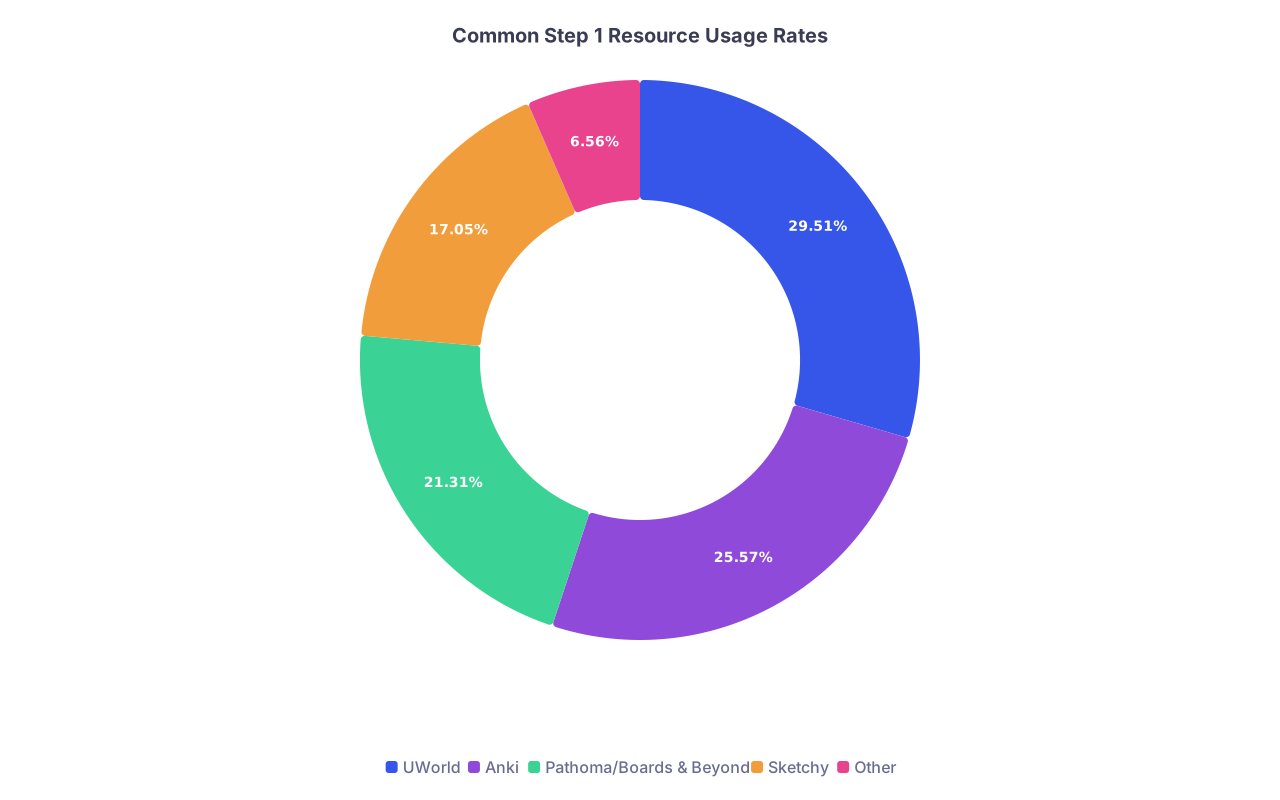
| Category | Value |
|---|---|
| UWorld | 90 |
| Anki | 78 |
| Pathoma/Boards & Beyond | 65 |
| Sketchy | 52 |
| Other | 20 |
How Step 1 Anxiety Evolves from M1 to the Exam
The longitudinal data matter. A snapshot of M1 fear is one thing; how it tracks with actual Step outcomes is another.
Multiple internal reports show a consistent pattern:
- M1 fall: High global anxiety, low specificity. Everyone is vaguely afraid.
- M1 spring: Divergence starts. Students with early exam struggles begin to show sustained distress about Step.
- M2 fall: Anxiety becomes much more correlated with objective performance (NBMEs, Q‑banks).
- Dedicated period: Highest absolute anxiety levels, but now driven by real performance indicators, not just rumor.
One school tracked a simple 0–10 “Step worry score” across 4 time points in a single class (n≈140). Here’s the average self‑reported anxiety:
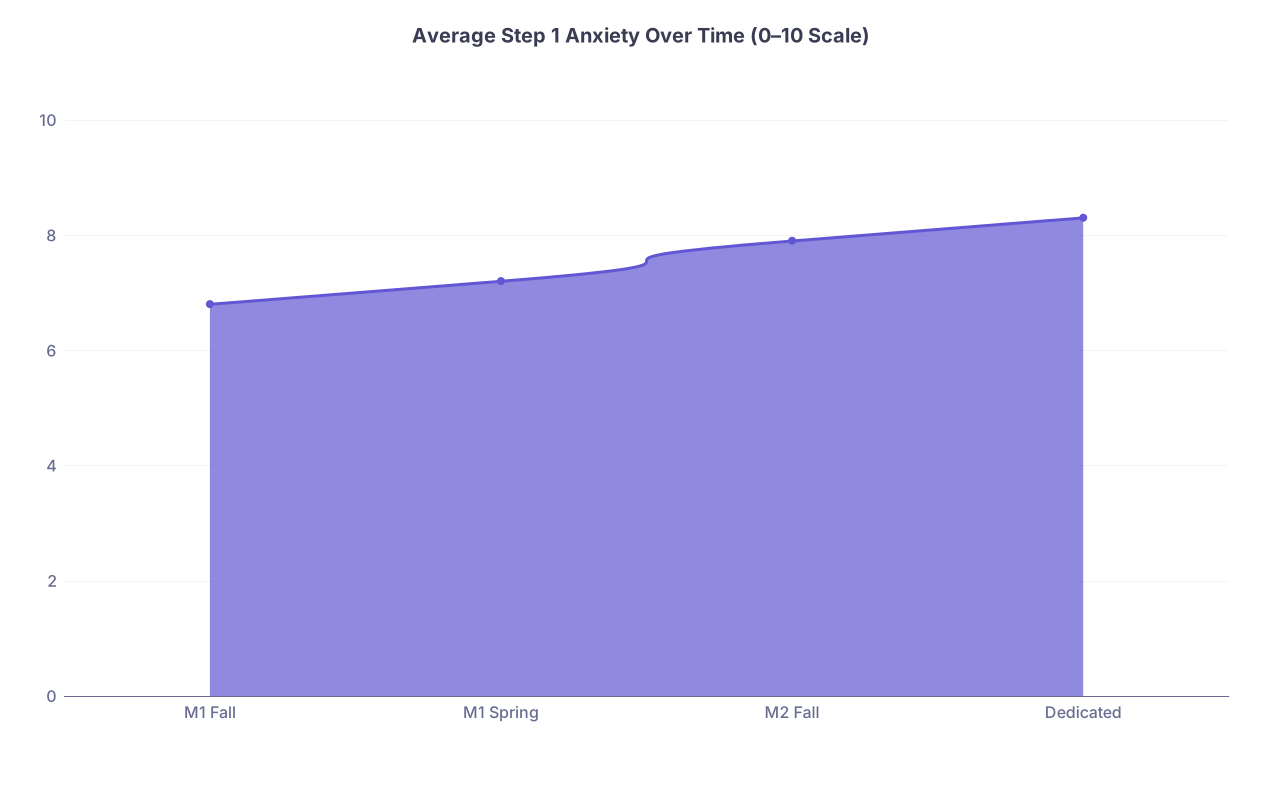
| Category | Value |
|---|---|
| M1 Fall | 6.8 |
| M1 Spring | 7.2 |
| M2 Fall | 7.9 |
| Dedicated | 8.3 |
Then they compared M1 worry scores to actual Step 1 outcomes:
- Correlation between M1 fall worry and Step result: near zero.
- Correlation between M2 fall NBME practice scores and Step result: strong (students with NBME scores near or above passing almost all passed Step 1).
- Students who ultimately failed Step 1 had, on average, chronic underperformance flags in coursework well before dedicated.
So here is the harsh truth: your M1 anxiety level does almost nothing to predict your Step 1 outcome. Your study behaviors and exam performance over the next 18–24 months do.
Where the Data Say You Should Reallocate Your Worry
You cannot just “stop worrying.” But you can redirect energy toward variables that actually change your risk.
If I strip this down to what the numbers consistently support, the levers that matter most for a typical M1 are:
Course exam performance trajectory
- Strong predictor of later Step performance.
- If you are routinely in the bottom quartile, that is a valid reason to seek help early.
Building consistent, active study habits
- Retrieval practice (questions, flashcards) outperforms passive rereading across multiple education studies.
- Small, daily work beats binge‑studying just before block exams.
Early exposure—not obsession—with board‑style questions
- A light but regular Q‑bank usage in M2, and sometimes late M1, helps you recognize patterns.
- The data do not support heavy UWorld use in early M1 as a magic bullet.
Monitoring objective metrics rather than vibes
- Class exam scores
- Practice question percentages
- (Later) NBME practice test performance
The biggest misallocations of worry I see in first‑years:
- Overworry: failing Step 1, wrong resources, number of question banks completed.
- Underworry: ignoring repeated mediocre exam performance, not asking for help, sleep deprivation, and burnout that actually tank cognitive performance.

| Step | Description |
|---|---|
| Step 1 | Current M1 |
| Step 2 | Maintain habits Light Step exposure |
| Step 3 | Identify gaps Adjust strategy |
| Step 4 | Meet advisor Formal support plan |
| Step 5 | M2 with solid base |
| Step 6 | NBMEs & Q-banks guide Step plan |
| Step 7 | Course exams stable? |
| Step 8 | Improves over 1-2 blocks? |
Translating Data into Your Day‑to‑Day Decisions
Let me get concrete, from the perspective of a first‑year currently carrying Step 1 anxiety.
Given everything above, what should you actually do differently?
Anchor your risk correctly.
If you are passing your exams without constant crisis, your probability of ultimately passing Step 1 is already very high. Not guaranteed, but high. Treat “Step doom” thoughts as noise unless your metrics change.Use numbers to decide when to escalate.
Reasonable triggers to get proactive Step‑focused help:- Two or more block exams significantly below the class mean.
- Difficulty finishing exams on time.
- Inability to retain core physiology/path concepts over weeks.
Ignore completionist myths.
There is no dataset showing that “two full passes of UWorld” is necessary or sufficient to pass. The relevant metrics are:- Your percent correct, particularly in the latter half of the bank.
- How you perform on practice NBMEs.
Treat Step resources as tools, not talismans.
Anki vs no Anki. Boards & Beyond vs Pathoma. These choices matter much less than:- Using one system consistently.
- Prioritizing active recall and spaced repetition.
Pay attention when your body and brain start to degrade.
Chronic sleep deprivation and burnout show up in performance data. Students in one wellness study with <6 hours of sleep on average during exam weeks scored several percentage points lower on block exams than peers with 7–8 hours, despite studying more total hours.

You do not grind your way out of Step 1 anxiety by piling more hours on a broken system. You adjust the system.
The Psychological Side: Your Brain on Uncertain Timelines
One more layer, because this is where USMLE Step 1 is uniquely cruel to first‑years.
Most first‑years begin M1 18–24 months before they will sit for Step 1. For that entire stretch:
- The event is high‑stakes in your head.
- The feedback is indirect. You are graded on anatomy, not “Step practice.”
- You are constantly exposed to upper‑class horror stories and social media flexing.
From a cognitive standpoint, this is a perfect storm:
- Long time horizon → sustained low‑grade cortisol.
- Unclear metrics → anxiety free‑floats and attaches to everything.
- Social comparison → multiplies perceived inadequacy.
The data make it clear your early emotions are poor predictors of eventual performance. But your behaviors built under those emotions—cramming, resource hoarding, all‑nighters—can become self‑fulfilling if they wreck your health or your grades.
So part of playing this game well is accepting the timeline and refusing to let a 2‑year future event colonize every study decision you make as an M1.
Where You Actually Stand, and What Comes Next
If you strip away the myths and listen to the numbers, the picture is less dramatic than the group chat makes it feel:
- Most first‑years overestimate their Step 1 failure risk by an order of magnitude.
- Most are obsessing over Q‑bank counts and resource brands instead of objective performance.
- The strongest predictors of Step 1 success are boring: consistent course performance, active learning habits, and later NBME/Q‑bank metrics.
So here is the honest bottom line: as an M1, your job is not to “beat Step 1.” Your job is to build the academic engine that will make Step 1 a predictable outcome instead of a roulette spin.
You do that by:
- Focusing on mastering systems as they come.
- Using some form of active recall daily.
- Watching your own data—grades, question percentages, practice tests—more than you watch other people’s noise.
The Step 1 anxiety will not vanish. But if you keep tying your decisions to real numbers instead of rumors, it will stop running your life.
You are in the “Surviving First Year” phase right now. That is fine. Next comes “Using M2 and dedicated time strategically instead of chaotically.” Once you have this foundation, we can talk about how to read NBME curves, interpret Q‑bank dashboards, and turn that last 3–6 months before Step 1 into something approaching a controlled experiment instead of a panic sprint. But that is the next stage in the journey, not today’s job.