You Are Here
It’s 10:45 p.m. You’re in the library, staring at a block of renal physiology that might as well be written in ancient Greek. Group chat is quiet. Office hours are over.
And yet… you know there are classmates who are not studying alone right now.
Someone from your M1 class is on Zoom with a faculty mentor walking through practice questions. Another is getting annotated slides emailed to them by an upperclass tutor. Someone else has a dean who “just checks in” every week, gives them old exam hints, and quietly nudges them toward resources before they ask.
You feel like you’re drowning. They’re getting a lifeboat.
Let me tell you the part nobody says out loud: faculty and administration absolutely do triage who gets extra help, extra slack, and extra second chances in first year. It’s not random. It’s not “fair” in the kindergarten sense. And it is 100% predictable if you understand how they think behind closed doors.
This is what I see in meetings, on Zoom debriefs, in those “student progress” email threads you never see. Let’s walk straight into the room you’re normally excluded from.
The Hidden Categories: How Faculty Sort You In Their Heads
Faculty don’t say this in public, but every class gets mentally sorted into buckets. They’d deny it if you asked directly. But watch behavior, not slogans.
There are four main unofficial categories administrators, small-group facilitators, and course directors use when they’re deciding who gets extra help, extra access, or extra chances.
| Category | Priority for Help | Risk to School | Likely Support Level |
|---|---|---|---|
| High‑risk, engaged | Very High | High | Intensive, proactive |
| High‑risk, disengaged | Low | Medium | Minimal, reactive |
| Solid, invested | Medium | Low | Helpful, informal |
| Strong, visible | Medium‑High | Low | Mentoring, favors |
Now, what do these actually look like in real life?
1. High‑Risk, Engaged
This is the student who is objectively struggling on exams but:
- Emails before the exam saying, “I’m worried, here’s what I’ve tried, can we talk?”
- Shows up to office hours prepared, with specific questions, not “teach me everything.”
- Follows through: uses tutoring, attends learning specialist sessions, changes study methods.
Faculty see this and go: “We can salvage this. This is a good investment.”
- Course directors email deans: “We should keep an eye on them.”
- They get offered early remediation plans, not just “sorry, you failed.”
- Their narrative in meetings is positive: “They’re working so hard; we need to support them.”
These students get a lot of extra help. Not because they’re the most deserving morally. Because they’re the most likely to respond to help and become a success story the school can point to.
2. High‑Risk, Disengaged
Same score profile as above. Different vibe.
This is the student who:
- Fails or barely passes an exam, then ghosts for two weeks.
- Skips office hours, no-shows for tutoring they signed up for.
- Sends vague emails after the fact: “I guess I’m just bad at tests. I’ll try harder next time.”
Faculty see this and think: “We’ve seen this movie.”
Support becomes minimal and formal:
- “Here’s the remediation policy.”
- “You can meet with Student Affairs if you’d like.”
- No one is hunting them down after the second attempt if they don’t move.
Here’s the harsh truth: if you look like you won’t help yourself, faculty will quietly conserve their bandwidth for someone who will. They’re not monsters. They’re overloaded.
3. Solid, Invested
These are the mid‑pack students doing fine academically but obviously trying:
- They ask good questions in small group.
- They do the reading.
- They’re not honor‑roll geniuses, but they’re steady.
These students get:
- Informal tips (“On the exam, I like to ask about…”).
- Willingness from faculty to answer emails at 11 p.m.
- Early invitations to research or TA‑type roles in M2/M3.
Not dramatic “save them from failing” support. But lots of soft advantages that stack up.
4. Strong, Visible
These are your 90+ exam scorers. But not all of them. Only the visible ones:
- They speak up intelligently in case discussions.
- They’re polite but confident with faculty.
- They’re already asking about research, electives, career paths.
These are the students faculty like to attach to. Because it reflects well. Because it’s easy. Because when they climb, everyone feels smart for “spotting their potential early.”
So they get:
- Extra mentorship, early career steering, letters of recommendation written before they even ask.
- “Just between us” hints about how certain exams are typically structured.
- Access to opportunities that are never advertised on a public listserv.
If you’re thinking, “So this is rigged,” you’re half right. But the criteria for entering any of these buckets are more under your control than you think.
What Actually Triggers Extra Help (It’s Not Just Your Score)
Let me kill one myth up front: failing by itself does not guarantee you useful help. It guarantees you a policy‑driven interaction. Which is very different.
The real triggers for extra, personalized, bend-the-rules-for-you help fall into a handful of insider criteria the faculty never write down.
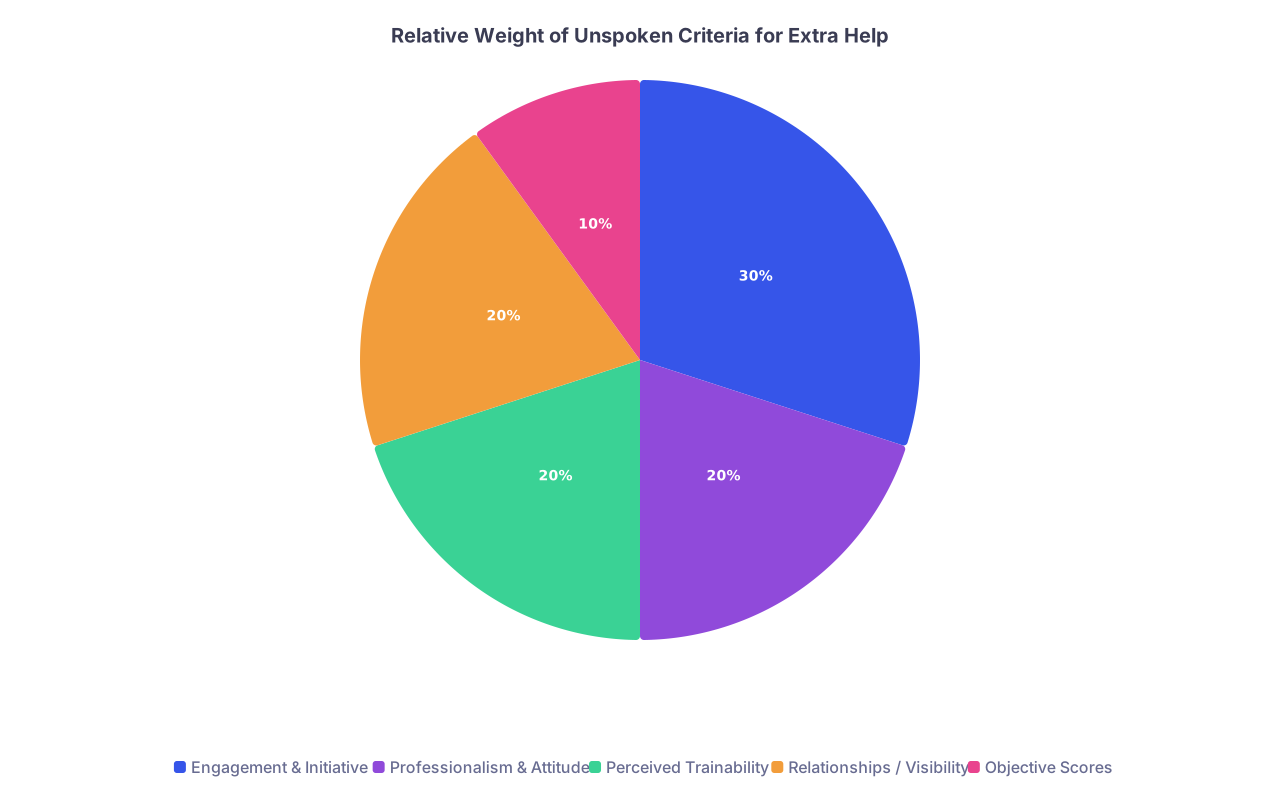
| Category | Value |
|---|---|
| Engagement & Initiative | 30 |
| Professionalism & Attitude | 20 |
| Perceived Trainability | 20 |
| Relationships / Visibility | 20 |
| Objective Scores | 10 |
Criterion 1: You Show Up Before Things Explode
Faculty remember who surfaces early.
Two students, same 68% on the first anatomy exam.
Student A:
- Sent an email two weeks before the exam: “I’m nervous about the pace. Could we discuss effective ways to study your lectures?”
- Attended two office hours.
- After the exam, sends: “I used X and Y strategies, but based on the result I think I underestimated Z. Can I meet to review what I did wrong?”
Student B:
- Radio silent until after grades release.
- Sends one email: “I’m not sure what went wrong. I studied a lot. Can I get extra credit or something?”
Student A gets real mentorship. Student B gets copied and pasted policy language.
The faculty mental model:
- “If I invest time in A, I only have to do this once.”
- “If I invest time in B, I’ll be having this same conversation five times this year.”
They pick A.
You want to be the student whose name is already familiar for the right reasons before you post your first bad score.
Criterion 2: Specificity > Vague Suffering
Faculty are allergic to vague complaints.
“Your exam was so hard” is not a reason to help you. That’s noise. And everybody says it.
Students who get real extra help say things like:
- “On the cardio section, I realized I missed most of the physiology conceptual questions, not the anatomy. I had focused mostly on memorization. Can we walk through 2–3 questions to see how you expect us to think?”
- “I used mainly Anki and boards‑style Qs for this block. In hindsight, I probably underused the assigned problems. What would you prioritize if you were me?”
This marks you as “trainable.”
Trainable students get:
- Extra practice questions emailed directly (“Here, try these; they match how I think.”)
- Faculty spending an extra 30 minutes after office hours with you.
- Deans stepping in early if your course director signals, “They’re working, let’s support them.”
Vague suffering gets you sympathy. Specific insight gets you strategy.
Criterion 3: You Don’t Make Your Struggle Their Problem
Watch the tone difference.
“I’m worried I might fail this class”
vs.
“I’m worried I might fail this class. Here’s what I’ve tried so far: [X, Y, Z]. Here’s what seems to help and what doesn’t. I think I’m missing something in how I approach the material. Could you help me identify it?”
The first one makes faculty feel burdened. They’re now being asked to fix your anxiety plus your study plan.
The second one makes them feel useful. They get to be the expert surgeon coming in for the precise intervention, not the general shrink for your life.
Students who get extra help consistently:
- Don’t make everything an emergency.
- Don’t blame the curriculum, the professor, or “trick questions” in their first sentence.
- Own their part and show they’re willing to change behavior.
That attitude flips switches for a lot of attendings who otherwise seem cold.
Criterion 4: You’re Not a Headache to Work With
Nobody admits this out loud, but it’s real: being low‑maintenance buys you slack.
Faculty talk. They absolutely do.
In small “student progress” meetings, I’ve heard things like:
- “They’re really struggling, but they’re great to work with. Let’s find them more support.”
- “Honestly, they’re doing fine, but every interaction is adversarial. I’m not chasing them.”
If you:
- Argue points on every quiz.
- Send long, aggressive emails after every exam.
- Publicly complain about faculty on social media.
You get quietly marked as: “Don’t volunteer to engage more than necessary.”
That label kills your access to the decent stuff: unofficial old questions, quiet pep talks, “keep an eye on them” discussions in the dean’s office.
Being professional and not exhausting to deal with is underrated currency.
Criterion 5: Someone In The System Already Likes You
This is the ugliest but also the most honest piece. Relationships matter more than MCAT scores.
If:
- A pre‑clinical course director likes you from small group.
- A dean remembers you from orientation because you asked a sharp question.
- An upperclass student tutor vouches for you (“They’re busting their ass, please help them out”).
You get priority. Extra time. More creative solutions.
This is how you see:
- One student getting a tailored remediation schedule with flexible deadlines.
- Another in the same situation gets the most rigid interpretation of the policy.
Same handbook. Different human behind the decision.
So yes, some people walk into M1 with instant help because they were known from a pipeline program, a summer research position, or even a random pre‑matriculation event. But you can build this inside the year too, if you’re conscious about it.
Who Gets Ignored (Even When They’re Struggling)
Flip side now. Let’s talk about the “invisible middle.”
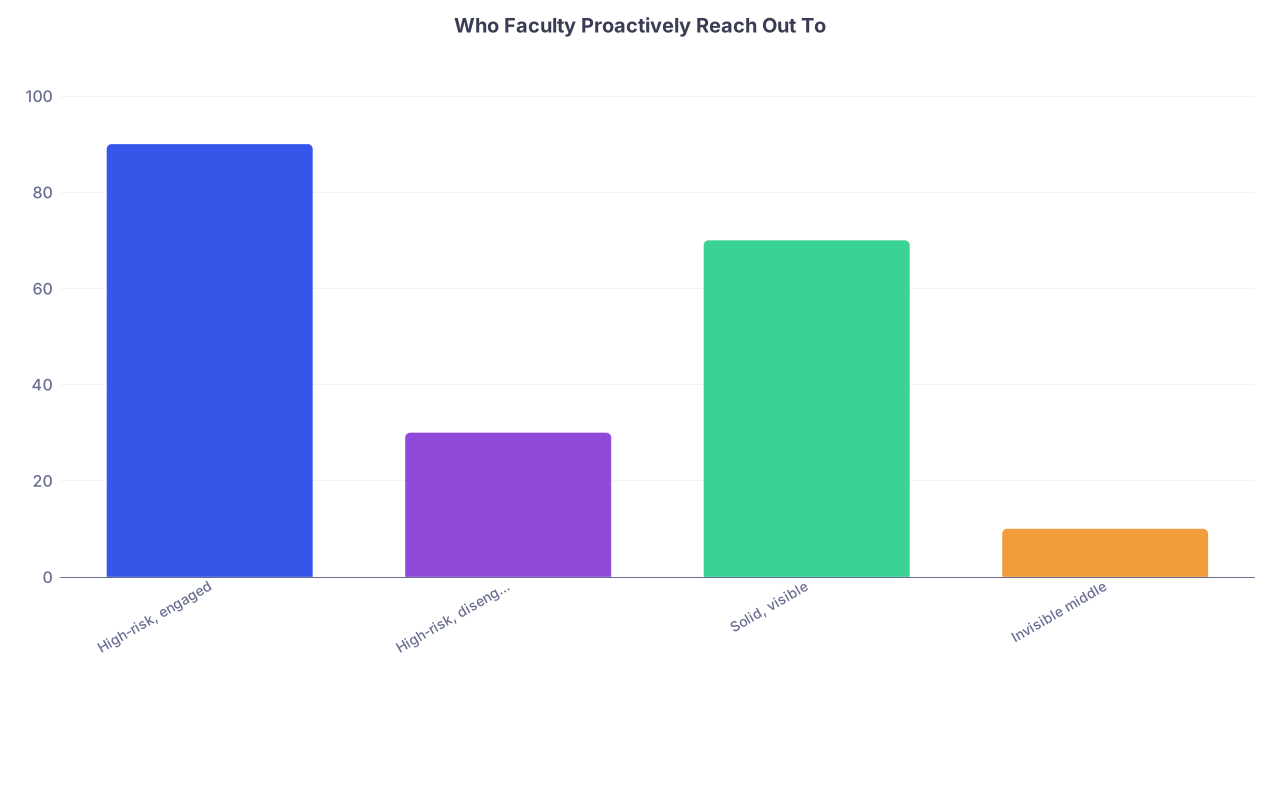
| Category | Value |
|---|---|
| High-risk, engaged | 90 |
| High-risk, disengaged | 30 |
| Solid, visible | 70 |
| Invisible middle | 10 |
The group that gets the least proactive help is not the lowest scorers. It’s the quiet 72–78% crowd who:
- Never fail outright.
- Never speak in class.
- Never email.
- Never cause problems.
- Never build relationships.
They’re not on fire enough to trigger alarms. But they’re not strong enough to attract mentorship.
Faculty basically forget they exist until something big happens:
- A board failure.
- A professionalism complaint.
- A meltdown in third year.
If you’re in this blob, you may feel weirdly abandoned. Because you are. Not maliciously. Just by omission.
You don’t get extra help because no one knows you need it. And no one has a story about you in their head.
That’s fixable.
How To Put Yourself In The “We Help Them” Category
You can’t control favoritism tied to personality or pre‑existing relationships. But you can absolutely hack your way into the “we help them” bucket in a systematic way.
Think of it like manipulating an attending’s mental model of you.

| Step | Description |
|---|---|
| Step 1 | New M1 Student |
| Step 2 | Visible & Professional |
| Step 3 | Early, Specific Outreach |
| Step 4 | Follow Through on Advice |
| Step 5 | Faculty See You as Trainable |
| Step 6 | Proactive Extra Help & Flexibility |
Step 1: Become Slightly Visible, Not Loud
You don’t need to become “gunner of the row.” You do need to exist in faculty memory.
Concrete moves:
- In the first 2–3 weeks, ask one thoughtful question in small group or lecture. Not every session. Just once or twice.
- After a good lecture, send a short email: “Appreciated how you clarified X vs Y—made it click.” That’s it. One or two sentences.
You’re now not a face in the crowd. You’re “that student who…” in their head.
Step 2: Contact Early When You Struggle – With a Plan
As soon as you see yourself trending down on quizzes, don’t disappear.
Email something like:
Dr. Smith,
I’m noticing that my first two quizzes in this block were 74% and 70%. I’m concerned I may be missing something in how I prepare.What I’ve been doing: [brief, specific list].
What I think may be the issue: [one or two guesses].Could I get 15–20 minutes of your time to understand how you’d recommend I adjust?
You’ve just hit all the insider triggers:
- Early concern.
- Specificity.
- Ownership.
- Respect for their time.
You go into the “we should try to help them” quadrant automatically.
Step 3: Do Exactly What They Suggest Once
You don’t have to marry every piece of advice. But the first time someone makes a concrete suggestion, follow it once and then report back:
I tried the pre‑reading + active recall approach you suggested for the last two lectures, and my quiz improved from 70 to 80. I think this is helping. Thanks again.
Now faculty see:
- Input → behavioral change → measurable result.
- You’re worth further investment.
These are the students who end up with:
- Extra sample questions slid their way.
- Faculty volunteering to go over failed exams in detail.
- Deans advocating for them when policies could go either way.
Step 4: Protect Your Reputation Like It’s a Grade
Every snarky comment you make in PBL. Every time you argue over half points. Every time you ignore an email request from a course coordinator.
It all contributes to your “work with” score.
Students who quietly kill their own chance at extra help:
- Are chronically late to required sessions without explanation.
- Dismiss standardized patients or preceptors in clinical skills.
- Publicly undercut other students in front of faculty.
If you force faculty to spend energy managing your behavior, they will not spend energy rescuing your grades.
Why Some People Get Second Chances on Exams and Others Don’t
Another piece you’ll notice: some first‑years seem to get resets, extensions, or “alternative assessments” when life happens. Others with seemingly similar situations get told: “No exceptions.”
Here’s what’s really going on.
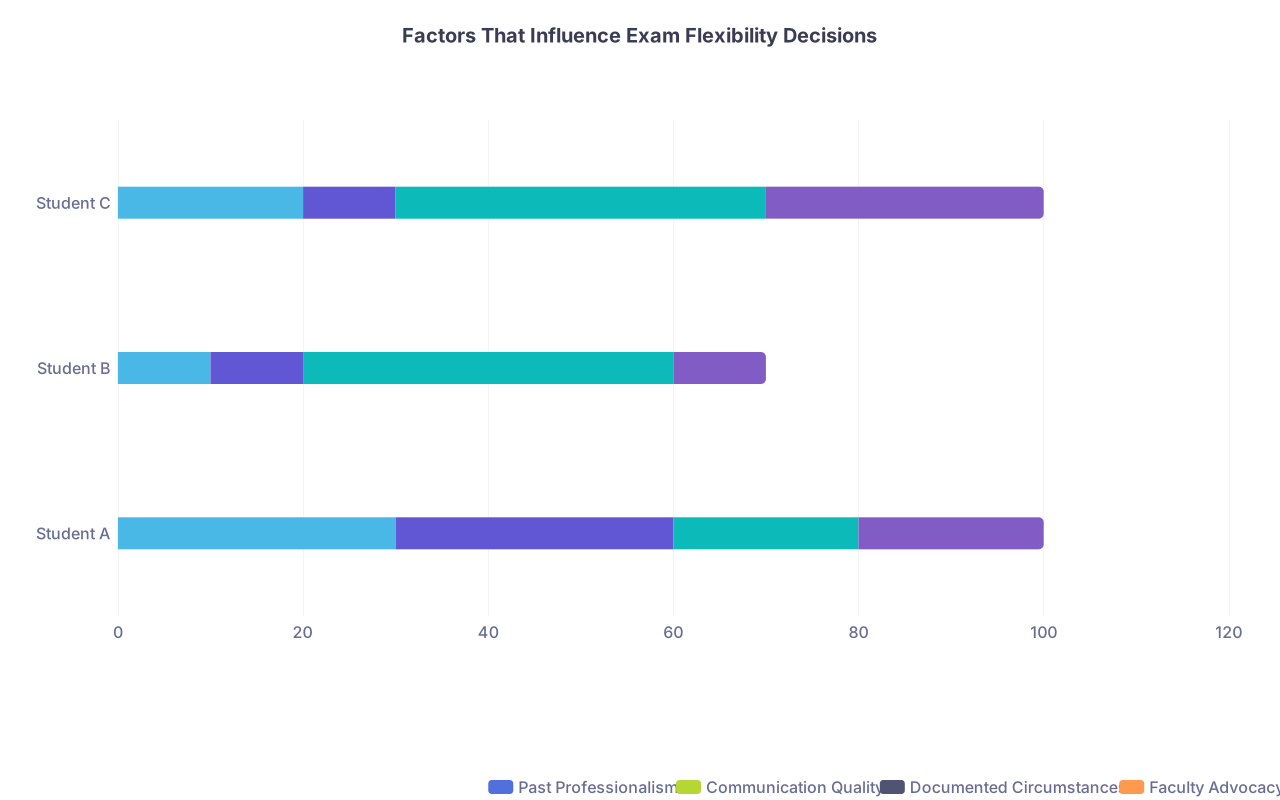
| Category | Past Professionalism | Communication Quality | Documented Circumstances | Faculty Advocacy |
|---|---|---|---|---|
| Student A | 30 | 30 | 20 | 20 |
| Student B | 10 | 10 | 40 | 10 |
| Student C | 20 | 10 | 40 | 30 |
Behind closed doors, when your name comes up for an exam exception, the conversation sounds like:
- “How have they been this year? Reliable or always an issue?”
- “Did they reach out early or dump this on us last minute?”
- “Do we have documentation, or is this just ‘I wasn’t ready’?”
- “Is anyone here willing to go to bat for them?”
If:
- You’ve been engaged and responsible all year.
- You email before the exam that you have a serious issue.
- You have any faculty member willing to say, “They’re solid, we should accommodate.”
You are very likely to get flexibility.
If:
- You’ve been difficult, unresponsive, or perpetually last‑minute.
- You claim disaster the night before the exam with no pattern of communication.
- No faculty member even knows you.
You will be held to the strictest possible read of the policy.
Same student handbook. Two very different lived realities.
FAQs: What Students Always Ask (And What We Actually Say Off‑Record)
1. “Do faculty actually have favorites, or am I just being paranoid?”
Yes, they have favorites. Not always for sinister reasons. Humans are wired to prefer people who are:
- Engaged but not obnoxious.
- Respectful but not obsequious.
- Interesting, curious, and low‑drama.
Favorites get faster replies, more thoughtful feedback, and earlier access to opportunities. Pretending this doesn’t happen is childish. Your play is not to whine about it. Your play is to make yourself easy to root for.
2. “If I totally bombed my first block, am I already doomed in their eyes?”
No. But your response to that bomb is what gets permanently recorded in people’s memories.
If you:
- Vanish, then send a panicked email three weeks later? That sticks.
If you:
- Set up a meeting, show insight into your mistakes, and actually execute a new plan? That sticks in a very different way.
I’ve seen students who straight‑up failed the entire first semester become faculty favorites because of how maturely and methodically they rebuilt.
3. “Is it manipulative to be nice to faculty just so they’ll help me?”
If you’re faking interest you don’t have, yeah, that’s a little gross. But being respectful, prepared, and appreciative isn’t manipulation. It’s professionalism.
Also, here’s the twist: faculty can usually smell outright flattery. What they respond to is effort and sincerity. You don’t need to butter anyone up. Just show you care about what you’re doing and that their time matters.
4. “What if I’m introverted and hate speaking up? Am I just screwed?”
No. Visibility doesn’t have to mean being the loudest in the room. It can be:
- Thoughtful emails after lectures.
- Short one‑on‑one conversations after class.
- Showing up to office hours with prepared questions, even if you barely talk otherwise.
You need some footprint, but it doesn’t have to be performative. Quiet competence plus occasional, targeted contact works fine.
5. “How much of this actually matters once I’m in clinical years?”
More than you think.
The same people deciding whether to bend in your favor in M1 are often:
- Writing your MSPE (Dean’s letter).
- Weighting your professionalism comments.
- Connecting you to research for competitive specialties.
The “this student works hard and is great to deal with” narrative that starts in first year absolutely follows you onto the wards. And so does the opposite.
The Short Version: What Actually Moves the Needle
Strip away all the noise, and you’re left with three levers you control:
- Be visible and professional. Not a ghost, not a headache. Someone faculty recognize and don’t dread interacting with.
- Ask for help early, specifically, and with ownership. Show you’ve tried, thought, and are ready to change.
- Follow through once and report back. Prove that you’re “trainable,” and people suddenly want to invest in you.
Do that, and you stop being “just another first‑year.” You become the kind of student people inside the system quietly decide to help.