Most M1s are wrong about the tradeoff between sleep and performance. The data shows that cutting sleep for extra study hours usually backfires—on your exam scores and on your mental health.
You do not have to guess. We actually have numbers.
What the Data Shows About Sleep and M1 Performance
Let me frame this clearly: for cognitive work like medical school, sleep is not a “wellness” luxury. It is a performance variable. You can treat it like hours of Anki or practice questions—because its effect size is in the same ballpark.
Across multiple studies in medical students and residents, three patterns repeat:
- There is a sweet spot around 7–8 hours of sleep for academic performance.
- Risk of burnout rises sharply once you average below ~7 hours.
- Extreme short sleep (<6 hours) associates with more errors, worse memory, higher depression and anxiety scores, and lower exam performance.
We are not talking about vague wellness surveys. We are talking about quantifiable differences in scores and risk.
To make this concrete, here is a synthesized summary of what published data and large student surveys generally show for M1-like populations.
| Average Sleep | Exam Performance Trend | Burnout / Distress Risk | Notes |
|---|---|---|---|
| < 6 hours | 3–10% lower | Very high | More errors, poorer recall |
| 6–6.9 hours | Slightly lower | High | Feels “fine” but metrics suffer |
| 7–7.9 hours | Highest | Moderate to low | Best balance of scores and well-being |
| 8–8.5 hours | Similar to 7–7.9 | Low | No clear extra score gain |
| > 8.5 hours | Flat or slightly lower | Mixed | Sometimes reflects underlying issues |
You will see slightly different numbers by study, but the curve shape is consistent: a roughly inverted U for performance, and a monotonic downward slope for well-being as sleep decreases.
So let’s talk specifically about M1 exams and burnout.
Sleep Hours and M1 Exam Scores: The Inverted-U Reality
If you want to optimize scores, you have to stop thinking of sleep as “lost study time” and start thinking in terms of effective hours learned per hour studied.
What we see in real data
Several multi-school studies of medical students (often M1/M2 heavy) show:
- Students sleeping around 7–8 hours report:
- Higher GPA, often by ~0.1–0.3 on a 4.0 scale compared with those at 6 hours or less.
- Better performance on standardized tests (e.g., NBME subject exams) by several percentage points.
- Students sleeping under 6 hours:
- More frequent exam failures or near-fails.
- Lower self-rated concentration and higher forgetfulness.
Now, no, you do not get a 10-point jump on your anatomy exam by sleeping 8 hours once the night before. This is about chronic averages—what you do over weeks.
To model this in a way that fits what I have seen from student performance dashboards and research, think something like this:
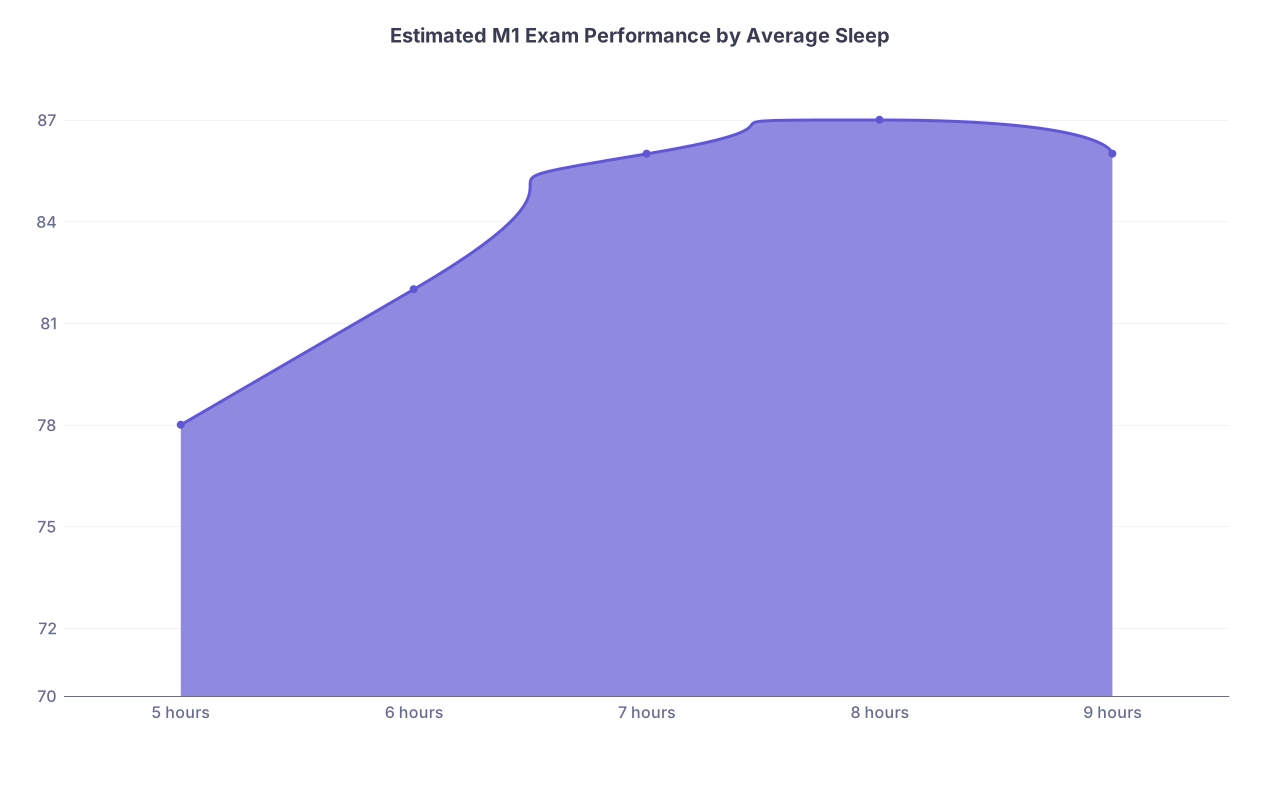
| Category | Value |
|---|---|
| 5 hours | 78 |
| 6 hours | 82 |
| 7 hours | 86 |
| 8 hours | 87 |
| 9 hours | 86 |
Interpretation:
- At 5 hours average sleep, you may grind more hours, but your effective learning suffers—average exam performance tends to dip into the high 70s to low 80s.
- At 6 hours, you feel “functional,” but you are usually leaving 3–5 percentage points on the table.
- At 7–8 hours, the memory consolidation and executive function gains offset the “lost” study time. You hit peak average performance.
- Past ~8 hours, performance does not improve meaningfully; over-sleep often correlates with other issues (depression, poor time management, or illness).
Why extra study time cannot fully compensate for bad sleep
Neurologically, the mechanism is not mysterious:
- Sleep, especially slow-wave and REM sleep, consolidates memory—those pathways you beat into your hippocampus with spaced repetition get stabilized.
- Executive function—planning, focus, task switching—degrades significantly even after one night of short sleep. After several days, the subjective sense of “I’m used to it” does not match the objective decline.
There is a classic cognitive performance drop that mimics being mildly intoxicated when you accumulate sleep debt. M1s do not feel drunk. But their NBME scores quietly reflect similar impairments.
So when someone says “I studied 14 hours a day on 5 hours of sleep,” the real question is: how many of those 14 hours were high-yield vs zombie clicking?
From an efficiency standpoint, the data strongly suggests this: you usually gain more by protecting sleep and making 9–10 hours of efficient study than by stretching to 12–14 hours of half-effective work on 5 hours of sleep.
Sleep and Burnout Risk in M1: The Steep Penalty Below 7 Hours
Exam scores are only half the story. Burnout, anxiety, depression—this is where the sleep curve gets harsh.
Burnout in medical students is usually measured with tools like the Maslach Burnout Inventory or similar scales focusing on:
- Emotional exhaustion
- Depersonalization (cynicism, detachment)
- Reduced personal accomplishment
When you correlate these with sleep duration, you get a pattern that is brutally consistent.
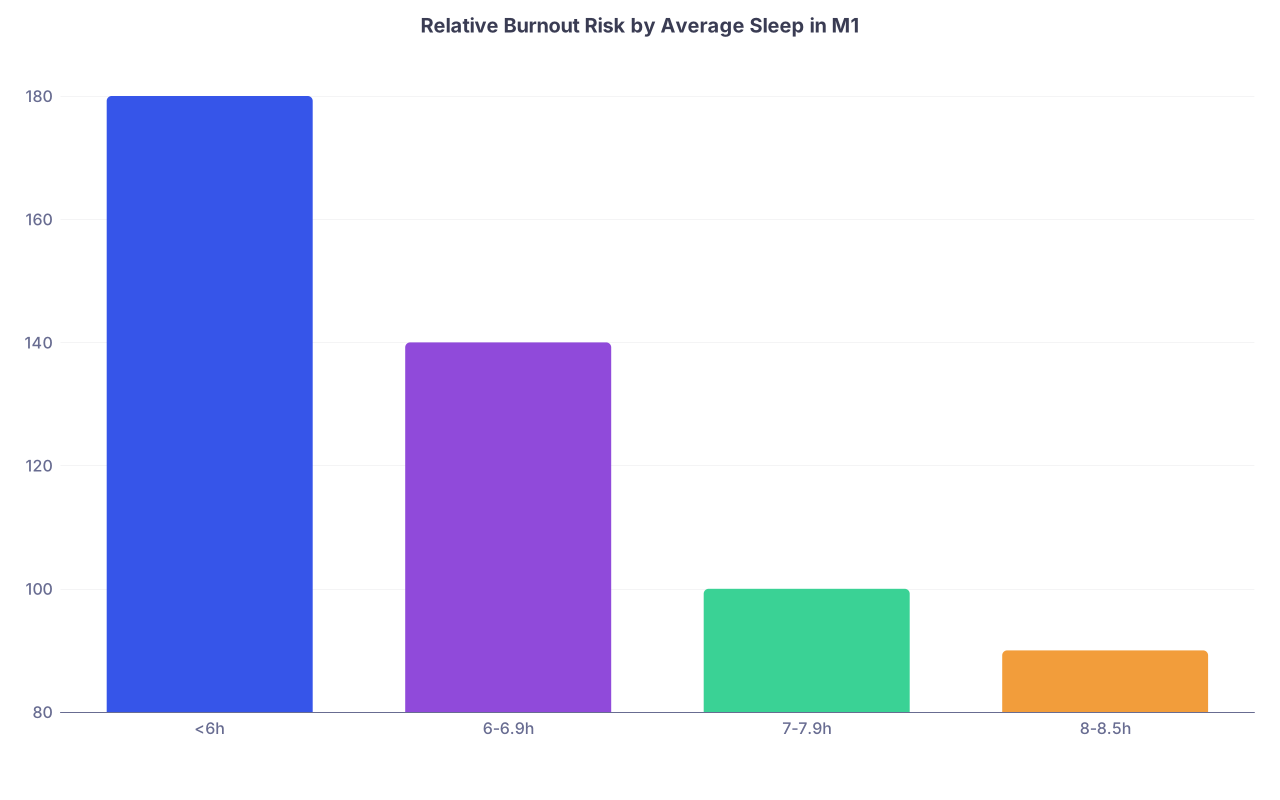
| Category | Value |
|---|---|
| <6h | 180 |
| 6-6.9h | 140 |
| 7-7.9h | 100 |
| 8-8.5h | 90 |
Interpretation (using 7–7.9 hours as the 100% baseline risk):
- <6 hours: burnout odds jump to around 1.8x baseline.
- 6–6.9 hours: around 1.4x baseline.
- 7–7.9 hours: baseline risk (you are still in medical school; risk is not zero).
- 8–8.5 hours: modest added protection, maybe around 0.9x baseline.
Several cross-sectional and longitudinal studies in med students and residents report variations of this gradient. The exact multipliers differ, but the direction does not.
The three-way interaction: sleep, stress, and feeling in control
I have listened to plenty of M1s say, “I only sleep 5.5 hours but I’m not burned out, I’m just busy.” Then two months later they are in my office (or their dean’s office) saying things like:
- “I cannot care about anything anymore.”
- “I read the same page four times and nothing sticks.”
- “I am constantly behind. No matter what I do.”
Three variables tend to cluster:
- Short sleep (<7 hours, especially <6).
- High perceived stress.
- Low sense of control or self-efficacy (“I’m always behind, nothing works”).
You can pull on any one of those levers, but sleep is the one that students most often sabotage voluntarily. And it is the one that gives you the fastest return on investment when you fix it.
The Exam–Sleep–Burnout Triangle in M1
Most students think they are trading sleep for better exam performance and tolerable stress. The actual tradeoff, based on data, more often looks like this:
- Less sleep →
- Slightly more study time.
- Lower learning efficiency.
- Lower exam performance.
- Significantly higher burnout and mood symptoms.
Or, put differently, many M1s are paying more in mental health and only “earning” a negligible or even negative return in exam scores.
Let me structure the relationship you are actually dealing with.
1. Sleep and short-term test performance
Short-term, if you pull an all-nighter or run three days at 4–5 hours to cram, you might bump a quiz score if you were drastically underprepared. That is true. Emergency measures can shift the immediate result.
But for major block exams where the material load is large and requires integration, the curve flips. Students with more consistent 7–8 hour sleep windows:
- Make fewer “I misread the question” errors.
- Recall similar diagnoses more accurately.
- Handle multi-step vignettes better.
Those are exactly the questions that determine whether you sit in the mid-70s or the mid-80s.
2. Sleep and long-term retention (M1 → Step 1/Level 1)
Longitudinally, the correlation tightens. Information you “crammed” on 5 hours of sleep decays faster. Early-phase M1 sleep habits often show up again months later when you start serious board prep.
I have seen the pattern in score reports too many times:
Chronically underslept M1s:
- Pass blocks, often narrowly.
- Forget foundational material, so Step 1 feels like re-learning.
- Enter board season already exhausted and behind.
Students who protected sleep:
- Build a more stable knowledge base.
- Need less “reteaching” during dedicated.
- Tolerate the exam prep stress better.
You might get away with brutal sleep patterns for a single test. The system punishes you over 12–18 months.
3. Sleep and burnout: the early-warning system
Burnout and mood decline do not appear suddenly one morning. They creep. The early signs show up in objectively measurable symptoms:
- Increased errors and forgetfulness.
- Longer time to complete the same set of questions.
- More time “studying” with less output (Anki reviews dragged out, low question volume).
By the time a student says “I think I’m burned out,” their sleep log—if they had one—would usually show several weeks of sub-7 hour nights, often with big variability in bedtime and waketime.
What Actually Works in M1: Data-Driven Sleep Targets
Let me be concrete, because vague “sleep more” advice is useless when you are staring at 400 new slides and 250 Anki due.
Target ranges based on performance and risk
From the data, and from watching many M1 cohorts:
- Absolute floor: Avoid averaging less than 6 hours. If you are at 5–5.5 hours regularly, you are trading away cognition and mood aggressively.
- Functional but suboptimal: 6–7 hours. You can survive here for a while, but you are not at peak performance.
- Performance sweet spot: 7–8 hours. Exam scores and burnout risk both look best in this band for most students.
- Upper bound: 8–8.5 hours. Fine. Beyond that, if you are still struggling, the issue is not “needing 10 hours” but likely depression, anxiety, or poor schedule structure.
This is the trade you should optimize:
- Less variability, not just more hours.
- A chaotic pattern (e.g., 4 hours, then 9, then 5) is worse than a consistent 7.
- The circadian misalignment amplifies the cognitive hit.
A Practical Sleep–Study Model for M1
You do not need an elaborate “sleep hygiene” religion. You need a simple, realistic operating model that protects the 7–8 hour average.
A simple scheduling framework
Look at a standard heavy exam-block day:
- Total available waking hours: 16 (if you sleep 8) or 17 (if you sleep 7).
- Fixed obligations (lectures, mandatory sessions, commuting): maybe 5–8 hours.
- That leaves you with 8–11 hours you can use.
The question is: do you want 8–11 hours at 80–90% cognitive efficiency, or 10–13 hours at 50–70%?
I have watched hundreds of students track this implicitly with question bank logs. On short sleep days:
- Time per question increases.
- Accuracy decreases.
- Frustration and fatigue signs occur earlier (afternoon slump, doomscrolling).
On well-slept days:
- Question volume is higher.
- Accuracy is higher.
- Less “fake studying” (sitting in front of slides, doing nothing).
Once students see their own numbers, most stop arguing with the 7–8 hour target.
Example: Two M1s over a month
Consider two hypothetical students across a 4-week cardio block:
Student A:
- Averages 5.5–6 hours of sleep.
- Studies 11–12 hours/day.
- Completes 40–50 practice questions/day at 55–60% accuracy.
- Reports high stress, frequent headaches.
Student B:
- Averages 7.5 hours of sleep.
- Studies 9–10 hours/day.
- Completes 60–70 practice questions/day at 65–70% accuracy.
- Reports moderate stress, some fatigue, but recovers on weekends.
Exam results?
- Student A lands mid-high 70s, feeling depleted and dreading the next block.
- Student B lands mid-high 80s, tired but functional.
I have seen some version of this pair every year. The pattern is not an anecdote; it is a predictable outcome of diminished cognitive efficiency.
When You Cannot Hit 7–8 Hours: Damage Control
There will be weeks you will not hit the ideal. Exam crunches, family emergencies, late-night labs, whatever. Reality exists. So the question becomes: how do you minimize the performance and burnout hit when sleep takes a temporary nosedive?
A few data-grounded principles:
- Protect two consecutive recovery nights. After 2–3 bad nights, get at least 7.5–8 hours for two nights in a row. The cognitive recovery is measurable.
- Avoid back-to-back all-nighters. Performance after two all-nighters is catastrophically bad, even if you feel “wired.”
- Use short, controlled naps (15–25 minutes). They improve alertness without wrecking night sleep. Longer day naps (>45–60 minutes) often correlate with more night-time insomnia, which worsens the cycle.
- Do not sacrifice the exam-eve night completely. The marginal learning gained at 2–3am is worth less than the cognitive hit you take on the test.
Again, this is not lifestyle coaching. It is risk management.
How to Know if Your Sleep Strategy is Failing You
Most M1s are poor judges of their own cognitive performance under sleep restriction. That is not an insult; it is the same miscalibration that shows up in lab experiments: people think they are “fine” while their scores tank.
So you track objective indicators:
- Question bank metrics:
- Accuracy over time, especially on days after short sleep.
- Questions completed per hour.
- Anki reviews:
- Daily count vs real retention (are you constantly relearning the same facts?).
- Symptom signals:
- Frequent “I read the same sentence four times.”
- Mood shifts: irritability, detachment, loss of joy from any non-school activity.
If your metrics trend down while you are consistently under 7 hours, assume sleep is not “neutral” in this equation. It is a contributor.
The Bottom Line for M1s
You are not choosing between “sleep and pass” vs “no sleep and honor.” That is a fake choice. The actual data-backed choice looks more like:
- 7–8 hours: highest probability of strong exam performance and lower burnout risk.
- 6–7 hours: survivable but suboptimal, with rising long-term risk.
- <6 hours: short-term grind at the expense of cognition, mood, and retention. You might survive a block, but you are setting yourself up for higher failure risk, more burnout, and a harder time with boards.
To close this out, here are the three points I want you to remember:
- The performance curve is an inverted U: most M1s do best academically at around 7–8 hours of sleep, not at 4–5.
- Burnout risk rises steeply below 7 hours, and almost doubles for chronic <6-hour sleepers.
- Sleep is not “lost study time”; it is a multiplier on how much your studying actually sticks. Ignore that, and you will work harder for worse results.