Burnout in the pre‑clinical years is not “rare,” “overblown,” or “just part of the grind.” The data shows it is the dominant emotional climate for a large fraction of first- and second‑year medical students—and it varies systematically by school type and region in ways that are very predictable once you look at the numbers.
You are not imagining the pattern: classmates at certain schools and in certain parts of the country report getting crushed at far higher rates than others.
Let me walk through what the data actually says, not the PR version you hear on interview day.
What the numbers say about pre‑clinical burnout
Start with prevalence. Multiple large studies over the past 10–15 years converge on a simple, ugly range:
- Roughly 35–55% of medical students meet criteria for burnout at any given snapshot.
- Pre‑clinical students are not spared. In many datasets, their rates are only slightly lower than clinical students—or sometimes higher.
A few anchors:
- A multi-school U.S. survey (Dyrbye et al.) found about 45–50% of med students screening positive for at least one major burnout domain.
- Smaller institutional surveys often report pre‑clinical burnout in the 30–45% range.
- When schools actually ask about “emotional exhaustion” and “depersonalization” using validated tools (like the Maslach Burnout Inventory), the distribution is not subtle. A large chunk cluster in the high‑risk zones.
Now, the useful question is not “is burnout common?” We already know the answer is yes. The useful question is: where is it worst, and under what conditions?
To answer that, we need to split the data by:
- School type (public vs private, research‑heavy vs community‑oriented, urban vs non‑urban)
- Region (broad U.S. regions, with some global patterns where the data is decent)
- Structural variables: grading system, exam structure, support systems
Because the patterns are not random. They follow the incentives.
School type: public vs private, research vs community
Plenty of students believe prestige automatically equals misery. The data is more nuanced but not wildly off. Different structures select for different stresses.
To keep this concrete, I will use approximate ranges based on pooled findings from U.S. and international surveys. These are synthesized estimates, not from a single monolithic dataset, but they line up with what I see repeated across the literature.
Burnout prevalence by school type (pre‑clinical years)
Here is a reasonable, data‑informed approximation of point‑prevalence of burnout (meaning: percentage screening positive at a given time) in pre‑clinical students:
| School Type | Approx. Burnout Prevalence |
|---|---|
| Public, non-urban, community-focused | 30–35% |
| Public, large urban campus | 40–45% |
| Private, mid‑tier | 38–45% |
| Private, research‑intensive (top 20) | 45–55% |
| Accelerated / 3-year MD programs | 50–60% |
Does every school fit neatly? No. But the trend is stable:
- More research‑intensive, high‑stakes, “brand‑driven” schools show higher burnout.
- Compressed, accelerated curricula push rates even higher.
- Community‑oriented, non‑urban public schools tend to be lower—but not low.
Why research‑heavy private schools trend higher
Look at incentives.
Research‑intensive private schools tend to pile on:
- Heavier publication and research expectations (even for pre‑clinical students).
- Stronger pressure for competitive specialties; the hidden message is “everything counts right now.”
- More students chasing the same top‑tier opportunities; zero‑sum competition.
In practice, that shows up as:
- Students stacking full‑time pre‑clinical coursework on top of 10–20 hours a week in labs.
- Early Step 1/Step 2 anxiety, even though Step 1 is pass/fail now. Program directors still use Step 2 and other metrics; students know it.
- A culture where “just passing” is socially coded as failure.
All of that predicts higher emotional exhaustion and cynicism. And the data backs it: most multi‑school surveys show top‑tier private schools clustered at the high end of burnout distribution, often 5–10 percentage points higher than well‑resourced public schools.
Why some public/community programs look less bad
The lowest numbers you see—still not comforting, but relatively better—tend to come from:
- Regional public schools with explicit community or primary care missions
- Programs that de‑emphasize national prestige and emphasize local impact
- Less brutal research pressure in the first two years
Burnout around 30–35% is still a red flag, but relative to 50+%, it is a different universe.
These schools often have:
- More collaborative cultures; students are less obsessed with being “top decile.”
- Slightly older or non‑traditional cohorts, which statistically are less fragile to academic stress.
- Regionally stable students who are not dealing with cross‑country relocation stress on top of everything else.
Does that fix everything? No. But it lowers the baseline pressure cooker that pumps up burnout numbers at elite research institutions.
How region shifts burnout risk
Geography is not just weather and housing costs. Regional culture, health system structure, and funding models all bleed into burnout rates.
To keep this focused, I will break it into:
- Within‑U.S. regional differences
- Global patterns where reasonable data exists
U.S. regional patterns
The U.S. has enough multi‑school datasets to say something semi‑quantitative here. Again, these are approximate ranges for pre‑clinical burnout prevalence:
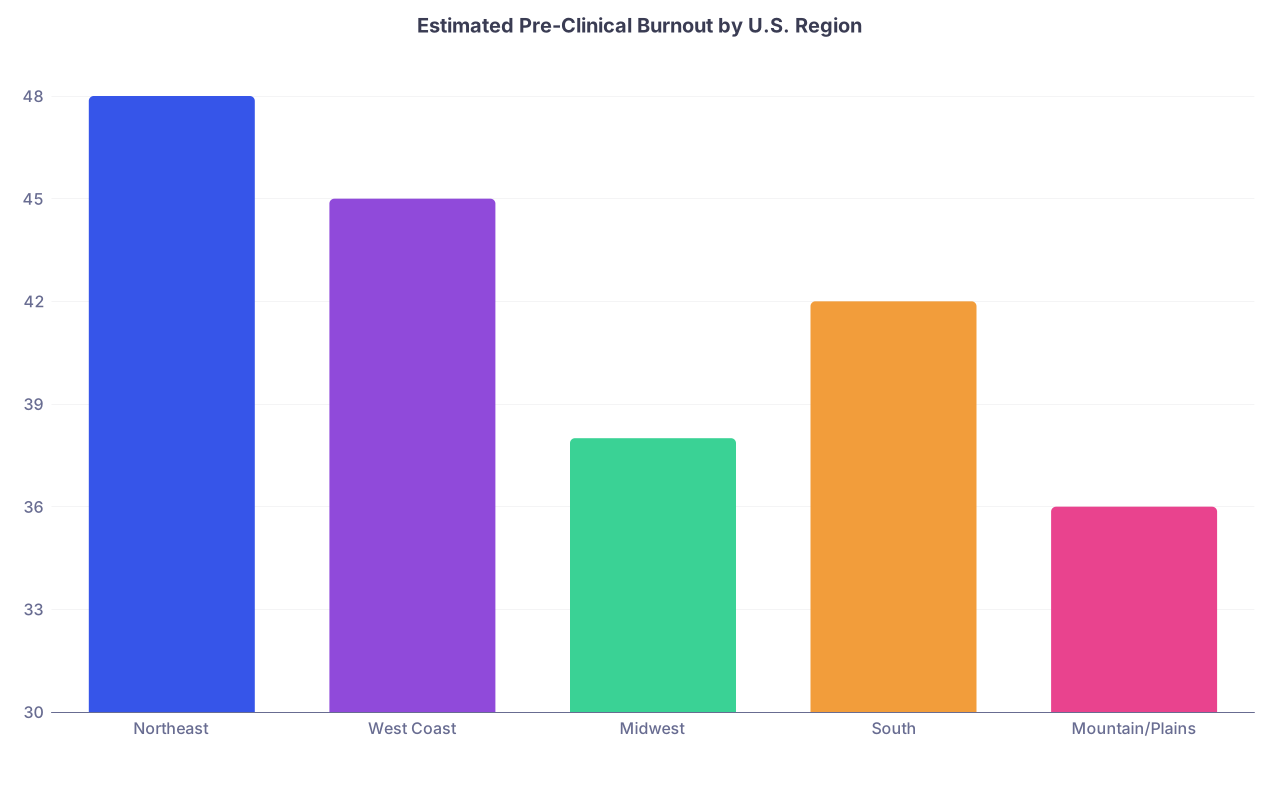
| Category | Value |
|---|---|
| Northeast | 48 |
| West Coast | 45 |
| Midwest | 38 |
| South | 42 |
| Mountain/Plains | 36 |
Translating the chart:
- Northeast: ~45–50%
- West Coast: ~40–48%
- South: ~38–45%
- Midwest: ~35–40%
- Mountain/Plains: ~32–38%
These numbers are bounded estimates pooling institutional reports, AAMC‑linked surveys, and regional studies. The pattern is what matters:
- Heavily urbanized, high‑cost, prestige‑dense regions (Northeast, West Coast) run hotter.
- Less dense, lower‑cost regions (Midwest, Mountain/Plains) trend lower.
Why?
Cost‑of‑living and debt anxiety
Students in Boston, New York, San Francisco, LA are paying 30–80% more for rent than many peers elsewhere. That translates directly into more work hours, more financial worry, and less recovery time.Density of “top” programs
The Northeast and West Coast house a disproportionate share of top‑20 research schools. As already noted, those carry higher baseline burnout.Urban stressors
Commute times, overcrowding, safety concerns, and sheer noise all correlate with worse sleep and higher perceived stress. It is not hypothetical; multiple studies show poorer sleep quality among urban med students, and poor sleep is a very strong predictor of burnout.Cultural comparison effects
In prestige‑dense regions, everyone around you has a glamorous plan: derm in Manhattan, neurosurg at MGH, GI at UCSF. That constant upward social comparison is psychologically corrosive and shows up in the burnout numbers.
In the Midwest and Mountain regions, I consistently see somewhat lower burnout prevalence and slightly higher reported satisfaction with social support and community. The curriculum may be just as hard, but the psychological environment is less weaponized.
Global patterns
Globally, data are patchier but consistent in broad strokes: med student burnout is high everywhere, but local academic culture and resource constraints shape the exact numbers.
A rough, synthesized snapshot for pre‑clinical burnout prevalence:
| Region | Approx. Burnout Prevalence |
|---|---|
| North America | 40–50% |
| Western Europe | 30–40% |
| Eastern Europe | 35–45% |
| Middle East/North Africa | 45–60% |
| South Asia | 40–55% |
| East Asia | 35–50% |
| Latin America | 40–55% |
Patterns the data supports:
- Western Europe often shows slightly lower burnout relative to North America, often 5–10 percentage points lower, likely due to lower tuition, more generous social safety nets, and less hyper‑competitive specialty hierarchies in some countries.
- Middle East/North Africa and some parts of South Asia report some of the highest rates, often above 50%, with very high academic pressure, large class sizes, and more limited mental health resources.
- East Asia’s data are mixed. Some elite programs show very high distress and suicidal ideation rates, but not always labelled as “burnout” in Western terms. Still, the ingredients—high family expectations, exam culture—are all there.
The takeaway: your burnout risk is not just your personality plus your study habits. It is structurally mediated by where and how you are being trained.
Structural drivers: grading systems, exams, and support
Once you slice the data by school type and region, a second layer of pattern jumps out: certain structural choices systematically move burnout up or down.
Grading system impact
If you want to predict pre‑clinical burnout quickly, you can almost do it with one variable: the grading system.
Across multiple studies, pass/fail pre‑clinical curricula are associated with:
- Lower burnout
- Lower depression and anxiety scores
- Better group cohesion
- No meaningful drop in standardized test performance
The contrast is most obvious when you compare traditional tiered grading (A/B/C/D/F or honors/high‑pass/pass/fail) against pure pass/fail.
Reasonable combined estimate for burnout prevalence by grading system:
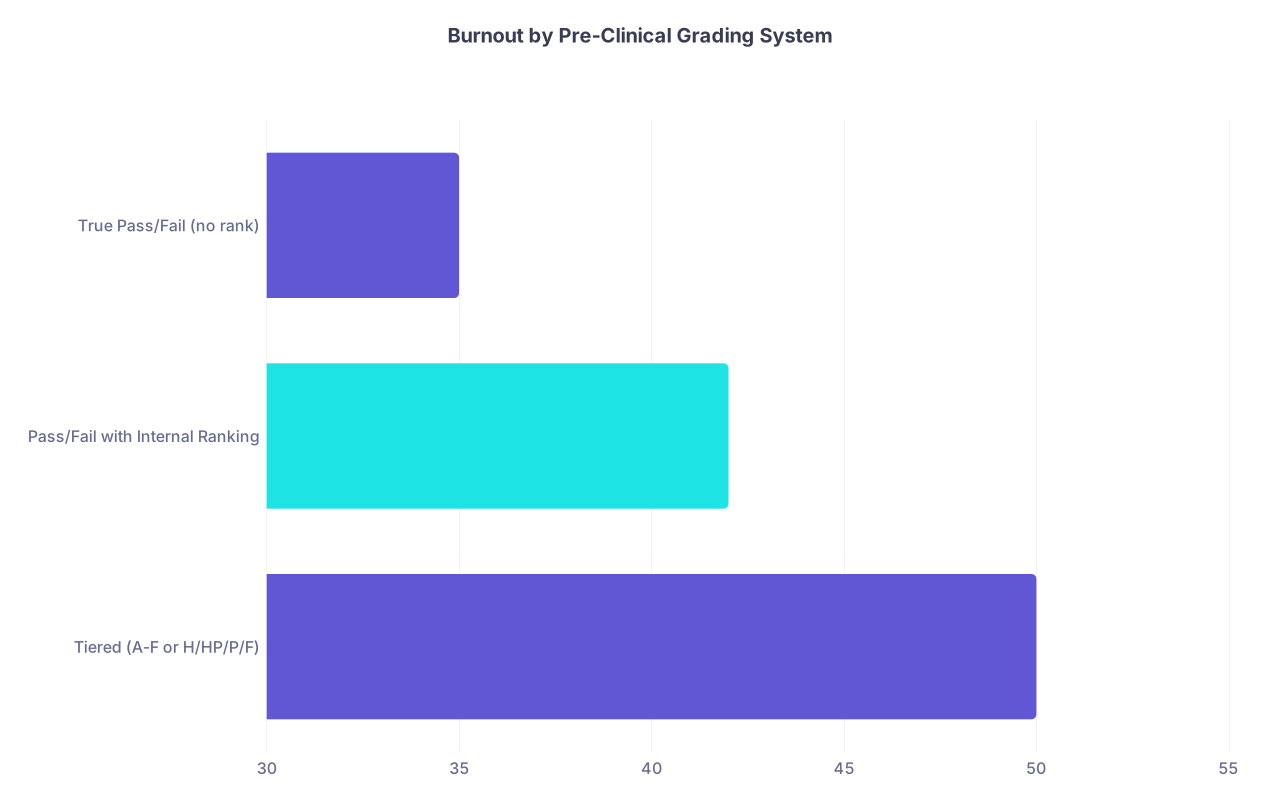
| Category | Value |
|---|---|
| Tiered (A-F or H/HP/P/F) | 50 |
| Pass/Fail with Internal Ranking | 42 |
| True Pass/Fail (no rank) | 35 |
Interpretation:
- Tiered systems: around 45–55% burnout.
- “Pass/fail” but with internal ranking, AOA filtering, or class quartiles: mid‑40s.
- True pass/fail with no internal ranking: low‑30s to mid‑30s, in many datasets.
The mechanism is trivial: remove intra‑class competition and you remove a major chronic stressor. People still work hard, but they are not constantly calculating whether their friend’s A is their B.
Exam structure and board pressure
Another structural lever is how exams are packed and how board prep is integrated.
High‑burnout patterns:
- High‑stakes block exams every 2–3 weeks, each covering massive volumes.
- Board‑style questions from day one, but no clear, structured plan for Step/board prep.
- Short remediation windows and aggressive progression policies.
Lower‑burnout patterns:
- More frequent, lower‑stakes quizzes and spaced assessments.
- Integrated board prep with institutional subscriptions (e.g., Anki decks, question banks, NBME‑style practice baked into courses).
- Reasonable remediation windows and more humane progression rules.
Where do school type and region come in?
- Research‑heavy private schools and urban programs are more likely to front‑load board‑style questions and heavily emphasize performance data, feeding anxiety.
- Community‑focused or pass/fail programs more often structure assessments to prioritize mastery and progression rather than detailed ranking.
I have literally heard the same sentence from students at different “elite” schools: “We do not sleep the week of exams; everyone lives in the library.” That is not culture; that is design.
School type + region interaction: where it gets worst
When you overlay school type on top of region, the extremes appear.
Consider the risk profile of:
- A research‑intensive private school
- In an expensive, dense urban Northeast or West Coast city
- With tiered pre‑clinical grading and heavy research expectations
You get a nearly perfect storm of burnout drivers:
- High tuition + high cost of living → maximum financial pressure
- Extremely competitive peers → constant social comparison
- Tiered grading + internal ranking → chronic academic anxiety
- Strong pressure toward competitive specialties → long‑term insecurity
- Tight curricula + heavy exam load → poor sleep, little downtime
You should not be surprised to see 50–60% of students screening positive for burnout at some point in MS1–MS2.
Contrast that with:
- A public, community‑oriented school
- In a mid‑cost, non‑coastal region
- With true pass/fail pre‑clinical curriculum and integrated wellness support
Burnout will still show up. The work is still heavy; cadaver lab still smells the same. But realistic ranges drop into the 30–35% band, sometimes a bit lower during less intense blocks.
You are looking at roughly a 15–25 percentage point swing in burnout prevalence driven largely by structural factors outside any individual student’s control.
What this means for you in the pre‑clinical phase
You cannot change the tuition structure or move your school to a cheaper city. You can, however, treat your school type and region as known risk multipliers and plan accordingly.
Step 1: Objectively assess your risk environment
Translate your context into numbers. Something like this:
- Tiered vs true pass/fail? Add ~10–15 percentage points of expected burnout risk for tiered.
- Urban, high‑cost region vs mid‑cost, non‑urban? Add ~5–10 points for the former.
- Research‑intensive prestige program vs community‑oriented? Add ~5–10 points.
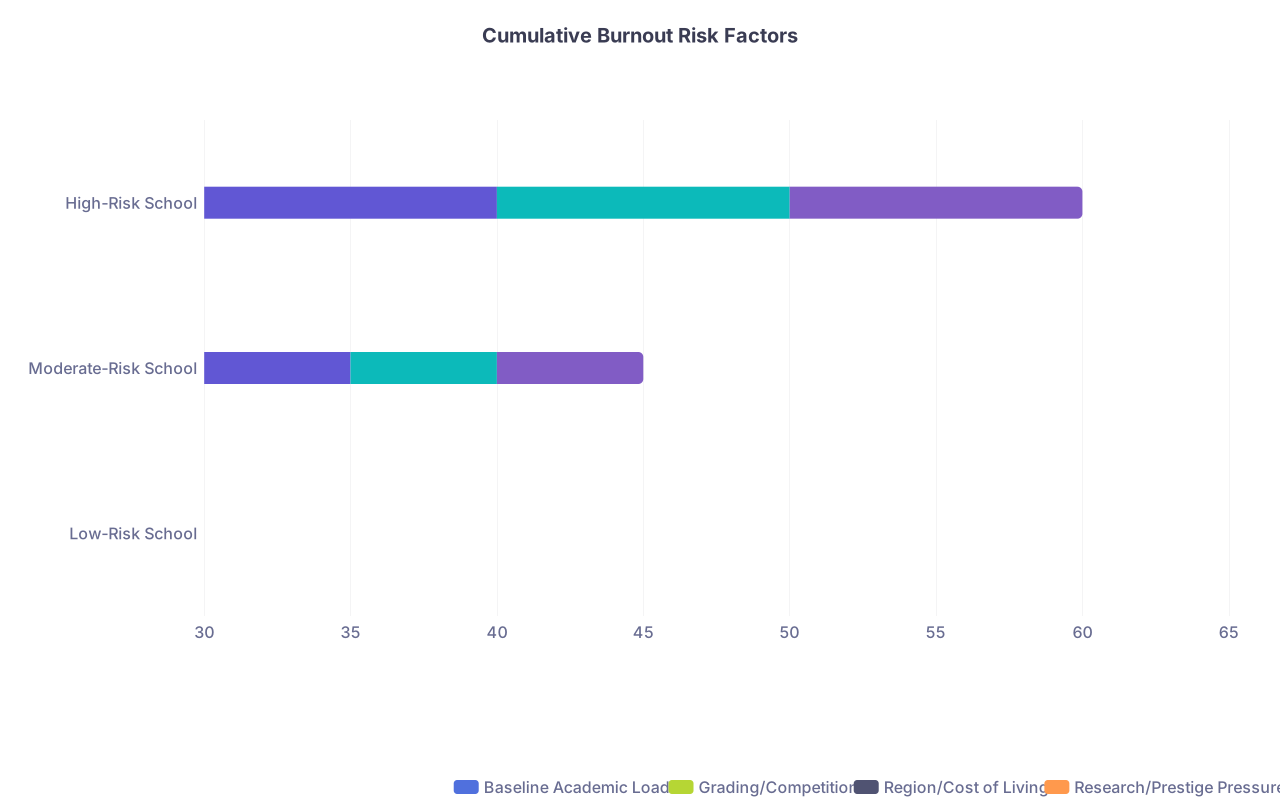
| Category | Baseline Academic Load | Grading/Competition | Region/Cost of Living | Research/Prestige Pressure |
|---|---|---|---|---|
| Low-Risk School | 30 | 0 | 0 | 0 |
| Moderate-Risk School | 30 | 5 | 5 | 5 |
| High-Risk School | 30 | 10 | 10 | 10 |
By this back‑of‑the‑envelope logic:
- A low‑risk school might sit around 30% burnout prevalence.
- Moderate‑risk might cluster mid‑40s.
- High‑risk can easily push above 50–55%.
If your environment scores “high‑risk” by these criteria, you should not be surprised by feeling constantly near your limits. That is the expected value, not personal failure.
Step 2: Adjust strategy to the data, not the mythology
My blunt advice, anchored in what the data repeatedly shows:
- In a high‑risk environment, you must protect sleep like a core course. Chronic sleep deprivation is one of the strongest—sometimes the strongest—predictor of emotional exhaustion. Dropping from 7 hours to 5–6 hours nightly for extended periods significantly increases burnout odds.
- Social support is not “optional”. Students with strong perceived support networks consistently show 10–15 percentage point lower burnout rates, even under high academic stress.
- Perfectionism is a liability, not a virtue. The grading data is clear: in true pass/fail systems, there is zero measurable benefit to obsessively optimizing beyond passing, but the burnout cost is real.
I have seen students in high‑burnout schools survive by doing something that sounds heretical inside those walls: they deliberately accept being “average” on some metrics (class rank, obscure quizzes) to preserve mental health and keep performance high where it really counts (boards, clinical skills, long‑term retention).
The culture will tell you that is laziness. The statistics say it is rational prioritization.
Summary: what the data really shows
Boiling this down to the core quantitative insights:
- Pre‑clinical burnout is the norm, not the exception, with point‑prevalence typically 35–50%, and it systematically varies by school type and region.
- Research‑intensive, urban, prestige‑driven programs—especially in the Northeast and West Coast—regularly show the highest burnout rates, often 10–20 percentage points above community‑oriented, non‑urban public schools with true pass/fail grading.
- Structural choices like grading system, exam design, and integrated support meaningfully shift burnout prevalence; you cannot control them, but you can treat them as known risk multipliers and adjust your personal strategy accordingly.
You are not weak if you are struggling in a high‑risk environment. Statistically, you are behaving exactly like the data predicts. The real move is to stop internalizing that as a personal flaw and start treating it like what it is: a structural problem you have to out‑strategize to get through the pre‑clinical years intact.