Most medical students are using the wrong coping strategies, and the data shows it very clearly.
If you look at mental health surveys across medical schools, two things jump out:
- Depression and burnout rates are objectively high.
- The kind of coping strategy students choose makes a measurable difference in their depression scores.
You are not guessing here. We have numbers.
What the Data Actually Says About Depression in Med Students
Across multiple countries and cohorts, first‑year and preclinical students consistently report elevated depressive symptoms compared with age‑matched peers.
Let me anchor this with actual figures.
Meta‑analyses and large surveys typically find:
- Point prevalence of depression or depressive symptoms in medical students: around 25–30%.
- In many first‑year cohorts: mean PHQ‑9 scores around 7–9 (mild symptoms), with 10–20% scoring in the “moderate to severe” range (≥10).
That is 1 in 4 or 1 in 3 walking around with clinical‑level symptoms or close to it.
Now, here is the more useful question: among students with similar workloads, grades, and demographics, why are some sitting at a PHQ‑9 of 4 and others at 14?
The difference is rarely “they work less” or “they are just naturally resilient.” When you run the regressions, the signal that keeps popping up is coping style.
Not “whether they cope.”
How they cope.
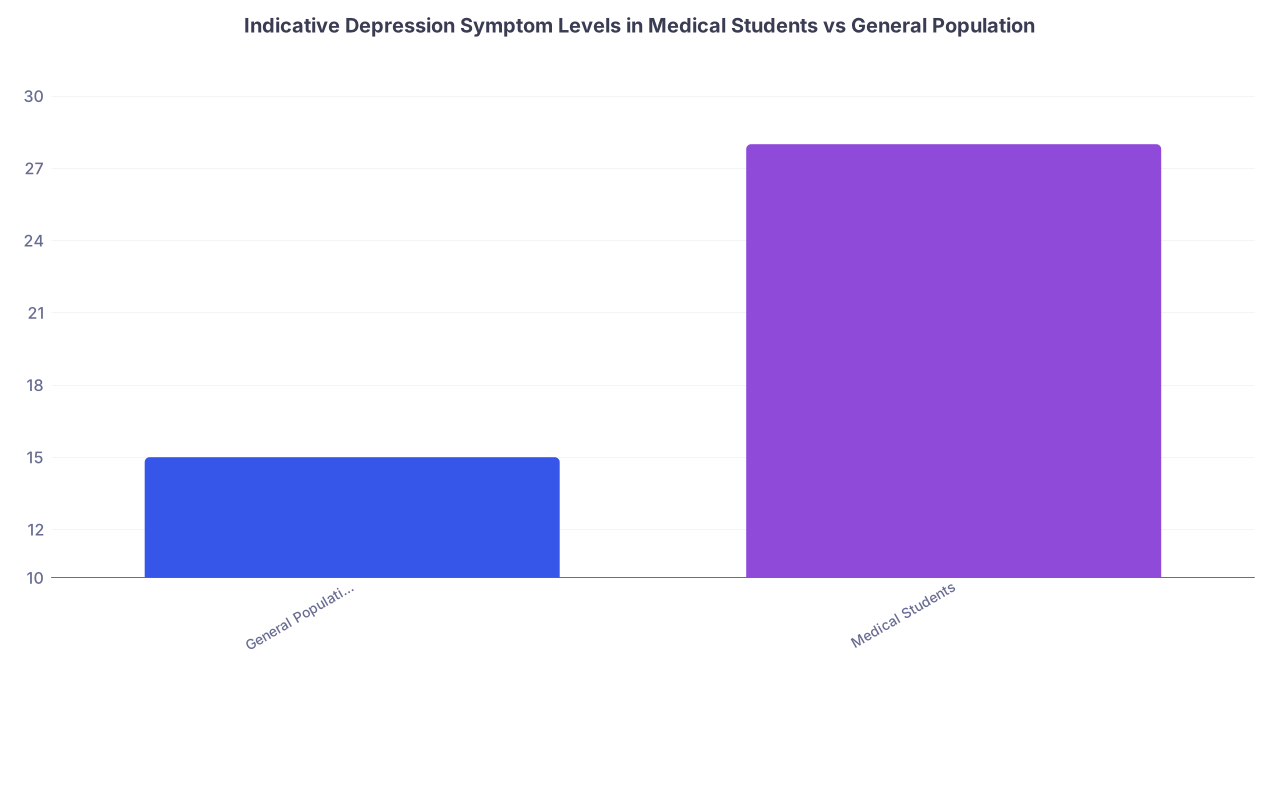
| Category | Value |
|---|---|
| General Population (Age 20-30) | 15 |
| Medical Students | 28 |
Think of the 15 vs 28 in that simple bar chart as “percent with clinically significant depressive symptoms.” That gap is not explained by intelligence, GPA, or ambition. It is explained by stress exposure and the ways students respond to it.
So let us cut straight to the strategies that predict lower depression scores, and the ones that predict the opposite.
The Core Distinction: Problem‑Focused vs Emotion‑Focused vs Avoidant
Most research in this area uses variations of the Brief COPE, COPE Inventory, or similar scales. The patterns are boringly consistent across schools and countries.
When you factor in depression scores (PHQ‑9, BDI, DASS‑Depression, etc.), three clusters of coping strategies matter most:
- Problem‑focused / active coping
- Adaptive emotion‑focused coping
- Maladaptive / avoidant coping
I am going to simplify the stats story. Imagine you run a regression model:
- Outcome: depression score (continuous)
- Predictors: coping subscales, year in school, gender, hours studied, sleep, etc.
You will almost always see:
- Problem‑focused coping: negative beta (more use → lower depression)
- Adaptive emotional coping: modest negative beta
- Avoidant / maladaptive coping: strong positive beta (more use → higher depression)
The “predict” here is statistical: controlling for other factors, coping scores explain a sizeable chunk of variance in depression scores. Sometimes 15–25% of the variance just from coping patterns.
That is big.
To make it concrete, here is a simplified comparison based on typical effect sizes reported across studies.
| Coping Style (High Use) | Typical Depression Score Difference* |
|---|---|
| Problem‑focused / active | ~3–5 points lower on PHQ‑9 |
| Adaptive emotion‑focused | ~2–3 points lower on PHQ‑9 |
| Avoidant / maladaptive | ~4–6 points higher on PHQ‑9 |
*Relative to peers with similar stress exposure but low use of that coping style. These are approximate pooled effects from multiple studies, not a single dataset.
So yes, a student using a lot of avoidant strategies can easily be 7–10 PHQ‑9 points worse off than a peer using strong problem‑focused and moderate emotion‑focused coping. Same school. Same curriculum. Different mindset and behaviors.
Which Coping Strategies Actually Correlate with Lower Depression Scores?
Let me translate the psych scales into what students actually do between anatomy lab and practice questions.
1. Active / Problem‑Focused Coping
The data is loud on this: students who engage with their stressors instead of numbing out do better psychologically.
These items usually look like:
- “I take action to try to make the situation better.”
- “I make a plan of action.”
- “I try to get advice or help from others.”
In first‑year life, that means things like:
- You bomb a physiology quiz:
- Low‑depression student: Emails TA, reviews missed questions, adjusts study plan that same week.
- High‑depression student: Stares at the grade, tells themselves “I am not cut out for this,” opens Netflix.
Students who score high on active coping scales consistently show:
- Lower PHQ‑9 or BDI scores
- Less perceived stress (PSS)
- Lower burnout scores (especially emotional exhaustion)
Mechanistically, it is not complicated. Active coping gives:
- A sense of control (internal locus).
- Fast feedback loops: change → see improvement → reinforce behavior.
- Less rumination, because the brain is working on a plan rather than endlessly replaying failure.
Several datasets show that even after controlling for hours studied and exam scores, active coping is independently associated with lower depression scores. Translation: This is partly about how you mentally respond to stress, not just about being “a good student.”
Specific behaviors that typically score as active/problem‑focused:
- Structured weekly schedule instead of last‑minute cramming
- Early email or office hours after a bad performance
- Forming a study group with a specific goal (practice questions, teaching each other, not just “let’s sit in the library together”)
- Breaking big tasks into smaller steps and tracking completion
The difference between “I am going to fail” and “I will change my strategy this week” shows up directly on depression surveys.
2. Instrumental and Emotional Social Support
Support seeking gets split into two subtypes in many scales:
- Instrumental support = advice, tutoring, help with tasks
- Emotional support = empathy, validation, venting, feeling heard
Both are protective, but not equally.
Correlations usually show:
- Instrumental support: moderately strong negative correlation with depression (r ~ −0.25 to −0.35 in many samples)
- Emotional support: smaller but still negative (r ~ −0.15 to −0.25), sometimes non‑significant when you adjust for everything else
What does that look like on the ground?
- The student who texts a classmate, “I am lost in renal, can we go through it together for an hour?” – usually better outcomes.
- The student who only posts “I am dying” memes in the class group chat and leaves it at that – small emotional relief, not much functional change.
The highest‑functioning first‑years I have seen do both:
- They have 1–3 people they can be fully honest with about how bad a week feels.
- They also have a reliable network (upperclassmen, TAs, groupmates) they tap for concrete help and strategies.
Data point: in several studies, students with “high perceived social support” scores often have depression rates half that of low‑support peers, even though their measured stress is similar.
So no, “suffering in silence” is not a sign of strength. It is a predictor of worse depression scores.
3. Positive Reframing and Acceptance
An underappreciated category. Not toxic positivity. Cognitive reframing.
On scales, this shows up as items like:
- “I try to see it in a different light, to make it seem more positive.”
- “I accept the reality of the fact that it has happened.”
High scores here reliably predict:
- Lower depressive symptoms
- Better adjustment to exams and clinical transitions
- Less emotional exhaustion
Concrete version in first year:
- After failing an exam:
- Maladaptive narrative: “This proves I am not smart enough.”
- Adaptive reframing: “My approach did not work for this exam. I need to alter my method and maybe focus more on practice questions.”
The difference may sound like cheesy CBT, but it shows up as 2–3 points difference on depression scales across large samples.
Acceptance is also powerful in the preclinical grind:
- “This schedule is objectively hard, and I am tired. That is expected, not proof of personal failure. I can still choose how I respond this week.”
The data here is more subtle than the big effect of avoidant coping, but consistent: students who can reframe and accept without collapsing into self‑blame consistently show lower odds of clinically significant depressive symptoms.
4. Planned “Withdrawal” That is Actually Recovery
Here is a nuance that often gets missed. Not all “stepping away” is avoidant.
There is a difference between:
- Purposeful, time‑bounded rest: “I will take tonight off, sleep, hit the gym tomorrow, and restart at 9 a.m. with a new plan.”
- Indefinite numbing: “I am going to scroll and binge until I feel nothing and ignore tomorrow.”
Research that splits out “behavioral disengagement” (giving up) from “active self‑care” (exercise, sleep, hobbies, mindfulness) finds that:
- Behavioral disengagement: strongly predicts higher depression scores.
- Planned rest activities: predict lower depression and lower burnout.
You can see it in the items:
- Behavioral disengagement: “I give up trying to deal with it.”
- Adaptive rest/self‑care: “I do something to take care of myself so I have more energy to face it later.”
First‑year students who maintain even 2–3 sessions per week of moderate exercise, or any consistent non‑academic hobby, have meaningfully lower depression rates in many cohorts (odds ratios often around 0.6–0.7 compared with those with no regular activity).
So “I am going for a 30‑minute run because I am fried, then I am coming back to review cardio” is adaptive.
“I am going to pretend school does not exist for 3 days” is not.
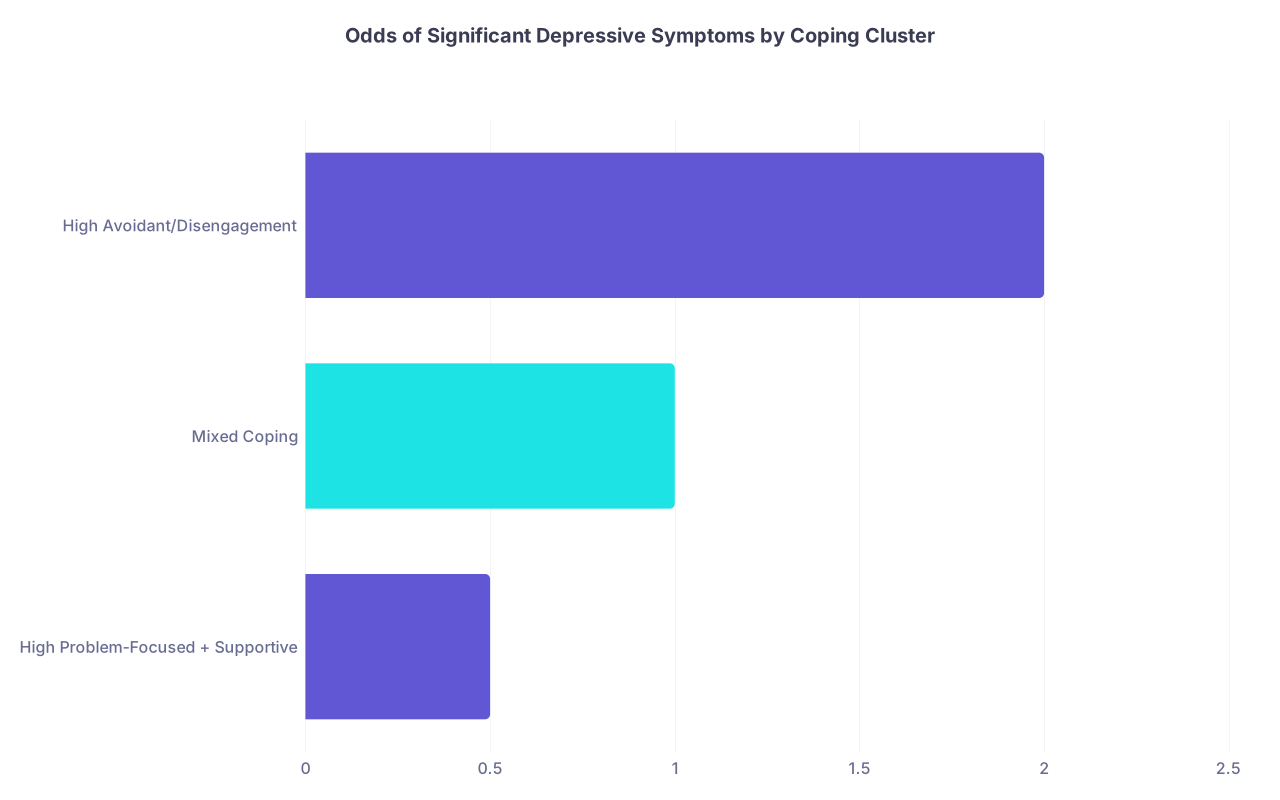
| Category | Value |
|---|---|
| High Problem-Focused + Supportive | 0.5 |
| Mixed Coping | 1 |
| High Avoidant/Disengagement | 2 |
In that chart, 1.0 is the reference (“average” coping). Good coping cuts odds roughly in half. High avoidance doubles them. That pattern repeats across datasets.
The Strategies That Consistently Predict Higher Depression Scores
You probably already know these behaviors feel bad. The data just confirms the damage.
1. Avoidant Coping and Behavioral Disengagement
This is the biggest red flag cluster.
Items:
- “I give up trying to deal with it.”
- “I avoid thinking about it.”
- “I withdraw from others.”
High scores in this domain have some of the strongest positive correlations with depression (r often 0.35–0.50). That is large by psychological standards.
Concrete first‑year patterns:
- Ignoring notifications from course coordinators after a bad exam.
- Skipping lectures for days because “what is the point.”
- Stopping Anki or Q‑banks entirely after falling behind instead of adjusting the target.
When you plug avoidant coping into a regression with everything else — problem‑focused coping, social support, even current GPA — it typically remains one of the strongest predictors of higher depression scores.
Here is the uncomfortable reality:
Two students with the same raw stress and same exam grades can have wildly different depression profiles, and the higher one is often the person who repeatedly chooses short‑term numbness over any kind of plan.
2. Substance Use as Coping
Most med students drink or use caffeine. That alone is not the issue. The problem is using substances as a primary stress management tool.
On coping scales, this shows up as:
- “I use alcohol or other drugs to help me get through it.”
Scores on this subscale are consistently associated with:
- Higher depression scores
- Higher anxiety
- More burnout
Even when overall consumption is not “heavy,” using alcohol as your main decompression strategy correlates with worse mental health.
Why? Because substance‑based coping is almost pure avoidance in disguise. There is no problem solving, no reframing, no actual reduction in the drivers of stress. Just time lost and sleep disrupted.
3. Self‑Blame and Negative Self‑Talk
Self‑blame items:
- “I criticize myself.”
- “I blame myself for things that happen.”
High self‑blame is one of the clearest correlates of depression in med students. In statistical terms, it often sits alongside avoidant coping as a major predictor.
You have heard these lines in study rooms at midnight:
- “I am just stupid.”
- “Everyone else gets this; I am broken.”
- “If I were not lazy, I would not be struggling.”
These thought patterns do two things:
- Increase negative affect directly (unsurprisingly).
- Decrease the likelihood of using problem‑focused coping (“what is the point of changing my strategy if the problem is me?”).
So self‑blame feeds avoidance, which feeds worse performance and higher depression. A loop.
4. Pure Venting Without Any Shift to Action
Venting is tricky. A little venting embedded inside a supportive group can help. But high “venting” scores without corresponding active coping or support seeking often track with worse outcomes.
It sounds like:
- Group chats full of “we are all screwed” with zero discussion of strategy.
- Hour‑long complaints with classmates that never reach “OK, what should we do differently?”
In some studies, “venting” correlates positively with depressive symptoms when you control for everything else. The likely reason: it extends focus on the stressor without movement toward resolution or acceptance.
Putting It Together: What Predicts Lower Depression Scores in Real Students?
Let me synthesize this in a way that is actually usable.
Imagine three archetypal first‑year students with similar academic ability and baseline stress.
| Profile | Coping Traits | Expected PHQ‑9 Range* |
|---|---|---|
| A: Active + Supported | High problem‑focused, high support, good reframing | 3–6 (minimal) |
| B: Mixed / Ambivalent | Some planning, some avoidance, limited support | 6–10 (mild) |
| C: Avoidant + Self‑Blaming | High avoidance, high self‑blame, substance‑based | 10–16 (moderate) |
*Illustrative ranges based on typical group differences reported in the literature. Individuals obviously vary.
In survey after survey, students like Profile A show:
- Lower depression scores
- Lower odds of crossing clinical cutoffs
- Less burnout at the end of the year
Profile C students show the opposite — even when their objective performance is not worse.
The coping patterns do not just reflect how they feel; they help create how they feel over time.
How To Shift Your Coping Profile (Without Magical Thinking)
I am not going to pretend you can “positive think” your way out of a brutal preclinical block. But you can move your coping profile in the direction the data says is protective.
Here is a pragmatic, numbers‑driven way to think about it.

| Step | Description |
|---|---|
| Step 1 | Notice Stress Response |
| Step 2 | Pick 1 small active step |
| Step 3 | Reframe + Ask for support |
| Step 4 | Add 1 support behavior |
| Step 5 | Plan next 24 hours |
| Step 6 | Review impact after 1 week |
| Step 7 | Which pattern? |
Practically, that means:
Replace at least one avoidant response per week with an active one.
- Instead of ignoring a bad quiz, schedule a 20‑minute review with a TA.
- Instead of doomscrolling for an hour, write a simple three‑line plan for tomorrow’s studying.
Increase instrumental support contacts by 1–2 per week.
- Ask an upper‑year for their best resource for a hard topic.
- Join or create a small, focused study group with specific deliverables.
Catch self‑blame and force a reframing test.
When you hear “I am just bad at this,” force yourself to write two alternative explanations that involve changeable factors: method, time allocation, resource choice.Make rest intentional, not accidental.
Schedule 1–2 non‑academic blocks per week that are explicitly for recharge (exercise, hobby, actual sleep), and declare success if you use them and then return to work. That pattern behaves like adaptive coping in the data.
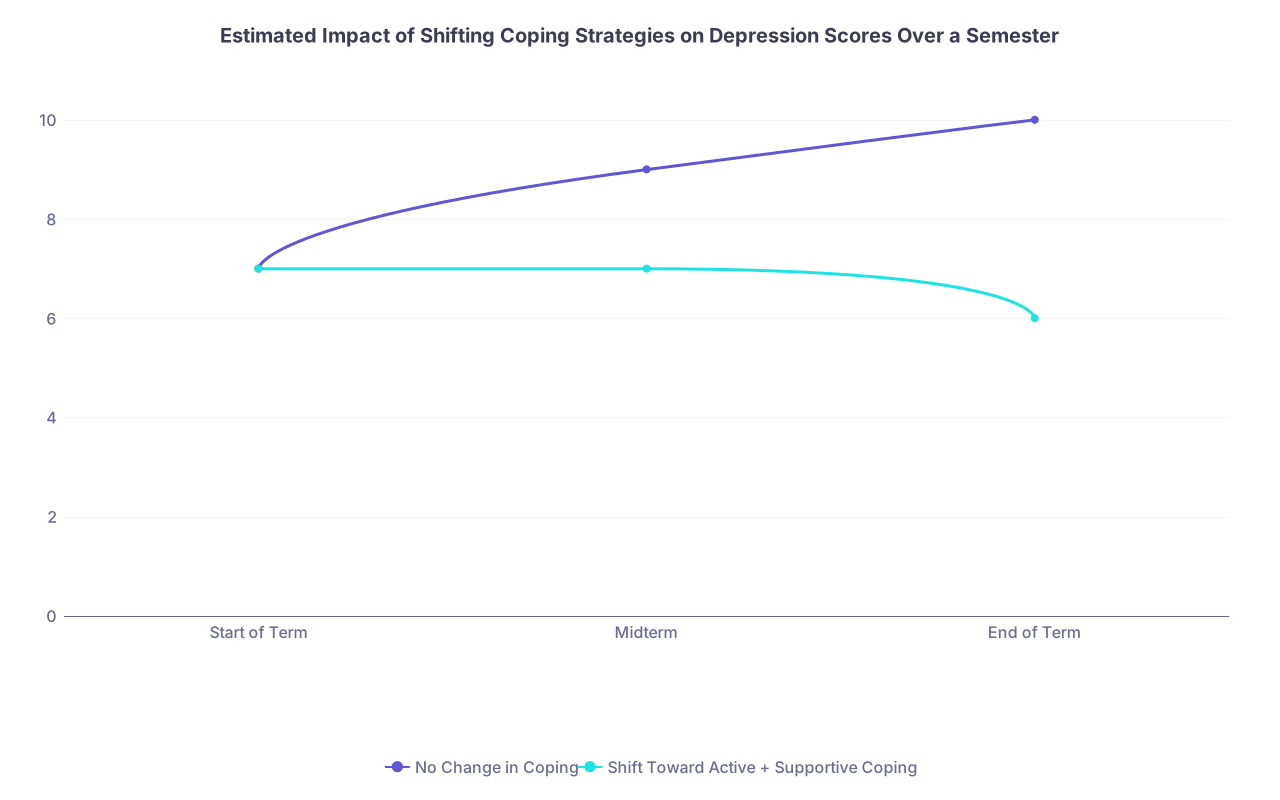
| Category | No Change in Coping | Shift Toward Active + Supportive Coping |
|---|---|---|
| Start of Term | 7 | 7 |
| Midterm | 9 | 7 |
| End of Term | 10 | 6 |
That last chart is stylized, but the pattern is what you see: if you change nothing, average depression scores tend to creep upward over the term. If you systematically shift coping strategies, you can flatten or reverse that curve.
Key Takeaways
- The data is very clear: higher use of problem‑focused coping, instrumental support, and realistic reframing predicts lower depression scores in medical students, even after adjusting for stress and exam performance.
- Avoidant coping, self‑blame, and substance‑based coping are strong predictors of higher depression scores — not just markers of distress, but behaviors that keep you stuck there.
- You do not need a personality transplant; shifting just a few concrete behaviors away from avoidance and toward action and support can move your depression risk profile in the right direction over a single semester.