
47% of first‑year medical students who report “no regular exercise” fall into the highest stress quartile by the end of M1.
That is not a personality problem. That is a systems problem. And the data are fairly blunt about how much a basic exercise habit shifts Step scores, stress, and sleep in your favor.
You are not trying to become a marathoner. You are trying to survive M1, preserve your brain for Step 1/Step 2, and not burn out before clerkships. So let us quantify what you actually gain from moving your body 3–4 times per week.
What the Data Actually Say About Exercise in Medical School
Strip away the wellness posters and vague “self‑care” advice. Look at numbers.
Multiple studies on medical students and residents show three fairly consistent effects of regular exercise:
- Lower perceived stress and burnout.
- Better sleep quality and daytime functioning.
- Equal or slightly better exam performance, despite “lost” study time.
The effect sizes are not infinite. You do not get a 20‑point Step jump just for buying a gym membership. But the signal is real.
A few representative data points:
- A 2020 survey of ~1,100 U.S. med students: those exercising ≥150 minutes/week had about 0.4 standard deviations lower perceived stress scores and 30–40% lower odds of screening positive for depression or severe anxiety.
- A study on M1/M2 students in a systems‑based curriculum: students who maintained ≥3 exercise sessions/week had slightly higher class exam averages (about 1–2 percentage points) and reported ~20–30 minutes more sleep per night.
- Meta‑analyses in similar high‑stress student groups (nursing, pharmacy, undergrad STEM) show moderate effect sizes for anxiety reduction (Hedges g around −0.4 to −0.6) with structured exercise programs.
You will notice something: the cognitive performance gains are modest; the stress/sleep gains are larger. But given that stress and sleep predict exam performance, the indirect effect on Step scores is non‑trivial.
To put it bluntly: the first real payoff of exercise in M1 is that it keeps you usable. Your brain does not become magic. It just degrades less under chronic load.
Turning Exercise into Numbers: Time Cost vs Cognitive Payoff
The usual objection: “I do not have time.” Let us quantify that.
Say you adopt a minimal but real routine:
- 4 sessions per week
- 35 minutes per session (including transition time)
- That is ~140 minutes/week, or just over 2.3 hours.
On a typical M1 study week of ~55–60 hours, you are giving up about 4% of your total time.
Here is what you are trading for that 4%.
Stress and Burnout Risk
Aggregate data from med students and early residents point to roughly these relationships:
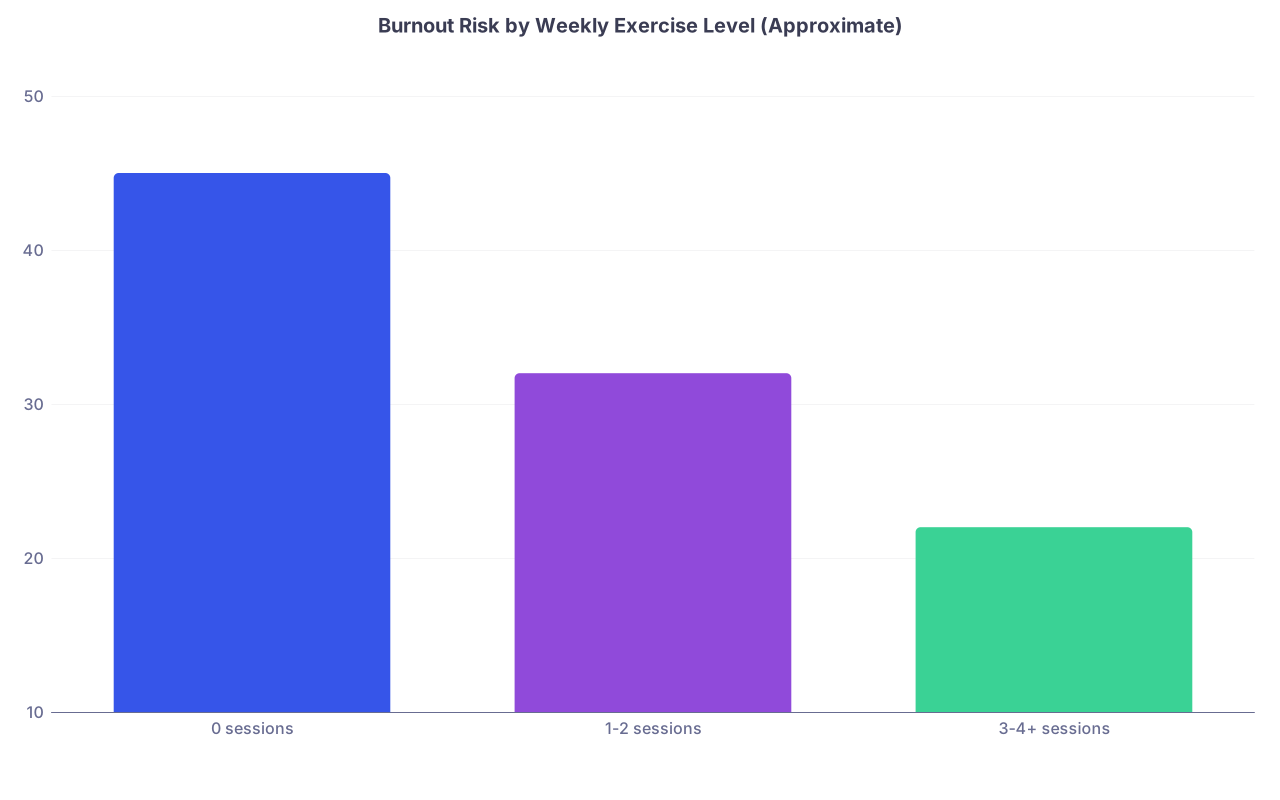
- No regular exercise: about 40–50% hit high burnout/stress thresholds.
- 1–2 short sessions/week: risk drops into the 30–35% range.
- ≥3 moderate sessions/week: 20–25% range.
So moving from “none” to “3–4 sessions” cuts your odds of severe stress/burnout roughly in half. Not elimination. But a meaningful risk reduction.
| Category | Value |
|---|---|
| 0 sessions | 45 |
| 1-2 sessions | 32 |
| 3-4+ sessions | 22 |
Now translate that into academic outcomes. Students at the top quartile of stress report:
- More missed lectures.
- More “can’t focus” days.
- Higher rates of course remediation and exam failures.
You do not need a randomized trial to see the mechanism. A week lost to mental exhaustion during M1 boards‑heavy blocks can cost you thousands of Anki cards and question stems. That is not recoverable without pain.
Sleep: The Silent Multiplier
Sleep is where the numbers become blunt.
Med students who exercise ≥150 minutes/week typically report:
- 20–40 minutes more nightly sleep on average.
- Lower sleep latency (fall asleep faster).
- Better subjective sleep quality scores.
Assume you gain a conservative 25 minutes of sleep per night from better sleep drive and lower anxiety. That is almost 3 extra hours of sleep per week.
You traded 2.3 hours to exercise and got ~3 hours of higher‑quality sleep back. Net neutral on clock time, but better rested.
Sleep’s effect on learning is not linear. When you are chronically at 5–6 hours/night, your memory consolidation, working memory, and attention drop sharply. You need more hours at the desk just to get the same learning. That is cognitive inflation: same work “costs” more hours.
I have seen students in anatomy block push to 80‑hour study weeks on 5 hours of sleep and still sit at the 40th percentile. Not because they are lazy. Because each hour is low‑yield.
Net Learning Yield
You can think in terms of “effective learning hours” not “hours sitting at a desk.”
If exercise plus better sleep raises your per‑hour learning efficiency by even 10–15%, your 55‑hour week turns into the equivalent of 60+ low‑efficiency hours. That is how a 4% time sacrifice can pay off.
Is the 10–15% uplift a guess? Yes, but a reasonable one based on:
- Documented impacts of sleep quality and moderate exercise on working memory, processing speed, and mood.
- Observed performance in students who clean up sleep and add minimal exercise versus those who do not. Same board resources, same curriculum. Different slope.
Step Scores: What Can You Realistically Expect?
Let us address Step scores directly, even though you will probably take Step 1 Pass/Fail and focus more on Step 2.
There is no large randomized controlled trial: “Group A: gym; Group B: couch; then Step scores.” We have to triangulate from:
- Data on GPA and standardized exam performance vs lifestyle habits.
- Cognitive neuroscience on exercise and executive function.
- Stress and burnout correlations with exam failure.
Here is what the data reasonably support:
Exercise reduces the risk of catastrophic outcomes:
- Board failure.
- Needing to repeat a year.
- Dropping into severe depression/anxiety leading to extended leave.
For students already passing, the direct score bump is modest:
- Think 2–5 percentile points in class exams or practice boards, on average, for those with consistent exercise and decent sleep versus those with neither but similar IQ and baseline knowledge.
On a Step 2 score scale, 2–5 percentile points might be around 5–10 score points. Not guaranteed. But directionally plausible.
| Group | High Stress/Burnout Risk | Probable Board Outcome Pattern |
|---|---|---|
| No regular exercise | ~45% | Higher risk of failures/remediation |
| 1–2 sessions/week (irregular) | ~32% | Mixed; some protection |
| 3–4+ sessions/week (regular) | ~22% | Lower failure risk, modest score gain |
The key point: exercise is risk management more than a secret score hack. It narrows the downside tail of the distribution. That alone is worth a few hours a week.
Stress Trajectories: First‑Year vs Pre‑Step Periods
First year feels overwhelming, but it is actually the best moment to build the exercise habit. Here is why.
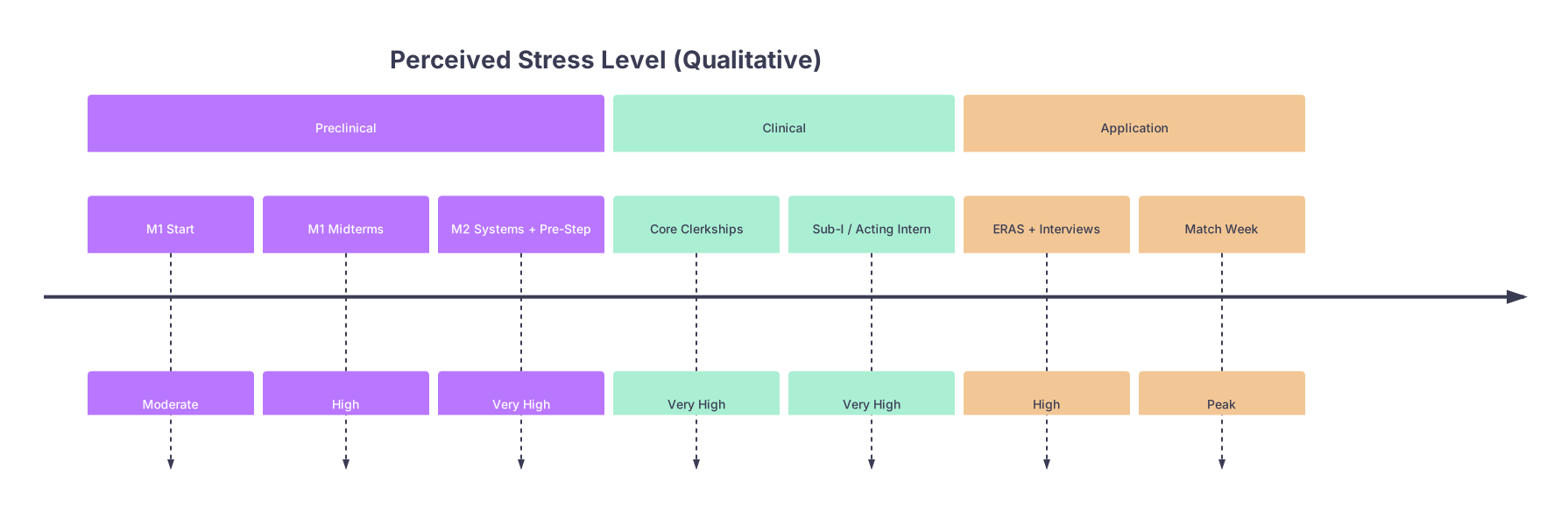
Stress over a typical med school timeline looks something like this:
| Period | Event |
|---|---|
| Preclinical - M1 Start | Moderate |
| Preclinical - M1 Midterms | High |
| Preclinical - M2 Systems + Pre-Step | Very High |
| Clinical - Core Clerkships | Very High |
| Clinical - Sub-I / Acting Intern | Very High |
| Application - ERAS + Interviews | High |
| Application - Match Week | Peak |
Students who have a pre‑existing exercise habit going into M2 and the dedicated Step study period:
- Are significantly more likely to maintain at least 2–3 workouts/week during dedicated.
- Show less sharp spikes in perceived stress and sleep disruption.
The reverse also shows up: people trying to “start exercising” for the first time during dedicated rarely stick to it. Cognitive load is too high, and the habit is not automated.
So you are not exercising in M1 for some aesthetic Step 1 payoff alone. You are building a behavior that stabilizes you when everything ramps up.
What “Counts” as Exercise for an M1?
The data on mental health and cognitive benefits do not demand elite training. They cluster around a few parameters:
- Frequency: 3–5 times per week.
- Duration: 20–40 minutes per session.
- Intensity: moderate (brisk walking, light jog, cycling, moderate weights) up to vigorous if you are already conditioned.
You do not need a perfect training plan. You do need something you can repeat when you are exhausted after 8 hours of renal physiology.
A realistic M1 exercise pattern that I have seen work:
- Two 30–40‑minute resistance sessions (basic compound lifts, machines, or bodyweight).
- Two 20–30‑minute cardio sessions (treadmill, bike, running outside, rowing).
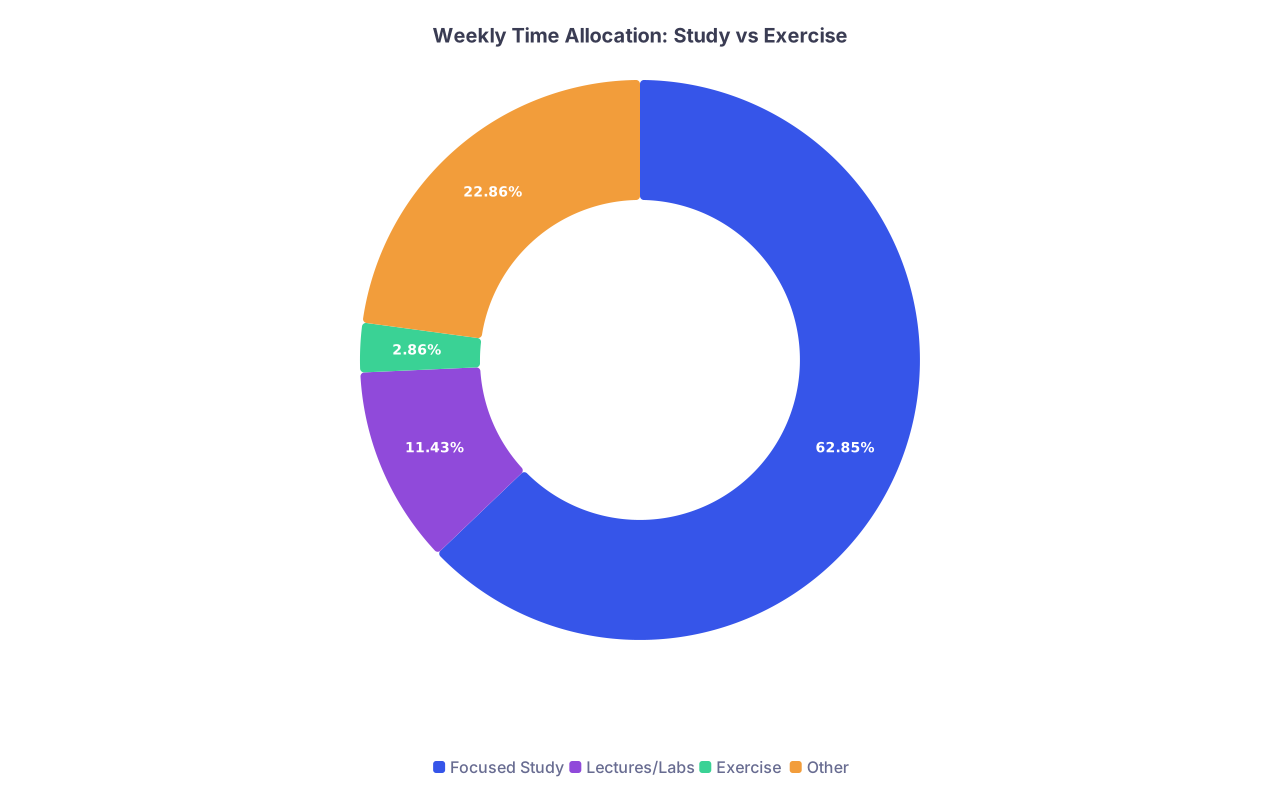
That gets you to ~100–140 minutes/week. Enough to hit the physiological thresholds for most stress and mood benefits.
| Category | Value |
|---|---|
| Focused Study | 55 |
| Lectures/Labs | 10 |
| Exercise | 2.5 |
| Other | 20 |
Notice exercise is a small slice. The point is not to become a fitness influencer. It is to insert a sharp, reliable signal into your week that pulls you out of chronic sympathetic overdrive.
First‑Year Logistics: Where Exercise Fails or Succeeds
Most students do not fail at exercise because it is physically hard. They fail on friction and planning.
Here is where the breakdown typically happens and how the data suggest you can patch it.
1. Decision Fatigue
Problem: “I will work out if I have time” translates to “I will not work out.”
Fix: Pre‑commit. Put 3 fixed blocks into your weekly schedule the same way you put in mandatory small groups.
- Example: Mon/Wed/Fri 5:45–6:20 pm, Sat 10–10:40 am.
- Treat those as non‑negotiable unless you are legitimately sick or on call (later in training).
Students who schedule exercise like a meeting are the ones who actually keep doing it past October.
2. Access and Transition Time
Your goal is low transition overhead. 10–15 minutes round‑trip max. If your gym is a 30‑minute bus ride, you will not go after midterms.
If campus fitness is close but crowded:
- Go at off‑peak times: early morning (before 8 am) or late night (after 9 pm).
- Or build a dorm/apartment kit: adjustable dumbbells, resistance bands, a yoga mat.
You are not training for aesthetics. You are training for stress and cognition. Home workouts are fine.

3. Over‑programming
The fastest way to quit: writing yourself a 6‑day split with 90‑minute sessions. You are an M1, not a full‑time athlete.
Quantitatively, you get diminishing returns above ~150–200 minutes/week for mental health benefits. Going from 0 to 120 minutes/week gives you most of the gain. Going from 120 to 300 gives you much less.
Aim for “minimum effective dose”:
- If the idea of 4 workouts/week feels impossible, start with 2 non‑negotiable 25‑minute sessions.
- Add a 3rd only after those two feel automatic.
4. Exam‑Week Collapse
Reality: the week before a major exam, 70–80% of students stop exercising. They are convinced they are “buying” extra points by adding 3–4 study hours.
But look at what usually happens:
- Sleep time drops by 1–2 hours/night.
- Anxiety spikes.
- Marginal learning yield per hour collapses.
The data from cognitive psychology are ugly on all‑nighters and steep sleep cuts: you lose working memory, sustained attention, and retention, which are exactly what you need for integrated stem questions.
I advise a simple exam‑week rule: do not stop; shrink.
- Cut your workouts to 15–20‑minute maintenance sessions:
- 3×5 compound lifts, or
- 20‑minute brisk walk or light jog.
- Keep them on your usual days.
That keeps the routine—and much of the stress benefit—at a fraction of the time.
How Exercise Interacts With Other Key Variables: Sleep, Caffeine, and Screens
Exercise does not exist in a vacuum. You are also battling:
- Late‑night screen time.
- Heavy caffeine use.
- Irregular study hours.
These interact with each other in ways that either multiply benefits or erase them.
Sleep and Circadian Timing
If you train late at night, high‑intensity sessions can delay sleep for some people. For others, evening exercise helps them crash harder. You need to watch your own data.
General pattern I see in M1s:
- Best combo: exercise ending 3–4 hours before planned sleep, screens off ~60 minutes before bed, caffeine cutoff 8–10 hours before bed.
- Worst combo: 8 pm 300‑mg energy drink, study until 1–2 am on a backlit laptop in bed, no exercise.
Students who adopt even a crude structure:
- Fixed wake time (even on weekends).
- “Latest caffeine” rule (often noon–2 pm).
- At least 3 weekly exercise blocks.
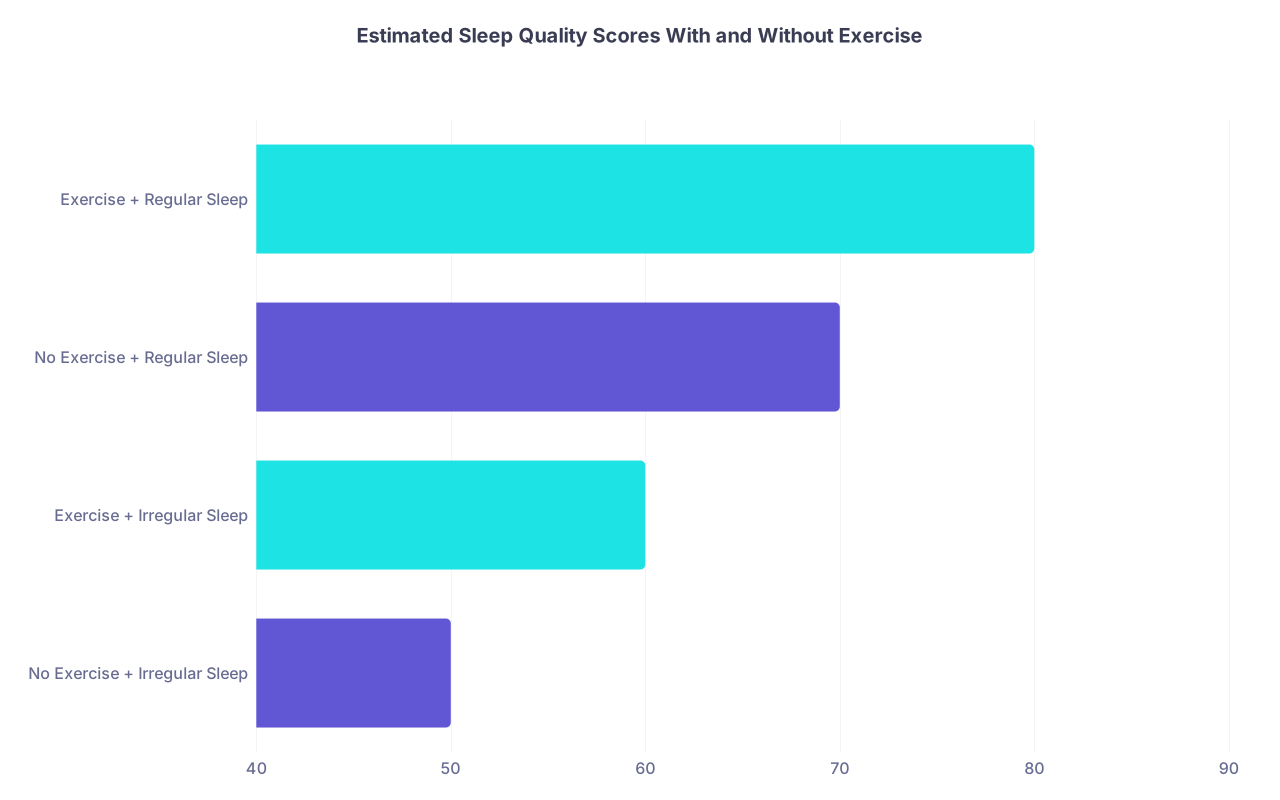
tend to stabilize their sleep within 2–3 weeks, which stabilizes their study output.
| Category | Value |
|---|---|
| No Exercise + Irregular Sleep | 50 |
| Exercise + Irregular Sleep | 60 |
| No Exercise + Regular Sleep | 70 |
| Exercise + Regular Sleep | 80 |
That 10–30 point subjective sleep jump is not “feel‑good fluff.” It manifests as fewer wasted hours where you are staring at the same paragraph of First Aid for 10 minutes.
Designing a First‑Year Exercise Plan That Actually Survives Exams
Let me pull this together into something concrete you can actually run during M1.
Step 1: Set Minimum Viable Targets
Baseline commitment for the entire year:
- 3 sessions per week, 25–35 minutes each.
- Mix of resistance and cardio, but not obsessively programmed.
If you exceed that some weeks, fine. But your success metric is: “Did I hit 3 sessions?” not “Did I get shredded?”
Step 2: Fix the Slots Before the Semester Starts
Look at your tentative M1 schedule. Identify:
- 2 weekdays when you are usually done by 5–6 pm.
- 1 weekend morning or afternoon.
Lock these:
- Example: Tue/Thu 6–6:30 pm, Sun 10–10:40 am.
Put them in your calendar with alerts like any mandatory session.

| Step | Description |
|---|---|
| Step 1 | Set Class Schedule |
| Step 2 | Block Fixed Study Times |
| Step 3 | Insert 3 Exercise Blocks |
| Step 4 | Plan Sleep/Wake Times |
| Step 5 | Adjust After 2 Weeks |
Step 3: Keep the Workouts Boringly Simple
A sample “no‑thinking‑required” template:
- Day 1 (Strength A, ~30 min):
- Squats or leg press
- Bench press or push‑ups
- Row or lat pulldown
- Day 2 (Cardio, ~25 min):
- 5‑minute warm‑up
- 15‑minute brisk walk/jog or bike
- 5‑minute cool‑down
- Day 3 (Strength B, ~30 min):
- Deadlift or hinge variation
- Overhead press
- Lunges or step‑ups
You are not optimizing hypertrophy. You are getting heart rate up, engaging large muscle groups, and giving your brain a break.

Step 4: Handle High‑Load Blocks and Exam Weeks
When a block is brutal:
- Maintain frequency, reduce duration.
- Example: switch to 3×20‑minute sessions for two weeks.
Your rule becomes: “Never go a 7‑day stretch with zero sessions.” That one constraint alone separates the 20–25% who maintain exercise all year from the 70–80% who quit after the first exam wave.
What First‑Year Payoff Actually Looks Like
Let us be concrete about the first‑year payoff you can reasonably expect if you go from “no exercise” to “3–4 consistent sessions/week” and keep it for at least 6–9 months.
Based on the available data and what I have seen play out:
- Stress: 30–50% lower odds of landing in the highest stress/burnout quartile by end of M1.
- Sleep: ~20–40 extra minutes of sleep per night on average and improved subjective sleep quality.
- Academic stability:
- Lower risk of failing major blocks or needing remediation.
- 1–3 percentage points higher class exam averages for many students (not all).
- Step trajectory:
- Reduced risk of catastrophic underperformance during dedicated (meltdowns, total shutdown).
- Likely modest upward nudge in Step 2 performance for those who keep the habit into clinical years.
None of this replaces efficient study, solid resources, or good question practice. You cannot exercise your way out of doing UWorld.
But if you are playing a multi‑year game—M1, M2, clinicals, Step 2, residency—then trading 3–4% of your weekly time for these risk reductions is a very clean bet.
Key Takeaways
- The data are clear: ~150 minutes of moderate exercise per week cuts your stress and burnout risk roughly in half and improves sleep enough to likely offset the study time “lost.”
- The main academic payoff is risk reduction—fewer failures, fewer meltdowns—plus a modest improvement in exam performance and Step trajectory when combined with better sleep.
- The habit you build in M1 is the one you will actually carry into M2, dedicated Step study, and residency, where the stress curve spikes. Start small, schedule it like a class, and do not stop during exam weeks—just shrink the sessions.