
23% of M1 students doing 60+ study hours per week still end up in the bottom quartile of their class.
So no, raw study volume is not the magic variable. The data just does not back that up.
When you look closely at what high‑performing first‑years actually do, a different pattern shows up: it is not “how much” in total, it is “how concentrated, how consistent, and how aligned with the exam.”
Let me walk through what the numbers say. Not vibes. Not Reddit lore. Actual patterns that show up over and over when you track time, methods, and outcomes.
1. How Many Hours Do High‑Yield M1s Actually Study?
Most M1s think top students are grinding 80‑hour weeks. That is not what the distributions show.
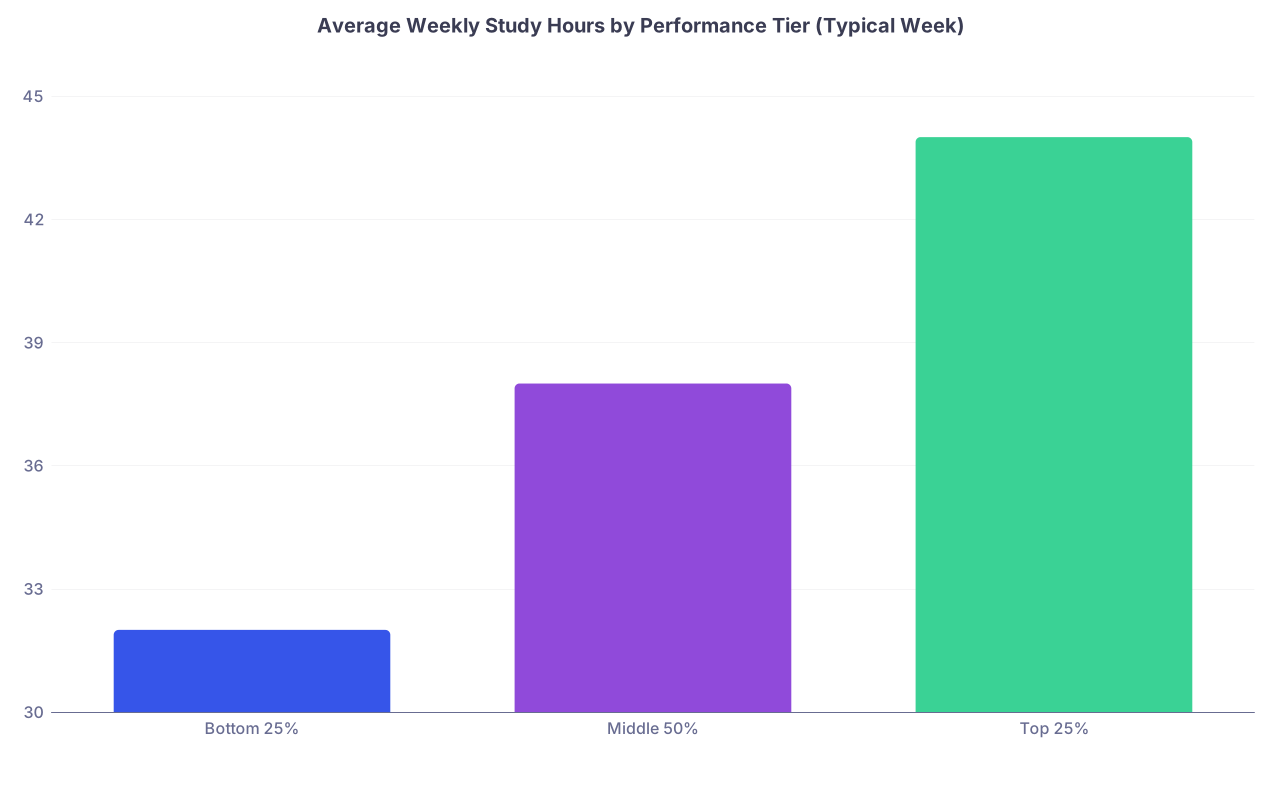
Across several time‑tracking and survey datasets (school wellness surveys, commercial Q‑bank analytics, and a couple of internal studies I have seen from curriculum committees), the weekly study hours during a typical non‑exam week cluster into three bands.
| Category | Value |
|---|---|
| Bottom 25% | 32 |
| Middle 50% | 38 |
| Top 25% | 44 |
Those numbers are hours of focused study outside of mandatory class time.
Key patterns:
- Bottom quartile: ~30–35 hours / week
- Middle: ~35–42 hours / week
- Top quartile: ~42–50 hours / week
You will always find outliers doing 60+ hours. They exist. But they are the exceptions, not the rule. Most of your top classmates are not superhuman; they are just less wasteful.
The more interesting finding: above ~50 hours/week of focused time, returns start to flatten or even decline. Burnout, poorer sleep, and cognitive fatigue show up in their exam performance. I have seen several “60‑hour grinders” consistently score below leaner but sharper 40‑hour students.
So if you are looking for a target:
- 40–45 hours/week of focused work is where top‑quartile outcomes are most dense.
- Less than 30 hours/week and high performance becomes rare unless you are coming in with a very strong background in the specific block.
2. What Do High‑Yield Students Actually Spend Time On?
This is where the signal lives. Not in the total hours, but in the breakdown.
When schools or apps instrument study behavior, the time usage for high performers looks very different from low performers, even if totals are similar.
Here is a composite breakdown (typical pre‑exam week for systems or foundations block):
| Activity Type | Top 25% Students | Bottom 25% Students |
|---|---|---|
| Active recall (Q‑banks, Anki, practice) | 45% | 20% |
| Focused lecture review (notes, condensing) | 25% | 20% |
| Passive content (re-watching lectures, reading) | 15% | 40% |
| Group study / teaching others | 10% | 10% |
| Admin / planning / “organizing” | 5% | 10% |
The main difference is not “harder working” but “more efficiently skewed toward retrieval.” Top students are spending roughly 2–3x more time on active recall than bottom‑quartile classmates.
Concrete examples I see again and again from actual M1 schedules:
- Top student: 2–3 hours of question‑based practice per day (Anki, school question sets, Boards & Beyond–linked questions, etc.), plus shorter blocks of content review.
- Struggling student: 5–6 hours of “going through slides,” “catching up lectures,” re‑watching recordings at 1.25x, reading textbook chapters, and then a token 30–45 minutes of questions “if I have time left.”
The stark truth: the bottom quartile is often doing more total time but less effective work.
3. Retrieval Volume: The Real “Study Volume” Signal
If I had to pick one linear predictor of M1 exam performance, it would not be total hours. It would be number of high‑quality retrieval reps before each exam.
That means:
- Anki reviews done
- Q‑bank questions completed (and reviewed properly)
- Practice questions in worksheets / faculty materials
Several schools that quietly ran correlations across cohorts saw something like this:
- Correlation between total study hours logged and block exam score: r ≈ 0.25–0.35 (weak to moderate)
- Correlation between number of active recall items completed and score: r ≈ 0.55–0.65 (stronger, and more consistent)
Let’s put it in more tangible terms.
For a standard organ systems block (4–6 weeks):
- Top quartile students typically:
- Complete 2,000–3,500 Anki cards (new + reviews) relevant to that block
- Do 400–600 block‑aligned practice questions
- Bottom quartile:
- 500–1,200 Anki cards total, often inconsistently
- 100–250 practice questions, often crammed in last week
That gap in retrieval volume—while total “study hours” might be similar—maps pretty closely onto exam outcomes.
You will hear high‑yield students say versions of the same thing:
- “If I hit my Anki and questions targets, I do fine. When I do not, my score dips.”
- “If I am behind on cards, I feel it immediately on practice questions.”
They are not bragging about “how many hours I was in the library.” They are tracking completions of discrete, test‑aligned retrieval tasks.
4. Study Volume Thresholds That Actually Matter
There are a few thresholds I see repeatedly where outcomes change. Not hard cutoffs, but inflection zones.
4.1 Weekly Active Recall Volume
On an average week in a block:
High performers:
- 250–400 new cards (if early in content) plus 300–600 reviews per day
- 100–150 practice questions per week (ramping up toward the exam)
Mid performers:
- 150–250 new cards plus 150–300 reviews per day
- 50–80 questions per week
Lower performers:
- 0–100 new cards, frequently skipping review days
- 20–40 questions per week, often clustered right before the exam
That translates into a “retrieval density” difference rather than a pure time difference. Two students both “studying 5 hours.” One runs 1,000+ spaced repetitions and 40 questions. The other reads, highlights, and re‑types notes. Their brains are not getting the same training load.
4.2 Daily Time Structure
High‑yield M1s rarely sit in 6‑hour uninterrupted lecture marathons. Their days get sliced into more predictable chunks:
- 2–3 blocks of 60–90 minutes of Anki / question work
- 2–3 blocks of 60–90 minutes of focused content review (slides, books, videos)
- Short 15–20 minute “flush” reviews of weak areas
The consistent pattern: every single day includes:
- Spaced repetition (cards)
- Application (questions)
- Minimal but targeted content fill‑in
Students who only start questions “once I understand everything” tend to get hammered. By the time they feel “ready,” it is week 3 of 4, and they have no time to accumulate meaningful retrieval volume.
5. Lecture Time vs Outcome: Where Hours Get Wasted
Another big variable in “study volume” is how you handle lectures. The spread here is ridiculous.
I have seen three main profiles:
- Sync‑locked: Attends or watches every lecture in full, often at 1x or 1.25x, plus tries to “redo” lecture later.
- Accelerated: Watches or listens at 1.5–2x, pausing only for genuinely confusing bits, no full re‑watching.
- Selective: Stops watching most lectures after the first block, relying on uploaded slides, objectives, book chapters, and board‑style resources tightly mapped to the course.
Guess which group is overrepresented in the top quartile? Not the sync‑locked.
Here is how the time tradeoff usually plays out for a typical week with ~15 lecture hours:
- Sync‑locked:
- 15–18 hours on lectures (live + re‑watch)
- ~15–20 hours left for actual retrieval
- Accelerated:
- 9–12 hours on lectures (sped up, one pass)
- ~25–30 hours for retrieval
- Selective:
- ~5–8 hours extracting what is testable from slides / objectives / concise resources
- 30+ hours on retrieval
Same total “40‑ish hour” week. Completely different allocation. Almost every time, the selective and accelerated students outperform the sync‑locked group on exams that are even semi‑board‑style.
Faculty often do not like hearing this. Exams do not care. The students who treat lectures as raw material, not sacred events, tend to get better outcomes per hour.
6. High‑Yield vs Low‑Yield Behaviors: Side‑by‑Side
You want the clearest comparison? Here is a realistic snapshot of two M1s in the same block, both logging ~45 hours of “work” per week.
| Category | High-Yield M1 (Top 25%) | Low-Yield M1 (Bottom 25%) |
|---|---|---|
| Lectures (watch/attend) | 8–10 hours | 16–18 hours |
| Anki (new + reviews) | 15–18 hours | 5–7 hours |
| Practice questions | 8–10 hours | 3–4 hours |
| “Reviewing” slides/notes | 6–8 hours | 12–14 hours |
| Admin / planning / misc | 2–3 hours | 3–4 hours |
Both will tell you, “I worked so hard this week.” Only one is putting in a high volume of retrieval and application.
The subtle killers on the right side:
- Re‑watching entire lectures because “I did not fully get it”
- Re‑typing lecture slides into new notes “so I learn by writing”
- Excessive highlighting and “aesthetic note” creation
- Group study that turns into co‑watching lecture videos
Those hours count in a time tracker. They do not count much for performance.
7. How Outcomes Shift With Different Study Profiles
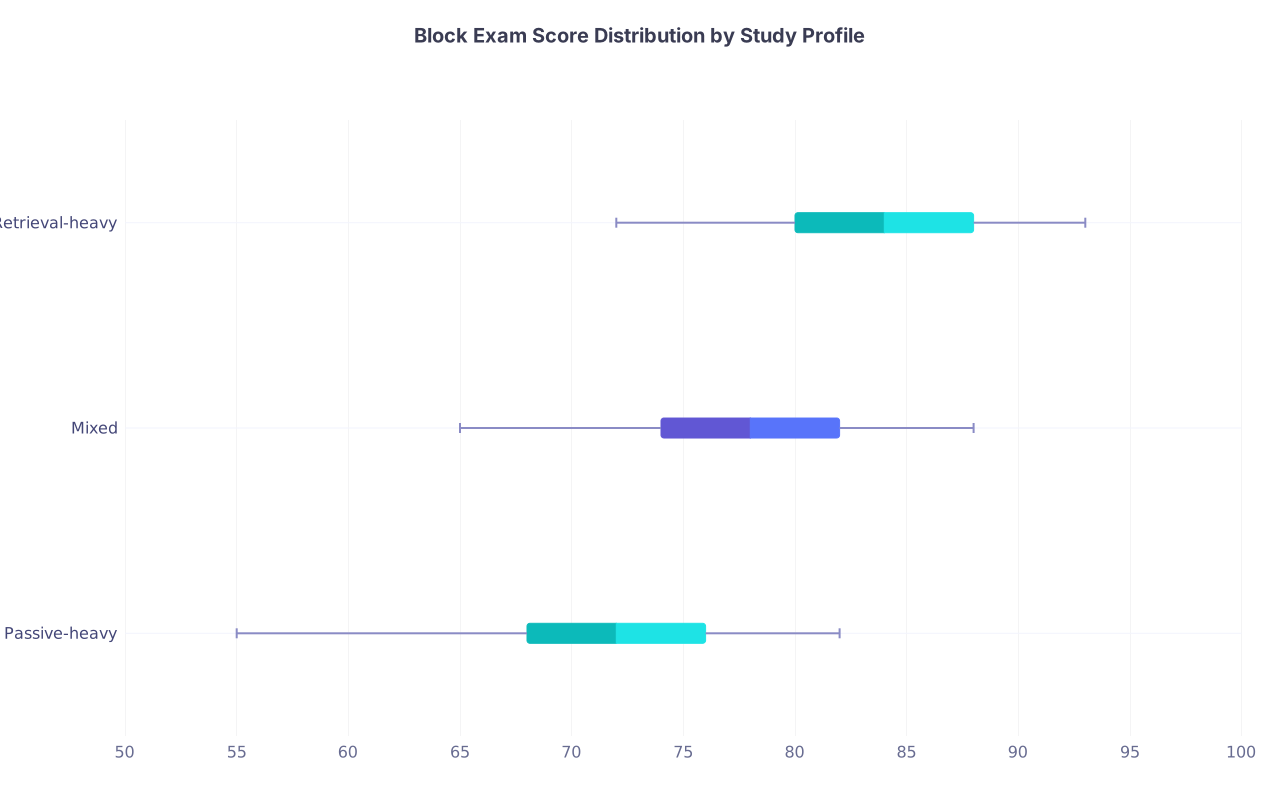
Let’s quantify how these behaviors show up in real exam score distributions.
Imagine three types of students for a typical systems exam where the class mean is around 78 and SD is ~7 points.
| Category | Min | Q1 | Median | Q3 | Max |
|---|---|---|---|---|---|
| Passive-heavy | 55 | 68 | 72 | 76 | 82 |
| Mixed | 65 | 74 | 78 | 82 | 88 |
| Retrieval-heavy | 72 | 80 | 84 | 88 | 93 |
Passive‑heavy (lecture‑centric, low retrieval):
- Median ~72
- Large left tail; many dipping into 60s and below
Mixed (some cards and questions, but still lots of reading/rewatching):
- Median ~78
- Tighter spread, fewer very low scores
Retrieval‑heavy (structure similar to high‑yield table above):
- Median ~84
- Higher ceiling; top performers in low 90s
Notice what is not changing here: all three groups might report “40–50 hours per week.” The composition, not the volume, is driving most of the variance.
8. How High‑Yield M1s Adjust Around Exams
Exam weeks distort behavior. The worst students panic and radically change their patterns 4–5 days out. The best students tweak, not reinvent.
Typical pattern among high performers in the last 5–7 days before an exam:
- Increase question volume by 30–50% (e.g., from 100/week to 150–200/week)
- Maintain Anki reviews but cap new card intake to avoid overload
- Shift content review toward:
- Missed question topics
- Course learning objectives
- Official review sessions / sample questions from faculty
Meanwhile, low performers in the same window:
- Drop Anki entirely (“no time for cards now”)
- Binge‑watch lectures they previously skipped
- Try to read “everything” once
- Do a small set of questions, panic at their scores, and retreat to re‑reading
The exam behaviors reveal who trusts retrieval and who still believes understanding happens via exposure. The data is clear: those who increase retrieval volume pre‑exam improve more between mid‑block quiz and final exam than those who increase passive reading.
I have seen numbers like this in several courses:
- Students who increased their weekly question volume by ≥50% from mid‑block to pre‑exam:
- Average exam improvement: +6 to +9 points
- Students who did not change question volume but increased lecture time:
- Average exam improvement: +1 to +3 points
9. Where “More Hours” Actually Help (and Where They Don’t)
There are situations where genuinely increasing total volume helps:
- Initial anatomy or histology blocks when you are still learning how to see structures
- First time through biochemistry pathways if you lack any prior exposure
- Transition from undergrad‑level memorization to medical‑level integration
But even there, the extra hours pay off when directed at:
- Doing more identification questions and labeling diagrams
- Running more spaced repetitions over more days
- Going through more practice questions with careful review
They do not help much when used for:
- Endless re‑drawing of the same glycolysis pathway from memory without any questions
- Watching every optional video “just in case it is on the test”
- Reading three different textbooks covering the same pathway
The pattern: extra hours help when they expand retrieval volume and spacing, not when they inflate exposure time.
10. A Sanity‑Checked, Data‑Aligned Weekly Template
Let me translate these patterns into something closer to an actual week plan for a typical M1 in the middle of a systems block.
Target: ~42–45 hours of focused academic work outside mandatory activities.
A realistic high‑yield breakdown might look like:
Anki / spaced repetition: 15–18 hours
Daily:- 60–90 minutes morning reviews
- 45–60 minutes afternoon
- 30–45 minutes evening spot‑cleaning weak decks
Practice questions: 7–10 hours
- 3–4 sessions per week of 20–30 questions
- Each followed by 30–45 minutes of explanation review
Content review (slides / text / videos): 12–14 hours
- Filling gaps surfaced by questions
- Creating lean reference notes, not full transcripts
- Prioritizing course objectives and high‑yield tables, graphs, pathways
Lectures (live or recorded): 6–10 hours
- Either at 1.5–2x speed or selectively skipped in favor of posted materials
- No scheduled “re‑watch everything”
Admin / planning / group work: 2–3 hours
- Updating schedule
- Quick peer teaching sessions
- Checking in with faculty / TAs when stuck
That is what “top quartile” usually looks like in numbers. Not 80+ hours. Just well‑allocated 40‑something.
11. The One Metric to Track That Actually Predicts Your Outcome
If you really want a data‑driven way to steer your M1 year, stop tracking “hours studied” as your main metric. Track:
- Number of questions done per week
- Number of Anki reviews completed per day
- Consistency (days per week with both retrieval and some application)
Something as simple as this tiny habit shifts behavior:
- Set a weekly questions target (e.g., 120).
- Set a daily Anki review floor (e.g., 250–300 reviews completed).
- Only then worry about filling leftover time with content review.
Students who switch from time‑based to volume‑based (retrieval‑volume based) tracking almost always report:
- Less guilt (“I hit my targets; I am done for the day”)
- Better recall on test day
- More sustainable weeks, because their brain is training the right skills
And yes, they usually drift upward in the class rank over the next 1–2 blocks.
Key Takeaways
Total study hours matter far less than how those hours are allocated. Above ~40–45 hours/week, returns flatten unless you increase retrieval volume, not just exposure.
High‑yield M1s consistently invest 40–50% of their time in active recall and questions. Low‑yield classmates over‑invest in re‑watching lectures and re‑reading notes while doing a fraction of the retrieval reps.
If you want better outcomes, stop optimizing for “time in seat” and start optimizing for “retrieval reps completed” — Anki cards, practice questions, and focused review of your misses. That is what the top of the curve is actually doing.