
Faculty are judging your coping skills from week one. Long before anyone asks “How are you doing?” they’ve already formed an opinion.
Not about your grades. About your breaking point.
Let me tell you what really happens behind the scenes in M1: attendings, small-group preceptors, course directors, and deans are constantly scanning for one thing—whether you can function under pressure without falling apart or becoming a problem they have to manage.
Not because they’re evil. Because they’ve seen what happens when someone can’t cope and still gets handed real patients.
You think you’re being evaluated on exam scores and attendance. Those are the easy metrics. The real assessment is quieter: how you react when you are overloaded, embarrassed, exhausted, or wrong.
And yes, this absolutely affects your future letters, opportunities, and how much slack you’ll get when things go sideways.
Let’s walk through how they actually judge you—and what you can do about it without faking some robotic “resilience” persona.
What Faculty Really Care About (That Nobody Tells You)
In closed-door meetings, faculty do not say, “Her Anki streak is amazing” or “He always sits in the front row.” They say things like:
- “She melts the minute she’s challenged.”
- “He takes feedback badly.”
- “You can push her and she adjusts.”
- “He gets quiet under stress, but he still shows up and communicates.”
Program directors and clerkship directors later read between the lines of letters: “handles stress appropriately,” “remains calm in high-pressure situations,” “is very receptive to feedback”—those are code phrases born from what started in your first year.
Here’s the uncomfortable truth: M1 and M2 are their simulation lab for your coping skills. No real patients yet. Minimal consequences if you crumble on an exam. So they observe how you deal with controllable stress before they put you anywhere near uncontrollable stress.
They’re watching for three things in particular:
- Do you maintain function under routine academic pressure?
- Do you respond to failure with adjustment or with drama?
- Do you ask for help early and appropriately, or do you implode silently then expect a rescue?
You can be introverted, anxious, or not naturally confident and still be seen as “coping well.” What kills you is chaos, denial, and emotional spillover into professionalism.
Where They’re Quietly Evaluating Your Coping Skills
They’re not judging you most on your best days. It’s the cracks they’re cataloging.
1. After Your First Bad Exam
That first tanked exam? That’s a faculty Rorschach test on you.
Here’s what typically happens at many schools:
- The course director prints a grade histogram.
- Anyone below some internal threshold (say <70%, or bottom decile) gets flagged.
- Names go on a “keep an eye on” list. That list gets shared in promotion committee meetings and sometimes with your advisor.
Now, what they do next depends entirely on your behavior.
Common patterns they talk about:
The Vanisher
Misses a few optional sessions, stops emailing back, avoids office hours. Eventually sends a panic email two days before the next exam: “I think I may be failing.”
Translation in faculty meetings: “Poor insight, poor self-monitoring, may be a problem on the wards when things get busy.”The Externalizer
Comes in furious: “The exam was unfair,” “You didn’t teach that,” “The class average is too low.”
Translation: “Difficulty owning performance, will blame systems not self—dangerous pattern for clinical errors.”The Over-Apologizer
Shows up crushed: “I’m so sorry, I’m such a disappointment, I promise this will never happen again.”
Faculty aren’t monsters—they feel for you. But privately: “Very fragile self-concept. Might not tolerate the normal failures of medical training.”The Adjuster
Comes in with: “I didn’t do well. Here’s what I think went wrong. I tried X and Y. I could use help fine-tuning my approach.”
Translation: “Good insight, responds to stress with problem-solving. Investable.”
They do not expect perfection. They do expect some combination of awareness, ownership, and adjustment.
If you quietly implode, they notice. If you rage outward, they notice more.
2. In Small-Group Sessions and Clinical Skills
You think those communication and small-group sessions are fluffy boxes to check. Faculty think of them as live-fire exercises in stress tolerance and interpersonal coping.
Patterns I’ve heard directly in debrief rooms:
“He shuts down when he’s wrong.”
The student is called on, answers incorrectly, gets corrected—and mentally leaves the room for the next 20 minutes. Won’t speak up again. Faculty label that: brittle ego, low frustration tolerance.“She gets defensive whenever corrected.”
Classic phrases: “I knew that, I just misspoke,” “That’s not actually what I meant.” Repeatedly. That triggers a huge red flag, because on the wards, defensiveness is poison.“He laughs when he’s uncomfortable.”
Nervous laughter while a standardized patient is describing chest pain, or while discussing serious topics. They understand anxiety, but they also see how you handle discomfort.
They’re not just listening to what you say. They’re watching how you recover after:
- Being wrong in front of peers
- Being corrected gently but publicly
- Being asked a question you did not expect
The student who says, “Oh, got it—so I was mixing up X and Y,” and then keeps participating? Faculty immediately categorize that person as having usable coping skills.
The student who disengages or becomes sullen? That goes in the narrative. It shows up later as “benefits from supportive learning environment” or “sensitive to criticism.”
3. Email and Communication Under Stress
You’d be shocked how much faculty judge you by your emails when you’re stressed.
The subtext they’re reading:
- Timing – Do you email the night before the exam with a meltdown, or early and matter-of-fact?
- Content – Is it facts and a plan, or emotion and vague distress?
- Tone – Are you respectful and concise, or dramatic and demanding?
Common faculty comments:
- “This student tends to escalate small issues.”
- “Communications are often urgent and poorly thought-out.”
- “Handles scheduling conflicts professionally and early.”
They save those emails. When a pattern emerges, that’s your reputation.
If you email:
“Dear Dr. X, I’m having some difficulty managing the volume in this block. I’ve adjusted my schedule but I’m still concerned about [specific issue]. Do you have 15 minutes sometime this week to discuss strategies?”
That reads as: coping under stress, seeking help early, not making your distress everyone else’s emergency.
4. How You Show Up Over Time, Not Just Once
Faculty pay attention to trajectories.
Everyone has a bad week. What they really care about is whether you bounce back or spiral.
They’ll talk about you in these terms:
- “She was overwhelmed early, but she stabilized and found a groove.”
- “He’s steadily decompensating. More absences, more excuses.”
- “She’s consistent. Even when she’s stressed, she does what she says she’ll do.”
At promotions and professionalism meetings, they don’t just look at isolated incidents. They look at patterns of:
- Late assignments
- Missed small groups
- Last-minute crisis emails
- Repeated requests for exceptions
- Emotional outbursts or tears in settings where others are managing
This isn’t about punishing emotion. It’s about asking: “Will this person fall apart when they’re on nights and three patients code?”
You’re building a longitudinal story—whether you mean to or not.
The Quiet Rubric They’re Using For “Coping”
Nobody hands you this rubric, but it runs in the background of every faculty discussion.
| Coping Area | What Faculty Look For |
|---|---|
| Response to Failure | Ownership, adjustment, not drama |
| Use of Resources | Early, appropriate, not crisis-only |
| Emotional Regulation | Can be distressed but still professional |
| Feedback Response | Non-defensive, integrates corrections |
| Reliability Under Stress | Shows up, follows through, communicates clearly |
They don’t expect you to be calm and happy all the time. They expect you to:
- Still be able to function when you are not okay.
- Signal problems before they become disasters.
- Accept reality when something goes poorly and modify your behavior.
That’s it. But you’d be surprised how many first-years fail at those three.
Why This Matters More Than You Think
You might be thinking: “It’s just M1. Once I hit clinical years, that’s when it really counts.”
Wrong order. Your M1–M2 coping narrative directly influences what happens in M3 and beyond.
1. Letters of Recommendation Start Earlier Than You Realize
Faculty who see you in M1 small groups often become your pre-clinical advisors, research mentors, or the people you go to for letters later.
They remember:
- The student who crumbled at the first setback.
- The one who was always “going through something” every exam block.
- The one who quietly handled a heavy load and only asked for help strategically.
Those vague phrases in letters—“mature,” “resilient,” “handles feedback well”—are built from M1 impressions.
2. Who Gets Opportunities (Research, TA Spots, Special Roles)
Here’s a real conversation I overheard between a course director and a research PI:
PI: “I’m looking for a student to help with my project, someone early M1 or M2.”
Director: “Do not take X. Very smart, but every deadline is a crisis. Y would be good—works hard, took a hit on the first exam but recalibrated and hasn’t had problems since.”
Your coping story is a filter. Faculty will not bring chronic crisis generators onto their projects. There’s too much risk and not enough time.
3. Academic Standing and Remediation Decisions
When you hit a borderline situation—failing a block, missing multiple sessions—your coping track record matters a lot.
Two students with identical failing exam scores:
- Student A has previously engaged with resources, been professional, and communicated early.
- Student B has vanished repeatedly, sent dramatic late-night emails, and shown poor insight.
Same objective metrics. Very different decisions in promotions meetings.
Student A gets: “We think they can recover with structured support.”
Student B gets: “We’re concerned this pattern will repeat in the clinical years.”
Same score. Different fate.
Concrete Examples of “Good” vs “Bad” Coping (As Faculty See It)
Let’s be specific, because vague advice is useless.
Scenario: You Bomb Your First Anatomy Exam
Bad coping moves (as judged by faculty):
- You email the course director at midnight: “I think I might not be cut out for medicine. I’ve never failed before. I don’t know what to do. Please respond ASAP.”
- You blame: “The exam didn’t reflect the lectures; everyone I talked to thought it was unfair.”
- You avoid: skip the feedback session, don’t look at your exam, pretend it’ll fix itself next time.
Good coping moves:
- You attend the review session and take notes, even if it hurts.
- You schedule a brief meeting and say: “I didn’t do well on this exam. Here’s what I tried. It clearly wasn’t effective. Can you help me figure out what to change?”
- You talk to learning resources early—not as a last resort after failing three exams.
Faculty label the second pattern as “coachable” and “insightful.” That label follows you.
Scenario: Personal Crisis During a Block
Let’s say a family member is hospitalized two weeks before an exam.
Bad coping pattern:
- You tell no one.
- You fail the exam.
- Then you ask for retroactive accommodations with, “I’ve been going through a lot at home.”
Faculty response (unspoken): “Why didn’t you say something? Now our options are limited, and we’re not sure you’ll speak up when things are unsafe clinically.”
Better pattern:
- You send a short, factual note to the course director or advising office: “A family member has had a serious health issue. I’m still planning to take the exam, but I may be somewhat distracted. If things worsen, I’ll reach out again.”
- You loop in student affairs if it’s major.
- If you crash, there’s already a documented trail of early communication.
Here’s the key: they don’t expect you to be unaffected. They expect you to manage the communication and planning like a professional, even while distressed.
How to Look Like You’re Coping (Without Faking Perfection)
You don’t need to become a robot. You do need to become predictable in a good way.
1. Use the “24-Hour Rule” for Emotional Reactions
If something sets you off—a grade, a comment, an interaction—do not fire off an email in the heat of it.
Give yourself 24 hours.
Faculty can tell the difference between a regulated response and an emotional discharge. The latter goes straight into the “coping problems” mental file.
After 24 hours, your email sounds more like:
“After looking at the exam and reflecting, I realize I was particularly thrown by [topic]. Do you have any advice on how to better prepare for that type of question?”
Same event. Completely different impression.
2. Get Good at Stating Facts Before Feelings
Poor coping communication starts with pure emotion: “I’m overwhelmed. I can’t handle this pace.”
Better: lead with data, then add context.
“Over the last two weeks I’ve been spending 10–12 hours a day studying and still underperforming on practice questions. I’ve tried [strategies]. I’m starting to feel burnt out and I’m not sure what to change.”
Faculty like students who can accurately report their situation. That’s a clinical skill as much as a coping skill.
3. Let Yourself Be Human in Private, Professional in Public
Crying in your car between labs? Fine. Completely normal.
Crying in every required session, derailing the group repeatedly? That becomes a professionalism and coping issue.
Build a small, trusted space—classmates, therapist, partner—where you can be unfiltered. Then show faculty the version of you that can be distressed and still communicate coherently.
It’s not faking. It’s the same skill you’ll need when your patient dies and you still have to talk to their family.
4. Know When To Say “I Need Help”—And Say It Early
The students faculty trust most are the ones who say:
“I think I’m at my limit with what I can handle alone. Can you help me figure out next steps?”
Not after the third failed exam. When they see the pattern starting.
They are much more generous with students who show pattern recognition and timely help-seeking than with those who repeatedly self-destruct then beg for exceptions.
How This All Shows Up Later on Evaluations and the Match
Everything I’ve described gets translated into polite, coded language that residency program directors read carefully.
Phrases like:
- “Remains calm and effective under pressure.”
- “Accepts feedback and applies it quickly.”
- “Insightful regarding own limitations; knows when to ask for help.”
Those don’t appear out of nowhere in M4. They start with that first small-group faculty member who remembers: “When she struggled, she adjusted, not exploded.”
Program directors know everyone can memorize. They’re scanning for people who won’t implode on day 3 of a tough rotation.
Your M1 coping story is the rough draft of your professional persona.
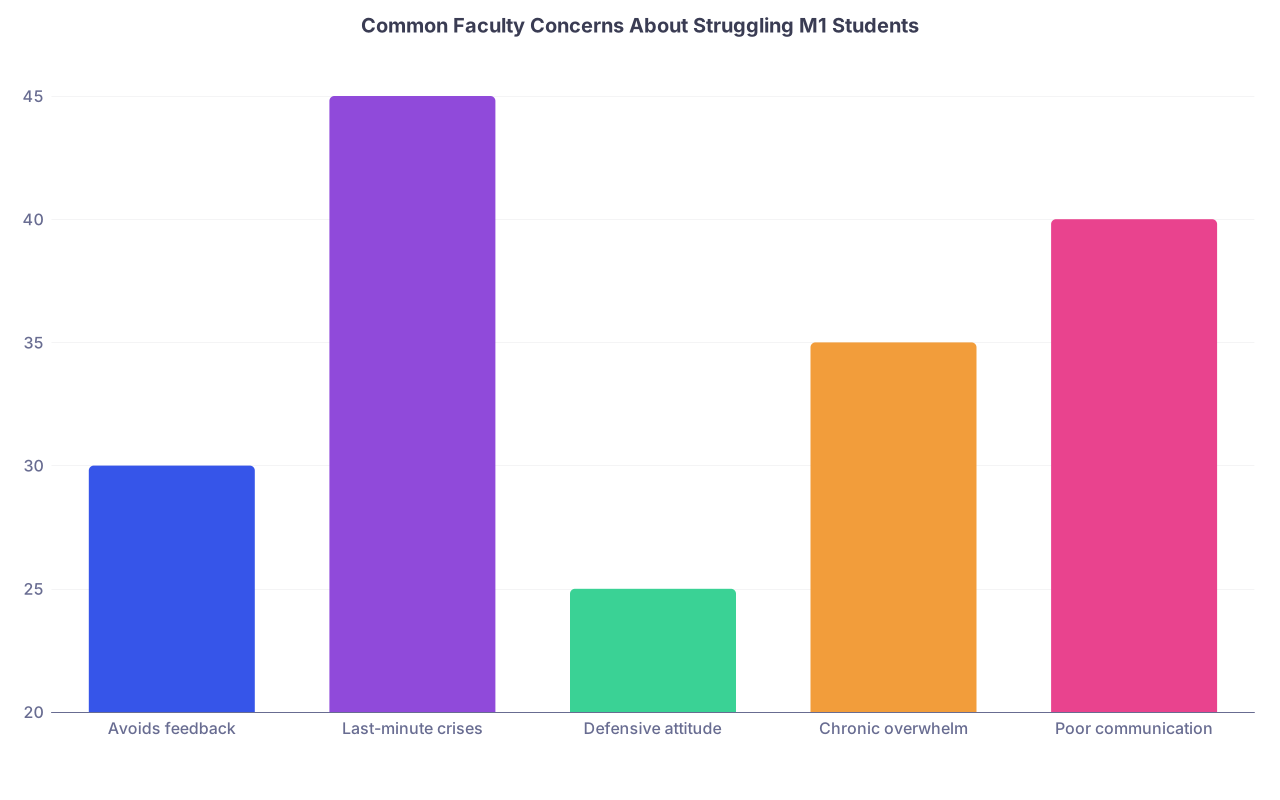
| Category | Value |
|---|---|
| Avoids feedback | 30 |
| Last-minute crises | 45 |
| Defensive attitude | 25 |
| Chronic overwhelm | 35 |
| Poor communication | 40 |

| Step | Description |
|---|---|
| Step 1 | Stressor: exam, feedback, personal issue |
| Step 2 | Problem-solving & early outreach |
| Step 3 | Avoidance or drama |
| Step 4 | Label: resilient, coachable |
| Step 5 | Label: fragile, high-maintenance |
| Step 6 | More opportunities & trust |
| Step 7 | Closer scrutiny & fewer chances |
| Step 8 | Student response |

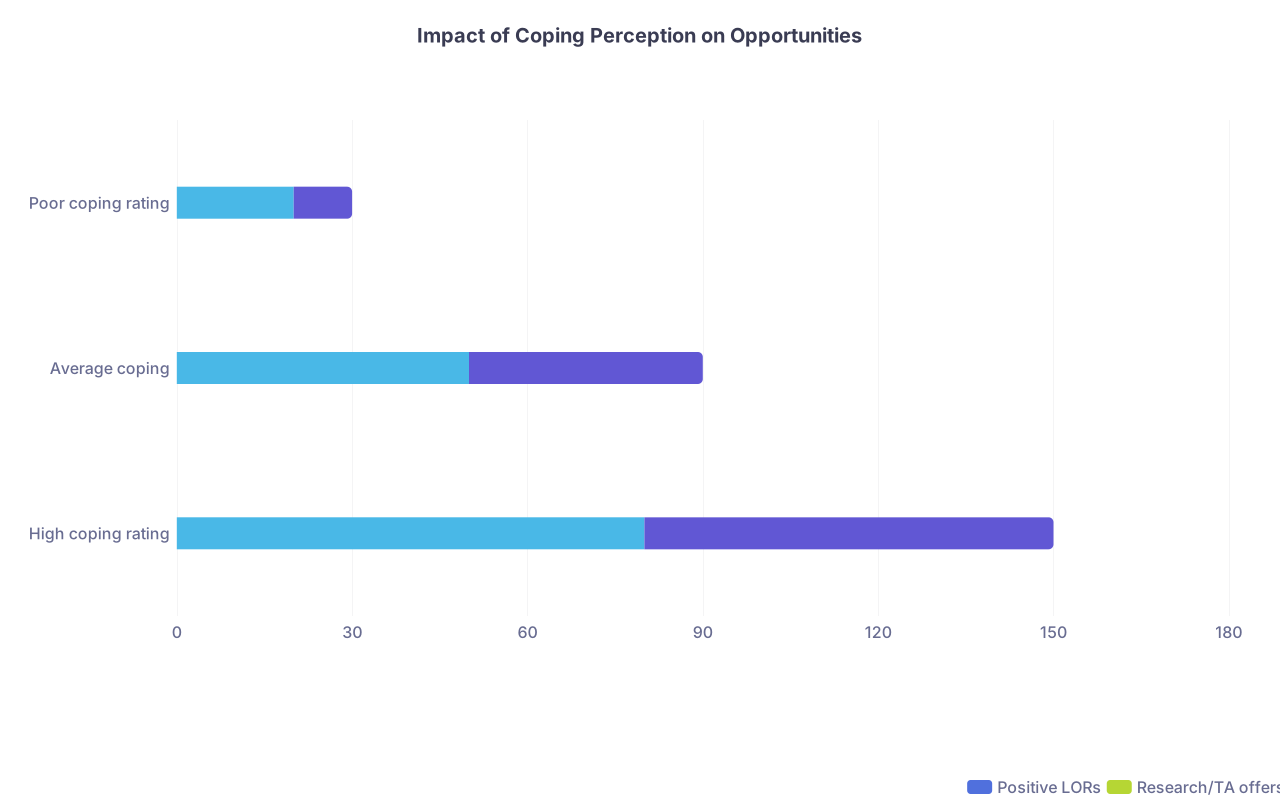
| Category | Positive LORs | Research/TA offers |
|---|---|---|
| High coping rating | 80 | 70 |
| Average coping | 50 | 40 |
| Poor coping rating | 20 | 10 |

The Bottom Line
You are not being judged on whether you never struggle. You are being judged on what you do when you struggle.
The faculty lens is ruthless but simple:
- Can you still function when under legitimate pressure?
- Can you own your mistakes without theatrics?
- Can you recognize early when you’re in over your head and communicate like a professional?
If you can, they’ll invest in you, forgive the rough patches, and advocate for you when it counts.
If you cannot, you become a concern to be managed, not a trainee to be trusted.
You’re in your first year. You’re still writing the story faculty will tell about you in letters and closed-door meetings for the next several years.
Write one that says: “When things got hard, this student didn’t collapse. They recalibrated.”
With those foundations laid, you’ll be in a very different position once you hit the clinical years and the stakes get real. But that’s a story for another day.