
What if everyone else in my class belongs here… and I’m just the mistake they haven’t found yet?
If that sounds even remotely like the inside of your head right now, yeah. You’re who I’m talking to.
You sit in lecture, you look around, and it seems like everyone’s getting it. People are asking insanely detailed questions about pathways you’ve barely memorized, someone next to you is casually annotating First Aid “for fun,” and you’re still trying to remember which cranial nerve does what.
And then the thought hits:
“I’m the only one here who can’t keep up.”
Let’s pull that apart. Brutally honestly. Because if you’re going to survive first year, you can’t keep running on the story that you’re the lone failure in a sea of geniuses.
The Lie You’re Telling Yourself (That Everyone Else Is Fine)
You know what every struggling med student has in common?
They’re convinced they’re the only one struggling.
I’ve seen this movie so many times. Student with a 3.9 GPA and good test scores hits med school, suddenly they’re scraping by on their first anatomy exam. They quietly panic, assume everyone else is cruising, and double down on shame and isolation.
Here’s the part no one sees:
- The “put-together” girl in the front row? She’s crying to her roommate at 1 a.m. because she bombed the last quiz and thinks she doesn’t deserve to be there.
- The guy who always knows the answer in small group? He’s rewatching lectures twice and living off caffeine and terror.
- The super confident ex-scribe who talks about clinical stuff all the time? Failed their first standardized exam and is now spiraling.
You just don’t see it, because med students are professional mask-wearers long before they get white coats.
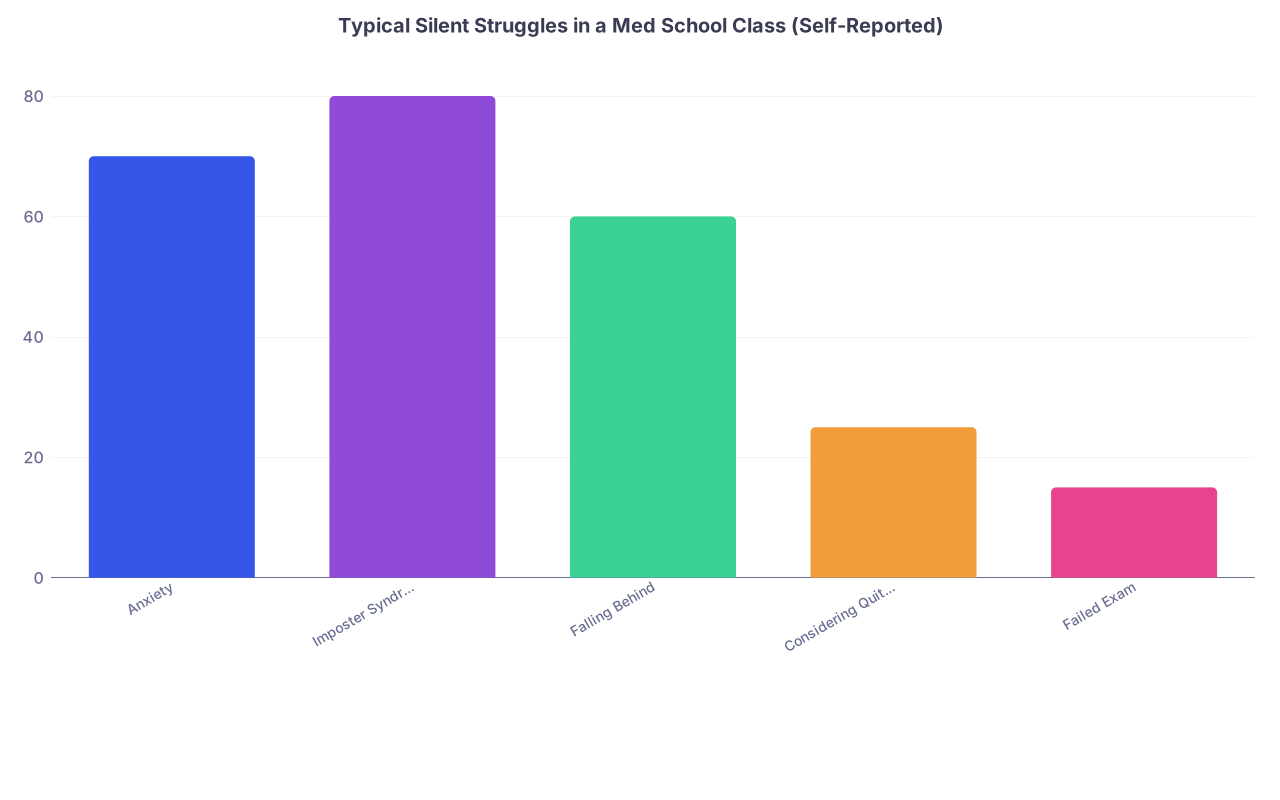
| Category | Value |
|---|---|
| Anxiety | 70 |
| Imposter Syndrome | 80 |
| Falling Behind | 60 |
| Considering Quitting | 25 |
| Failed Exam | 15 |
Those numbers aren’t exact for your school obviously, but they’re realistic ranges from what schools report and what students quietly tell each other behind closed doors.
You are absolutely not the only one struggling. You might just be the only one struggling out loud in your own head.
What “Struggling” Actually Looks Like in Med School
Let me guess how your brain works right now:
- “I read for 3 hours and remember nothing.”
- “I keep re-learning the same stuff.”
- “I’m terrified to check my grades.”
- “Everyone else seems to have Anki decks, boards resources, study plans… and I’m just clicking through slides.”
That counts as struggling, sure. But in med school, there are levels of “struggle.” And not all of them are doom.
| Type of Struggle | What It Often Means |
|---|---|
| Low quiz/exam scores early | Normal adjustment phase, fixable |
| Can’t keep up with content load | Study strategy issue, not intelligence |
| Constant anxiety, dread, insomnia | Mental health support needed, common and treatable |
| Repeated course failures | Needs structured intervention, still not the end |
| Thinking of dropping out weekly | Burnout + fear, not proof you don’t belong |
The problem is your brain lumps everything into one category:
“I’m struggling = I’m not cut out for this = I’m going to fail = I’ll never be a doctor.”
That jump? That’s the lie.
There’s a gigantic difference between:
- “I have no idea how to study for med school yet”
versus - “I am fundamentally incapable of doing this.”
The first one is incredibly common. The second one is extremely rare.
The Secret Everyone Pretends Isn’t True: Med School Is an Adjustment, Not a Judgement
Here’s the part nobody likes to admit:
Med school doesn’t magically select only people who are naturally good at this. It selects people who met the metrics. That’s it.
Some of your classmates:
- Had undergrad that basically spoon-fed them board-style questions.
- Took multiple gap years working as scribes or tutors in related content.
- Did post-baccs that were literally med-school-lite.
- Have parents who are physicians and already explained half the curriculum over dinner growing up.
So when you look around and think, “Why is everyone else fine?” you’re not comparing effort. You’re comparing starting lines.
You might just be the one who’s actually hitting this level of intensity for the first time. That feels like being “the dumb one.” It’s not. It’s being the one who wasn’t pre-calibrated to this weird, toxic academic environment.
And frankly, some people coasting first semester get wrecked when the firehose really turns on later. You just hit your wall earlier.
Red Flags vs Normal Chaos: How Worried Should You Actually Be?
Your anxiety is probably screaming “emergency” 24/7. Let’s separate normal flailing from actual danger.
Very common, usually fixable (but feels awful):
- First exam(s) under class average
- Barely passing quizzes
- Needing to rewatch lectures
- Studying all day and still feeling behind
- Needing a full 1–2 months to find a study rhythm
- Crying after exams, then still passing the course
This is basically first-year med student bingo.
Concerning, needs action but not a death sentence:
- Failing multiple exams in a row
- Not understanding how questions are written or tested
- Avoiding opening your grades for days or weeks
- Freezing on exams even when you studied
- Constant thoughts: “I can’t do this,” “I shouldn’t be here”
These are the “don’t white-knuckle this alone” signs. Still fixable. But not by just reading harder.
Urgent: Get help, immediately. Like now.
- Failing entire blocks/courses
- Skipping exams or required sessions out of fear or paralysis
- Not eating, sleeping, or functioning outside of class
- Thoughts of self-harm, “they’d be better off without me,” or anything in that territory
This is where you stop trying to brute force it and bring in backup: counseling, academic support, trusted faculty, literally anyone who is trained to help you.
Reading this article is fine. But if you see yourself in that last list, reading isn’t enough. You need actual humans, now.
“What If I Actually Fall Behind Everyone Else?”
You probably already feel like you’re behind everyone. Even if you’re not.
Let’s be annoyingly practical for a minute: what does “behind” actually mean in med school?
It doesn’t mean:
- Not having pre-read every lecture
- Not using fancy resources other people swear by
- Not starting boards prep in month 1 (seriously, breathe)
It does mean:
- You can’t get through the current week’s material before the next week starts
- You’re watching lectures from two weeks ago and haven’t touched current stuff
- You genuinely don’t know what’s being tested on the next exam
If that’s you, then yeah, you’re behind. But behind is not permanent. Behind is a logistics problem.
A lot of students dig the hole deeper by trying to “catch up perfectly.” They say things like:
“I’ll just rewatch everything from the last three weeks and make full Anki decks and detailed notes and THEN I’ll start new material.”
That’s how you stay stuck.
Here’s the uncomfortable truth: sometimes you have to triage your learning. Like an ER for your study life.
You prioritize:
- What’s high-yield for the next exam
- What’s heavily emphasized in lecture/objectives
- What integrates with future content
And you let go of:
- Detailed rabbit holes
- Perfect notes
- Understanding every slide at research-level depth
It feels wrong. Like you’re cheating or being a “bad student.” But this is how most of the “successful” people in your class are actually operating behind the scenes.
The Comparison Trap That’s Slowly Killing You
You’re probably doing this:
- Checking the group chat right after exams
- Listening to everyone brag/complain about how little they studied
- Hearing “That exam wasn’t bad at all” and then spiraling because it was brutal for you
- Watching people talk about their 85s and 90s while you’re just hoping you passed
You need to hear this plainly: comparison in med school is poison.
Not “unhelpful.” Poison.
Someone’s 92 on the last exam doesn’t take a single point from your 72. Their success doesn’t reach into your scantron and erase your answers.
You can’t see:
- Who has test-taking tutoring
- Who’s using old exams or question banks you’ve never heard of
- Who re-watches lectures 3x and lies about how much they studied
- Who’s barely holding it together emotionally despite the good scores
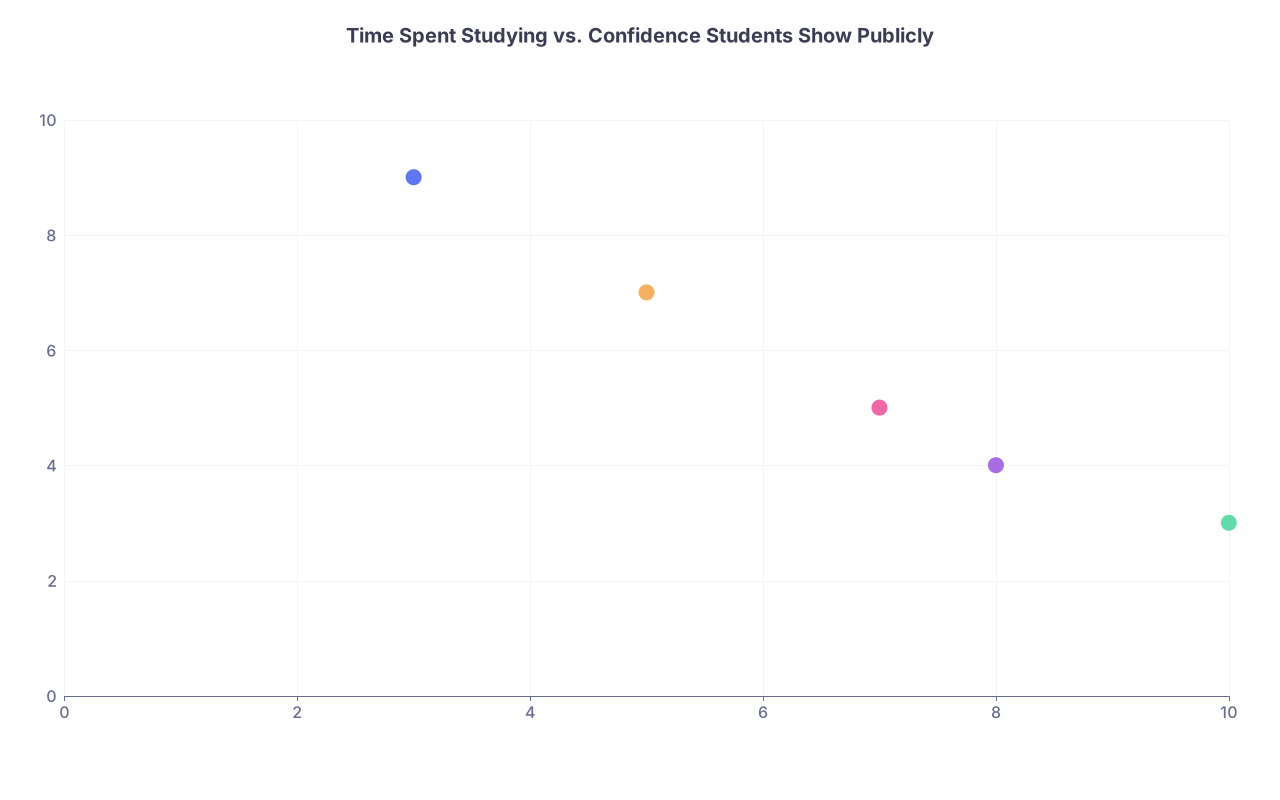
| Category | Value |
|---|---|
| Student A | 3,9 |
| Student B | 8,4 |
| Student C | 10,3 |
| Student D | 5,7 |
| Student E | 7,5 |
Those numbers? Hours studied vs “I’m fine” confidence level. Totally mismatched. That’s what actually happens.
If you’re going to survive, you have to treat other people’s reported experience like social media: heavily filtered, often misleading, and not a reflection of your value or potential.
What If I Have to Repeat, Remediate, or Even Take Time Off?
Let’s go to the nightmare scenarios your brain keeps playing at 2 a.m.
“I’ll fail this block.”
“I’ll have to repeat a year.”
“My school will kick me out.”
“I’ll never match.”
“My life is over.”
Here’s the ugly but reassuring reality:
- People fail courses. Every year. At every school.
- Many of them remediate successfully and move on. Quietly.
- Some repeat a year and still become excellent residents.
- A few leave medicine altogether and build other careers that don’t involve constant panic and exhaustion.
Are there consequences to failing courses? Yes. It can affect:
- How some programs view your application
- How much explaining you’ll have to do in interviews
- How tightly you’ll have to plan your boards timeline
But does it automatically mean:
- “You’re done”
- “You’ll never match”
- “You’re not smart enough”
No. That’s your catastrophizing, not reality.
I’ve seen people with:
- Failed first-year courses
- Board failures on Step 1 or Step 2
- Medical leaves for mental health
…still match. Sometimes not into their dream hyper-competitive field, but into solid careers, with normal lives, paying off loans, practicing medicine.
You’re allowed to struggle now and still end up okay.
So What Do I Actually Do If I Feel Like the Only One Struggling?
You’re probably hoping for some magic system here. There isn’t one. But there are a few concrete moves that separate people who stay stuck from people who slowly, painfully, get their feet under them.
Tell one person the truth.
Not “I’m a little stressed.” The real thing: “I feel like I’m the only one failing and I’m scared I don’t belong here.” A classmate. A mentor. A counselor. Someone. Saying it out loud kills some of its power.Talk to academic support before you’re in flames.
People wait way too long because they’re ashamed. By the time they reach out, it’s damage control. You’d be shocked how normal your situation looks to people who see this every year.Pick one study method to improve, not ten.
Maybe it’s using more practice questions. Maybe it’s actually doing Anki consistently instead of binge-making cards. Maybe it’s reading less and forcing yourself to recall more. But change one controllable thing. Not everything at once.Stop asking “Am I dumb?” and start asking “What’s not working?”
One question paralyzes you. The other one actually leads somewhere.Schedule actual breaks like they’re required labs.
Your brain isn’t a bottomless sponge. The more you punish yourself, the worse you’ll remember. It’s not lazy to rest. It’s necessary to pass.
The Thing You Won’t Believe But Need To Hear
You’re not the exception to the rule of “med school is hard for everyone.”
You’re not the one mistake your admissions office made.
You’re not the only one secretly drowning.
You’re not the only one whose brain doesn’t just “get it” from lecture.
Here’s what you probably are:
- A normal first-year student in a brutal environment
- Someone who was used to succeeding and now has no idea how to handle struggling
- Someone whose anxiety is way louder than their actual performance
You might not be where you want to be academically. That’s real. Grades are real. Exams are real.
But the story your brain is telling – that you’re alone in this, uniquely broken, and doomed – that part’s fiction.
You’re allowed to struggle here. You’re allowed to get help. You’re allowed to take longer, adjust, and still become a doctor.

| Step | Description |
|---|---|
| Step 1 | Feeling Like Youre the Only One Struggling |
| Step 2 | Adjust Study Methods |
| Step 3 | Meet Academic Support |
| Step 4 | Use Practice Questions & Active Recall |
| Step 5 | Plan Remediation/Support |
| Step 6 | Anxiety, Dread, Imposter Syndrome |
| Step 7 | Counseling/Mental Health Support |
| Step 8 | Ongoing Coping Strategies |
| Step 9 | Return to Curriculum |
| Step 10 | Failing or Just Behind? |
FAQ (Exactly 5 Questions)
1. What if I’m literally at the bottom of my class?
Someone is. Statistically. That doesn’t mean they’re not going to be a doctor. Being below the median in a group of extremely high-achieving people doesn’t make you “bad.” It just means you’re now in an environment where everyone was top of their class before. If you’re passing, even barely, you’re still meeting the bar. Bottom of med school >> top of nowhere.
2. Should I tell faculty or my dean that I’m struggling, or will they judge me?
You’re scared they’ll think, “We made a mistake on this one.” They won’t be surprised. They see this pattern every year. They’ll probably be more worried if you don’t show up until you’ve already failed courses. You don’t have to give them your whole life story; you can just say, “I’m working really hard and my results aren’t matching, and I’d like help before I fall further behind.”
3. If I fail a class, is my dream specialty dead?
Not automatically. It complicates things, yes. Super competitive fields (like derm, ortho, plastics) get harder to reach with academic issues, but nothing is fully decided after one failed course. Step scores, clinical grades, research, letters – all of that still matters. And if your dream specialty truly becomes unreachable, there are still multiple other fields where you can have a good life and good career. That sounds like settling now; it doesn’t feel like settling later.
4. How do I stop thinking about quitting all the time?
You might not, at least not right away. A lot of people mentally quit medicine multiple times during first and second year and still end up graduating. The goal isn’t to never think “I want out.” The goal is to separate momentary overwhelm from actual decision-making. Talk to someone neutral (not just other panicked classmates) before making any big moves. Give yourself permission to consider quitting without assuming that means you have to.
5. How do I know if this is just normal med school stress or if I actually need therapy/medication?
Here’s the line: if your stress is messing with basic functioning – sleep, appetite, ability to concentrate, ability to enjoy anything – or if you’re feeling hopeless, numb, or like people would be better off without you? That’s not “normal stress.” That’s “get help now.” Med students are notorious for waiting too long because they’re afraid of stigma or documentation. Don’t be a hero. Quiet suffering isn’t impressive; it’s dangerous.
Key points, so your brain can hang onto something:
- You are not the only one struggling. You’re just only hearing your own thoughts.
- Struggle in first year usually means “adjustment required,” not “you don’t belong.”
- Getting help early – academic and mental health – is how people stay in med school, not how they prove they shouldn’t be there.