
The idea that “if you’re stressed in M1, you’re not cut out for medicine” is garbage.
If anything, the opposite is usually true: the people who feel stress, question themselves, and worry about how they’re doing are the ones actually paying attention. The robots who feel nothing? Those are the ones I worry about.
But I get it. You’re not asking this in some abstract, philosophical way. You’re probably sitting there at 1:30 a.m., palms sweaty, Anki queue out of control, watching another lecture at 1.5x thinking:
“I’m this stressed already. And it’s just M1. What does that say about me?”
Let’s actually answer that. Not with the fake motivational nonsense, but with what this kind of constant stress usually really means.
The Ugly Truth: M1 Is Designed To Break Your Old Identity
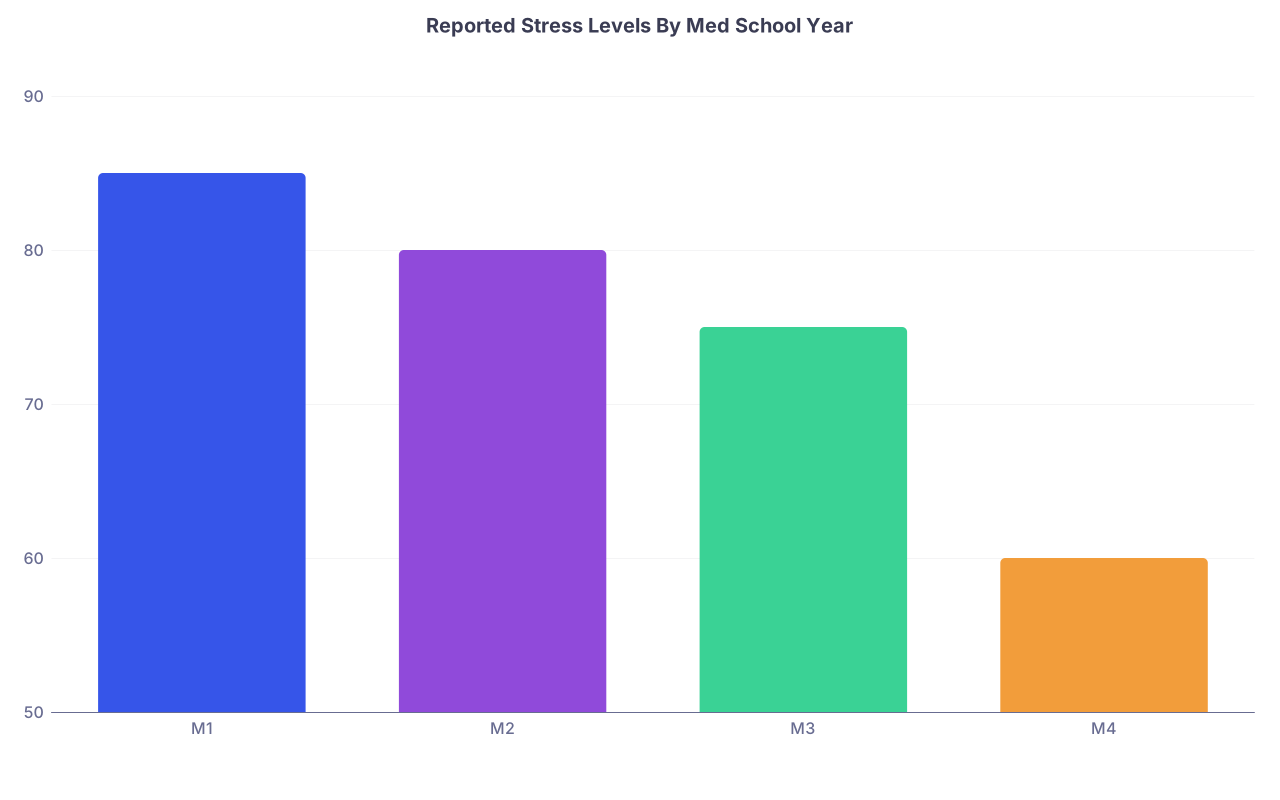
| Category | Value |
|---|---|
| M1 | 85 |
| M2 | 80 |
| M3 | 75 |
| M4 | 60 |
Here’s the part no one says clearly enough: first year doesn’t just test your knowledge. It blows up your entire sense of who you are as a “good student.”
In undergrad, you might’ve been:
- The one who never needed to study that hard
- The one who always finished early
- The one friends asked for help
Then M1 hits and suddenly:
You’re behind by Wednesday.
You forget basic physiology you “just learned.”
You re-read the same sentence in First Aid three times and it still doesn’t stick.
So your brain goes straight to the nuclear option: “Maybe this means I’m not cut out for this.”
What it actually means is you’re going through the identity demolition phase that almost everyone in med school hits. I’ve watched people from Ivy League undergrads, 99th percentile MCATs, crumble in the first 2–3 blocks. Not because they’re dumb. Because they’ve never had to rebuild a study system from scratch under this much volume and pressure.
Stress in M1 usually means:
“I’m a normal human being reacting to an abnormal environment.”
Not:
“I’m secretly defective and faking my way through.”
Constant Stress vs. Being “Not Cut Out For It” – They’re Not The Same Thing

Let me separate two things your brain is probably mashing together.
- “I feel constantly stressed.”
- “Therefore, I’m fundamentally not built for medicine.”
Those are not logically connected. But they feel connected when your nervous system is in fight-or-flight 12 hours a day.
Here’s what usually drives that constant stress in M1:
- You’ve never seen this amount of information at this speed before.
- You haven’t stabilized a routine yet — every week feels like a new experiment.
- You’re comparing your inside (panic, doubt) to everyone else’s outside (their color-coded iPad notes and fake chill).
- You believe the story that “real” future doctors should be handling this calmly.
Reality check: a lot of your classmates are also stressed out of their minds. They’re just quieter about it, or they express it differently (dark humor, avoidance, or 12-mile runs at 5 a.m. that look “healthy” but are basically anxiety sprints).
If constant stress automatically meant “not cut out for it,” I can list dozens of now-board-certified attendings who should’ve been kicked out of M1 emotionally. They were miserable. Thought about quitting. Some Googled non-med careers during neuro.
They’re practicing now. Competent, kind, solid physicians. The common thread? Their M1 stress said nothing about their long-term potential. It only said, “this is a brutal adjustment phase.”
The Worst-Case Scenarios Your Brain Won’t Shut Up About
Let’s drag the scary thoughts into daylight. Because you are thinking them.
“Everyone else is handling this better than me.”
Probably not. You’re just not inside their group chats and late-night breakdowns. I promise you someone in your class cried over the brachial plexus. Someone else failed a quiz and didn’t tell anyone. Someone’s marriage is under strain. You see the filtered version.
“I’m already maxed out now… how am I supposed to handle M2? Step? Residency?”
You’re comparing your today capacity to some horror-movie version of the future where nothing about you ever grows, adapts, or changes. People build capacity over time. The stuff that feels absolutely crushing in month 3 of M1 usually feels… not easy, but manageable, a year later.
“If I’m this stressed, I’ll burn out and hurt patients.”
This one hits hard. But being aware of your stress and worried about burnout actually puts you ahead of the people who ignore their limits until something explodes. The dangerous ones are the “I’m fine, I don’t need help” types who aren’t fine and won’t admit it.
“What if this constant anxiety means I actually hate medicine and just haven’t admitted it yet?”
Sometimes stress is just stress. It doesn’t always mean you hate the thing itself. Being buried in histology slides and random minutiae isn’t the same as hating patient care. A lot of people don’t even like M1 content. They still end up loving third-year on the wards.
Signs You’re Struggling vs. Signs You Actually Might Need To Reroute
| Situation | What It Usually Means |
|---|---|
| Crying after exams, but still engaging with content | Normal adjustment and pressure |
| Constant comparison, imposter thoughts | Common in high-achieving cohorts |
| Grades hovering near pass but improving | You’re learning how to learn here |
| Total emotional numbness, no interest in patients ever | Possible values mismatch |
| Persistent wish to leave *even if* stress was fixed | Might signal true misalignment |
There is a difference between “this is incredibly hard” and “this is fundamentally wrong for me.” Your anxious brain lumps them together because anxiety loves extremes.
You’re struggling in a way that’s actually normal when:
- You still care about doing well, even when you feel like trash.
- You have moments (even short ones) where something clicks and you think, “Oh. This is actually kind of cool.”
- When you imagine being a doctor 10+ years from now, a part of you lights up, even though M1 feels like wading through concrete.
- If someone snapped their fingers and removed the constant panic but kept the workload, you’d probably stay.
You might be misaligned if:
- The only thing keeping you here is sunk cost and fear of what people will think if you leave.
- You never, ever feel even a tiny bit of interest or curiosity — just dread and resentment, all the time.
- The idea of doing anything else (even something lower paying, less “prestigious”) consistently feels like relief, not just escape.
Even then, I’d still say: don’t make that call in the middle of the M1 storm. You’re making a life verdict with a flooded brain. Get stable first, then reassess.
Your Nervous System Is Not Broken. It’s Overloaded.
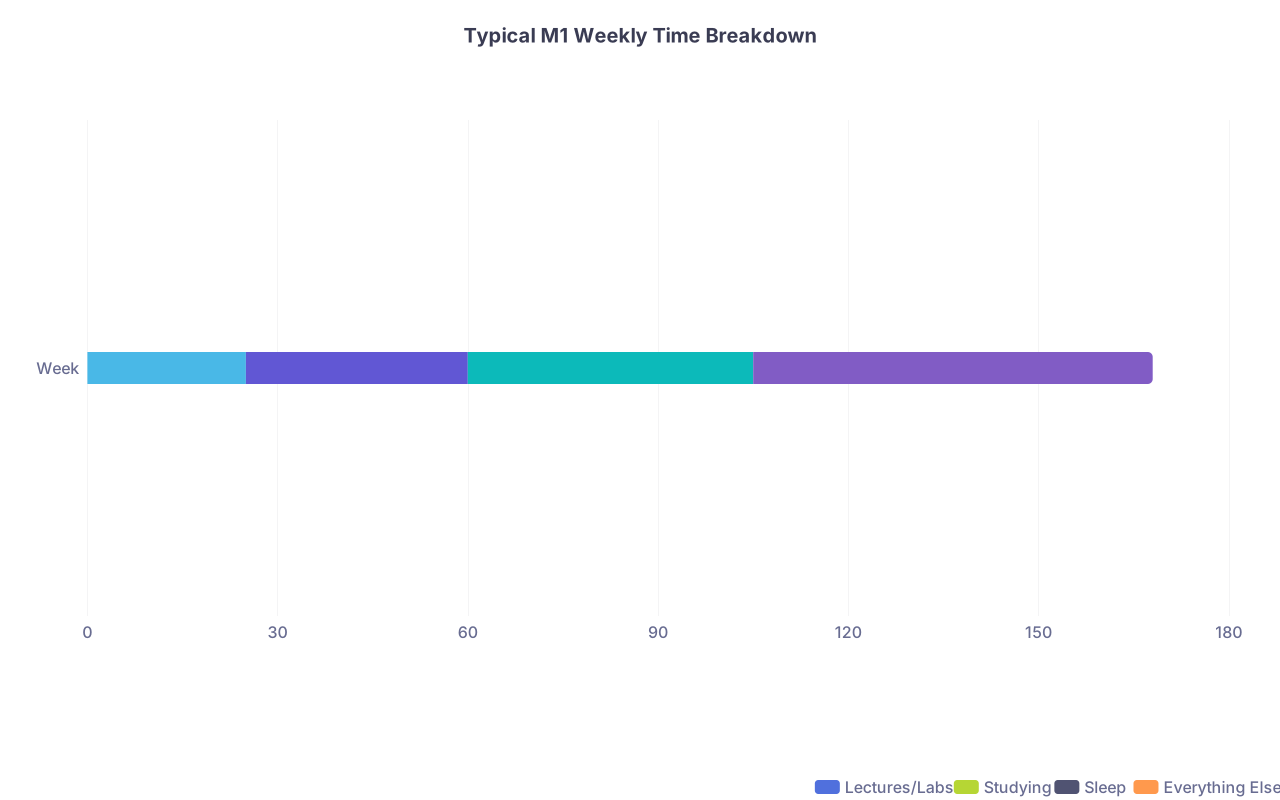
| Category | Lectures/Labs | Studying | Sleep | Everything Else |
|---|---|---|---|---|
| Week | 25 | 35 | 45 | 63 |
You’re not weak for feeling constant stress. You’re a human nervous system doing exactly what nervous systems do under unrelenting pressure: firing alarms.
Medical school is wired to trigger:
- Fear of failure (exams, remediation, “falling behind”)
- Social comparison (class rankings, who answers questions, who did research at Hopkins)
- Identity threat (“if I’m not the smart one anymore, who even am I?”)
That’s a lot. And then you layer on poor sleep, caffeine abuse, maybe decreased movement, and probably less time with the people who used to keep you sane. Of course you feel constantly on edge. Your brain’s reading the situation as, “We are under attack 24/7.”
What helps is not telling yourself, “I shouldn’t be this stressed.” That just adds shame on top of stress. What actually helps is asking, very bluntly:
“What would make this 10% more livable this week?”
Not 100%. Just 10%.
Maybe that’s:
- One night a week where you close the laptop at 9 p.m., non-negotiable.
- Moving from 5h sleep to 6h (yes, that one hour matters).
- Watching lectures at 1.5x and accepting not everything will be perfectly mastered the first time.
- Admitting to someone (tutor, dean, counselor) “I’m not okay” instead of pretending.
Tiny adjustments don’t fix the whole system, but they pull your nervous system out of red-alert mode.
The Silent Curriculum: Everyone’s Pretending More Than You Think

One of the most brutal parts of M1 is that no one is fully honest about how they’re actually doing.
You hear:
“Oh yeah, I’m a little tired, but it’s fine.”
“Anatomy’s intense, but manageable.”
And you’re like, “Cool cool cool, I woke up at 3 a.m. thinking about the urea cycle and my heart hasn’t stopped racing since.”
Behind the scenes, I’ve watched:
- “Chill” students have panic attacks before OSCEs.
- Top test scorers melt down because they missed one stupid question.
- People quietly start therapy, go on meds, take leaves — and most classmates never know.
You’re probably not seeing the whole story of anyone you’re comparing yourself to. You’re comparing your raw footage to their highlight reel.
Does that fix your stress? No. But it does mean your interpretation — “everyone else is fine; I’m the broken one” — is almost certainly wrong.
What If I’m Already At My Limit In M1?

| Step | Description |
|---|---|
| Step 1 | Notice constant stress |
| Step 2 | Adjust study + sleep + support |
| Step 3 | Talk to school support / counselor |
| Step 4 | Reassess in 2-4 weeks |
| Step 5 | Consider leave or reduced load |
| Step 6 | Continue with new supports |
| Step 7 | Functioning day to day? |
| Step 8 | Still overwhelmed? |
Here’s the fear: “If I’m maxed out in M1, I’ve already hit my ceiling. I’ll never be able to handle more.”
That’s not how humans work.
Capacity isn’t a fixed number. You build it like you build muscle — with repeated stress plus recovery. What M1 usually does wrong is it throws all the stress at you and you cut out all the recovery trying to keep up. No wonder you feel like you’re maxed out and breaking.
An actually useful question is:
“Given how I’m wired, what system lets me function without frying my circuits?”
For some people that means:
- Switching from passive note-taking to active question banks early
- Setting brutally clear cutoffs at night (e.g., “I stop by 10:30, no matter what”)
- Accepting being good enough at certain low-yield details instead of perfect
For others, honestly, it does mean something bigger:
- Talking to admin about reduced course load
- Taking a mental health leave and coming back
- Getting treatment for anxiety/depression/ADHD that’s been borderline for years
None of those things mean you’re not cut out for medicine. They mean you’re taking yourself seriously as a human being with actual limits.
I’ve seen students take leaves in M1 and come back later, more stable, and absolutely crush the rest of school. If anything, that kind of decision shows you are cut out for this long term — because you’re willing to do unglamorous, uncomfortable things to protect your ability to keep going.
You Don’t Have To Prove You’re Invincible To Belong Here

Medicine has this stupid, unspoken rule: you’re only worthy if you can suffer endlessly without flinching. That mindset is why so many residents and attendings are burned out disasters.
You don’t need to prove you’re unbreakable. You need to prove you’re willing to:
- Be honest with yourself when something’s not sustainable
- Adjust instead of white-knuckling yourself into the ground
- Ask for help sooner than your pride wants you to
Constant stress in M1 doesn’t mean you’re not cut out for this. It means you’re in a pressure cooker and your body is correctly screaming, “This is a lot.” That’s not weakness. That’s a working alarm system.
The question isn’t “Am I secretly not meant to be here?”
It’s “What support, structure, and honesty do I need to stay here without destroying myself?”
And that question? That’s what people who last in this field actually ask.
FAQs
1. How do I know if my stress is “normal” M1 stress or something I should be really worried about?
If you’re anxious, tired, overwhelmed before exams — that’s normal. If you’re unable to get out of bed, not eating, not sleeping, having thoughts that the world would be better without you, or you physically can’t make yourself go to class or study for days, that’s past “normal.” That’s “I need professional help now” territory. When in doubt, err on the side of taking it seriously and talking to someone — school counselor, therapist, physician. You’re not overreacting by asking.
2. Everyone else seems to be studying more than me. Should I just push harder even if I feel burned out?
That’s the trap. You see someone doing 14-hour days and think, “I should too,” even though your brain is already fried at 9 hours. More hours doesn’t always equal better performance, especially when you’re exhausted. If pushing harder means your retention tanks, your sleep gets worse, and you start dissociating through lectures, it’s not helping. A shorter, more focused day with real rest will usually beat a marathon zombie grind.
3. What if I fail an exam? Does that prove I don’t belong in med school?
No. It proves you’re human in a brutal environment. Plenty of people fail a quiz, exam, or even a course and still end up strong residents. What matters is what happens after: do you get help, adjust your approach, talk to faculty or academic support, figure out what specifically went wrong? Or do you quietly spiral and decide this one data point defines your entire future? The system is built with remediation for a reason — because they know this happens.
4. Is it a red flag if I don’t actually like a lot of the M1 content?
Not necessarily. A ton of people don’t enjoy memorizing enzyme names, random anatomy branches, or cell markers. They’re here for patients, not pathway diagrams. You don’t have to love every subject to be a good doctor. What is a red flag is if you never feel any interest or connection — not in clinical skills, not in patient stories, not in anything related to medicine outside of exams. If literally nothing about the field itself appeals to you, then it might be worth a deeper, calmer conversation with yourself (preferably not mid-block).
5. If I get mental health treatment or accommodations, will programs think I’m weak or not want me later?
This fear is common — and it keeps people suffering silently. In reality, lots of med students, residents, and attendings get therapy, meds, or accommodations. You are not required to blast your entire history to everyone. Schools and programs care much more about whether you can function safely and reliably now than about whether you once needed help. Getting treatment usually improves your functioning. Quietly falling apart because you’re afraid to ask for support? That’s what actually puts you at risk.
Key points? Stress in M1 means you’re reacting like a human in a high-pressure system, not that you’re fundamentally unfit for medicine. And you don’t prove you belong here by suffering in silence — you prove it by adjusting, asking for help, and finding ways to stay in this for the long haul without losing yourself.