
The biggest threat to your med school performance isn’t your anxiety meds. It’s untreated anxiety pretending you don’t need help.
The Fear Behind The Question
Here’s what I know you’re actually asking under that title:
“Am I going to ruin my brain with SSRIs or benzos or stimulants and then fail out?”
“Will an adcom or dean secretly judge me as ‘less capable’ if I’m on meds?”
“What if I need them to function but they make me slower, foggier, less sharp than my classmates?”
“What if I stop them and everything crashes right before exams?”
You’re not worrying about nothing. You’re just aiming the worry at the wrong target.
Most med students don’t talk about this, but I’ve seen the pharmacy bag in the white coat pocket. The Lexapro, Zoloft, Prozac, Wellbutrin, propranolol, occasional benzo, sometimes stimulants for ADHD. People take meds and then ace Step 1, crush OSCEs, match derm. You just don’t see that part on their Instagram.
The real issue isn’t: “Are meds bad?”
The real issue is: “Is my current combo (or lack of treatment) helping or hurting my ability to function like a human who has to memorize 10,000 facts?”
Let’s break this down like you would for a patient, but brutally honest and focused on what actually affects your performance.
How Anxiety Itself Tanks Your Med School Performance
Before you blame the meds, ask what your anxiety is doing to you without them.
Think about days like this:
- You sit in lecture and don’t absorb a word because your brain’s just screaming, “You’re behind, you’re behind, you’re behind.”
- You open Anki and immediately feel nauseous. Card 1 out of 1,500. Heart rate already at 120.
- Night before an exam, you sleep 3 hours because you keep catastrophizing: “If I fail this exam, I fail this course, then I fail med school, then I never match…”
That’s not “just being stressed.” That’s your cognitive bandwidth getting chewed up by anxiety. Memory, focus, recall, executive function — anxiety steals from all of them.
Untreated or poorly controlled anxiety can:
- Wreck sleep (and sleep is literally memory consolidation)
- Make you procrastinate studying because starting feels unbearable
- Cause test-day meltdowns where you blank on things you actually know
- Push you into burnout or depression midway through MS1
So when you’re scared your medication might cause brain fog, compare it to what your current anxiety is already costing you.
You’re not choosing “perfect, clean brain” vs “medicated brain.” You’re choosing between “dysregulated, anxious brain” vs “possibly calmer, more functional brain.”
What Anxiety Meds Actually Tend To Do To Performance
Let’s be blunt. Different meds, different risks. You know that intellectually, but your anxiety is treating them all like poison.
| Med Type | Common Academic Impact |
|---|---|
| SSRIs/SNRIs | Usually neutral or positive |
| Benzos | Helpful short-term, risky if frequent |
| Propranolol | Good for performance anxiety |
| Stimulants | Helpful if true ADHD, risky misuse |
| Hydroxyzine | Sedating, timing is everything |
SSRIs / SNRIs (Lexapro, Zoloft, Prozac, Effexor, etc.)
This is what most anxious med students are on.
Worst-case nightmare in your head:
“I’ll feel numb, slower, like my brain’s underwater, and everyone else will be sharper.”
Reality in most students I’ve seen:
- Less baseline panic
- Longer stretches of focused study
- Fewer emotional breakdowns that nuke an entire day
- Slight adjustment period, then performance either improves or stays the same
Do SSRIs / SNRIs sometimes cause side effects? Yes. Initial fatigue, GI stuff, maybe some emotional flattening. But if a dose is so sedating that you can’t study, that’s not “the price you must pay.” That’s a signal to your prescriber to adjust.
Benzos (Ativan, Xanax, Klonopin)
This is where things get trickier.
Your fear: “If I take a benzo, I’m nuking my hippocampus and I’ll fail Step 1.”
Used occasionally, for specific situations (e.g., panic attack the night before a big exam, flight anxiety for away rotations), they can be a lifesaver. The problem is creep — when “occasionally” becomes “I can’t get through a regular week without this.”
Regular or high-dose benzo use can:
- Impair short-term memory
- Make you feel detached, fuzzy, slow
- Create dependence where anxiety actually worsens between doses
Using one benzo pill before a massive exam because you’d otherwise be in full fight-or-flight is different from popping one every other day just to function. The first can actually help your performance. The second can quietly sabotage it.
Propranolol
Med school secret weapon for some people. Non-addictive, great for performance anxiety.
It won’t fix racing thoughts, but it can stop the visible shaky hands, pounding heart, and “I’m going to pass out during OSCE” feeling. Some students use a low dose before oral exams or big presentations.
Downsides:
- Can make you a little fatigued
- Not ideal if you run very low blood pressure or have asthma
But as far as “meds that ruin your brain,” this one isn’t high on the list.
Stimulants (Adderall, Ritalin, Vyvanse), if you also have ADHD
Big anxiety trigger here: “If I need stimulants to focus, I’m defective and I’ll be dependent forever.”
Here’s the thing:
If you have real ADHD, not treating it can be way more damaging to your academic performance than appropriately using stimulants.
I’ve watched classmates go from:
- “Reading the same paragraph 6 times and retaining nothing”
to - “I can sit, work for 3 hours, and actually remember what I studied.”
The danger zone is misuse:
- Taking too much
- Using them when you’re already massively anxious
- Sleeping less because “the meds will keep me going”
That combo fries focus and mood over time.
The Part Everyone Skips: Sleep, Timing, And Dose
Your anxiety is telling you: “Medication = on or off switch.” That’s not how this works.
You can absolutely be on meds and still sabotage yourself with bad timing.
Picture this:
You take your SSRI at night, and it’s activating for you. So you lie there wired, get 4 hours of sleep, and then feel like a zombie all day. Your conclusion? “The meds are ruining my performance.”
Or you pop hydroxyzine 25–50 mg at 7 pm to calm down, and then try to late-night cram. Of course you feel slow. You basically took a chemical “please go to bed now” pill.
Medication success in med school often comes down to boring stuff like:
- What time you take it
- Whether your dose is too high / too low
- Whether your prescriber understands that you are not just “a random anxious person” but “a random anxious person trying to memorize 17 immunology pathways”
You are allowed to say to your prescriber:
“I have to be cognitively sharp from 8 am to 6 pm most days. This current med schedule makes me feel foggy until noon. We need to fix that.”
If they dismiss that, that’s not “proof meds are bad.” That’s proof you need someone who actually gets your reality.
“Will My School Or Future Program Judge Me For Being On Meds?”
This is one of the ugliest fears:
“If anyone finds out, I’ll be labeled unstable, weak, risky.”
Here’s the unvarnished truth:
Interviewers, attendings, faculty — a non-trivial number of them are on meds themselves. Or have been. Or have therapists. Or have been through burnout and depression. The culture is still messed up, but it’s way more common than anyone admits out loud.
What actually matters to schools and programs is:
- Do you show up?
- Can you do the work?
- Are you safe with patients?
- Are you taking care of yourself enough that you’re not constantly in crisis?
Needing meds to function is not the red flag.
Ignoring your crashing mental health until you’re failing rotations or disappearing — that’s what gets noticed.
You do not need to disclose specific medications to your school unless there’s some accommodation situation, and even then, it usually goes through disability services, not your dean broadcasting it at faculty meetings.
The “What If I Crash Right Before Exams?” Spiral
I know this one.
“What if my meds randomly stop working the week of my cardio exam? What if side effects hit during Step 1? What if I need a dose change right before OSCEs?”
You’re trying to build certainty in a system that doesn’t give certainty. Meds are like everything else in medicine: imperfect tools.
So you reduce catastrophic risk instead of chasing total safety.
Here’s what that looks like in practice:
You don’t start a new med or huge dose change 3 days before a major exam if you can avoid it. You try to stabilize earlier in the semester. You plan follow‑ups with your prescriber before crunch times, not during.
You watch for patterns. If every time you go up a dose, you’re useless for 10 days, you don’t let that change land on the week you’re doing neuro, the heaviest block of the year.
You keep non‑pharmacologic tools (therapy, breathing exercises, realistic study plans, accountability) in place so your entire stability doesn’t rest on one pill bottle.
Is there still risk? Yeah. There’s risk in doing nothing too.
How To Tell If Your Meds Are Hurting Or Helping Your Performance
Here’s where your anxiety lies to you the most. It either tells you:
“Everything is awful —— must be the meds.”
or
“Everything is awful —— but if you change anything you’ll die.”
You need data, not vibes.
For 2–4 weeks, track:
- Hours studied per day
- Estimated quality of focus (0–10)
- Sleep duration
- Panic attacks / severe anxiety episodes (Y/N)
- Major side effects (sedation, nausea, brain fog)
Then look at patterns:
If on meds you’re:
- Studying more hours
- Retaining more
- Having fewer breakdowns
…but also a little more tired? That’s often a net win.
If you’re:
- Constantly groggy
- Re-reading the same material
- Missing questions you clearly knew yesterday
That’s when you talk to your prescriber about dose/timing/med choice. Not to abandon treatment. To tune it.
Your Worst-Case Scenario vs What Actually Happens
Let’s name the absolute horror-script your brain is running:
You start or adjust anxiety meds. You become a zombie. You bomb an exam. That tanks your GPA. Which tanks your Step score. Which tanks your residency chances. You end up unmatched, in debt, and it all started with that one prescription.
Here’s what usually happens instead, in the real world:
You start or adjust anxiety meds.
First 1–2 weeks: a bit weird. Maybe tired, maybe slightly off.
By week 3–6: your baseline panic is lower. You can sit and study longer. Your mood swings calm down. You still have bad days, but they don’t take you out for 3 in a row.
You might tweak dosage once or twice. Maybe switch meds once. During that time, you still pass your classes. Maybe not perfectly. But you don’t implode.
You’ll never see a paper titled: “Lexapro user matched into ortho and lived a normal life.” But those people exist. Everywhere.
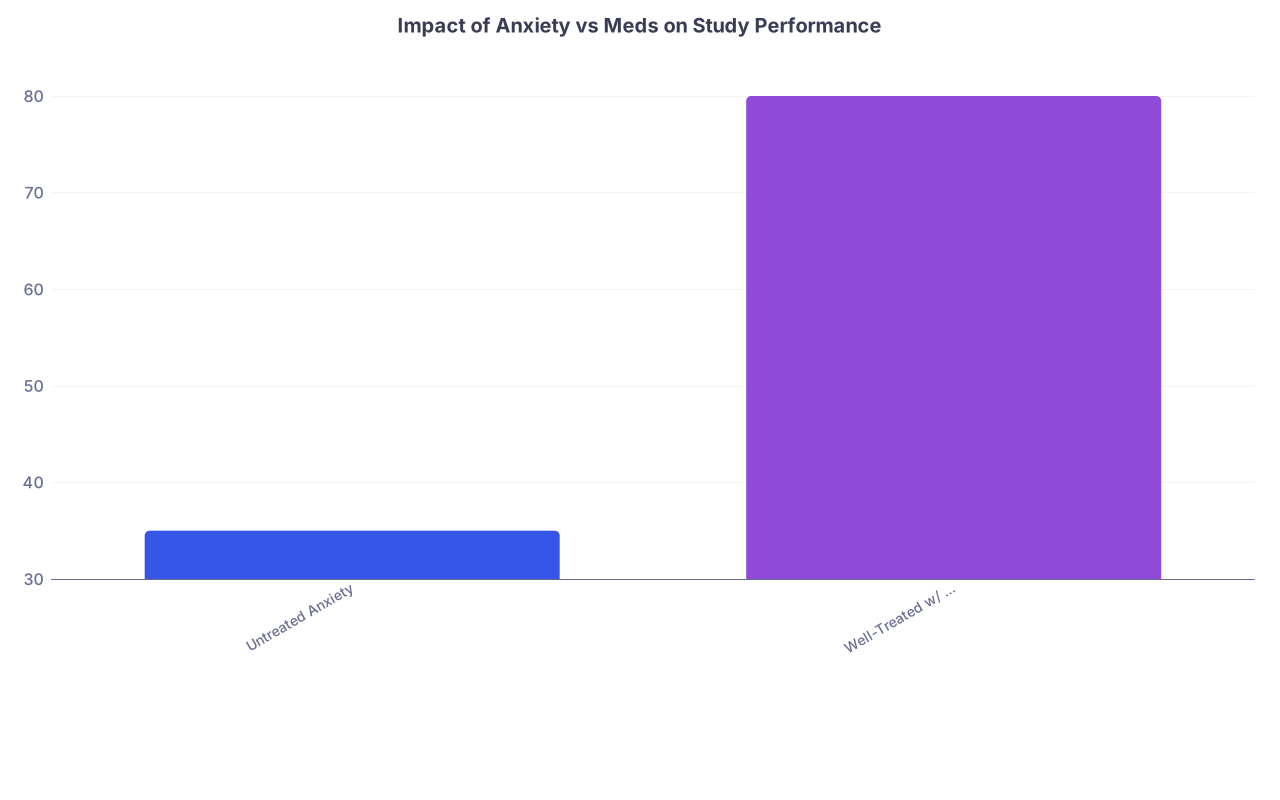
| Category | Value |
|---|---|
| Untreated Anxiety | 35 |
| Well-Treated w/ Meds | 80 |

| Step | Description |
|---|---|
| Step 1 | High anxiety, poor focus |
| Step 2 | Start/adjust meds |
| Step 3 | 1-2 weeks: side effects, adjustment |
| Step 4 | 3-6 weeks: more stable mood |
| Step 5 | Better sleep & study consistency |
| Step 6 | Improved exam performance |
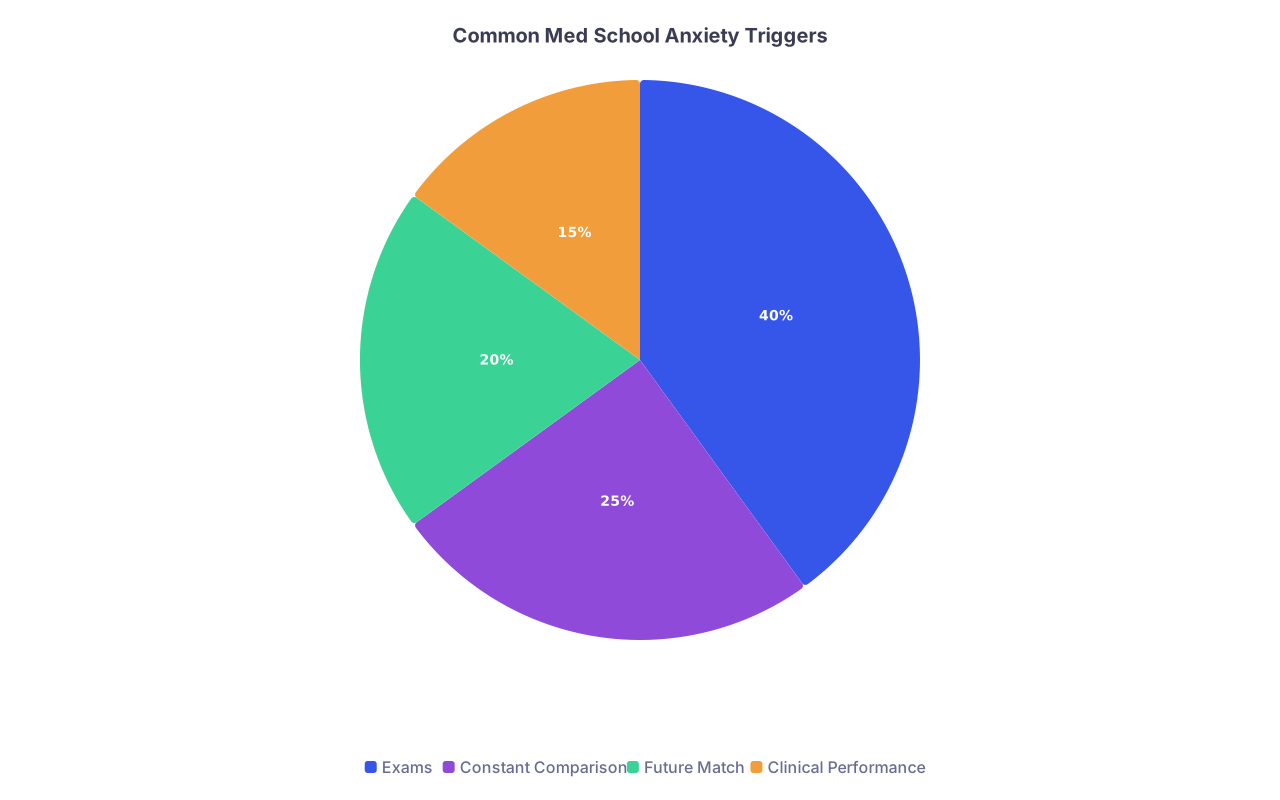
| Category | Value |
|---|---|
| Exams | 40 |
| Constant Comparison | 25 |
| Future Match | 20 |
| Clinical Performance | 15 |


What You Can Actually Do This Week
You’re probably reading this at 2 am, already spiraling. So here’s the unglamorous, non-magical truth:
- You’re allowed to need medication and still be a strong med student. Those aren’t opposites.
- You’re allowed to advocate for yourself: “This dose kills my mornings. I need a change.”
- You’re allowed to not have it perfectly figured out during MS1.
If your current fear is: “What if my anxiety meds affect my med school performance?”
The better question is: “How do I make my treatment — meds or not — work with my academic life, not against it?”
It’s not all-or-nothing. It’s not “on meds = doomed, off meds = pure.” It’s trial, feedback, adjustment, repeat. Just like literally every treatment plan you’ll ever write.
FAQ (Exactly 4 Questions)
1. Should I delay starting anxiety meds until after first year so they don’t mess up my performance?
I wouldn’t. First year is already a psychological blender. Going into it with untreated, severe anxiety because you’re scared of meds is like refusing anesthesia because you’re scared of side effects, then trying to do surgery awake. If your anxiety is moderate to severe and already impacting studying, relationships, or sleep, getting it treated before MS1 (or early in the year) usually helps more than it hurts. Just avoid huge med changes right before massive exams if you can.
2. What if I feel emotionally flat or “numb” on my SSRI — is that automatically bad for my performance?
Not automatically, but it’s a red flag you shouldn’t ignore. There’s a difference between “less overwhelmed and more steady” and “I don’t care about anything, including studying.” Emotional flattening can kill motivation, which obviously hurts performance. That doesn’t mean “all meds are bad.” It usually means your dose is too high, or that specific med isn’t a good fit. Bring it up clearly: “I can function, but I feel too flat and unmotivated. I need a different balance.”
3. Can I take a benzo before a big exam without destroying my memory?
If you use a short‑acting benzo at a low dose, prescribed by your doctor, and you only use it in rare, high-anxiety situations, you’re not erasing your knowledge. In fact, reducing extreme panic can actually let your brain access what you studied. The problem is frequent use, high doses, or relying on it every time you’re stressed. That’s when you start seeing more noticeable cognitive dulling and dependence. This is a surgical tool, not a daily multivitamin.
4. Will being on anxiety meds hurt my chances for residency later?
Not if you’re functioning well. Programs care about performance, professionalism, and reliability — not whether you take 10 mg of Lexapro at night. You don’t list medications on ERAS. What hurts more is unaddressed mental health issues leading to failed courses, leaves of absence, or concerning evaluations. Quietly doing the work to keep yourself stable — including meds if needed — is one of the most pro-residency things you can do.
Close your browser tabs for a second and do one tiny, concrete thing:
Write down, on paper, how your anxiety has affected your studying this week — number of hours lost, meltdowns, sleep. Then ask yourself honestly: is my fear of medication bigger than the actual damage my anxiety is already doing?
If the answer is yes, message your prescriber or campus mental health today and start a real conversation about making your treatment match your med school life.