“I Regret Choosing Medicine”: How Common Is It in First Year?
It’s 11:47 p.m. You’ve re-read the same paragraph about the Krebs cycle four times and it still looks like static. Your group chat is full of people joking about “only” studying 8 hours today. Your chest feels tight. And the thought that keeps looping in your brain isn’t “I’m tired.”
It’s: “I think I made a mistake. I regret choosing medicine.”
You start googling things you’re half-afraid to type:
“med students who regret medicine”
“quit med school first year”
“how common to hate med school”
You land here because you’re hoping someone will either tell you:
- “You’re not alone; this is normal,” or
- “You’re right, this is a sign; get out now.”
You kind of want both answers at the same time. I know that feeling way too well.
Let’s talk honestly about how common regret is in first year, when it matters, when it’s just your fried brain talking, and what people actually do about it.
How Common Is “I Regret Choosing Medicine” in First Year?
Let me just say it clearly: regret, doubt, and “what have I done” thoughts are extremely common in first year. Way more than anyone admits out loud.
I’ve heard all of these, verbatim, from MS1s:
- “If I’d known it was like this, I wouldn’t have come.”
- “I think I liked the idea of being a doctor more than the reality.”
- “I should’ve done PA / NP / tech / anything else.”
- “I worked this hard for… this?”
You’re not some uniquely broken outlier. You’re just in the blast radius of a life choice with no easy exit door.
Let’s put some numbers to the vibe.
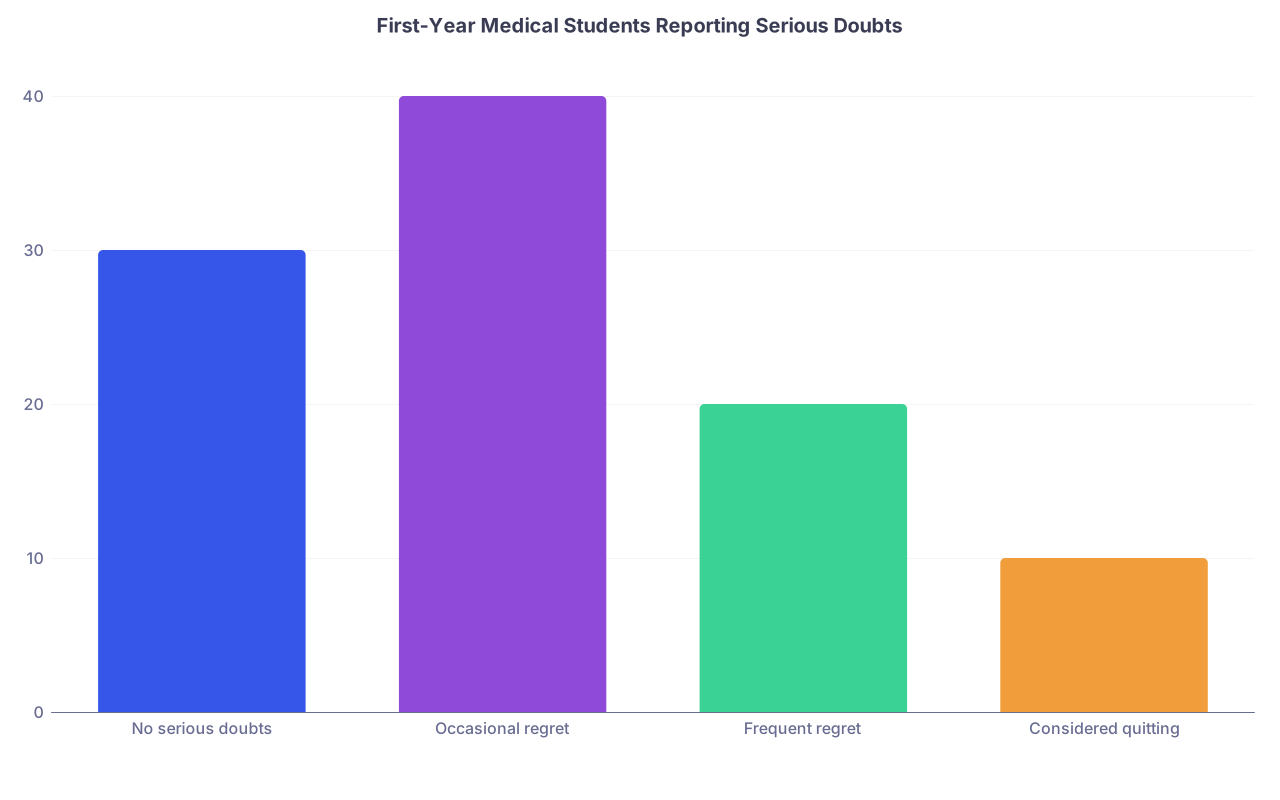
| Category | Value |
|---|---|
| No serious doubts | 30 |
| Occasional regret | 40 |
| Frequent regret | 20 |
| Considered quitting | 10 |
Are these exact numbers from one perfect study? No. But they’re in the ballpark of what multiple surveys and mental health studies on med students show:
- A big chunk (probably the largest group) has passing “this sucks” thoughts but doesn’t seriously want to quit.
- A solid minority has frequent regret, sometimes daily, especially around exams.
- A smaller but not tiny group has actually looked up withdrawal policies, leave of absence forms, or alternate careers.
So if your brain is screaming, “Everyone else loves this and I’m the only idiot regretting it,” that’s just not reality.
They’re just not saying it in the anatomy lab.
Why First-Year Regret Hits So Hard
You’re not just dealing with hard classes. You’re dealing with a total identity earthquake.
Here’s the messed up recipe:
You romanticized medicine for years.
Shadowing 4 hours in clinic ≠ existing 80 hours a week in material you can’t fully absorb.The workload is stupidly dense.
Not always “hard” in the conceptual sense. Just… never-ending. You lose the feeling of finishing anything.Everyone is posturing.
“Yeah, I didn’t really study for that.”
Translation: I studied all day but I’m pretending I didn’t so I look naturally brilliant.You lose your normal metrics of success.
You used to be top of your class. Now a “median” score feels like personal failure. Which is irrational but still gutting.You don’t touch actual, meaningful patient care for a while.
So the “why I did this” part is mostly theoretical, while the “this is awful” part is very, very real.
That mix is exactly what feeds the sentence: “If this is what medicine is like, I regret coming here.”
But here’s the thing: first-year med school is not what medicine is actually like. It’s a warped little bubble of content dumping, weird grading, and identity demolition.
You’re judging the entire career by the absolute worst-designed, least-human part of the path.
Regret vs Burnout vs “I Need Sleep”: Telling Them Apart
This is where people get scared: “What if this regret means I’m truly not meant for medicine and I’m just ignoring the truth?”
Fair question. Let’s actually pull this apart.
1. Situational Misery (Very Common, Often Temporary)
This is:
“I hate this right now. I hate this exam block. I hate this class. I hate this environment.”
Signs it’s situational:
- On breaks or lighter weeks, you feel more like yourself.
- A good clinical experience briefly reminds you why you started.
- You catch yourself thinking, “If it wasn’t this insane, maybe I could handle it.”
That’s not proof you chose the wrong career. That’s proof the current phase is badly structured for normal human brains.
2. Burnout / Depression Wearing a “Career Doubt” Mask
I’ve seen this a lot: people insist they “regret medicine,” but when you scratch the surface, what you see is:
- Chronic sleep debt
- Panic attacks around exams
- Loss of interest in everything (not just medicine)
- Can’t concentrate, feel numb, cry randomly
That’s not a pure career decision. That’s mental health screaming for help.
You cannot make a clean, logical life choice from the middle of that storm. You can try, but it’ll be distorted as hell.
3. Deep, Persistent Misalignment (Less Common, but Real)
This is where it might actually be: wrong fit, full stop.
Patterns I’ve seen in people who eventually did leave medicine (and were relieved, not wrecked):
- The regret predates med school. They had doubts even before acceptance, but pushed them down.
- They fundamentally don’t care about clinical medicine. Like, at all. Not “burned out caring,” just never had genuine interest.
- Even in less stressful periods, the idea of actually being a physician in 5–10 years fills them with dread, not just fatigue.
That’s different from: “I hate First Aid” and “I hate multiple-choice tests.”
You have to be brutally honest with yourself here:
Do you want to escape this phase, or do you want to escape ever being a doctor?
The answer to that matters.
What First-Year Regret Usually Means Long-Term
Let me cut through your biggest fear:
“I regret this now → I’ll regret my entire life → I’ll be trapped forever.”
That’s the nightmare your brain is playing. The reality is a lot messier and more forgiving.

Here’s what I’ve actually seen happen to first-years who said, “I regret choosing medicine”:
They survive MS1, get more clinical exposure, and the regret softens.
They still hate the exams, sure, but a patient interaction, a good preceptor, or a cool procedure suddenly makes it feel less pointless.They adjust expectations.
They realize they don’t have to be the 260 Step scorer doing neurosurgery at MGH. Family med, psych, peds, outpatient IM all become “real” options, not “giving up.”They build their own version of medicine that feels tolerable—sometimes even meaningful.
Less prestige, more sanity. And that’s fine.A small group actually leaves.
Not in week 2, usually. More like: after a year, or after a leave of absence. And many of them feel a huge sense of relief and go on to do other health-adjacent things, or something totally different.
Being miserable in MS1 does not lock in your future. It just sucks right now.
Concrete Things To Do When You’re Thinking, “I Regret This”
I know you’re not looking for “self-care” platitudes. You’re looking for: “What do I actually do tomorrow when I wake up and still hate everything?”
Here are moves that are actually useful, not fluffy.
1. Run a “Reality Check” with Someone Who’s Seen All 4 Years
Not your equally-panicked classmates. Someone like:
- A trusted MS3/MS4
- A chill resident (not the superhuman robot one)
- A dean of students who actually meets with students, not just gives speeches
Say this out loud: “I’m wondering if I chose the wrong career. Can I ask what MS3/MS4/residency is really like, compared to this?”
You’re trying to answer:
“Do things ever get meaningfully better for people like me?”
You’ll hear patterns. Some will say: “MS1 was the worst, MS3 reminded me why I came.” Others will say: “MS2 was my breaking point.” It gives you more data than your spiraling brain.
2. Separate “Do I Hate Medicine?” from “Am I Just Exhausted?”
Make yourself answer 2 different questions:
- If I had a week off, with no school responsibilities, would I still feel the same intensity of regret?
- When I imagine being a doctor in a setting I like (outpatient clinic, psych, surgery, whatever), do I feel:
a) dread,
b) nothing, or
c) a tiny spark of “that could still be good, if I get through this”?
If the regret dial drops after sleep and a break, that’s not pure career regret. That’s your nervous system screaming.
3. Talk to Mental Health – Even If You Think “I’m Not That Bad”
Look, a school counseling appointment is not a contract. You’re not signing a form that says “I quit medicine.”
You’re saying: “I am not okay, and I need a witness and a sounding board.”
Usually what comes out in those sessions is:
- You’re carrying unrealistic expectations from undergrad.
- You’re catastrophizing any performance that’s not “top.”
- You’re basing your identity on grades in a system designed to crush everyone equally.
They can also help you map out:
“If I did want to leave, how would I even approach that conversation?”
Which—ironically—usually makes people panic less and feel less trapped.
4. Learn What Your Exit Options Actually Are
This sounds backwards, but I’m serious: sometimes regret shrinks when quitting becomes possible, not forbidden.
Ask (quietly, to someone you trust, or via policy documents):
- What’s the leave of absence policy?
- What’s the process if I wanted to withdraw after this year?
- Are there masters/other programs I could pivot into with the credits I have?
| Option | When It Happens | Typical Next Step |
|---|---|---|
| Early withdrawal | MS1–early MS2 | New career/degree |
| Leave of absence | Any year | Return later or switch |
| Transfer (rare) | After MS1/MS2 | Different school/program |
| Dual degree pivot | MS2–MS3 | MPH/MBA/research focus |
| Finish MD, shift | Post-grad | Non-clinical career |
Knowing you’re not locked in forever sometimes makes staying feel like a choice—not a sentence.
5. Time-Limit Your Decision
Tell yourself something like:
“I’m not allowed to make a permanent decision in the middle of this exam block. I will revisit at [end of semester / after boards / after next break] with clearer data.”
That doesn’t magically solve the pain, but it stops you from trying to solve a 10-year problem with a brain that hasn’t slept in 3 days.
How This Feels Over the Rest of First Year
Your brain probably wants a timeline: “When does this start to feel less like constant regret?”
There isn’t a single answer, but the pattern through the year often looks like this:
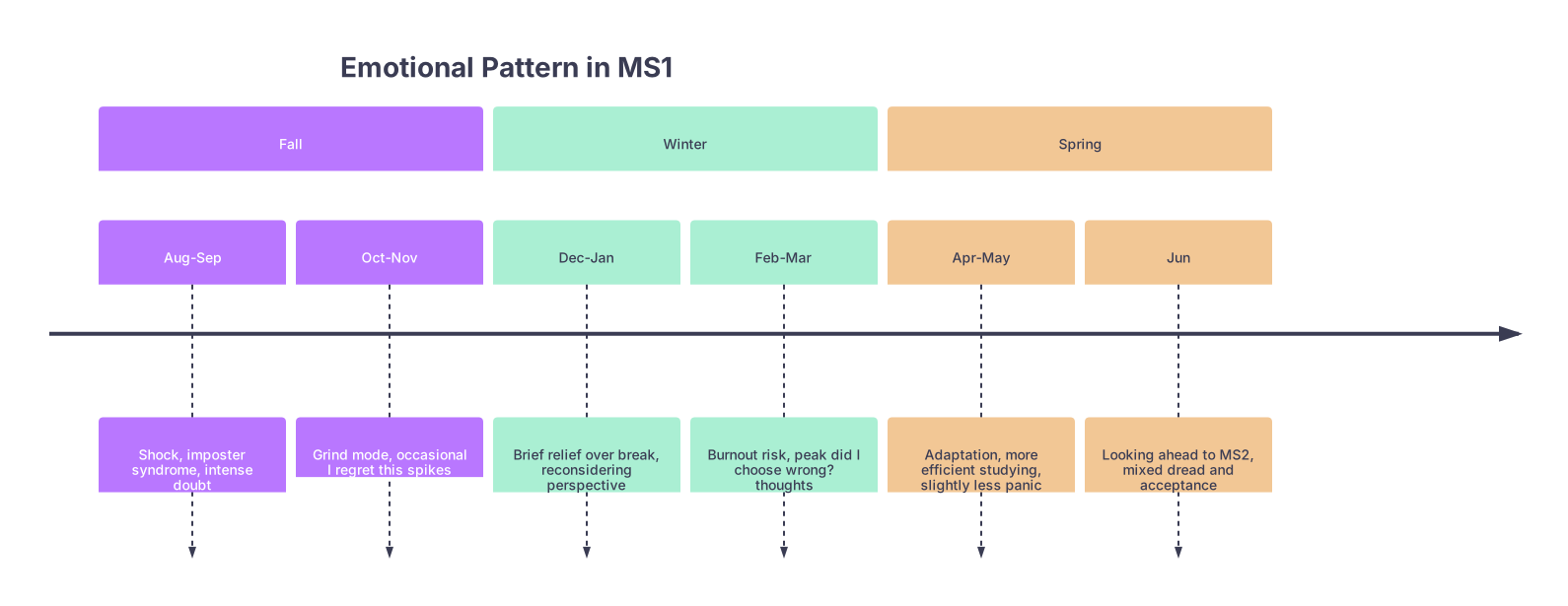
| Period | Event |
|---|---|
| Fall - Aug-Sep | Shock, imposter syndrome, intense doubt |
| Fall - Oct-Nov | Grind mode, occasional I regret this spikes |
| Winter - Dec-Jan | Brief relief over break, reconsidering perspective |
| Winter - Feb-Mar | Burnout risk, peak did I choose wrong? thoughts |
| Spring - Apr-May | Adaptation, more efficient studying, slightly less panic |
| Spring - Jun | Looking ahead to MS2, mixed dread and acceptance |
The worst spikes of “I regret medicine” often line up with:
- First anatomy exam
- First truly bad grade
- First time you realize you can’t out-study your anxiety
- Long stretches with zero patient contact
If that’s where you are, it’s not a prophecy. It’s a stage.
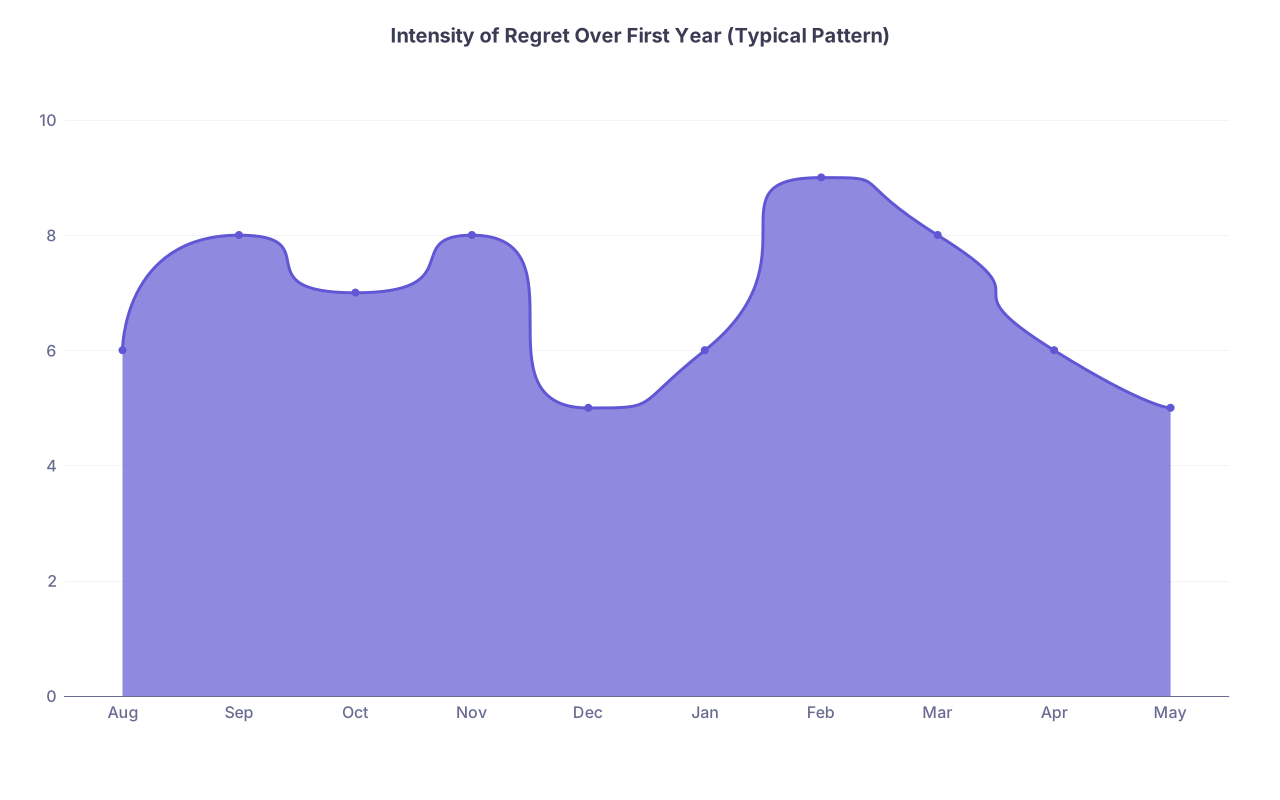
| Category | Value |
|---|---|
| Aug | 6 |
| Sep | 8 |
| Oct | 7 |
| Nov | 8 |
| Dec | 5 |
| Jan | 6 |
| Feb | 9 |
| Mar | 8 |
| Apr | 6 |
| May | 5 |
(Scale 1–10: 10 = “why did I ruin my life.”)
Not everyone follows this exact curve, but lots of people hit 8–9 at some point. They just… don’t announce it.
When You Should Take Your Regret Very Seriously
I’m not going to gaslight you with “it’s just a phase” if some red flags are actually blaring. Pay attention if:
- You feel unrelenting dread about ever being a doctor, even on well-rested days.
- You never actually felt drawn to patient care; it was always prestige/family pressure/status.
- You’ve lost interest in everything that used to matter to you for months.
- You’ve had serious thoughts of self-harm or “it would be easier if I weren’t here.”
That last one isn’t a “maybe talk to someone when you have time.” That’s get help now territory: school counseling, a trusted dean, a crisis line, whoever is available fastest.
Continuing down a path you deeply, consistently don’t want is not “being strong.” It’s how people break.
The Ugly But True Middle Ground
Here’s the part no glossy brochure will tell you:
- You might never be obsessed with medicine.
- You might always feel a little ambivalent.
- You might finish med school, match into something sane, and think, “I don’t love this, but I don’t regret it either. It’s fine. It pays the bills. I help people sometimes.”
Not every doctor is living some grand calling. A lot of them are living a stable, decent life in a job that’s… okay, with some really good moments.
If the regret you feel now is “this is brutal and I hate this phase,” but there’s still some part of you that can imagine a version of your future where being a doc is good enough—that’s not failure.
That’s just adulthood with more anatomy.
Years from now, you probably won’t remember the exact Krebs cycle slide that broke you. You’ll remember whether, in that moment, you listened to fear alone—or whether you got curious, asked hard questions, and made a decision (to stay or to leave) that respected the actual human being stuck in the middle of all this: you.
FAQ (Exactly 5 Questions)
1. Is it normal to regret choosing medicine during first year?
Yes. Very normal. Lots of MS1s question their decision at some point, especially around heavy exam blocks or after a disappointing grade. They just don’t usually say it out loud in public, so it feels like you’re the only one. You’re not.
2. How do I know if I truly picked the wrong career and not just a hard year?
Look at patterns, not single bad weeks. If even when you’re rested and not under immediate exam pressure, the idea of being a physician fills you with genuine dread, and you never felt a real pull toward patient care, that points more toward misalignment. If your doubts flare mainly when you’re exhausted and fade when you get breaks or good clinical exposure, it’s more likely the phase, not the whole path.
3. Do people actually quit med school in first year?
Yes, some do. It’s not the majority, but it’s also not unheard of. Usually they’ve had doubts for a long time, sometimes even before matriculating. Most who leave either take a leave of absence first or finish the year before making a final decision. And many who leave go on to build fulfilling careers elsewhere—they’re not doomed.
4. Is it a bad sign that everyone else seems fine and I’m falling apart?
You’re comparing your insides to their outsides. People downplay their stress constantly. I’ve seen students who looked totally calm in small group then cried in the counseling center an hour later. If you’re struggling, it doesn’t mean you’re weaker or less suited for medicine. It might just mean you’re more honest with yourself—or more burned out.
5. Should I just push through first year and decide later?
Often, yes—but not blindly. Pushing through can make sense if you also: get mental health support, talk honestly with upperclassmen or faculty, and learn your real options (including leave of absence or withdrawal). For many people, the picture looks very different after surviving MS1 and seeing more of what actual medicine—not just lecture slides—really is. But if your mental health is tanking or you’re having serious self-harm thoughts, the priority is safety first, decisions second.