You got an interview. Good. Then the second problem hits: the format, timing, tech setup, or schedule is going to work badly for you unless something changes.
This is where a lot of applicants spiral. They worry that asking for an accommodation will make them look high-maintenance, fragile, or less competitive. I have seen people type a perfectly reasonable two-sentence request, then sabotage it by adding three paragraphs of medical history, a mini trauma memoir, and an apology tour. Bad move.
Here is the truth: accommodations are about access. Not special treatment. Not asking for favors. Not giving the program a backstage pass to your health history. If a barrier is going to interfere with your ability to participate fully in the interview, fix it early and professionally.
The stakes are real. Interview days can be long, rigid, noisy, overpacked, and poorly designed for fatigue, hearing or vision needs, neurodivergence, chronic illness, migraines, anxiety, ADHD, medication timing, mobility issues, or the simple reality that not every applicant functions well in a one-size-fits-all setup. If you wait, you risk performing below your actual level for a preventable reason. That is unnecessary. And frankly, dumb.
The biggest mistake is not asking. The second biggest is oversharing.
Your goal is simple: name the barrier, request the adjustment, keep the rest private.
Why Residency Interview Accommodations Feel So Risky
Residency applicants are not imagining the pressure. Interview season already feels like a long audition. Every email is loaded. Every interaction feels like it might be judged. So when you need an accommodation, it is easy to assume the request itself will become a red flag.
That fear makes sense. But it also pushes people into bad strategy.
I have seen applicants do all of the following:
- Say nothing and suffer through a format that clearly puts them at a disadvantage
- Wait until the last 24 hours, when the coordinator has no clean way to help
- Overexplain, thinking more detail will make the request seem more legitimate
- Apologize so much that the email sounds like a confession instead of a logistics request
None of that helps you.
A clean accommodation request is not a character test. It is a practical correction to an access problem. Treat it that way. If you need:
- captioning for a virtual interview
- extra time between interview blocks to manage fatigue or blood sugar
- a quieter room for an in-person interview day
- materials in advance to support processing or assistive technology
- a scheduling adjustment because of a medical treatment window
say that. Directly. Briefly.
The wrong frame is: "I need them to understand my whole situation."
They do not.
The right frame is: "I need this specific barrier removed so I can participate fully."
That shift matters. It protects your privacy, keeps the communication professional, and gives the program something actionable. Most coordinators are far more able to respond to a concrete request than to a long, emotionally loaded explanation. They need logistics, not your life story.
And yes, the emotional part is real. Asking can feel exposing. Especially if your need is tied to mental health, neurodivergence, chronic illness, or something that has already made medical training harder than it should be. I get it. But your interview request is not the place to process that history. Save your energy for the interview itself.
Decide What You Actually Need Before You Contact Anyone
Do not start with diagnosis. Start with function.
That is the cleanest way to avoid oversharing and the fastest way to figure out what to ask for.
Use this three-part self-check before you email anyone.
1. Identify the exact barrier
Be specific. "Interview day is stressful" is not a barrier. "Back-to-back interviews without breaks worsen my fatigue and make it hard to concentrate by the final sessions" is a barrier.
Ask yourself:
- What part of the interview process creates the problem?
- Is it timing, technology, environment, communication, travel, sensory load, or stamina?
- What happens if nothing changes?
2. Identify the task affected
Pin down what the barrier disrupts.
Examples:
- hearing interviewers clearly
- seeing shared materials
- maintaining focus across a long block
- managing medication, nutrition, or pain
- processing verbal information quickly in a noisy environment
- participating equitably in a virtual format
This keeps you from making vague requests that nobody knows how to implement.
3. Identify the minimum effective adjustment
This is where people often overreach or underspecify.
Good accommodation requests are narrow and practical:
- live captioning for virtual interviews
- a 10- to 15-minute break between scheduled sessions
- first or earlier interview slot
- written itinerary or names in advance
- quiet waiting area
- flexibility to keep camera off briefly during breaks, if relevant to the format
- accessible platform compatibility
The phrase I want you to remember is minimum effective adjustment. Not your ideal day. Not every preference. The smallest change that gives you equal access.
That also helps you distinguish a true accommodation from a routine preference.
Preference vs accommodation
A preference is "I would rather not have an early start."
An accommodation is "I need a later start because early-morning medication side effects would interfere with participation."
A preference is negotiable comfort. An accommodation addresses a barrier that would otherwise impair access.
That distinction matters because it sharpens your ask and makes your request easier to defend if someone pushes back.
Your disclosure rule
Use this rule every time:
If the request can be understood and implemented without naming your diagnosis, do not name it.
That is the default. Efficient. Protective. Professional.
If documentation is required, provide the minimum necessary to support the requested adjustment. Not your whole chart. Not your treatment timeline. Not the dramatic origin story.
How to Ask for Accommodations Without Oversharing
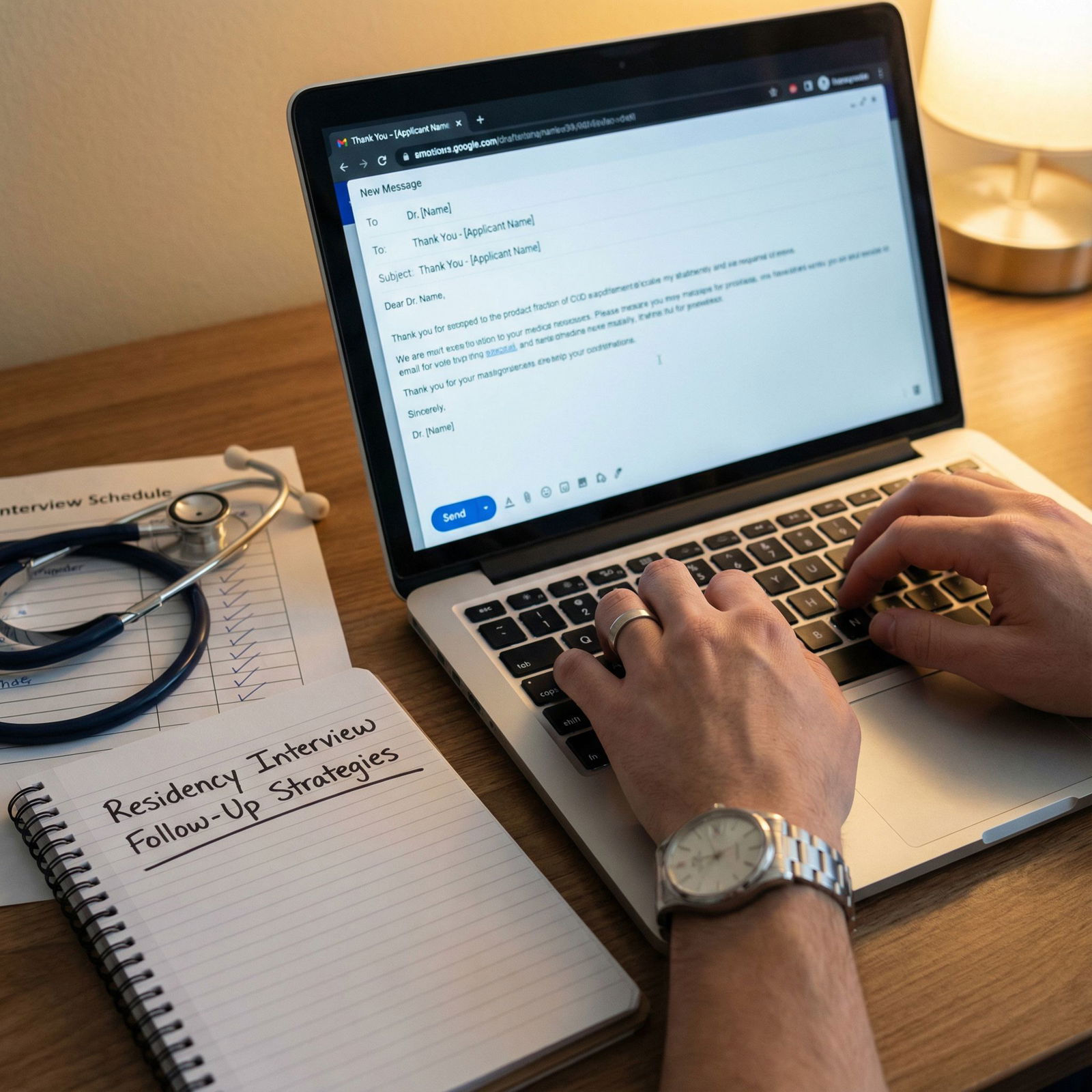
Here is the protocol. Simple. Repeatable. Effective.
Step 1: Ask early
As soon as you know the interview format and see the barrier, send the request. Early is easier for everyone. Schedules are more flexible. Tech support has time. Coordinators are less stressed.
Last-minute requests are harder to fulfill cleanly. Sometimes still possible. But harder.
Step 2: Contact the right person
Usually that is:
- the residency program coordinator
- the interview scheduling contact
- the GME office contact, if the program directs applicants there
- an institutional accessibility office, if one is listed
Do not blast the entire faculty panel. Do not CC half the program unless there is a reason. Keep it contained.
Step 3: Use a tight message structure
Your message should include five parts:
- Greeting
- Clear request
- Brief functional reason
- Specific proposed solution
- Appreciation and contact availability
That is enough.
Step 4: Keep the explanation functional, not personal
Bad accommodation emails sound like applicants are trying to prove they deserve help. Good ones sound like logistics.
Strong example
Subject: Interview accommodation request
Dear [Coordinator Name],
Thank you for scheduling my interview. I am writing to request a small accommodation to support full participation in the interview day. I would appreciate [specific adjustment].
I have a medical condition that affects [relevant function only, such as stamina, hearing, visual access, or concentration] during prolonged or [specific setting] sessions, and this adjustment would help ensure I can participate effectively throughout the day.
If helpful, I am glad to discuss logistics or provide any documentation that is actually required. Thank you for your help.
Sincerely, [Name]
Even tighter example
Dear [Name],
I am looking forward to my interview on [date]. I am requesting live captioning for the virtual interview day so that I can participate fully in each session. Please let me know if there is a preferred process for arranging this. Thank you very much.
Best, [Name]
That works. Clean. No unnecessary exposure.
What not to say
Here is the kind of wording that causes problems:
- "I have struggled for years with severe anxiety related to several personal and medical experiences..."
- "My psychiatrist recently changed my medication after a difficult few months..."
- "I have ADHD and also a chronic illness and historically long interview days have been very triggering for me..."
- "I am so sorry to ask for this and completely understand if it is inconvenient..."
Why this is bad:
- It gives away more than the program needs.
- It invites follow-up questions you do not want.
- It shifts the tone from logistics to personal disclosure.
- It makes the request sound exceptional when it is not.
Better substitutions
Instead of:
- "I have severe anxiety and panic attacks."
Say:
- "I would benefit from a brief break between interview sessions to support effective participation."
Instead of:
- "Because of my ADHD, I struggle to process rapid verbal instructions."
Say:
- "Receiving the interview itinerary and session details in writing in advance would help me prepare and participate fully."
Instead of:
- "I have a chronic illness with fatigue and medication timing issues."
Say:
- "A slightly later start time or scheduled break would help me manage a medical need and participate effectively."
Notice the pattern. Functional. Specific. Minimal.
What about documentation?
Most applicants fear this more than the request itself.
Here is the practical rule: if documentation is requested, ask what exactly is required before sending anything.
You want answers to:
- Is documentation actually required for this request?
- What information must it include?
- Who will review it?
- Can identifying diagnostic detail be omitted if the functional limitation and need are clear?
Usually, the useful documentation is brief and focused on:
- the existence of a condition or disability, if necessary
- the functional limitation
- the accommodation recommended
That is all. A short note is often enough. Submitting full specialist letters, medication lists, therapy summaries, or old records is almost always excessive.
Etiquette that helps
A few habits make your request easier to receive:
- Be calm and direct.
- Do not over-apologize.
- Do not make the request sound optional if you truly need it.
- Do not argue your worthiness.
- Do not turn the email into a personal narrative.
- Do thank the coordinator for helping with logistics.
Think of it the same way you would think about correcting a wrong interview link or a scheduling conflict. Professional problem-solving. Not confession.
What to Do If the Program Pushes Back or You Start Oversharing
Prompt: Vintage sketch style illustration of a residency applicant at a wooden desk striking through long paragraphs on a printed email draft and circling one concise sentence, warm lamp light, restrained tension, notebook, watch, and laptop nearby, textured paper feel, expressive hand-drawn lines, no text overlay, no watermark
Sometimes the program asks for too much. Sometimes you panic and start talking too much. Both can be fixed.
If the program asks for more detail than you want to give
Do not get defensive. Get precise.
Use this script:
"Thank you for your response. I am requesting this adjustment to address a functional barrier to full participation in the interview day. Could you clarify what documentation is required specifically to support this request? I would prefer to provide only the information necessary for arranging the accommodation."
That does three things:
- keeps the focus on access
- asks them to justify the scope of the request
- signals that you have boundaries
If they still press for broad medical detail, ask whether the institution has an accessibility office or GME contact who handles accommodation review. Move it out of the casual email lane and into the proper process.
If the conversation gets uncomfortable
Pause. Slow down. Repeat the request.
Use a de-escalation line: "My main need is [accommodation]. That adjustment would address the barrier and allow me to participate fully."
Then stop talking.
Silence is useful here. People overshare because they rush to fill the space. Do not.
If you catch yourself oversharing in real time
This happens on calls. You start explaining, hear yourself doing too much, and want to crawl under the desk.
Fix it fast:
- Stop.
- Summarize in one sentence.
- Redirect to the requested adjustment.
For example: "Let me simplify that. The main issue is that I need brief spacing between sessions to participate effectively, and I am asking whether that can be arranged."
Done. Back on track.
If the program cannot meet the exact request
Ask for alternatives.
Try:
- "If that exact adjustment is not possible, what similar option could support access?"
- "Could we explore another scheduling arrangement?"
- "Is there an alternative platform or format available?"
Document the exchange. Save the emails. If needed, escalate through the institution's accessibility office or GME office. Quietly. Professionally. But do it.
Practical Templates, Boundaries, and a Final Action Plan
Here is the simplest template worth using.
Email template
Subject: Interview accommodation request
Dear [Coordinator Name],
Thank you for arranging my interview on [date]. I am writing to request [specific accommodation] so that I can participate fully in the interview day.
I have a medical need that affects [brief functional limitation only], and this adjustment would address that barrier. Please let me know whether this can be arranged or if there is a formal process I should follow.
Thank you for your help.
Sincerely, [Your Name] [AAMC ID or ERAS ID if appropriate]
Boundary rules
These are nonnegotiable.
- Disclose the minimum.
- Keep the explanation functional.
- Do not volunteer diagnosis, treatment history, medication details, or personal backstory unless truly required.
- Do not apologize for having access needs.
- Do not send records before confirming what is necessary.
- Do not let a simple request turn into a self-justification exercise.
I will say this plainly: oversharing does not make your request more legitimate. It just makes you more exposed.
Interview-day checklist
Once the accommodation is approved, do not assume everything will magically work.
Confirm:
- the accommodation is documented in writing
- the timing and logistics are correct
- the virtual platform works with your needs
- any captioning, accessibility features, or scheduling changes are active
- you have the coordinator's direct contact info
- you have a one-sentence explanation ready if a logistical question comes up
Example: "Yes, I have an approved scheduling adjustment, and the coordinator has the details."
Short. No improvising.
Final action plan
If you are stuck, do this today:
- Identify the barrier.
- Name the exact task it affects.
- Choose the minimum effective adjustment.
- Draft a three- to five-sentence request.
- Remove extra medical details.
- Send it early to the right contact.
- Confirm receipt.
- Save all communication.
- Follow up if needed.
- Show up prepared, not apologetic.
That is how you handle accommodations without oversharing. Clear request. Tight boundaries. Problem solved.