
Civilian medical students get to play by ERAS rules. You don't.
If you are an HPSP scholar or a USUHS student, applying for residency isn't just about matching into a specialty you love, it's an operational military assignment process governed by defense budgets, congressional billet allocations, and active duty service obligations.
When civilian applicants fail to match into their dream specialty, they drop into the Supplemental Offer and Acceptance Program (SOAP) or take a research year. If you fail to match in the Military Graduate Medical Education (GMESB) board without a calculated backup strategy, the military doesn't hand you a gap year. They assign you to a General Medical Officer (GMO) tour, a flight surgery billet, or a transitional year spot where the needs of the service dictate your life for the next one to three years.
A traditional backup strategy won't save you here. You need a military-smart backup plan built around operational timelines and payback reality.
This article is written for educational purposes only and is not financial advice, not legal advice, and not tax advice. Military obligation terms and figures vary by branch and year, so consult a qualified professional before making binding decisions.
Understanding Military Service Obligations
Before you can choose a backup specialty, you have to understand the math behind your uniform. Every dollar the military spends on your medical education comes attached to time.
HPSP recipients incur a year-for-year active duty service obligation (ADSO), usually capping at four years. USUHS graduates owe seven years of active duty time after completing residency. But here is the catch that trips up fourth-year applicants: where you do your residency dictates when that clock starts ticking.
- In-Service Residency: You complete your training at a military treatment facility (MTF) like Walter Reed, Madigan, or San Antonio Military Medical Center. You receive active duty pay and benefits as a captain or lieutenant. However, your residency years do not count toward paying back your school obligation. They add to your total active duty time for retirement, but your 4-year active duty payback clock remains paused until you graduate residency.
- Civilian Deferred: The military allows you to train at a civilian program because they don't have enough in-service slots for your specialty. You are placed in an inactive reserve status. You get paid a civilian resident stipend, and your active duty payback clock sits untouched until you complete training.
- Civilian Sponsored: The military pays you as an active-duty officer while you complete a civilian residency program. This usually adds a year-for-year payback extension on top of your medical school obligation.
Now factor in operational tours. Specialties like Flight Surgery or Undersea Medicine (DMO) are operational assignments. Taking a flight surgeon tour after an intern year satisfies a portion of your active duty obligation while pausing your specialty training. I've seen students treat these operational tours as a catastrophe when they miss their primary match. Wrong mindset. A planned operational tour is one of the most effective tools to reset your application, build military officer credentials, and re-apply to a competitive specialty.
The Military Match Timeline: What You Need to Know
The military match timeline runs months ahead of the civilian NRMP match. If you try to build your military backup strategy in the autumn of your MS4 year, you've already lost the game.
Here is the exact timeline you must follow:
MS3 Year: January, May
- At this point you should decide on your primary and secondary target fields. If you are aiming for a high-competition in-service specialty (Orthopedics, Dermatology, ENT, Ophthalmology), you must pick a secondary field now.
- At this point you should schedule your audition rotations (ADOs). Military programs heavily favor applicants who rotat in-person. You get maximum two active duty training rotations per year. Allocate one rotation to your primary target program and the second to a backup program or an MTF with multiple strong residency options.
MS4 Year: June, July
- At this point you should log into the Medical Operational Data System (MODS). MODS is the military's application portal. It opens early summer.
- At this point you should submit your initial specialty preferences. You will rank primary specialty preferences AND secondary/backup preferences.
MS4 Year: August, October
- At this point you should complete your interviews. Military residency interviews take place during audition rotations or virtually through October.
- At this point you should lock in your final MODS rank order list by mid-October.
MS4 Year: November, December
- At this point you should prepare for Match Results. The Joint Graduate Medical Education Selection Board (JGMESB) meets in late November.
- December Match Day: Military match results drop in mid-December. If you match into a full residency, great. If you match into a Transitional Year (TY) or preliminary General Surgery year, your backup strategy executes immediately.
Notice the gap between December and March? If you receive a civilian deferral during the military match in December, you have a window to enter the civilian NRMP match in March. But you must have your ERAS application fully prepped in September just in case.
Building Your Military Backup Specialty Strategy
A civilian backup strategy focuses on picking a less competitive field in ERAS. A military backup strategy must focus on billet allocation and service branch demand.

The military doesn't care if you're willing to move across the country for a open spot. If the Navy only has 4 billets for Otolaryngology this year and 12 people apply, 8 people are getting redirected. If those 8 people didn't rank a realistic backup inside MODS, the board decides for them.
Rule 1: Choose Safe Backups with High Billet Density
Safe backups in the military match are specialties with high volume and high service demand:
- Internal Medicine (Categorical)
- Family Medicine
- Transitional Year (TY) / Preliminary Surgery
If you are applying for Orthopedic Surgery, ranking General Surgery or an In-Service TY as your second choice keeps you at a major military medical center where you can research, build rapport with the department, and re-apply the following cycle.
Rule 2: Evaluate the Billet Shortage Report
Every summer, each branch releases its Graduate Medical Education target numbers.
- At this point you should check the target numbers released in July. If your primary choice (e.g., Anesthesiology) only lists 6 total positions across all military treatment facilities for your branch, that is a high-risk cycle. You must pair it with a backup field that shows 20+ available billets.
Step-by-Step: Assembling Your MODS Rank Strategy
- Primary Specialty (1st Choice): Your dream field (e.g., Urology).
- Primary Specialty Programs: Rank all military sites offering that specialty.
- Secondary Specialty (Backup): A high-demand field (e.g., General Surgery or Internal Medicine).
- Transitional Year / Internship Options: Rank TY programs at major tertiary MTFs where your target primary specialty exists. This positions you to re-apply next year while completing your PGY-1 requirements.
Navigating Service Commitments in Your Backup Plan
Your backup specialty directly controls the trajectory of your active duty obligation. Some specialties allow you to pay off your obligation faster; others force you to defer, delaying your military exit date.
High-Demand, Short-Path Specialties
Primary care specialties (Family Medicine, General Internal Medicine, Pediatrics) are the backbone of military health systems.
- Family Medicine: 3-year residency. You complete training quickly, enter active duty as a fully credentialed attending, and clear your 4-year HPSP obligation by age 31.
- General Practice / General Medical Officer (GMO): Completing a 1-year internship (TY or Preliminary) followed by a 2-to-3-year operational tour (Flight Surgeon, Brigade Surgeon, Undersea Medical Officer).
Do not view a GMO tour as a failure. Operational tours pay active duty flight or operational hazard pay, count year-for-year toward paying off your medical school payback obligation, and make you an extremely competitive applicant when you re-apply to competitive specialties in MODS. I've known dozens of applicants who missed Radiology or Derm on their first try, completed a two-year Flight Surgery tour in Europe or Japan, paid off half their service commitment, and matched seamlessly on their second attempt with stellar officer evaluation reports (OERs).
Handling Deferrals vs. Immediate Payback
If you list a civilian program as your backup, you must be prepared for the financial and structural reality:
If Civ-Deferred: You receive civilian resident pay (often lower than O-3 active duty pay with BAH), and your military obligation remains frozen. You emerge from residency with your full 4-year military payback obligation ahead of you.
If In-Service: You draw O-3 pay with housing allowance throughout residency, but you are subject to military reassignment, PT tests, and military decorum throughout residency.
At this point you should model your financial and personal life around both outcomes. Ask yourself: Am I willing to delay my civilian entry by 3 years if I take an operational tour? Am I prepared for lower civilian resident pay if I get deferred?
Checklist: Building Your Military Backup Strategy
To keep your planning sharp, follow this sequential checklist leading into your application season:
- 18 Months Out (Spring MS3): Review the previous year's JGMESB match statistics for your branch. Note the selection rates for your target specialty.
- 12 Months Out (Summer MS3): Select one target audition site for your primary specialty and one site for your backup specialty (or a major MTF hosting both).
- 6 Months Out (June MS4): Obtain the newly published GME billet allocation numbers from your branch specialty consultant.
- 4 Months Out (August MS4): Build a parallel ERAS application if you intend to request civilian deferral as part of your primary or secondary plan.
- 2 Months Out (October MS4): Finalize your MODS rank list. Ensure you have ranked a PGY-1 Transitional Year or Preliminary track at a hospital with an active residency program in your primary field.
- 1 Month Out (November MS4): Complete a final review of your application file with your branch Specialty Consultant or a senior Military Medical Mentor.
Summary: Protecting Your Career with a Military-Smart Backup Plan
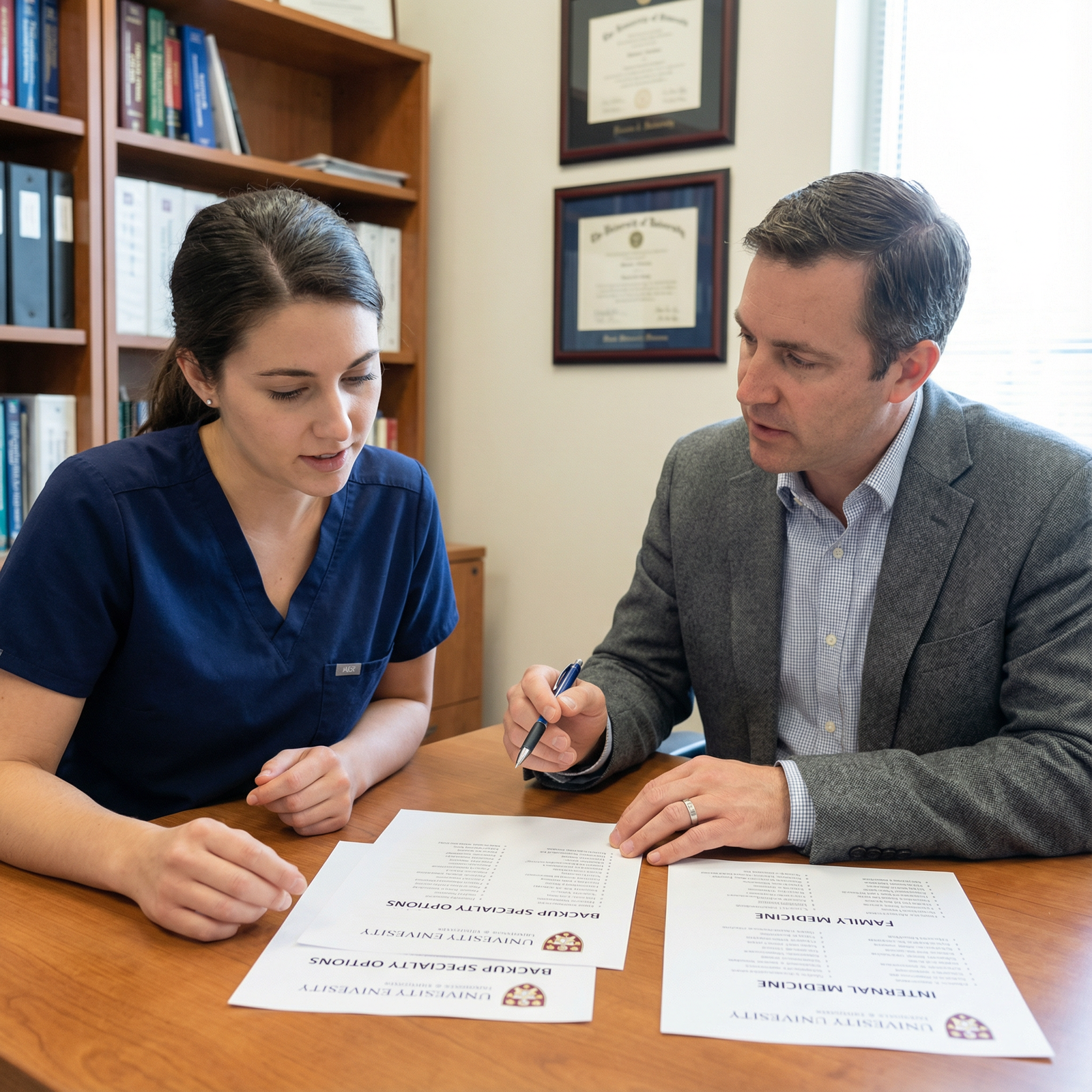
The military match rewards applicants who respect its operational realities. Trying to force a civilian application mindset onto MODS will lead to unwanted assignments and wasted application cycles.
Plan early. Factor in operational tours like Flight Surgery as legitimate strategic assets, not setbacks. Align your backup preferences with military branch staffing demands, and evaluate how each potential backup specialty alters your active duty service commitment.
At this point you should gather your board scores, rotation reviews, and draft MODS rank list, and schedule a formal review with your service branch Specialty Consultant. Getting expert eyes on your backup plan now is the single best step you can take to secure your career, in uniform and beyond.