
The usual advice about “just pick a less competitive backup” is statistically lazy. The data show that some so‑called backups barely move your unmatch risk, while others slash it dramatically.
If you treat backup specialties as a serious portfolio problem instead of vague Plan B talk, your odds improve. A lot.
Below I am going to walk through what the Match data actually support: which backups materially lower your risk of going unmatched, which are illusionary safety nets, and how to combine them in a way that makes quantitative sense rather than emotional sense.
1. The Core Problem: Most Backups Are Fake Safety Nets
Let’s get the scale right first.
NRMP’s “Charting Outcomes in the Match” and “Results and Data” reports (plus supplemental tables) give you enough to approximate risk:
- Overall US MD senior unmatch rate: roughly 5–7% in recent years
- In the most competitive specialties, effective unmatch probabilities are much higher if you are below their typical Step 2 / research / AOA thresholds
- For IMGs in competitive fields, unmatch risk can easily exceed 30–40%
So when a dermatology applicant says, “I’m backing up with anesthesiology,” the question is not “Is anesthesia easier than derm?” The question is: how much does anesthesiology actually reduce the joint probability of being unmatched?
If two specialties reject the same profile for the same reasons, they are not backups. They are clones.
You care about two things:
- Absolute competitiveness (match rate in that field for people like you)
- Correlation structure: how similar the selection filters are to your primary specialty
High correlation = weak backup.
Low correlation = real hedge.
2. Competitiveness Reality Check: Where Match Rates Actually Sit
Let us anchor on US MD seniors for clarity. These are approximate numbers from recent NRMP cycles; they move a bit year to year but the hierarchy is consistent.
| Specialty Group | Approx Match Rate |
|---|---|
| Ultra-competitive (Derm, PRS, Ortho, ENT, Neurosurg) | 60–80% |
| Competitive (EM, Anesthesia, Rad Onc, Ophtho, Urology) | 80–90% |
| Core IM/Gen Surg/Peds/OBGYN/Neuro | 90–95% |
| Broad-access (FM, Psych, Path, PM&R) | 95–99% |
Two immediate takeaways:
- Several “backup” fields live in the 80–90% band. That is not a safety net. That is still a risky bet if you are a marginal applicant.
- True risk-reducing backups tend to sit in the 95%+ zone for your demographic.
Now layer in applicant type. For IMGs, DOs, and reapplicants, you should mentally shift the entire table downward. A “95%” field for US MDs might be 75–85% for you.
The point: a credible backup usually has substantially higher match probability than your target field for your specific profile, not just a little.
3. Correlated Risk: Why Some Backups Fail Together
This is where most people get burned. They pick backups that share the same failure modes as their main specialty.
A few examples I have seen repeatedly:
- Derm applicant with mediocre Step 2 and thin research backs up with radiology and anesthesiology. Same red flags: test score heavy, strong school bias, likes high board numbers. If you are too weak for one, you are very likely too weak for the others at many programs.
- Ortho applicant with poor clinical evaluations backs up with general surgery. Both care deeply about letters from surgical services, strong team feedback, and procedural work ethic. If attendings do not like working with you in the OR, neither group will be excited.
A backup works when the selection filters differ. In practice that means at least one of these is true:
- The backup is much more tolerant of your weaker attributes (score, research, class rank, visa status)
- The backup values some strengths you actually have that your main field largely ignores (e.g., longitudinal primary care experience, psych rotations, communication skills)
If you are weak in the same dimensions both specialties prize, you have just doubled down, not hedged.
4. Quantifying Risk Reduction: Simple Portfolio Math
Let me put numbers on this.
Say you are a US MD senior aiming at plastic surgery with an individual match probability of 60% based on your score profile and research (this is plausible; derm/PRS/ENT applicants with mid‑tier stats often live in the 40–70% zone).
You consider two backup scenarios:
Scenario A: Backup with another competitive specialty
You add anesthesiology as backup. For a candidate like you, suppose:
- Probability of matching PRS: 60%
- Conditional probability of matching anesthesia if you do not match PRS: 50% (because programs filter similarly: board heavy, strong letters, institutional pedigree)
Assume for simplicity that if you match PRS you do not go to anesthesia, and vice versa.
Then your overall probability of matching somewhere:
- P(match) = P(match PRS) + P(no PRS AND match Anes)
- = 0.60 + (0.40 × 0.50)
- = 0.60 + 0.20
- = 0.80
Unmatch risk: 20%. Better than 40%, but still high.
Scenario B: Backup with a broad-access field
Same PRS probability (60%), but you pick family medicine:
- Probability of matching FM if you do not match PRS: conservatively 90% for a US MD with your stats (frankly probably higher if you apply properly)
Then:
- P(match) = 0.60 + (0.40 × 0.90)
- = 0.60 + 0.36
- = 0.96
Unmatch risk: 4%. That is the difference between a stressful gamble and a tolerably safe portfolio.
The structure is always the same:
P(unmatch) ≈ P(no match primary) × P(no match backup | failed primary)
You want that second term to be very small. That happens when:
- The backup match rate is high for people like you
- The reasons you might fail in the primary are not strong predictors of failure in the backup
5. Which Backup Specialties Actually Lower Risk?
Now to the question you care about: which backups, for which primary targets, most reliably reduce unmatch risk based on historical data patterns.
I am going to focus on US MD seniors, then note where things break for DO/IMG.
For ultra-competitive procedural fields (Derm, PRS, Ortho, ENT, Neurosurg)
High risk primaries. You need actual parachutes, not slightly smaller cliffs.
Historically effective risk-lowering backups:
- Internal Medicine (categorical)
- Family Medicine
- Pediatrics
- Psychiatry
- Pathology
- Sometimes PM&R (though more competitive in certain regions)
The best risk reduction usually comes from:
- Family Medicine
- Psychiatry
- Pathology (except in a few academic hubs where it has become more selective)
These three tend to have:
- High fill rates but still reliably high match rates for US MDs
- Some tolerance for mid‑tier Step 2 scores, especially if other aspects are solid
- Less obsession with surgical research, AOA, or tier‑1 school names
What does not reduce risk nearly as much as people think for these groups:
- Anesthesiology
- Diagnostic Radiology
- Emergency Medicine (recent volatility and some saturation)
These are “easier than derm” but still fairly competitive and strongly exam-driven. They share too many filters with derm/PRS/ortho to be excellent hedges for marginal applicants.
For competitive but not apex fields (Anesthesia, EM, Radiology, Ophtho, Urology)
If anesthesia is your primary, you are typically not at the same risk as derm, but unmatch probability can still be meaningful if you underperform Step 2 or rotate poorly.
High-yield backups that actually move your risk:
- Internal Medicine
- Family Medicine
- Psychiatry
- Pediatrics
- Pathology
- Sometimes categorical Neurology
The pattern shows up clearly in NRMP data: US MD seniors with applications spanning anesthesia or EM plus IM/FM/Psych have very low final unmatch rates compared with those who keep all their eggs in mid‑competitive baskets.
If you are backing up anesthesia with radiology and EM only, your global risk remains substantial if your weakness is boards or school prestige. Score-driven, academic-leaning programs in these fields tend to move together.
For “core” specialties (IM, Gen Surg, Peds, OB/GYN, Neuro)
These applicants often think they do not need backups. The unmatch rates are indeed lower (often 3–7% for US MD seniors), but if you are:
- At a low‑tier school
- Borderline on Step 2
- Without strong clinical evaluations
…your personal unmatch probability is higher than the headline number.
Credible risk-lowering backups here:
- For Internal Medicine: Family Medicine, Psychiatry, Pathology
- For General Surgery: Preliminary surgery (limited safety), IM, FM, sometimes Anesthesia if scores are strong
- For Pediatrics: Family Medicine, Psychiatry
- For OB/GYN: Family Medicine, Internal Medicine (though OB folks rarely choose this), Pathology less commonly
- For Neurology: Internal Medicine, Psychiatry, sometimes Pathology
Family Medicine and Psychiatry again act as “absorbent” fields: many applicants with uneven scores or from less prestigious schools still match there if they apply widely.
6. Special Case: Prelim and Transitional Year “Backups”
A lot of surgical or radiology applicants assume prelim surgery or transitional years are their backup. The data reality is mixed.
Prelim surgery:
- Can reduce the risk of being completely unemployed
- Does not reliably reduce the medium‑term risk of ending up without a categorical position in your target field
- Prelim surgery spots themselves can be competitive in desirable locations
Transitional year:
- Often highly competitive in popular urban and academic centers
- Does not itself guarantee a subsequent PGY‑2 spot in a competitive specialty
- Works better as part of a planned, articulated pathway (for example, matched diagnostic radiology + guaranteed TY) rather than a true fallback
So yes, prelim/TY can limit short‑term catastrophe, but they are weak long‑term backups unless tied to a broader reapplication strategy. Statistically, they do not function like switching to FM or Psych in terms of fully resolving the unmatch risk.
7. DO and IMG Applicants: The Backup Equation Changes
For DO and especially for non‑US IMGs, the risk landscape is steeper. Match rate gaps are significant.
| Specialty | US MD Seniors | US DO Seniors | Non-US IMGs |
|---|---|---|---|
| Family Medicine | 95–99% | 90–96% | 60–75% |
| Internal Medicine | 95%+ | 85–93% | 50–70% |
| Psychiatry | 95–99% | 90–96% | 55–75% |
For IMGs, “broad-access” is narrower:
- Some academic FM and IM programs essentially do not take IMGs
- Visa constraints further shrink your realistic pool
So, which backups actually lower risk for DO/IMG?
The pattern is similar, but the bar is higher for “apply broadly” and “be realistic”:
- For an IMG aiming at IM or Neuro: genuine backups are FM, Psych, sometimes Pathology in regions historically welcoming to IMGs
- For DOs aiming at Anesthesia/EM: backups that help are FM, IM, Psych, and occasionally community Pathology/PM&R
The key is to use historic program-level data (which programs took DOs/IMGs in the last 3–5 cycles) rather than generic specialty labels. A “psych backup” consisting solely of university-heavy, IMG-unfriendly programs is not a backup.
8. Application Volume and Signal: How Many Backup Programs?
Another data-backed mistake: backing up in name only with a token handful of programs.
NRMP analyses are consistent: for most specialties, match probability increases sharply as program count rises up to a threshold (roughly 12–20 for very competitive fields, 20–30 for mid‑competitive, lower for FM/Psych if you are strong), then plateaus.
For a primary + backup strategy, this implies:
- You must apply to enough programs in your backup field for its intrinsic high match rate to matter
- Sprinkling 5 Psych applications into a 70‑program Derm list does not move your risk much
As a rough, data-literate rule of thumb for US MDs:
If your primary field is ultra‑competitive and your profile is mid‑tier:
- 40–60+ programs in the primary
- 25–40 in a true backup (FM/Psych/Path)
If your primary field is competitive (Anes/EM/Rads) and you are borderline:
- 30–40+ primary
- 20–30 backup (FM/IM/Psych)
Yes, that is a lot of applications. The alternative is a high P(unmatch). This is probability math, not vibes.
9. Strategic Pairings: What Actually Works in Practice
Let me spell out some statistically sensible pairings I have seen repeatedly convert high-risk situations into stable outcomes.
These are not about “similar lifestyle” or “similar personality.” They are about orthogonal risk.
High-risk primary → low-risk backup
- Dermatology → Internal Medicine or Psychiatry or Pathology
- Plastic Surgery → General Surgery + Family Medicine / Pathology
- Orthopedic Surgery → General Surgery + Family Medicine / PM&R (if numbers are solid)
- ENT → General Surgery + Internal Medicine / Pathology
- Neurosurgery → Neurology + Internal Medicine / Psychiatry
Mid-risk primary → moderate/low-risk backup
- Anesthesiology → Internal Medicine / Family Medicine / Psychiatry
- Diagnostic Radiology → Internal Medicine / Family Medicine / Pathology
- Emergency Medicine → Family Medicine / Internal Medicine / Psychiatry
- Ophthalmology → Internal Medicine / Neurology / Family Medicine
- Urology → General Surgery + Internal Medicine / Family Medicine
The big underused hedge, based on outcomes data: Psychiatry. Applicants underestimate how much it can absorb people with non‑perfect scores, non‑elite schools, or career pivots, while still offering a strong, stable career.
Family Medicine is the other obvious one, but many students carry an unfounded stigma around it, then act surprised when they end up unmatched after playing chicken with a high-risk specialty.
10. A Simple Framework to Decide Your Own Backup
Strip away the noise. You can do a quick, data-grounded risk assessment with three steps.
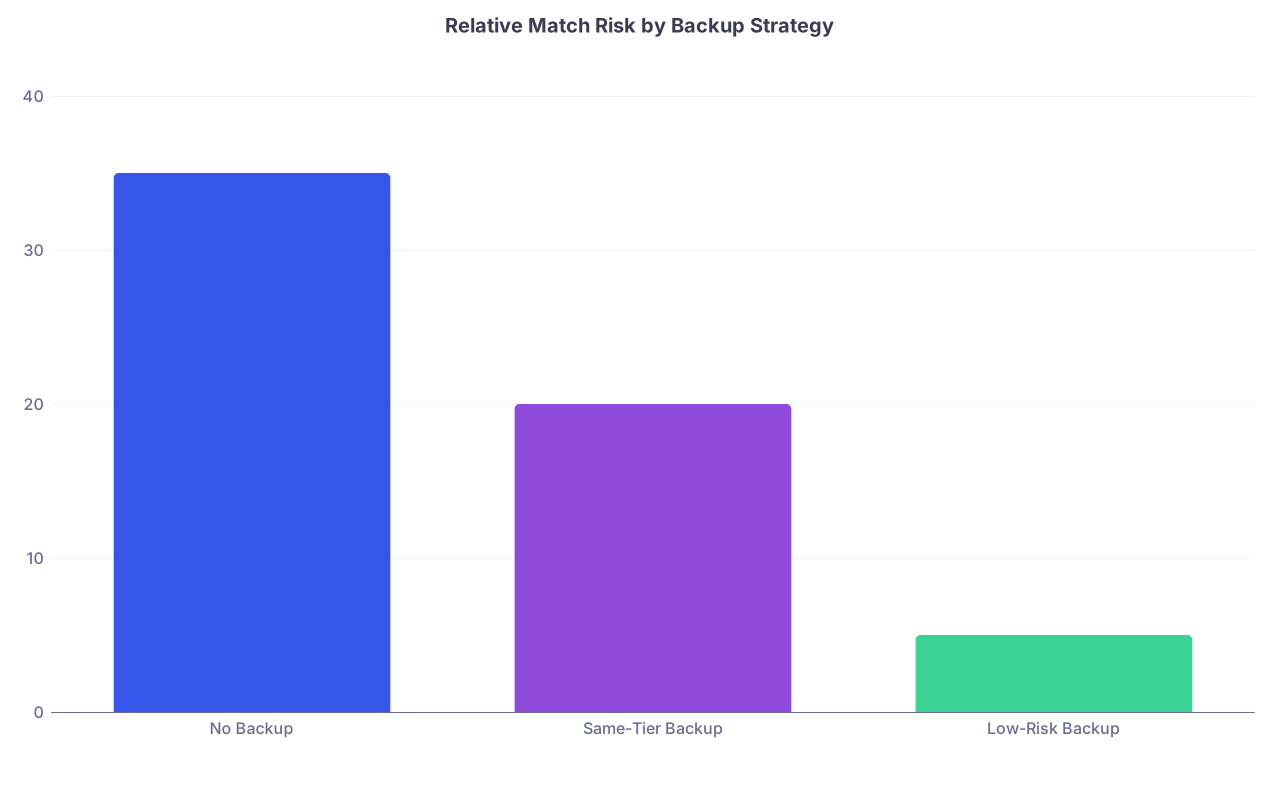
| Category | Value |
|---|---|
| No Backup | 35 |
| Same-Tier Backup | 20 |
| Low-Risk Backup | 5 |
(Values are illustrative unmatch probabilities for a mid‑tier applicant in a high‑risk field.)
Step 1: Estimate your personal primary-field match probability
Use:
- Your Step 2 vs that specialty’s matched median
- Your research vs typical expectations
- Your school’s historic match list in that field
- Honest feedback from faculty
If you are <70% likely to match (and many derm/PRS/ENT applicants are), you should not go all‑in without serious backup.
Step 2: Pick backup fields with (a) clearly higher match rates for your profile and (b) different failure drivers
Score-heavy, research-obsessed field as primary? Back up with something that:
- Cares more about clinical performance and interpersonal skills
- Has historically high match rates for people with your Step range and school type
That points to FM, Psych, sometimes Path, or IM depending on your specifics.
Step 3: Commit adequate volume
Then you actually apply in numbers consistent with historical match curves, not token gestures. If you would feel devastated being unmatched, do not run a high-variance strategy.
11. Visualizing the Application “Portfolio”
To tie everything together, here is a simple conceptual flow of a rational strategy.

| Step | Description |
|---|---|
| Step 1 | Choose primary specialty |
| Step 2 | Estimate personal match probability |
| Step 3 | Minimal or no backup |
| Step 4 | Identify weaknesses |
| Step 5 | Select fields tolerant of weaknesses |
| Step 6 | Check match data for those fields |
| Step 7 | Commit 20-40 programs in backup |
| Step 8 | Choose different backup |
| Step 9 | Prob >= 80 |
| Step 10 | Match rate >> primary? |
The logic is boringly quantitative:
- If your primary chance is high, you can afford to keep backups narrow or absent.
- If your primary chance is moderate or low, you must either:
- Adjust expectations and choose a safer primary, or
- Layer in a robust backup with enough applications and low correlation of failure.
Everything else is storytelling.
FAQ (exactly 5 questions)
1. If I am a strong applicant for a competitive specialty, do I still need a backup?
If your objective odds of matching are comfortably above 80–85%—for example, top-decile Step 2, strong research, home program support, and your school routinely matches into that field—you can rationally choose not to back up. The marginal benefit of adding a low-risk field may not justify the time and money. But be honest with the data; most applicants who claim “I am very competitive” are actually sitting in the 50–75% band when compared to national distributions.
2. Is backing up into another competitive specialty ever a good idea?
It can be, but mainly for career-fit reasons, not pure risk minimization. For example, someone torn between anesthesiology and EM may apply to both because they could be happy in either. Statistically, this may move your unmatch risk down somewhat, but because both fields often filter on similar metrics (Step scores, strong clinical letters, rotations at reputable institutions), the hedge is partial. If you are truly risk-averse, you add a low-risk field beyond that.
3. How do couples matching change the logic of backups?
Couples match multiplies risk, because both of you need an acceptable outcome. Data show that couples have slightly lower overall match rates compared with similar solo applicants. This makes robust backups even more important. In practice, the more competitive partner often needs to be more flexible, and at least one of you should anchor in a broad-access field (IM/FM/Psych/Path) if either partner is aiming high-risk and both want to avoid geographic or match failure.
4. Does applying to a backup hurt my chances in the primary field?
Program directors consistently say, and behavior largely confirms, that simply applying to a backup does not hurt you. What hurts is diluted effort: weak letters, generic personal statements, incoherent story. The data show plenty of applicants who matched their primary while also applying heavily in another field. As long as your primary application remains strong and focused, the existence of a backup portfolio is invisible to most programs.
5. If I am already in a prelim year after going unmatched, should I reapply to the same field or pivot to a backup?
The NRMP reapplicant data are blunt: reapplicants to highly competitive fields have substantially lower success rates than first-timers, unless they have made major improvements (dramatically better letters, new research, strong advocacy from well-known faculty). From a risk perspective, the safer strategy is usually to pivot to a field with higher match rates for your profile (IM/FM/Psych/Path), using your prelim year to amass strong evaluations and fresh letters. You can still keep a token number of applications in your original field if you must, but the numbers favor the pivot.
With this quantitative lens on backups, you are better positioned to build an application portfolio that behaves like a diversified investment rather than a series of hopeful bets. The next step is to drill down to specific programs and regional patterns that match your profile—which is its own data exercise for another day.