The idea that you must cling to your original dream specialty no matter what is bad advice.
If your scores came back lower than expected, you are not done. You are at a fork in the road. And if you handle this part like a professional instead of a panicked student, you can still build a satisfying career, match safely, and keep future doors open.
This is about realigning your plan, not surrendering.
Step 1: Face Your Score Reality Like a Grown-Up
Do this first. Before you talk to mentors. Before you rewrite your ERAS. Before you stalk Reddit for “low score success stories.”
Pull your actual data:
- USMLE/COMLEX scores (Step 1 status, Step 2 CK, COMLEX Level 1/2)
- Class rank / quartile or AOA status (if applicable)
- Any exam failures or repeats
- Number of publications, presentations, serious research experiences
- Clinical evaluations / narrative comments (honors, HP, etc.)
Now categorize yourself honestly, not aspirationally.
| Category | Strong | Borderline | At-Risk |
|---|---|---|---|
| Step 2 CK | ≥ 245 | 230–244 | < 230 or failed |
| COMLEX Level 2 | ≥ 620 | 560–619 | < 560 or failed |
| Class Rank | Top 25% | 25–60% | Bottom 40% |
| Research | 3+ outputs | 1–2 outputs | None |
| Red Flags | None | 1 mild | Failures/remediation |
You know where you land.
Now pair your profile with your current target specialty:
- Is your dream specialty low-, mid-, or high-competitiveness?
- Are you above, at, or below the typical matched applicant range?
You are not asking “Is it technically possible someone matched with my score?” You are asking:
“If I apply in this specialty as-is, what is my realistic match risk on the first try?”
If the honest answer is “high risk,” you need a backup plan. That is not failure. That is risk management.
Step 2: Understand What Makes a Good Backup (Most People Get This Wrong)
A “backup specialty” is not just “anything less competitive.” A solid backup checks four boxes:
Clearly less competitive than your primary specialty
Not slightly less. Clearly less. Emergency medicine is not an ideal backup for plastic surgery if your scores are already weak for EM.Matches your clinical strengths and personality reasonably well
You do not need to feel the same passion as for your dream specialty, but you must be able to tolerate the work long term.Has enough residency spots and programs
More programs = more safety nets. Backup specialties with tiny numbers of positions are not real backups.Has pathways to subspecialize or shift later
Some fields are “keystone” specialties that keep doors open (internal medicine, family medicine, general surgery, pediatrics, psychiatry).
If a “backup” fails any of those four, it is not a backup. It is another gamble.
Step 3: Know the Competitiveness Tiers (And Where You Can Still Move)
You cannot re-align intelligently without a ballpark sense of how specialties stack up.
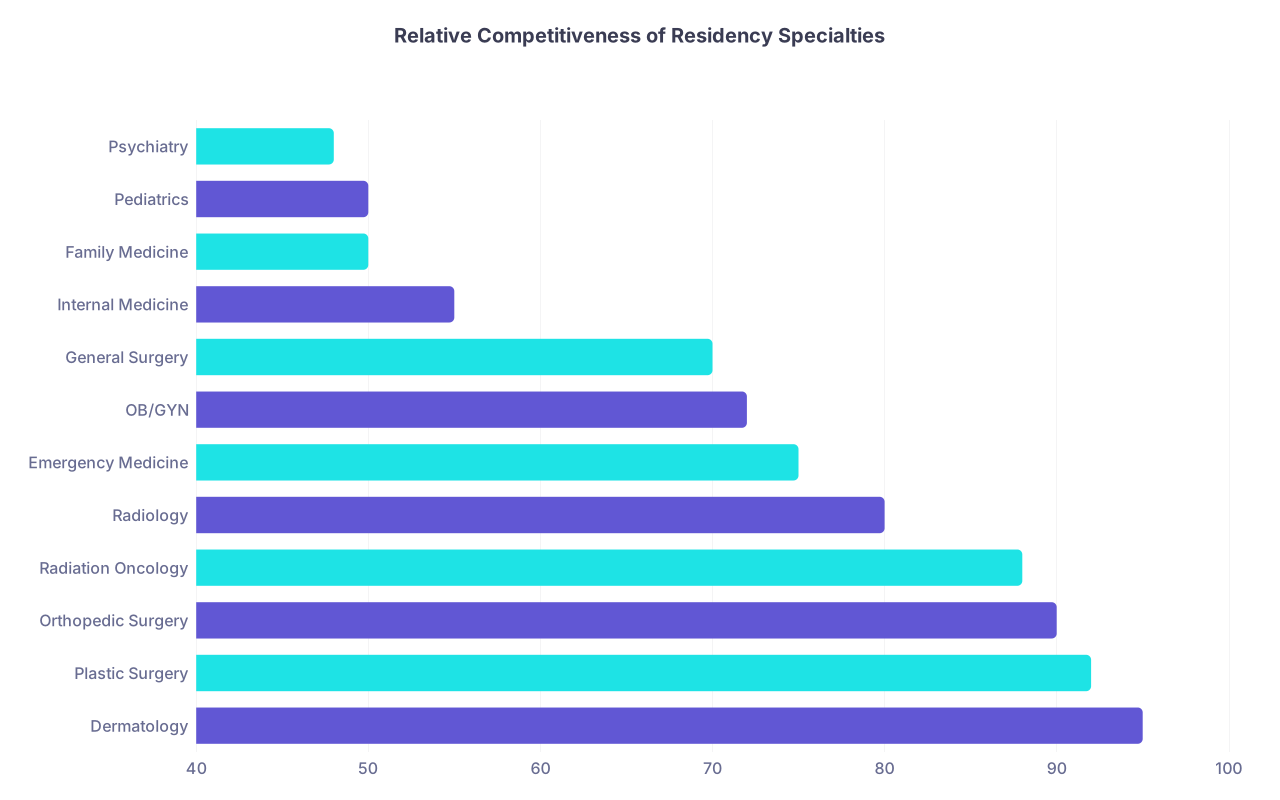
| Category | Value |
|---|---|
| Dermatology | 95 |
| Plastic Surgery | 92 |
| Orthopedic Surgery | 90 |
| Radiation Oncology | 88 |
| Radiology | 80 |
| Emergency Medicine | 75 |
| OB/GYN | 72 |
| General Surgery | 70 |
| Internal Medicine | 55 |
| Family Medicine | 50 |
| Pediatrics | 50 |
| Psychiatry | 48 |
Broad tiers (US MD focus, but the pattern holds across):
Ultra-competitive
Dermatology, Plastic Surgery, Neurosurgery, Ortho, ENT, IR (independent entry), some integrated programs (PRS/IR).
High-competitive
Radiation Oncology, Radiology, EM (varies by year), Ophtho, Urology, Anesthesiology, some General Surgery programs.
Moderate
General Surgery (community programs), OB/GYN, IM at strong but not top-tier academic centers, many Anesthesia and EM programs.
Less competitive / more accessible
Family Medicine, Psychiatry, Pediatrics, many community Internal Medicine programs, Pathology, PM&R (varies), Neurology.
You do not need a perfect tier label. You just need the direction of travel:
- Step down from ultra-competitive → high/moderate.
- Step down from high → moderate/less competitive.
- If you are already in a moderate field and struggle with scores → strongly consider less competitive fields or broad-based prelim + reapply strategy.
Step 4: Map Logical Backup Pairs (What Actually Makes Sense)
Let me lay out realistic backup patterns I have seen work.
1. Surgical Dream → Medical or Broader Surgical Backup
If your primary is:
- Ortho, Plastics, ENT, Neurosurgery, CT surgery
Backup options that still use your surgical interest:
- General Surgery (aim more for community, non-elite academic)
- OB/GYN (for some students)
- Transitional year + re-assess, but only with very strong advising
Non-surgical but realistic and still procedure-heavy:
- Interventional PM&R (via PM&R first)
- Interventional Pain (via Anesthesia, Neurology, PM&R later)
- Emergency Medicine at community programs
Key reality: A “backup” of ENT → Plastics is not a backup. That is trading one lottery ticket for another.
2. Road Specialty Dream → Core Medicine or Pediatrics
If your primary is:
- Radiology, Anesthesia, Ophtho, Derm
Backups that often work:
- Internal Medicine (especially community programs)
- Family Medicine
- Pediatrics
- Psychiatry
Why this is smart:
- You can still aim for subspecialty work:
- Cardiology, GI, Pulm/CC from IM
- Allergy/Immunology from IM/Peds
- Child psych from Psychiatry
- You keep academic careers and fellowship options on the table.
3. EM Dream → IM / FM / Psych
Emergency Medicine has become much more volatile. If your scores are low for EM, you need to respect that.
Common backup structures:
- Dual apply EM + IM
- Dual apply EM + FM
- EM + Psych (for those who truly find psych tolerable)
Do not make the mistake of applying only to EM with a weak application during a bad EM match cycle “because I will regret it forever if I don’t try.” You will regret not matching much more.
4. IM Dream at Top Programs → IM + Safety Nets
If your dream is academic, powerhouse IM (MGH, Hopkins, UCSF, etc.) but your Step 2 score and CV are mediocre:
- Keep IM as primary, but diversify across tiers:
- A small number of reach academic programs
- A large core of realistic academic/community university programs
- A solid chunk of lower-tier / community programs as safety
This is not really a “backup specialty” situation. It is a backup program tier situation. But the same logic applies—do not build a list of only ego programs.
Step 5: Decide Your Strategy – Single Specialty vs Dual Apply
Now you know:
- Where your scores sit.
- How competitive your primary specialty truly is.
- Logical backup fields.
Time to choose a strategy. There are three main ones.
Strategy A: Realign Completely to a Backup Specialty
When to do this:
- You are clearly below the score range for your dream specialty.
- You have little or no dedicated research in that dream field.
- There are red flags (failures, LOA) that will be magnified in a hyper-competitive specialty.
- You care more about matching once than gambling for 2+ cycles.
What to do:
Commit early.
Before VSLO, away rotations, or letter requests lock you into a story you will then need to explain away.Rewrite your personal statement to center the backup field.
Not a half-hearted “ever since I was young I loved all of medicine.” Commit to the new specialty’s narrative.Target rotations in the backup specialty:
- Home rotation + 1 away (if helpful for that specialty).
- Get at least 2 strong letters from that field.
Apply broadly in that specialty, including:
- Community programs
- Less popular geographic areas
- Programs known to be DO/IMG friendly if applicable to you
Strategy B: Dual Apply (Done Correctly)
Dual applying is often done terribly. “I’ll just click a second specialty box in ERAS the night before submission.” That is how you end up with 2 weak applications instead of 1 strong one.
Dual apply only if:
- Your dream specialty is not completely unrealistic.
- You can build a coherent story that justifies both.
- You are willing to attend interviews in your backup specialty without resentment.
The structure:
Choose a primary and a secondary clearly.
Example: Primary EM, backup IM.Split letters deliberately.
- EM: 2–3 EM SLOEs, maybe 1 IM or other.
- IM: 2–3 IM letters, maybe 1 EM. Do not send EM SLOEs to IM programs that will not know how to read them.
Write two separate personal statements.
Yes, two. Each with a different emphasis and different patient stories.Segment your programs list:
- Apply more heavily in the backup to guarantee a decent interview volume.
- Remove programs in your primary specialty that are extreme reaches.
Have an internal rank rule set before interviews.
Example: “Any solid IM program in X, Y, Z cities will be ranked above my weakest EM programs.”
Make decisions with a cold head before emotions creep in.
Strategy C: Delay / Strengthen Then Reapply (Risky, Sometimes Right)
Sometimes the correct move is:
- Do a prelim year (IM or Surgery).
- Or a research year.
- Or a home-country internship (for IMGs) while beefing up the CV.
- Then reapply to the original dream specialty.
You choose this only if:
- Your dream specialty is central to your identity and long-term satisfaction.
- Advisors in that field look at your file and say: “If you fix X and Y, you have a real shot next year.”
- You have the financial and emotional bandwidth to stomach another cycle.
But notice one thing: even here, you are effectively using a backstop—the prelim year or transitional year is your hedge so that the gap year is not a complete loss.
Step 6: Modify Your Application Story Without Sounding Flimsy
Your narrative has to change. If you are pivoting from Neurosurgery to IM, people will ask. You need an answer that is:
- Honest enough to be believable.
- Future-focused enough to not sound bitter or broken.
Bad explanation:
“I always dreamed of neurosurgery, but my Step 2 wasn’t high enough so now I am applying to IM.”
Good explanation:
“I was initially very drawn to the procedural intensity of neurosurgery and spent time exploring it. On rotations I realized I enjoyed the diagnostic work, longitudinal relationships, and complex medical decision making even more. Internal medicine gives me that daily. My neurosurgery experience actually sharpened my interest in [neurocritical care / stroke / oncology], which I plan to pursue through IM training.”
The structure:
- Past Exploration – It is fine to mention the original field briefly.
- Authentic Shift – What you discovered about yourself clinically.
- Present Fit – Why the backup specialty actually fits your strengths.
- Future Vision – Clear fellowships, practice settings, or academic interests within that specialty.
Do not over-share about scores in your personal statement. That belongs in advisor conversations, not as the lead line of your life story.
Step 7: Build a Targeted Backup Specialty List (Method, Not Vibes)
You need a disciplined approach to program selection. Not vibes-based scrolling.
For your backup specialty, assign programs into three buckets:
- Reach – Slightly above your stats but not insane.
- Realistic – Your stats line up well with their typical residents.
- Safety – Historically friendlier to lower scores, DOs, IMGs, or red flags.
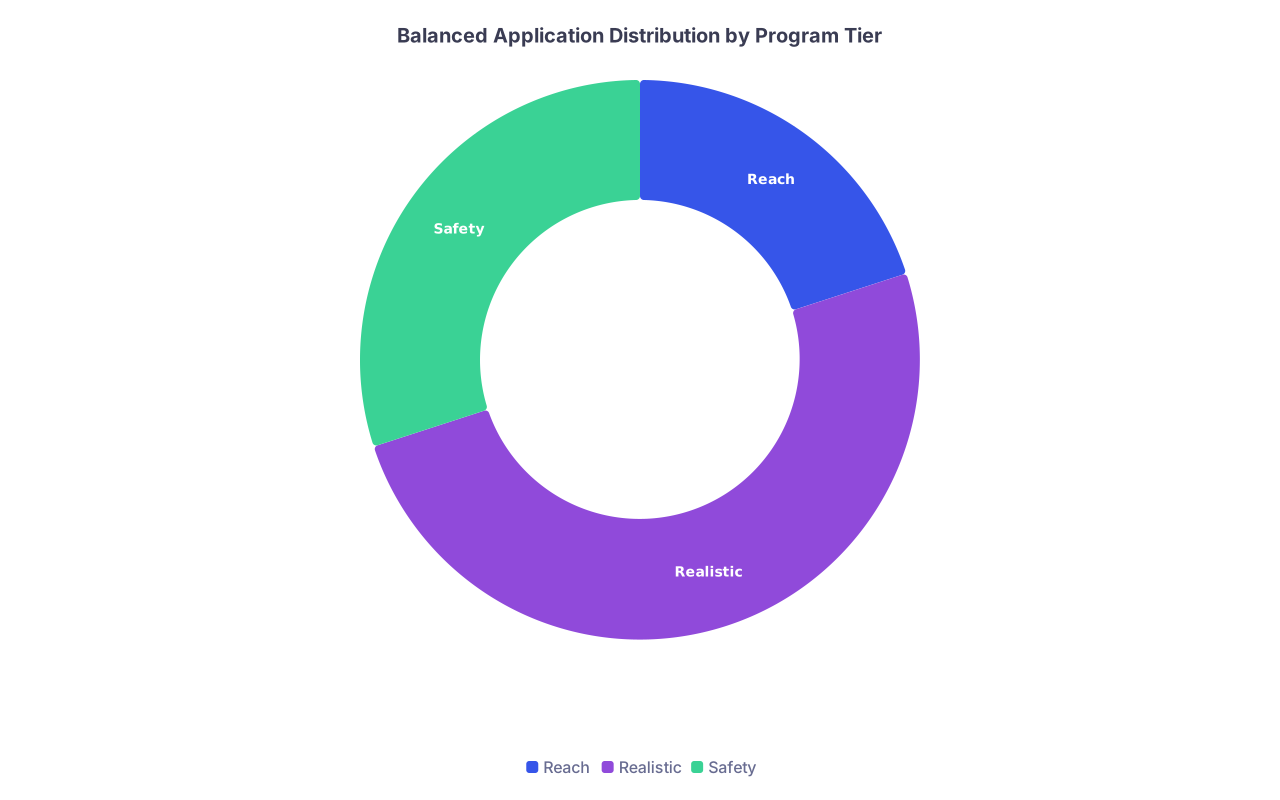
| Category | Value |
|---|---|
| Reach | 20 |
| Realistic | 50 |
| Safety | 30 |
Rough distribution (for backup specialty):
- 20% Reach
- 50% Realistic
- 30% Safety
Then pressure-test it:
- Does your list include less desirable geographic areas?
- Does it have a mix of academic and community programs?
- Are there at least 2–3 programs where, on paper, you are one of the stronger applicants, not one of the weaker ones?
If you cannot point to any safety programs in your backup field where you are clearly in the top half by stats, your “backup” is still too risky.
Step 8: Fix What You Can, Quickly and Aggressively
Your scores are your scores. But a backup strategy is not just shuffling specialties. It is also plugging every hole you can before ERAS locks.
Here is where you can still move the needle:
Step 2 CK / Level 2 (if not yet taken or can be retaken legally):
- Treat this as your redemption exam.
- 6–8 weeks of dedicated time with UWorld, NBME self-assessments, and strict schedule.
- Document improvement numerically.
Letters of Recommendation:
- Prioritize attendings who will write superlatives, not big names who barely know you.
- For a backup specialty, get at least 2 letters within that field. Weak but relevant trumps strong but irrelevant in many cases.
Clinical Performance on Key Rotations:
- Show up early, volunteer for notes and tasks, ask focused questions.
- Ask your residents explicitly: “What is one thing I can improve this week?” then actually fix it.
- Honors on a rotation in your backup specialty carries weight.
CV Patching for Backup Specialty:
- Join a small ongoing project in that field: QI, chart review, case report.
- Even a poster or abstract demonstrates real engagement.
Is this cosmetic? Partly. But residency selection is (uncomfortably) about optics as much as substance. You want your application to say: “I am serious about this backup field, not just desperate.”
Step 9: Manage the Emotional Whiplash So You Do Not Sabotage Yourself
You are going to feel grief about letting go of the original plan. I have seen people tank backup interviews because they were still mourning a field that already moved on.
You cannot fake your way through that. You need to work it through ahead of time:
- Talk it out with 1–2 trusted people (not 15 random classmates).
- Name the loss explicitly: “I am sad to likely not be a neurosurgeon.”
- Then pivot to: “What do I actually want my day-to-day life to look like?”
That question often reveals that the backup is not that far off.
During interviews for the backup specialty:
- Never frame it as “second choice.”
- Speak about it as your future career. Because if you rank it, you must be willing to live that reality.
- Programs are allergic to being someone’s consolation prize. Do not trigger that.
Worked Example: Realigning After a Disappointing Step 2
You:
- US MD, mid-tier school
- Step 1: Pass (no numeric)
- Step 2: 223
- Middle of the class
- 1 ortho research project, no pubs yet
- Wanted Ortho for 2 years
Reality:
- Ortho is ultra-competitive.
- Your 223 + average CV → Ortho match probability is extremely low.
- You could chase a research year, away rotations at non-elite programs, and still have a high failure risk.
Smart options:
- Realign to General Surgery or PM&R.
- Gen Surg: You like the OR, you accept tougher lifestyle.
- PM&R: You like MSK, procedures, longitudinal care.
You pick PM&R after shadowing and a rotation. You:
- Get 2 PM&R letters + 1 from a strong IM attending.
- Write a PM&R-focused personal statement connecting your ortho interest to function, rehab, chronic disability.
- Apply widely to PM&R including community and smaller-name programs.
- You keep 3–5 very community-heavy Ortho programs as extreme long shots if you cannot let it go, but you mentally commit to PM&R as the real plan.
Result:
- You match PM&R at a solid community program in a city you can live in.
- Down the line, you do a Sports/Spine fellowship, work in an MSK group, do procedures all day. Your day-to-day looks surprisingly close to what you originally wanted.
That is how backup realignment is supposed to function. Not as self-punishment, but as course correction.
FAQs
1. Should I still apply to my dream specialty at all if my scores are low?
If your probability is near-zero, applying widely to your dream specialty instead of a realistic backup is self-sabotage. However, if you have genuine strengths (outstanding research, strong home department advocacy, unique skills) and your advisors in that specialty believe you have a non-trivial chance, consider a small, targeted dream application plus a serious backup plan. But do not spend 80% of your applications on a 5% shot.
2. Is Family Medicine or Psychiatry “giving up” if I wanted something competitive?
No. That mindset is poison. Family Medicine and Psychiatry are not consolation prizes. They are high-need fields with deep intellectual and human complexity. If you match into FM or Psych and lean into them, you can build a career with procedures, academic work, leadership, teaching, and subspecialization. “Prestige” fades fast when you are six years out and actually living your life.
3. How do I talk about my low scores if programs ask directly?
Be brief, accountable, and forward-looking:
- Acknowledge: “My Step 2 score is lower than I wanted.”
- Give a concise context if there is one (illness, timing, etc.) without making excuses.
- Emphasize what changed: improved clinical performance, strong ITEs, better study systems.
- Pivot to strengths: “Despite that score, my clinical supervisors consistently highlight X and Y, and I have demonstrated strong performance in [backup specialty] rotations.”
One or two sentences, then move on. Do not turn it into a monologue about failure.
Remember the core points:
- A backup specialty is a strategy, not a surrender—pick it using competitiveness, personality fit, and future options, not ego.
- Dual applying or pivoting entirely only works if you commit to a coherent story and build a real application for the backup, not a leftover one.
- You cannot change old scores, but you can change everything else: letters, rotations, narrative, program list, and attitude. That is where you win this phase.