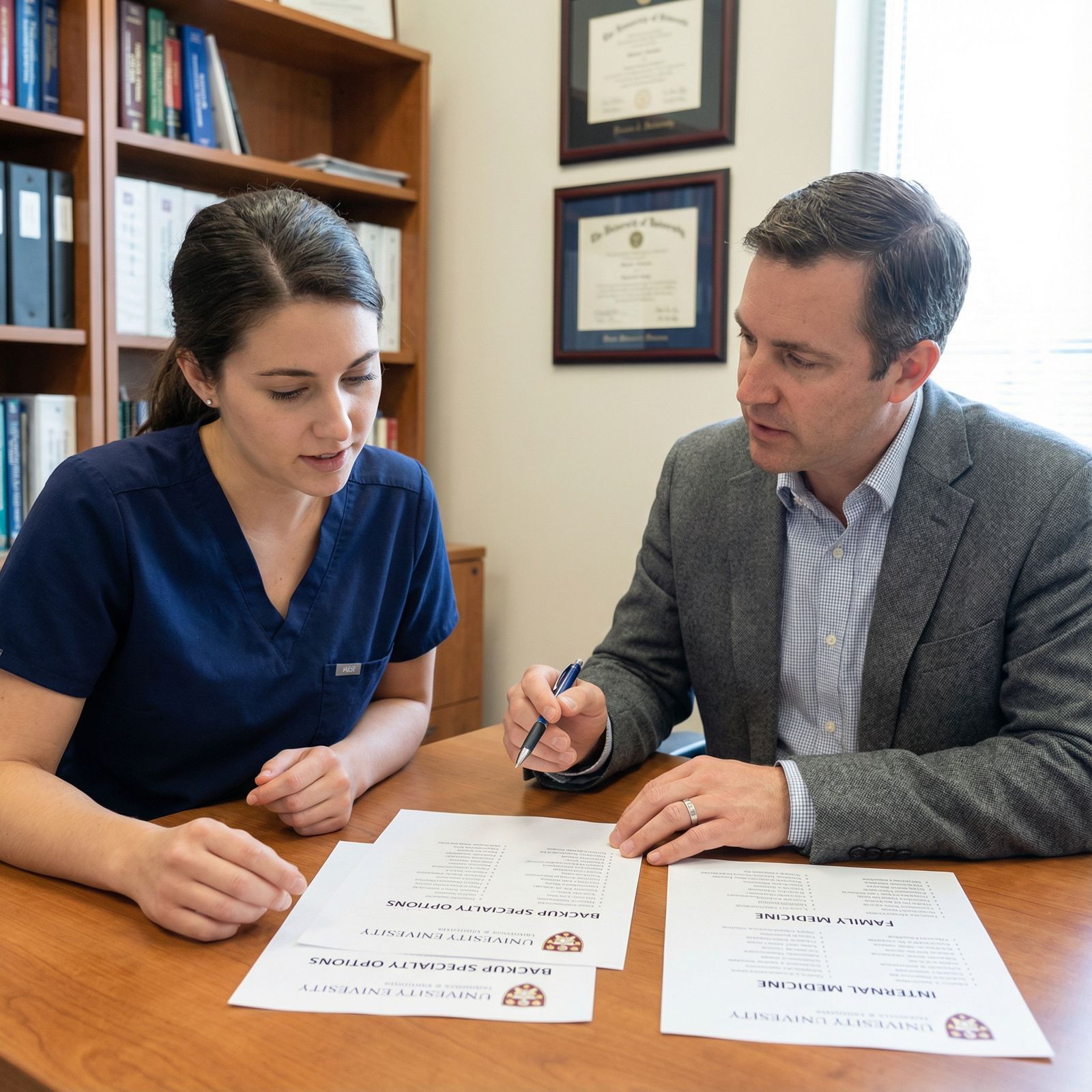
Urology is one of the most competitive specialties in the United States. For a US citizen IMG (American studying abroad), the bar is even higher: fewer interview spots, more scrutiny on your file, and a shorter list of programs truly open to international graduates. That reality makes backup specialty planning not just “nice to have,” but essential risk management.
This article will walk you through a structured, realistic approach to backup planning as a US citizen IMG targeting urology residency—how to choose a plan B specialty, how to dual apply without sabotaging your primary goal, and how to keep your options open while still presenting as a genuine, committed urology applicant.
Why Backup Specialty Planning Matters So Much for US Citizen IMGs in Urology
Urology combines surgery, technology, oncology, and clinic continuity. It is small, prestigious, and highly selective. As a US citizen IMG (often an American studying abroad in the Caribbean or overseas), you start the race with some systemic disadvantages:
- Fewer urology programs seriously consider IMGs
- Heavy emphasis on school reputation and home-institution rotation networks
- Limited opportunities for early urology exposure and letters from US academic urologists
The risk profile: how competitive is the urology match?
While year-to-year numbers change, several patterns remain stable:
- Urology is among the most competitive surgical specialties.
- Match rates for IMGs (including US citizen IMGs) are significantly lower than those for US MD graduates.
- Many programs do not routinely review IMG applications, regardless of how competitive you are on paper.
For an American studying abroad in a non-US school, even with strong scores and experiences, urology is never a “safe” bet. That doesn’t mean you can’t or shouldn’t pursue it. It means you need a realistic parallel plan.
What backup planning is—and is not
Backup specialty planning is:
- A deliberate, strategic choice of one or more backup specialties that you would actually be willing to train in and practice.
- A way to protect yourself against going unmatched and losing an entire year (or more).
- A framework for dual applying residency: applying to urology plus another specialty in parallel.
Backup planning is not:
- A sign that you are “less committed” to urology.
- A guarantee that you will match somewhere.
- Something that must be visible in your urology application materials.
You can be 100% sincere in your interest in urology and still respect reality enough to design a plan B.
Step 1: Clarify Your Risk Level as a US Citizen IMG Targeting Urology
Before choosing your plan B specialty, you need a clear, honest assessment of your risk profile. This helps determine how aggressively you must plan for backup options.
Key factors to evaluate
Ask yourself:
USMLE scores (or Step exams)
- Are your scores at or above the average for matched urology applicants (especially Step 2 now that Step 1 is pass/fail)?
- Any failures or significant score drops?
- For IMGs, a strong Step 2 score is often crucial to even get screened in.
School reputation and clinical environment
- Are you at a well-known Caribbean or international school with an established match history into competitive specialties?
- Does your school offer US-based core rotations at reputable teaching hospitals?
- Have prior graduates from your school matched into urology or other competitive surgical subspecialties?
Urology-specific exposure and letters
- Do you have US urology rotations (ideally at academic centers)?
- Any urology research, abstracts, or posters?
- At least one strong urologist letter, preferably more?
Geographic and visa considerations
- As a US citizen IMG, you don’t need visa sponsorship, which helps.
- But some programs still blanket exclude IMGs, regardless of citizenship.
Personal constraints
- Are you geographically limited (e.g., spouse’s job, family)?
- Are you financially able to handle an unmatched year, research year, or SOAP?
The more “risk factors” you accumulate (lower scores, unknown school, limited urology letters or research, strong geographic constraints), the more robust your backup specialty strategy must be.
Risk categories and what they imply
You can roughly categorize yourself:
Low-to-Moderate Risk US Citizen IMG
- Strong Step 2 score
- Several solid urology letters
- Some urology research or presentations
- From a school with a track record of US matches
- Action: Consider dual applying to one backup specialty, with a moderate number of applications.
High Risk US Citizen IMG
- Average or below-average Step 2
- Limited urology letters or experiences
- Little or no meaningful urology research
- School with weak US placement or unknown by many PDs
- Action: Strongly consider dual applying and being quite generous with backup applications; consider more match-safety in your backup list.
Self-classifying honestly helps you decide whether your backup strategy is “light insurance” or an equally serious path.
Step 2: Choosing a Backup Specialty That Makes Sense for a Urology Applicant
Not every specialty is a good backup for a urology applicant. You want a plan B specialty that:
- You could truly see yourself practicing if urology doesn’t work out.
- Aligns at least somewhat with your skills and interests.
- Is more accessible to US citizen IMGs than urology is.
- Allows you to build on some of the same experiences (surgical interest, procedures, research where possible).
Here are the most commonly considered backup options for urology applicants, with a focus on an American studying abroad.
1. General Surgery
Why it fits:
- Shared surgical mindset with urology.
- Overlapping technical skills (OR environment, perioperative care, laparoscopy).
- Some training programs later allow fellowships leading into urology-like practice areas (e.g., surgical oncology, minimally invasive surgery, etc., though not urology itself).
- You can reuse much of your narrative about loving procedures, acute care, and complex anatomy.
Pros for US Citizen IMGs:
- More programs overall than urology.
- Many community-based programs are open to IMGs.
- Your urology letters can often still be used as “surgical” letters.
Cons:
- General surgery is still competitive at top-tier academic centers.
- Lifestyle and career trajectory can be different from what many urology applicants envision.
- Once you commit to a general surgery residency, it is realistically your long-term path unless you reapply early.
Who should consider it:
- Students who genuinely enjoy the OR and can be happy in a surgical life even without urology.
- Those with strong surgical evaluations and strong Step 2.

2. Internal Medicine (with an eye on subspecialty)
Why it fits:
- Significantly more residency positions than urology.
- A clear pathway to competitive fellowships (e.g., nephrology, oncology) that share some overlap in patient population (renal, GU cancers).
- Reasonably feasible match odds for many US citizen IMGs.
Pros for US Citizen IMGs:
- Many programs are IMG friendly.
- If your exam scores are decent and your clinical evaluations solid, you can create a robust application relatively quickly.
- Research in oncology, outcomes research, or quality improvement can translate.
Cons:
- Very different daily work from surgery/urology.
- You may need a separate set of letters from internists.
- You must genuinely make peace with a primarily medical (non-surgical) career if that becomes your path.
Who should consider it:
- Students who like patient continuity, chronic disease management, and intellectually complex diagnostics.
- Those who are drawn to GU oncology but are open to approaching it from the internal medicine–oncology route rather than surgical oncology.
3. Transitional Year + Reapplication Strategy
A less traditional but sometimes rational approach is to plan a Transitional Year (TY) or preliminary year as a “soft backup,” with the intention of:
- Strengthening your urology application (extra research, more US clinical performance, new letters).
- Reapplying to urology (or shifting to another specialty) from a position of increased clinical maturity.
Pros:
- Keeps you in the system and clinically active.
- Bridges the gap between graduation and reapplication.
- Shows programs you can function as an intern in the US environment.
Cons:
- Transitional Year spots themselves can be competitive.
- You may end up with a year of training that doesn’t directly count toward another specialty.
- No guarantee that you’ll match urology the second time.
Who should consider it:
- Applicants dead set on urology who receive some positive signals (interviews, interest) but do not match.
- Those who can financially and emotionally tolerate a multi-year path.
4. Other Procedural Fields (e.g., Radiology, Anesthesiology, Family Medicine with a procedural focus)
Depending on your interests and local IMG-friendliness:
- Anesthesiology: procedural, OR-based, requires strong scores; some programs IMG-friendly.
- Diagnostic Radiology: highly competitive for IMGs in many settings, but for the right candidate with research and strong scores, may be considered.
- Family Medicine with advanced procedural or rural training: less competitive overall, but in certain settings allows scope for office-based procedures, vasectomies, etc.
For the majority of US citizen IMGs targeting urology, the most realistic backup specialty options—balancing interest + feasibility—are usually General Surgery and Internal Medicine.
Step 3: How to Execute Dual Applying Without Torpedoing Your Urology Chances
Dual applying residency—submitting applications to urology and a backup specialty—requires strategy. Done poorly, it can make you look indecisive. Done well, it limits your risk of going completely unmatched while preserving your chances in urology.
1. Separate your narratives
Your urology application should read as if urology is your primary and genuine passion:
- Personal statement: focused on your journey into urology.
- Experiences: emphasize surgical, GU, oncology, and procedural interests.
- Letters: majority from urologists and surgeons.
Your backup application should tell a coherent, honest story that explains:
- Why you are drawn to that field (surgery, IM, etc.).
- How your strengths and experiences align with it.
- Why you will be a strong resident in that specialty.
You do not have to disclose in either narrative that you are dual applying.
2. Manage letters of recommendation smartly
For urology:
- Aim for at least 3 strong letters from urologists or surgeons.
- A letter from a non-surgeon can be acceptable if it’s from a research mentor or someone who knows you extremely well.
For your backup specialty:
- Obtain at least 2 specialty-specific letters (e.g., from general surgeons if backing up with general surgery, or internists if backing up with IM).
- It’s okay to reuse one broadly surgical letter (e.g., from a urologist extolling your OR performance) for general surgery, but try to have at least one letter directly from the specialty you’re backing up in.
Be careful when requesting letters:
- Explain to attendings that you are applying in urology and also considering X as a backup (many will respect your pragmatism).
- Ask them not to mention another specialty by name in letters unless it’s aligned with the specific program you’ll use it for.
3. Tailor your application list and strategies
For Urology:
- Target all reasonably IMG-friendly programs with a history of interviewing or matching US citizen IMGs.
- Lean into any geographic or institutional connections you have.
- Use your ERAS application (for the PGY-1 year) to back up surgical intern years where relevant.
For Your Backup Specialty:
- Apply broadly to IMG-friendly programs—this is crucial.
- Use tools like:
- NRMP’s Charting Outcomes in the Match (for broader context)
- Program websites and unofficial IMG-friendly lists
- Alumni data from your school
- As a US citizen IMG, cast a wider geographic net than US MDs typically need.
4. Interview strategy and scheduling
- Prioritize urology interviews whenever possible—this is your primary goal.
- Schedule backup specialty interviews both early and throughout the season; don’t leave them all for the very end.
- Avoid openly discussing your dual-application strategy during interviews unless directly asked. If asked:
- Be honest, calm, and focused on genuine reasons you’d be happy in that field.
- Emphasize that any program you applied to is a place you’d be proud to train.

Step 4: Building a Strong Application That Works for Both Urology and Backup
As an American studying abroad, you don’t have time or bandwidth to build two completely separate CVs. You need a core portfolio that serves urology but still looks attractive to your plan B specialty.
Clinical experiences
- Maximize US-based core rotations with strong evaluations.
- Prioritize at least one sub-internship (“sub-I”) or audition rotation in urology at a US academic site.
- For your backup:
- If backing up with general surgery: try to obtain at least one general surgery sub-I or acting internship.
- If backing up with internal medicine: aim for one US IM sub-I.
Research
Focus first on urology and surgical research if possible:
- Case reports, quality-improvement projects, retrospective reviews, literature reviews.
- Present at local or national urology/surgery conferences when you can.
This research will naturally strengthen your urology application. For backup specialties:
- General surgery will easily value your urology/surgical research.
- Internal medicine may still value your research skills, even if the topic is GU, but you may want at least one IM or general medicine–adjacent project if time allows.
Personal branding and professionalism
Across both applications:
- Highlight work ethic, teachability, and resilience.
- Emphasize your comfort with US clinical settings as a US citizen IMG: understand documentation, communication, and healthcare systems.
- Demonstrate longitudinal commitment: continuity clinic, QI projects, or leadership roles that show depth rather than scattered dabbling.
Step 5: Ranking, Match Strategy, and Emotional Planning
Dual applying and planning backups is not just logistical—it’s emotional. You must be prepared for multiple scenarios while staying focused.
Setting up your rank lists realistically
Remember that the urology match uses a separate matching process from the main NRMP match. Common pathways:
Scenario A: You match into urology
- That’s your path. You withdraw from your backup applications in the main match.
- Emotional task: fully commit to your urology program and let go of backup “what ifs.”
Scenario B: You do not match into urology
- You now depend on your backup specialty rank list in the main NRMP match.
- Rank programs based on:
- Fit (academic vs community)
- Location you can realistically live in
- Program culture and IMG support
- Be honest: any program you rank could become your future, so don’t rank places you would never actually attend.
Considering SOAP and reapplication
If you go unmatched in both urology and your backup specialty, you have several options:
Participate in SOAP:
- Focus on IMG-friendly fields with open positions (often internal medicine, family medicine, prelim surgery).
- Be ready with quick-turnaround application documents and updated personal statements.
Plan a research year or additional clinical year:
- Urology research year at a US academic center can upgrade your candidacy.
- A dedicated IM or surgical research position can also help, especially if you plan to switch specialties.
Decide whether to reapply to urology:
- You must have clear incremental improvement (higher scores, new letters, strong research).
- Recognize that reapplying in urology as an IMG is an uphill battle, though not impossible.
Emotional resilience
Backup planning protects you practically, but it can also create identity dissonance: “Am I a future urologist or something else?”
Strategies:
- Mentally rehearse all outcomes:
- “If I match urology, I’ll be thrilled and ready.”
- “If I match my backup specialty, I can still build a meaningful, rewarding career.”
- Seek mentorship:
- Talk to IMGs who dual applied or changed specialties successfully.
- Avoid over-identifying with a single possible career label; focus on the deeper values that attracted you to medicine in the first place (procedures, relationships, problem-solving, advocacy, etc.).
Practical Example: A US Citizen IMG Applying Urology with General Surgery Backup
Imagine you are a US citizen IMG who:
- Attends a Caribbean school with decent US match outcomes.
- Has Step 2 = 241, no failures.
- Completed:
- One urology elective at a US academic center → strong letter.
- One general surgery sub-I at a community hospital → solid letter.
- Has one poster at a regional urology meeting.
Your plan might look like:
Urology applications:
- Apply broadly to all programs with any IMG friendliness.
- Use a urology-focused personal statement.
- Letters: Two urologists + one general surgeon.
General surgery backup:
- Apply to a wide range of community and mid-tier academic programs known to interview IMGs.
- Write a separate personal statement emphasizing:
- Love of the OR.
- Enjoyment of your general surgery sub-I.
- Willingness to engage in broad surgical practice.
- Letters: General surgeon from sub-I + one urologist (framed as a surgeon letter) + possibly an internal medicine or core clerkship letter.
Rank strategy:
- Rank urology programs realistically based on interview impressions and IMG track record.
- If no urology match:
- Use general surgery rank list in NRMP.
- If unmatched again:
- Enter SOAP, focusing on prelim surgery or IM; consider a research year and reapplication strategy.
This is a workable, rational plan that keeps urology as your top priority but shields you from the all-or-nothing risk.
FAQs: Backup Specialty Planning for US Citizen IMG in Urology
1. As a US citizen IMG, do I really need a backup specialty if I’m applying to urology?
For almost all US citizen IMGs, yes. Urology is highly competitive, and the number of programs that seriously consider IMGs is limited. Even a strong candidate can go unmatched purely due to numbers. Having a backup specialty—and ideally, a full dual applying strategy—greatly reduces your chance of losing a year and keeps your career momentum going.
2. Won’t dual applying hurt my chances in the urology match?
Not if you manage it carefully. Program directors in competitive fields know that many applicants, especially IMGs, create backups. As long as:
- Your urology application (personal statement, letters, experiences) clearly shows focused, genuine interest in urology.
- You don’t openly project indecision or “I’ll be happy doing anything” energy during interviews.
…your dual-application plan is unlikely to harm you. Most of the backup process is invisible to urology programs.
3. What is the best backup specialty for a urology applicant who is an American studying abroad?
There is no single “best” option, but General Surgery and Internal Medicine are the most common and practical for many US citizen IMGs:
- General Surgery works well if you love the OR and want to stay in a procedural, operative career.
- Internal Medicine is more accessible for many IMGs and offers potential subspecialties (e.g., nephrology, oncology) that intersect with GU disease.
The right plan B specialty is one you can genuinely imagine building a satisfying career in, not just a random fallback.
4. If I match into my backup specialty, can I try again for urology later?
In theory, yes—but it’s difficult. Switching from another residency to urology is rare and heavily dependent on:
- Finding an unfilled urology spot or a program willing to take a transfer.
- Impressing urologists enough during electives, research, or moonlighting to sponsor such a move.
- Logistics of funding and training credit.
If you match into your backup, you should assume that specialty is your likely long-term path. You can still carve an excellent career—procedural IM, complex oncology care, general surgery with urologic-adjacent interests—but you should not rely on a later pivot to urology as your main strategy.
Thoughtful, honest backup specialty planning does not diminish your ambition to become a urologist. It demonstrates maturity, insight, and strategic thinking—qualities any residency program, in urology or beyond, will value in a future colleague.