
The fantasy that you can just “switch later” from your backup specialty is one of the most dangerous comfort stories in the Match process. It makes people rank lists they do not really believe in and apply to fields they barely understand.
Let me be blunt: yes, people do switch. But far fewer than you think, at far higher cost than anyone tells you, and with way more risk than the average MS4 appreciates.
You need to plan your backup like you may actually live that career. Because statistically, you probably will.
The Myth: “I’ll Just Match Something Safe and Switch Later”
I have heard this line verbatim on the wards:
“I’ll shotgun IM now and if I still want derm later I’ll just switch.”
“I’ll do a prelim surgery year and then hop into ortho once I prove myself.”
“I’ll rank FM at the bottom as a safety. Worst case I can always reapply to anesthesia.”
This mindset does three things:
- It underestimates how hard it is to re-enter the Match from another residency.
- It overestimates how much programs want midstream transfers.
- It ignores the structural barriers: PGY cap rules, funding limits, specialty-specific expectations, and the optics of “changing your mind.”
You’re not just changing your PGY label. You’re trying to convince a different specialty to burn one of their limited, tightly funded positions on someone who already used resources elsewhere. That’s a harder sell than ERAS blogs make it sound.
What Actually Happens When People “Switch”
Let’s separate the clean narratives told on Reddit from the messy reality I’ve seen up close.
There are a few realistic switching scenarios:
Intra-specialty adjustments
Example: Categorical internal medicine at one program → categorical internal medicine at another.
This is the most feasible type of “switch.” Programs understand couples match, geography issues, bad fit. Still not trivial, but doable.Adjacent specialty switches with clear overlap
Example: Internal medicine → neurology; pediatrics → child neurology; surgery prelim → anesthesia; IM → radiology.
These happen. But they’re usually:- Heavily dependent on networking.
- Limited to rare, unadvertised openings.
- Easier when you’re early (PGY‑1) and willing to move anywhere.
Big pivot switches
Example: Psychiatry → orthopedic surgery; family medicine → dermatology; OB/GYN → radiology.
These are rare. The success stories are survivorship bias shouting over a silent majority who never made it.
Now look at what’s stacked against you.
Funding and PGY Caps: The Silent Gatekeepers
Training slots are not just chairs in a conference room. They’re tied to GME funding and “initial residency period” rules. If you have not looked at this, you’re making decisions half-blind.
In the U.S., Medicare GME funding essentially “locks in” a maximum number of funded years when you start your first residency. If you switch into a field with a longer required training period after already using up funded years, some or all of your remaining time may be unfunded.
Translated:
You become financially radioactive for some programs.
Programs have to justify why they’re taking on someone who might not be fully funded when they could just take a straight-through new grad. Many simply will not.
| Specialty | Typical Categorical Length (Years) |
|---|---|
| Family Medicine | 3 |
| Internal Medicine | 3 |
| Pediatrics | 3 |
| Psychiatry | 4 |
| General Surgery | 5 |
| Orthopedic Surgery | 5 |
If you do 2 years of family medicine, then decide you want general surgery, on paper that sounds like “only” adding two more years. In practice, it may mean unfunded time that the hospital has to eat. Many will not.
This is why “I’ll just switch later” often quietly dies at the program director level. You never even see the rejection. You just never get the interview.
What the Data and Match Patterns Actually Show
We do not have perfect data on every switch, but we have enough to see the pattern:
- NRMP data consistently show that reapplicants and prior trainees have lower Match rates than first-time applicants with similar stats.
- Competitive fields (derm, ortho, ENT, plastics, urology, IR) are dominated by clean, direct paths from med school. Transfers happen, but they’re outliers, not a backup plan.
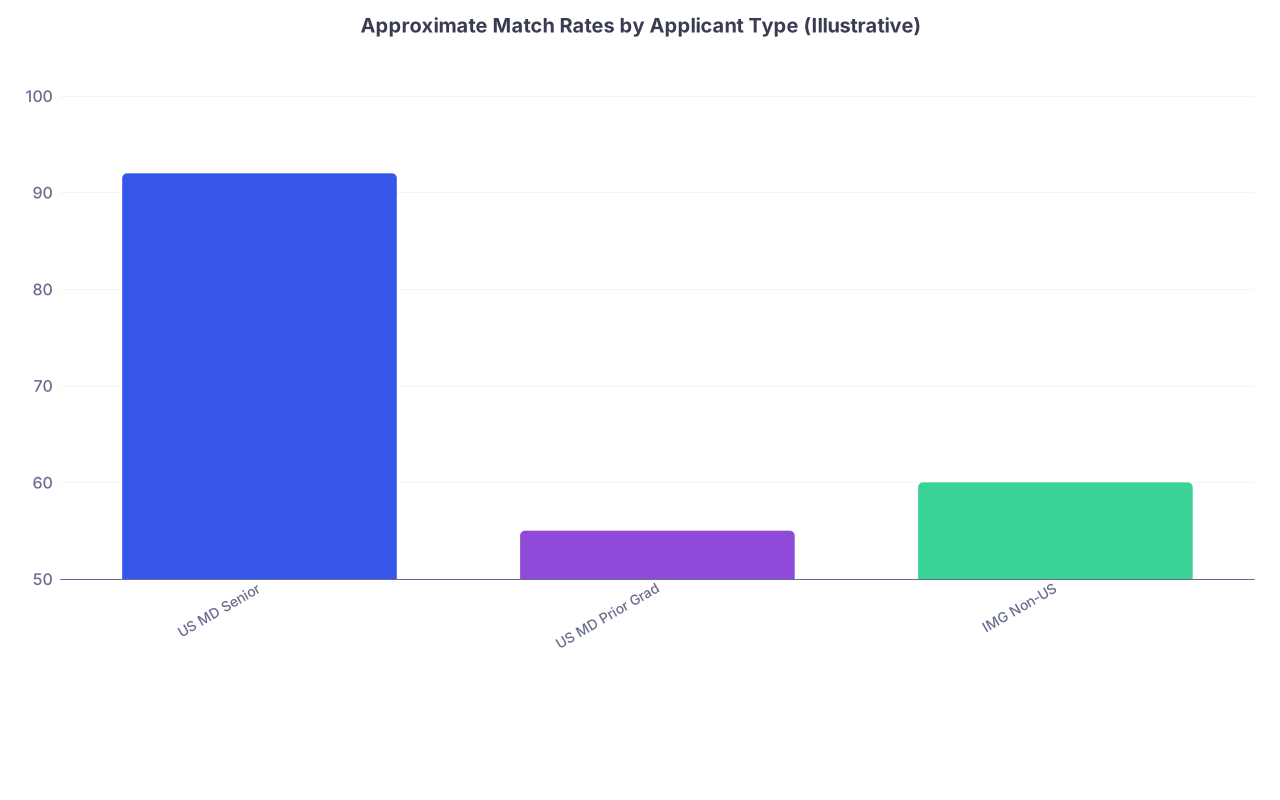
| Category | Value |
|---|---|
| US MD Senior | 92 |
| US MD Prior Grad | 55 |
| IMG Non-US | 60 |
Those numbers vary year to year and by specialty, but the pattern doesn’t change: once you’re not a fresh US MD senior, the game gets harder, not easier.
Now layer in this reality: most people who say they’ll reapply later… never do.
Not because they’re lazy. Because life hits:
- Loans are due.
- You’re finally making a real salary.
- You’ve moved, built a life, a relationship, maybe a family.
- Taking a year off to research or reapply feels terrifying.
So the “I’ll switch later” line is often code for “I’m not ready to accept I might never do this specialty.”
Backup Specialties: How People Actually Get Stuck
Here’s the real danger: picking a backup you do not want and then assuming you’ll fix it in the future.
I have seen versions of this over and over:
- The student who ranked psychiatry as a backstop for neurology. Matched psych. Was sure they’d switch. Three years later, they’re a psych attending, never reapplied, still occasionally bitter.
- The MS4 who threw family medicine at the bottom under anesthesia “just in case.” Matched FM at a community program with no research, no connections. Now trying to pivot to anesthesia with no recent anesthesia experience and a program that (understandably) wants them focused on primary care.
- The near-miss derm applicant who slid into internal medicine. Fully intended to reapply. Then got swallowed by wards, notes, and step-down units. By the time they had bandwidth to think, they were PGY‑3, done with IM, and geographically anchored.
Switching isn’t just about desire. It competes with exhaustion, inertia, debt, and real adult constraints.
That’s why your backup has to be something you can live with indefinitely, not just a placeholder you fantasize about abandoning.
Common Backup Myths, One by One
Let’s go after a few specific myths.
Myth 1: “I’ll Do a Prelim Year Then Slide Into Categorical”
Sometimes. Not routinely.
Prelim internal medicine or surgery spots are often presented as “tryouts.” That’s selectively true:
- In strong academic centers with known pipelines, some prelims do get picked up into categorical spots.
- But the funnel is narrow. Far more prelims complete their one year and then scramble for something else.
Prelim surgery with the vague plan of “I’ll hop into ortho or neuro or plastics once they see my work ethic” is fantasy unless a program director has looked you in the eye and said, “We often create categorical positions for strong prelims.” Even then, there are no guarantees because positions depend on unpredictable variables: other residents resigning, new funding, accreditation changes.
Myth 2: “Internal Medicine is a Perfect Backup for Everything”
IM is flexible, yes. That does not make it an all-purpose trampoline.
Things IM actually is:
- A rich base for subspecialties like cards, GI, heme/onc, pulm/crit.
- A solid generalist field with varied paths: outpatient, hospitalist, academic, hybrid.
Things IM is not:
- A generic staging area for any competitive specialty you didn’t match.
- A guaranteed stepping stone to radiology, derm, anesthesia, or EM.
Programs know when they’re a backup. If you walk into internal medicine repeatedly signaling you see it as a temporary holding pattern, you tank your chances of getting the support you’d need to pivot.
Myth 3: “If I Excel in Any Residency, They’ll Want Me”
No. They’ll respect you. They may like you. That’s different from being able to use you.
Think like a program director in a competitive specialty:
- You have 3 PGY‑2 slots.
- One extra slot appears because someone left.
- You can give it to:
- A known superstar MS4 with a clean story, full funded years ahead, or
- A PGY‑2 from another specialty with some years already spent and unclear funding.
You’re not choosing between “solid vs terrible.” You’re choosing between “excellent vs excellent but more complicated.” The simpler option usually wins.
Programs do take transfers. But they do not build their recruitment strategy around them. You’re a bonus, not the default.
How to Actually Pick Backup Specialties (Without Lying to Yourself)
You cannot eliminate risk, but you can stop making fantasy-based decisions. Here’s the evidence-based way to think about backups.
1. Assume You Will End Up in Your Backup
Not “might.” Assume will.
If you had to do only your backup specialty for 30 years, could you tolerate it without constant resentment?
- If yes, that’s a real backup.
- If no, it’s not a backup. It’s denial dressed up as strategy.
2. Look at Real Match Data, Not Vibes
Pull recent NRMP data for your primary and potential backup fields. Look hard at:
- Fill rates
- US MD senior match rates
- Step scores, publications, AOA, etc for matched applicants (where available)
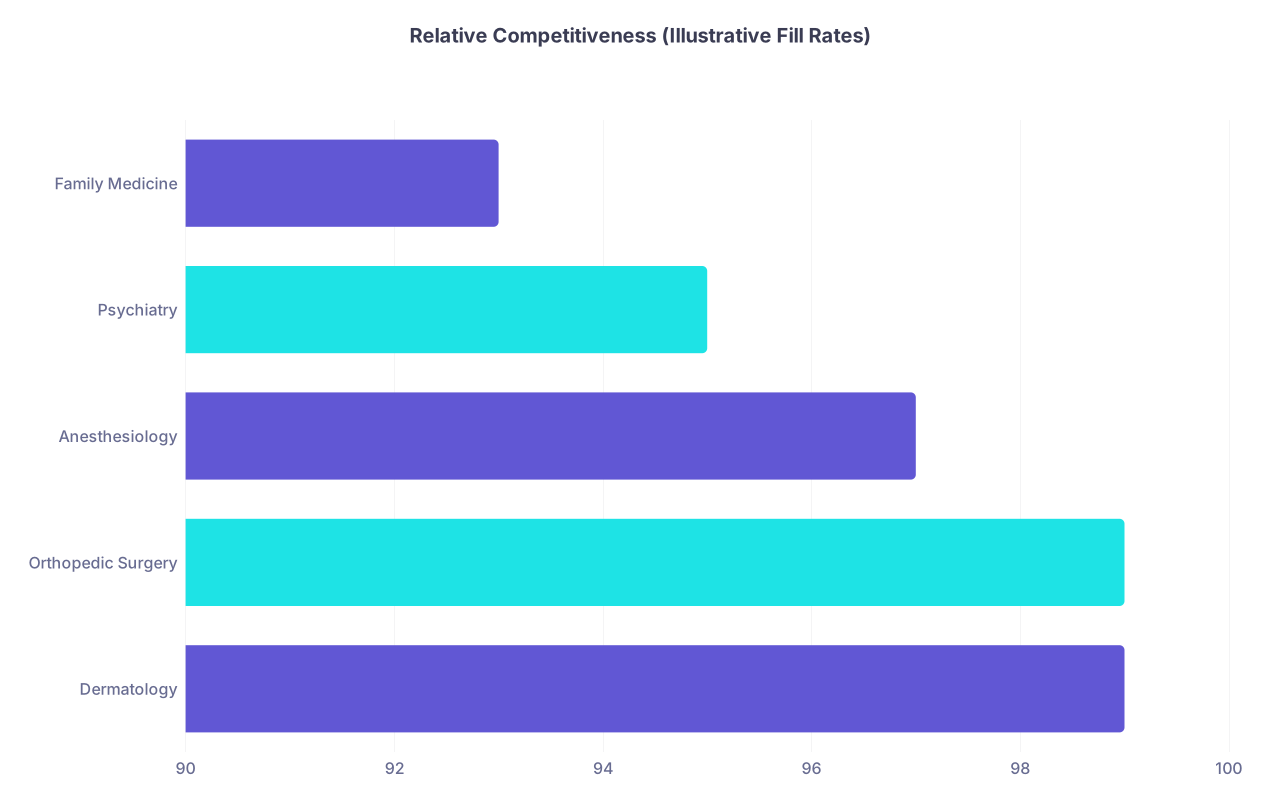
| Category | Value |
|---|---|
| Dermatology | 99 |
| Orthopedic Surgery | 99 |
| Anesthesiology | 97 |
| Psychiatry | 95 |
| Family Medicine | 93 |
A “backup” isn’t a true backup if your odds are still marginal. Backing up from derm to radiology or anesthesia is not actually backing up for an average applicant; it’s sidestepping into another selective funnel.
3. Prioritize Real Transfer Adjacency, But Don’t Count on It
If you want optionality, pick a backup that at least lives in the same clinical ecosystem:
- For neurology, psychiatry or internal medicine make more sense than OB/GYN.
- For anesthesiology, internal medicine or surgery prelim make more sense than pediatrics.
- For interventional radiology, diagnostic radiology or maybe surgery is more rational than family medicine.
That doesn’t guarantee a switch. It just means if a rare door opens, you’re not starting from zero.
4. Think in Terms of Worst-Case Life, Not Best-Case Pivot
Best-case scenario with a backup is obvious: you match, decide you like it, and build a good career.
The more relevant scenario is: what if you try to switch and fail?
- Where will you live?
- What kind of day-to-day work will you do?
- Are there fellowships or niches within that backup that could scratch some itch from your “dream” field? (Example: procedural FM with OB and scopes; psych with interventional work; IM with cards/ICU.)
If your worst-case vision is intolerable, change your backup before the rank list locks—not after.
The Logistics of Switching, When It Actually Works
Let’s say you’re one of the few for whom switching is realistic. How does it usually happen?
Not by passively “being excellent” and waiting.
Transfers typically involve:
- Early and honest conversations with your current program director.
- Willingness to move anywhere geographically, quickly.
- Aggressive networking: alumni, subspecialty mentors, old med school faculty.
- Willingness to accept a lower PGY level than you’ve already completed.
- Often, a gap year plugged with research or a non-ACGME role.

| Step | Description |
|---|---|
| Step 1 | Resident unhappy or misaligned |
| Step 2 | Talk to mentor and PD |
| Step 3 | Research options and funding limits |
| Step 4 | Network and contact programs |
| Step 5 | Apply for rare open transfer spots |
| Step 6 | Switch program and possibly PGY level |
| Step 7 | Stay in current field or reapply later |
| Step 8 | Offer? |
Most residents staring down 80-hour weeks, loans, and moves across states don’t have the stamina for this gauntlet. That is not a character flaw. It’s reality.
Which is why your initial backup decision matters so much more than your hypothetical switching strategy.
Application Strategy: Breadth vs Backup Fantasy
A smarter way to reduce risk is not to rely on switching later, but to reduce the chance you need to at all.
Strategies that actually work better than “I’ll just switch later”:
- Apply more broadly within your chosen specialty, including less glamorous programs and locations.
- Pragmatically calibrate your primary specialty choice based on your objective profile: scores, research, letters, clinical performance.
- If you’re truly on the bubble for an ultra-competitive field, consider dual applying into a genuinely acceptable backup simultaneously, not sequentially.
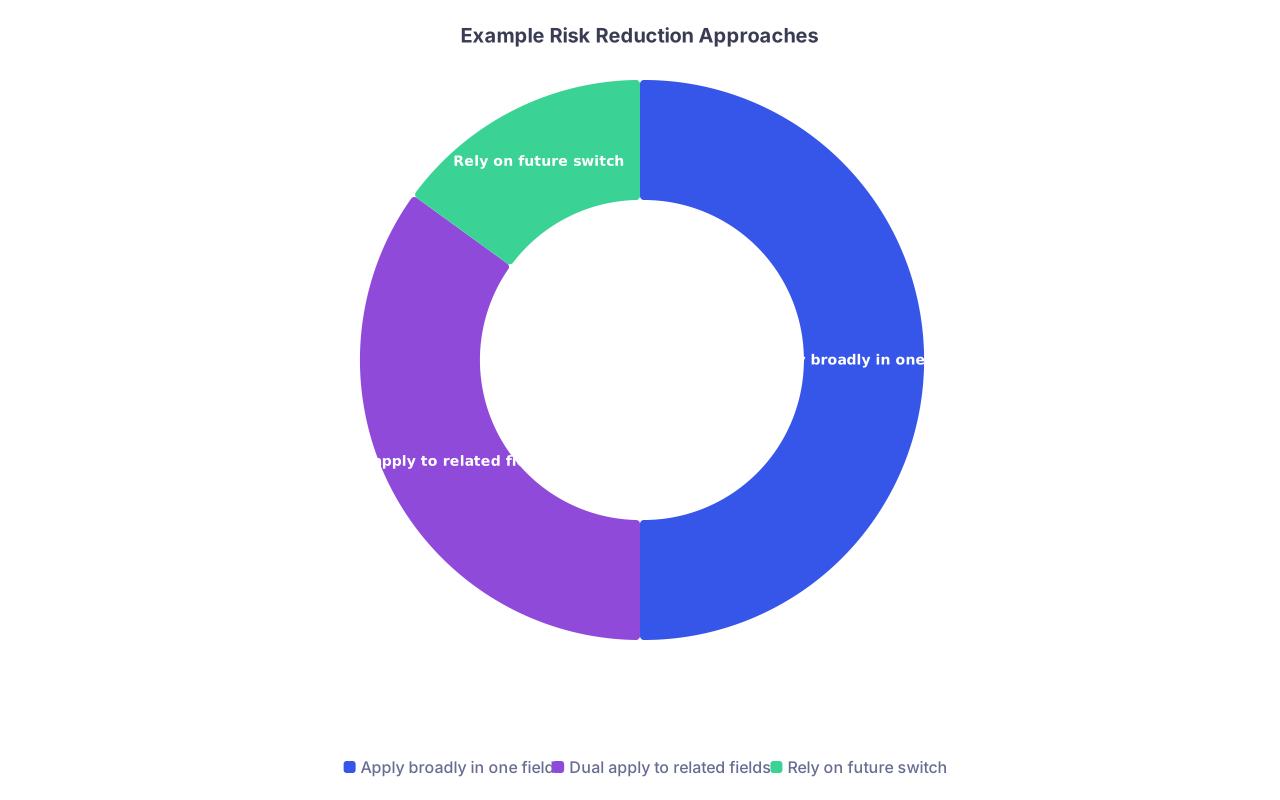
| Category | Value |
|---|---|
| Apply broadly in one field | 50 |
| Dual apply to related fields | 35 |
| Rely on future switch | 15 |
That last slice—the “rely on future switch” crowd—is where most regret lives.
The Bottom Line
Let me strip it down.
- Switching specialties after starting a backup is possible but statistically uncommon, structurally constrained, and personally costly. It’s not a plan; it’s a long shot.
- Your backup specialty should be something you can inhabit for an entire career without hating your life. If you cannot say that honestly, it’s not a real backup.
- You control more by choosing wisely now—calibrating your primary field, picking a tolerable backup, and applying strategically—than by gambling on a future “switch” that might never materialize.
Believe the data, not the comforting legend. The Match is stressful enough without building your future on a story that sounds good in MS4 group chat but falls apart the minute you sign your first resident contract.