
It’s late November. You’re on a medicine ward, answering pages, pretending to care about the sodium while secretly refreshing your email for interview invites. You aimed high: Derm. Or Ortho. Or ENT. The “reach” specialty.
Now you’re staring at your ERAS dashboard, realizing the truth: you also applied to Internal Medicine. Or Family. Or Transitional Year. The so‑called “backup.”
Here’s the part nobody explains clearly: every single program that sees your ERAS is asking one quiet, ruthless question:
“Are we the backup?”
I’ve sat in those rooms. Watched PDs flip through applications in under 60 seconds. Heard the exact phrases that decide who gets an interview and who gets buried. So let me walk you through how “backup” actually plays behind closed doors, specialty by specialty, and how to structure your ERAS so you look serious everywhere you apply.
Not honest. Strategic.
What Program Directors Actually Do When They Smell “Backup”
Let me start with the thing applicants always underestimate:
Programs are insanely sensitive to being used. Especially in smaller or competitive specialties.
Some PD quotes I’ve actually heard:
- “If they wanted us, they would have rotated here.”
- “This looks like someone who struck out in ENT and is throwing apps at IM.”
- “I’m not wasting an interview on someone who’s going to rank anesthesia number one.”
They’re not always right. But their perception is what matters, not your noble internal narrative.
Here’s what they look at, in rough order, when they’re trying to decide if you’re “ours” or “someone else’s problem”:
- Specialty alignment of your whole application
- Letters of recommendation pattern
- Personal statement content and tone
- Research and extracurriculars
- Where else you applied (yes, they can often tell)
- Step scores and “fit” with their typical match
We’ll break these down, then talk strategy for common backup pairings.
The First Red Flag: Does Your Application Speak One Language or Two?
Programs don’t start by looking for backup energy. They start by hunting for commitment.
When we pull up an applicant, this is roughly what happens in that first 30–60 seconds:
- Specialty applied to flashes on top.
- We scroll quickly through experiences: are they consistent with this specialty?
- We glance at publications/posters: what field?
- We open letters: who wrote them? What specialty?
- If something doesn’t line up, someone says it out loud:
- “Huh. A ton of Ortho research, no medicine stuff… but applying IM?”
That “huh” is death.
Programs want to believe you actively chose them, not that you washed up on their shore after your dream ship sank.
So they look for coherence:
- If you’re applying IM: do you have IM rotations, IM letters, IM research or QI?
- If you’re applying FM: primary care, continuity clinic, underserved work?
- If you’re applying TY/prelim: a mix that at least makes sense with your main target?
Your job, when you’re using a backup, is to make each application look like it lives in its own universe. Or at least doesn’t scream, “I’m cheating on you.”
How Letters of Recommendation Outs You Immediately
Let me be blunt: letters are the quickest way committees sniff out backup status.
Here’s the mental math every reviewer is doing:
- You applied to Internal Medicine
- You uploaded 3 letters
- They’re from:
- Orthopedic surgeon
- Orthopedic surgeon
- Research mentor (sports medicine)
You think: “Well, they show I’m a strong student.”
We think: “Orthopedics didn’t want them. Why are we the consolation prize?”
Behind closed doors, the reaction isn’t subtle. I’ve heard:
- “They didn’t even bother to get one IM letter?”
- “We’re clearly plan C.”
- “Hard pass. Next.”
On the flip side, here’s what makes a PD pause and reconsider:
- 2 solid letters in your primary specialty
- 1 targeted, genuine letter for the backup specialty
- Or at least a hybrid letter that clearly speaks to your suitability for both
The absolute worst pattern: four letters from your dream specialty and nothing targeted to the backup. You just told the committee, with documentation, that you didn’t think they were worth the effort.
If you’re reading this before MS4 starts: schedule your rotations and letters with this in mind. Leave space to generate legit letters for the backup.
If you’re reading this during application season with no backup letters: you’ll need to compensate elsewhere and accept some doors will stay closed.
The Personal Statement: Where Committees Catch You Lying
Programs absolutely read personal statements for signal. They skim, yes. But they’re hunting for one thing:
“Is this written to us?”
Nothing irritates faculty more than a generic, repurposed statement that barely bothers to name the specialty.
I’ve watched someone read a PS out loud in committee and then say: “This exact paragraph could be for Derm, IM, or Peds. Hard no.”
Three ways you out yourself:
Vague specialty language
- “I love variety and continuity of care” — sure, that’s half of medicine
- “I enjoy procedures and team-based care” — that’s basically everything
Sloppy find-and-replace
I’ve literally seen:- “During my interest in Internal Medicine [edit: Anesthesiology]…”
Or a statement talking about outpatient continuity for an anesthesia application. We laugh. Then we move on.
- “During my interest in Internal Medicine [edit: Anesthesiology]…”
Selling someone else’s dream
When your entire PS is about your deep, lifelong love of surgery… sent to Family Medicine. That doesn’t make you “honest.” It makes you undateable.
If you’re using a backup, you need separate statements. Full stop.
Not just swapping out the word “Dermatology” for “Internal Medicine.”
Different logic. Different narrative. Different “why this field.”
Committees can smell a recycled PS in under 10 seconds. And once they smell it, everything else you wrote is discounted.
Research and Activities: The Background Radiation of Your Story
You can’t hide your past. But you can frame it.
Programs absolutely notice if:
- 90% of your research is in plastics, but you’re applying IM
- Your only leadership roles are in the Ortho interest group
- All your posters and abstracts are surgical, now you’re suddenly in FM territory
Does that automatically kill your backup application? No.
Here’s how PDs roughly categorize this:
- “Primary-aim kid with a rational backup”
- “Burned at the altar of a competitive field”
- “Cannot let go of dream, will leave us first chance”
- “Genuinely switched interests, late but sincere”
You want to live in the first or last category.
I’ve seen strong IM programs rank highly an applicant who had 3 years of ENT research. Why? Because:
- They had 2 excellent IM letters
- Their IM PS was specific and believable
- They had done an away in IM
- Their MS4 schedule clearly shifted to IM rotations
- They openly admitted in a coherent way: “I realized I liked the complexity and continuity more than the OR”
What they don’t trust: someone who did only Ortho, never touched IM seriously, and then acts shocked when we wonder if they’re just camping here until a PGY2 spot opens elsewhere.
How Programs Know Where Else You Applied
You think ERAS is siloed. It is. And it isn’t.
Here’s the reality:
- PDs talk. Constantly. Across specialties. Across institutions.
- APDs share impressions, “red flag” names, and sometimes even “this person is clearly hedging with us.”
- If you do couples match, some applications half-expose your partner’s specialty decisions.
- Your MSPE, transcript comments, and experiences often reveal primary goals.
Some very honest applicants straight-up write in their PS or mention on interview: “I also applied to X as a backup.”
Let me be direct: that level of “radical honesty” rarely plays the way you think it will. Programs already assume competitive applicants might be hedging. But if you underline that in neon, they treat you like a flight risk.
You don’t need to lie. You also don’t need to volunteer more than asked.
Answer what’s in front of you. Don’t submit a confession letter.
Common Backup Pairings: What Committees Actually Think
Let’s go through some classic combinations and how they land on the other side.
| Primary Specialty | Backup Specialty | Typical Committee Reaction |
|---|---|---|
| Ortho, ENT, Uro | Categorical IM | Suspicious but open if IM work is real |
| Derm, Rad Onc | IM or FM | Assumes primary miss, looks for sincerity |
| Neurosurgery | Surgery or IM | Views as big shift; needs strong rationale |
| Anesthesia | IM or TY | Anesthesia sees TY; IM sees partial fit |
| Competitive anything | Transitional Year | Everyone assumes re-apply plan |
Competitive surgical → Internal Medicine or FM
Example: Ortho primary, IM backup.
What IM looks for:
- At least one real IM letter
- Some exposure to inpatient medicine that isn’t just your MS3 core rotation
- An IM personal statement that isn’t obviously a hacked Ortho one
- MS4 schedule that doesn’t scream “Ortho until December, then panic”
IM is used to being a backup for surgical hopefuls. But they will not reward laziness. If it feels like you thought of them as the consolation prize, they will do the same to you.
Derm/Rad Onc → IM/FM
These are classic.
We know:
- You probably chased Derm/Rad Onc early
- Your research is loaded in that direction
- You may have AWAYS or sub-Is there
The committee questions:
- Did you actually like the medicine side?
- Do you understand what day-to-day IM or FM looks like?
- Are you going to be miserable without procedures/clinic type X?
If you can show in your narrative and letters that you enjoy longitudinal care, complex medical decision-making, and the less glamorous bread-and-butter work, you can absolutely get traction.
Neurosurgery → Surgery/IM
Neurosurg to general surgery? Seen as plausible.
Neurosurg to IM? That raises eyebrows. Not impossible, but you better explain it.
The internal conversation:
- “Why the 180?”
- “Are they running from lifestyle, intensity, or something else?”
- “Will they become disengaged when not in the OR?”
You need a coherent storyline that shows growth, not collapse.
Primary Specialty → Transitional Year / Prelim
Here’s the dirty truth: almost everyone views TY and prelim spots as intentional limbo.
TY programs know they are the bridge year for:
- Anesthesia
- Radiology
- Derm
- PM&R
- Ophtho
- Re-applicants
Prelim medicine/surgery slots see tons of “I’ll reapply in my dream field” energy.
If your ERAS screams “I’m only here for a year,” that doesn’t hurt you as much with TY. That’s literally the design. But if you’re applying to categorical and TY in the same department at the same institution, trust me—those PDs talk. And they notice.
How Many “Backup” Signals Is Too Many?
Think of each component of your application as a signal. One mismatched signal? Fine. Five? You’re done.
Here’s a rough scale:
- 0–1 mismatch: “Legit candidate, maybe late switch.”
- 2–3 mismatches: “Hedging, questionable primary commitment.”
- 4+ mismatches: “Backup tourist. Waste of interview.”
For a backup specialty application to be taken seriously, you want:
- Specialty-specific PS
- At least one (ideally two) letters from that field
- MS4 schedule that includes that specialty seriously
- At least one activity, research, QI, or longitudinal project that touches it
You cannot fix everything mid-September. But you absolutely can fix:
- Personal statements
- Letter choices and assignment
- How you describe your experiences in ERAS text boxes
- Who you ask to make a last-minute, honest letter
When You Should Tell a Program They’re Backup… and How
This is the question I always get in advising:
“Should I tell them I applied to another specialty?”
Here’s the uncomfortable truth: if you have to ask, the answer is usually no.
You don’t walk into an interview and open with, “Just so you know, you’re my second choice if Derm doesn’t work out.”
There are rare exceptions:
- You started in one field, had a legitimate, late, well-documented change of heart
- Your MSPE and transcript openly show you were ENT-committed for 3 years
- The interviewer directly asks, “What other specialties did you apply to?”
If they ask, don’t lie. But don’t self-sabotage with a rambling confession either.
You say something like:
“I was initially very interested in ENT. I did X, Y, Z in that field. But through my medicine rotations and especially my sub-I, I realized I was much more drawn to complex medical decision-making and longitudinal care. So I made a decision to commit to IM this cycle, and I’ve focused all my fourth-year time and energy in that direction.”
Then stop talking.
If you’re applying dual-specialty (e.g., Med-Peds and IM, or IM and Anesthesia), same rule. You don’t have to pretend the other doesn’t exist. You do have to explain what you’d want from each path without sounding like you’re just climbing towards lifestyle or prestige.
Strategic Structuring: How to Make Each Application Look “True”
Let’s talk practical maneuvering.
You’re not just one applicant. On ERAS, you are however many versions of yourself you create with:
- Separate personal statements
- Different letter combinations for different specialties
- Selective highlighting of experiences in interviews and communications
You should build tracks:
- Ortho track with Ortho letters and Ortho PS
- IM track with IM letters and IM PS
- TY track with more generalist “broad training” PS and a flexible letter mix
ERAS allows you to assign different letters to different programs. Most of you underuse this. PDs notice when your IM program got two IM letters and one Ortho, while Ortho programs got three Ortho letters and never see the IM letter.
That pattern quietly says: “I know I may end up in IM, and I’ve prepared for that seriously.”
The opposite—no letters in the backup field—says: “If I land here, it’ll be by accident.”
Even when you can’t fully align everything, partial signals help. One honest, strong letter from a backup specialty attending who says, “I’d be happy to have this person in my field,” is worth more than ten vague “excellent student” notes from your dream field.
How Committees Actually Argue About Backup Candidates
Let me show you how this sounds in the real room.
We’re in a ranking meeting. We’re reviewing a borderline candidate for IM who clearly went after Derm.
Person A: “This is a Derm re-applicant. Tons of Derm research, two Derm letters, one IM letter.”
Person B: “Yeah, but the IM letter is great. And they crushed their IM sub-I. Step 2 is solid. They clearly like clinic and complexity.”
Person C: “Do you think they’ll leave if Derm PGY2 opens up?”
Person B: “Maybe. But their interview was actually very ‘I like medicine’ not ‘I’m here under protest.’ I believed them.”
PD: “Where do we put them? If they match here and leave, we get burned. But they’d be a strong intern.”
Then you see the tradeoff: perceived commitment vs quality.
Your job is to make it very easy for Person B to defend you.
The Harsh Reality: Some Programs Will Never Be Okay Being Backup
There are programs—especially mid-tier in competitive specialties—that are extremely reactive to backup vibes.
These are the committees that say:
- “I don’t want someone who really wanted UCSF and ended up with us.”
- “If we see they blanketed Derm and then threw us in, we’re not playing that game.”
You’re not changing their culture. So you don’t build your strategy around convincing those people.
You build for the reasonable programs that understand:
- Some specialties are brutally competitive
- Smart students diversify their risk
- Good physicians come from imperfect, non-linear paths
Those programs exist in every specialty. They just want proof that if you land with them, you’ll show up fully.
Give them that.
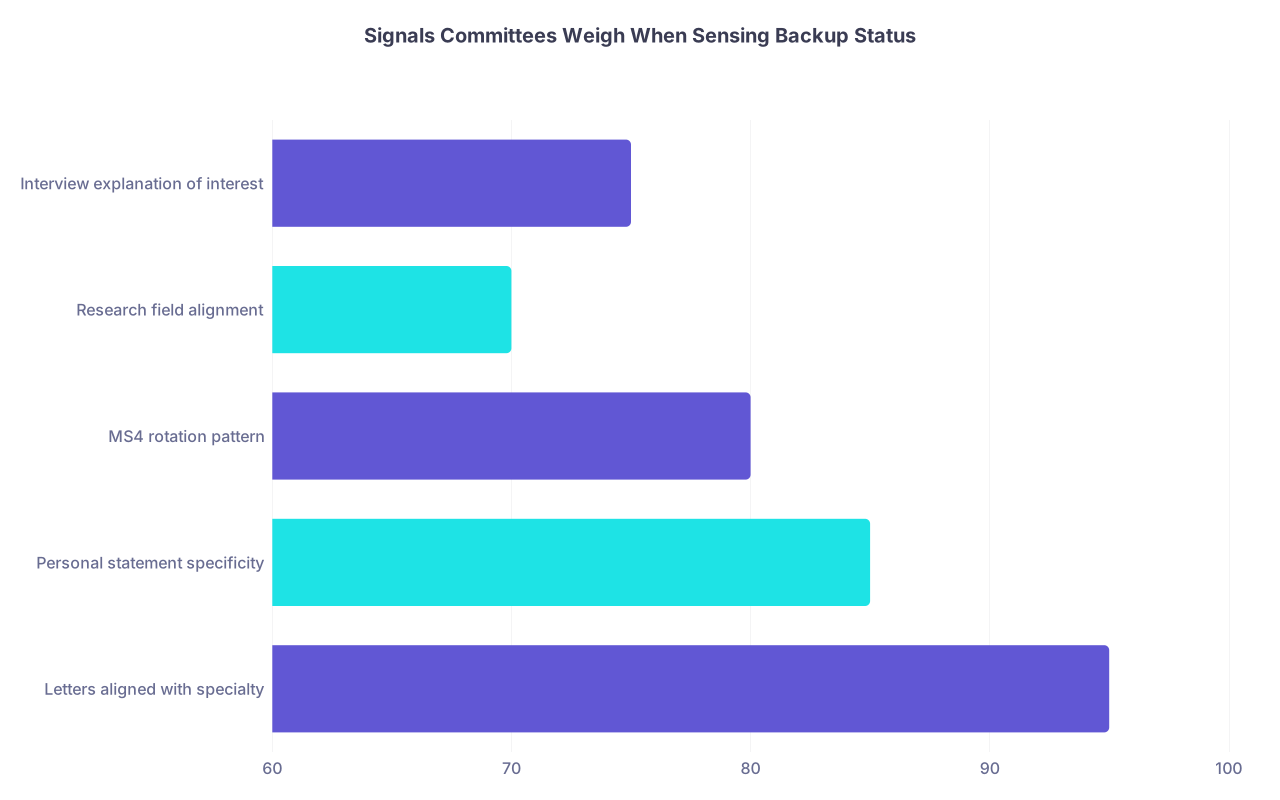
| Category | Value |
|---|---|
| Letters aligned with specialty | 95 |
| Personal statement specificity | 85 |
| MS4 rotation pattern | 80 |
| Research field alignment | 70 |
| Interview explanation of interest | 75 |
What You Should Actually Do Right Now If You’re Using a Backup
If you’ve already submitted ERAS and your stomach’s dropping as you read this, here’s the damage control:
Fix personal statements where you still can
If a program allows updates or you haven’t assigned PS yet, get specialty-specific versions in place.Audit your letters
Make sure each specialty at least gets 1 letter from that field if remotely possible. If not, choose the most “generalizable” letters—people who comment on your clinical reasoning, teamwork, adaptability, not your “surgical hands.”Tune your interview answers
Stop telling every program the whole soap opera of your application strategy. When you’re at an IM interview, talk like someone who wants IM. Not someone mourning Derm.Ask yourself one brutal question
“If this backup specialty were the only field in the world, would I be okay doing it?”
If your honest answer is no, you’re not using a backup. You’re gambling with something you’ll resent if you actually match there. Reconsider your entire plan.

| Step | Description |
|---|---|
| Step 1 | Choose primary specialty |
| Step 2 | Identify realistic backup |
| Step 3 | Focus on single specialty |
| Step 4 | Plan MS4 rotations for both |
| Step 5 | Secure letters in both fields |
| Step 6 | Write separate PS for each |
| Step 7 | Assign letters per program |
| Step 8 | Prepare interview narratives |
| Step 9 | Is it highly competitive |
FAQs
1. If I’m dual applying, should I tell programs during interviews?
Only if you’re directly asked, or if your history makes it unavoidable. Then answer cleanly: brief acknowledgment of the past interest, clear present commitment to the specialty you’re interviewing for, and stop. Do not monologue about being “torn” between two fields. Committees hate indecision more than they hate backup applicants.
2. Can I use the same personal statement for my primary and backup specialties?
You can. And you will get treated like a generic, low-commitment applicant in at least one of those fields. If you’re serious about both, each deserves its own narrative. Even a 60–70% shared core with a specialty-specific opening and closing is miles better than pure copy-paste.
3. How many letters should be specialty-specific for my backup?
For a backup to be taken seriously, you want at least one strong letter from that specialty. Two is better. If you truly can’t get that, then prioritize letters that talk about traits universally valued in that field (for IM: clinical reasoning, reliability, communication; for FM: continuity, empathy, broad interest, etc.). But understand: you’re fighting uphill.
4. Will programs automatically know if I applied to another specialty?
Not automatically. ERAS doesn’t send a neon “dual applicant” banner. But patterns in your MSPE, experiences, research, and letters tip people off. And PDs talk. The more misaligned your story, the higher the odds you get “found out” informally. Instead of hiding, build a coherent story for each side.
5. Is it ever better not to use a backup specialty and just go all-in?
Yes. If your primary specialty is moderately competitive and your application is clearly on target, sometimes splitting attention just weakens both sides. Or if your “backup” is something you’d truly hate doing, matching there is not a win. Backups make sense when: the primary field is brutally competitive and you could genuinely see yourself content in the backup. Anything else is self-sabotage wearing a safety net costume.
You’re in the thick of it now. Email alerts, interview juggling, quiet fear. But this is where the real game is played—not just in your scores or your CV, but in how coherently your story lands in rooms you’ll never see.
If you get your backup strategy right, you don’t just increase your chances of matching. You increase your chances of ending up somewhere you can actually live with, not just survive.
With that foundation in place, your next task is more tactical: how you handle those interviews when the door finally opens and three faculty start deciding whether you’re “one of us” or someone else’s backup. But that’s a conversation for another night.