Why Backup Specialty Planning Is Essential for Caribbean IMGs Targeting Interventional Radiology
Interventional Radiology (IR) is one of the most competitive training pathways in the United States, and that difficulty is magnified if you are a Caribbean medical graduate. Between the inherent competitiveness of IR, the extra scrutiny sometimes placed on Caribbean medical school residency applicants, and the limited number of independent IR positions, you cannot rely on a single-path strategy.
Thoughtful backup specialty planning is not “giving up” on IR. It is a proactive risk‑management strategy to maximize your chances of:
- Practicing procedural, image‑guided medicine even if you don’t match IR
- Matching into some residency in the same match cycle
- Building a path that can still lead back toward IR or an IR‑adjacent career
This article walks through a structured, realistic approach to designing a backup plan tailored specifically for a Caribbean IMG pursuing Interventional Radiology.
1. Understanding the IR Match Landscape as a Caribbean IMG
Before you pick a backup specialty, you must understand what you are up against in the IR match.
1.1 IR Pathways: Integrated vs Independent
For most graduating medical students, the main route is the Integrated Interventional Radiology (IR/DR) residency, a categorical 6‑year program (PGY‑1 to PGY‑6) that combines diagnostic radiology (DR) and IR.
The other traditional route is the Independent IR residency (2 years after completing a DR residency), but this is more relevant if you are already in diagnostic radiology or have completed DR training.
As a Caribbean IMG applying from medical school, your pathway is almost always:
- Primary target: Integrated IR
- Strategic option: Diagnostic Radiology with an eye toward future IR fellowship or independent IR residency
- Backups: Thoughtfully chosen non‑radiology specialties that still align with your clinical and career interests
1.2 Competitive Pressures Specific to Caribbean IMGs
A Caribbean medical school residency applicant targeting IR faces three layers of competition:
Specialty competitiveness
- IR/DR is among the most competitive specialties, with relatively few spots and high USMLE expectations.
- Programs often have a strong preference for US MD students and sometimes US DOs, leaving fewer spots for IMGs.
Perception of Caribbean schools
- Many program directors are cautious about Caribbean IMGs due to variable school quality, shelf exam structures, and inconsistent clinical experiences.
- You must over‑document your strengths: scores, letters, research, and performance in US clinical rotations.
Limited “second chances” within radiology
- If you do not match IR, there aren’t many “nearby” specialties to slide into at the last minute within the same application list.
- You need to build that flexibility deliberately through dual applying and backup planning.
1.3 Why “IR‑Only” Is High Risk
For a Caribbean IMG, applying only to IR/DR programs without a backup is usually a gamble with a high probability of going unmatched. Consider:
IR programs are small and can screen heavily by:
- USMLE thresholds
- School type (US MD vs others)
- Research productivity in IR/radiology
Even strong candidates with excellent metrics can go unmatched because:
- Program lists are short and selective
- IR is subject to trends—some years see surges of highly competitive US MD/DO applicants
If your IR match fails and you have not prepared a backup specialty:
- Your options during SOAP are limited and extremely stressful
- Many remaining SOAP spots are in fields or locations you may not want
- You may be forced into a gap year, visa challenges, or career uncertainty
2. Strategic Principles of Backup Specialty Planning
To protect yourself without undermining your IR candidacy, think about backup specialty planning as a structured, multi‑step decision process.
2.1 Clarify Your Core Career Interests
First, understand what you actually like about Interventional Radiology. Common themes:
- Image‑guided procedures
- Minimally invasive therapy
- High‑acuity care (e.g., trauma embolizations, emergent interventions)
- Oncology integration (e.g., ablations, chemoembolization)
- Vascular disease management
- Technology and devices
Then ask: Which of these are “must‑haves” versus “nice‑to‑haves”?
This will help you select a backup specialty that:
- Preserves as many of your core interests as possible
- Keeps you satisfied even if you never get back to IR
- Provides some future path to IR‑adjacent work (e.g., pain procedures, vascular interventions, imaging‑heavy practice)
2.2 Define Your Risk Tolerance
There is a spectrum between “all‑in on IR” and “maximum safety.” For a Caribbean IMG, the right point usually isn’t at either extreme.
Ask yourself:
If I go unmatched this cycle, can I:
- Afford a dedicated research or prelim year?
- Manage visa and financial constraints?
- Tolerate the psychological stress of trying again?
Am I willing to:
- Move anywhere in the US if it means I match my backup?
- Work in an underserved or rural area?
Your answers will guide how aggressively you dual apply and how competitive your backup specialty should be.
2.3 Understand Dual Applying vs “Hidden” Backup
Two core strategies:
Dual applying residency
- You intentionally apply to IR and another specialty in the same ERAS season.
- You have separate personal statements and letters tailored to each.
- This is best for Caribbean IMGs because it gives you a real Plan B before the match list is submitted.
Plan B specialty through SOAP or re‑application
- You apply only to IR initially, then scramble into other fields during SOAP or reapply next year.
- This is much riskier for Caribbean IMGs; you’re often competing for leftovers with limited ability to curate good options.
For Caribbean graduates, dual applying with a structured backup specialty is usually far superior to relying on SOAP alone.
3. Choosing the Right Backup Specialty: Radiology‑Adjacent and Beyond
You want a backup that is:
- More accessible to Caribbean IMGs than IR/DR
- Clinically satisfying and sustainable for you
- Logically justifiable based on your experiences and interests
- Strategically consistent with your long‑term IR or IR‑adjacent goals

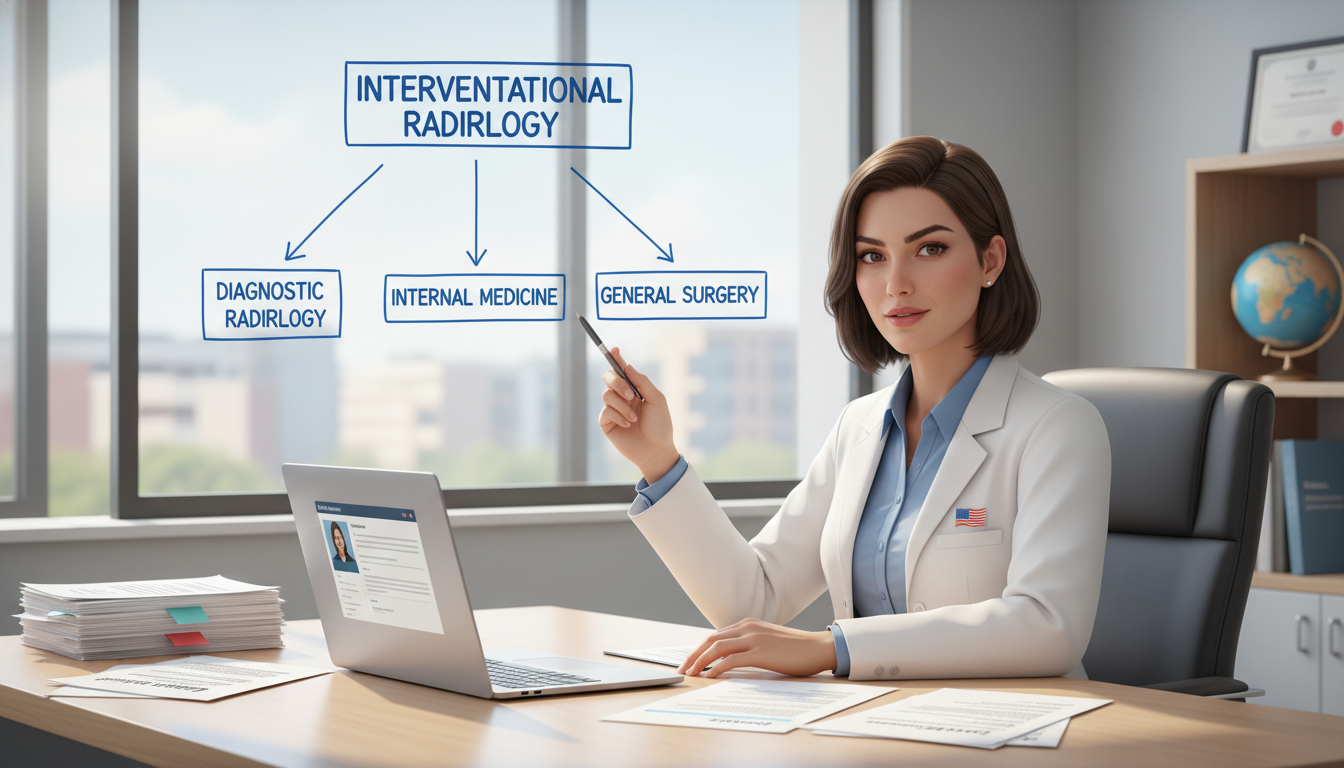
3.1 Diagnostic Radiology as the Primary Backup
Why DR is the most logical backup:
- Overlaps heavily with IR in imaging, radiologic anatomy, acute care, and procedures (for some subspecialties)
- Gives you access to:
- The independent IR residency pathway, or
- IR fellowships at some institutions
- Many programs see DR applicants interested in IR as a plus, not a negative
Challenges as a Caribbean IMG:
- DR is still moderately competitive, especially at university programs
- Some programs have limited history of taking Caribbean graduates
- You must show you are equally serious about DR, not just treating it as a consolation prize
How to position DR in your application:
- Letters of Recommendation:
- At least one strong DR or IR letter discussing your imaging skills, work ethic, and fit for radiology
- Personal Statement:
- For IR: emphasize procedures, innovation, and patient‑facing aspects
- For DR: emphasize imaging, problem‑solving, multidisciplinary collaboration, and openness to IR later
- ERAS Strategy:
- Apply broadly to DR programs, including community and hybrid programs more IMG‑friendly than some large academic centers
- Tailor your DR personal statement and experiences; do not send an IR‑focused statement to DR‑only programs
For many Caribbean IMGs targeting IR, Diagnostic Radiology is the primary backup and sometimes the true best path to an IR‑centered career.
3.2 Non‑Radiology Backup Specialties With Procedural & Imaging Overlap
If your application metrics or school context make both IR and DR quite high risk, it’s smart to identify a parallel plan B specialty outside radiology. Some attractive options:
3.2.1 Internal Medicine → Interventional Cardiology / Advanced Procedural Fields
Pros:
- Internal Medicine is relatively more accessible to Caribbean IMGs, especially in community and IMG‑friendly university programs.
- You can later subspecialize in:
- Interventional Cardiology
- Electrophysiology
- Advanced heart failure with device work
- You keep:
- Longitudinal patient care
- Procedures (caths, device implants, etc.)
- Imaging overlap (echocardiography, cardiac CT/MR)
Cons:
- Longer training path (residency + fellowship/s).
- Competition within cardiology can still be strong.
- Less focus on non‑cardiac interventions compared with IR.
This path is best if you enjoy physiology, chronic disease management, and the cardiovascular system as much as—if not more than—pure procedural work.
3.2.2 General Surgery → Vascular Surgery / Surgical Oncology / Trauma
Pros:
- Strong procedural focus, operative skill development
- Potential future fellowships in:
- Vascular Surgery
- Surgical Oncology
- Transplant or Trauma/Acute Care Surgery
- Many Caribbean IMGs match into surgery, especially prelim positions (though categorical is more competitive).
Cons:
- Surgical lifestyle (hours, call, physical demands)
- Training is long and intense
- Prelim surgery alone is not a stable career endpoint
Use this backup if you truly love the OR, anatomy, and acute care, and can see yourself as a surgeon independently of IR.
3.2.3 Anesthesiology → Pain, Regional, Procedural Subspecialties
Pros:
- Anesthesiology often has moderate competitiveness with reasonable IMG access at many programs
- Future subspecialties include:
- Pain Medicine (many image‑guided procedures)
- Regional Anesthesia
- Critical Care
- Procedure‑heavy, physiology‑focused, involvement in perioperative and ICU care
Cons:
- Fewer crossovers with imaging in the formal radiologic sense
- Pain medicine has its own competitive dynamics and regulatory considerations
Best if you like procedures, acute physiology, and the OR/ICU environment.
3.2.4 Neurology → Neurointerventional Options (Indirect)
In some systems, neurologists go on to neurointerventional training (often via vascular neurology and interventional neuroradiology collaborations), though this path is less standardized in the US compared to radiology‑based routes. Still, neurology can be an intellectually fulfilling field with:
- Stroke and neurovascular focus
- Heavy imaging usage (MRI/CT)
- Potential IR‑adjacent opportunities in some institutions
3.3 A Tiered Backup System: Primary, Secondary, Emergency
A robust backup plan for a Caribbean IMG pursuing IR might look like:
- Primary goal:
- Integrated IR/DR at any IMG‑friendly program, any location
- Primary backup specialty:
- Diagnostic Radiology (broad list, IMG‑friendly focus)
- Secondary backup specialty (plan B specialty):
- Internal Medicine or Anesthesiology (broad list, significant IMG representation)
- Emergency backup (if scores or red flags exist):
- Strong emphasis on a more accessible field like Family Medicine, Psychiatry, or Pediatrics as a last resort to avoid going unmatched completely
You may not need all four layers, but thinking in tiers prevents an all‑or‑nothing outcome.
4. How to Implement Dual Applying Without Undermining Your IR Candidacy
The biggest concern many IR‑focused Caribbean IMGs have is: “If I dual apply, will IR programs think I’m not serious?” The answer depends on how thoughtfully and discreetly you structure your application.

4.1 ERAS Application Structuring
Key components:
Separate Personal Statements:
- IR: heavy emphasis on procedural radiology, innovation, device use, multidisciplinary intervention care
- DR: focus on diagnostic imaging, multidisciplinary case discussions, patient‑care impact through accurate reads
- IM/Anesthesia/etc.: emphasize what is authentically attractive about those fields to you, not that they are backups
Targeted Program Lists:
- IR/DR: mostly university and large academic centers, plus some large community training programs with IR spots
- DR: broader mix of academic and community programs, especially those known to take IMGs
- Plan B specialty: wide distribution, emphasizing IMG‑friendly programs and less desirable locations where competition is lower
Letters of Recommendation:
- At least one IR or DR faculty letter to support both IR and DR applications
- Specialty‑specific letters for IM, Anesthesiology, or others, if you are dual applying there
4.2 Interview Season Strategy
During interviews:
For IR and DR programs:
- Do not emphasize your backup specialties unless asked directly.
- Present as genuinely committed to a radiology‑centered career.
For plan B specialty interviews (IM, Anesthesia, etc.):
- Be honest but strategic:
- You might say you are “strongly interested in procedural and imaging‑guided work” without announcing IR as your first choice.
- Focus on what you enjoy in that specialty’s scope (e.g., chronic disease management, ICU care, OR environment).
- Be honest but strategic:
4.3 Rank List Construction
Your final NRMP rank list should reflect:
- All IR/DR programs you would be happy to attend, in true order of preference.
- DR programs (if applying) below IR, in genuine preference order.
- Plan B specialty programs (IM, Anesthesia, etc.) below DR.
For most Caribbean IMGs, it is unwise to list only IR programs at the top with no DR or plan B specialty below them unless you are explicitly prepared to go unmatched and take a gap year.
5. Special Considerations for Caribbean IMGs: Metrics, SGU, and Match Reality
If you are from a large Caribbean medical school such as SGU (St. George’s University) or similar institutions, you will hear a lot about SGU residency match outcomes and how many graduates match into radiology or IR each year. Use that information intelligently.
5.1 Understanding SGU Residency Match and Other Caribbean Outcomes
- Schools like SGU often publish match lists showing successful entries into Diagnostic Radiology, IR, and other competitive specialties.
- These lists:
- Demonstrate it is possible but do not show how many people applied and failed.
- Highlight the top of the class—those with high scores, strong US letters, and substantial research.
If you are not at the very top of your class or have average scores, you must build more robust backups than simply hoping to replicate another SGU residency match success story you’ve seen online.
5.2 Score Thresholds and Red Flags
For IR and DR, Caribbean IMGs generally need:
- Strong USMLE Step 2 CK (and Step 1 if taken for score)
- Minimal or well‑explained gaps and failures
- Strong clinical evaluations in US‑based rotations
If your metrics are below typical IR/DR IMG‑match levels—for example:
- Step 2 CK in the low 220s or below
- Any exam failures
- Limited or no IR/DR research
Then leaning more heavily into your plan B specialty (e.g., Internal Medicine) is critical, with IR as a reach. You can still craft an IR‑adjacent future through cardiology, vascular, or pain fellowships.
5.3 Visa and Location Flexibility
As a Caribbean IMG, especially if you require a visa:
- Many IR and DR programs are H‑1B averse or only offer J‑1
- Plan B specialties (Internal Medicine, Pediatrics, Family Medicine) often have many J‑1 positions and some H‑1B options
- The more geographically flexible you are, the better your odds across both IR and your backup specialty
When choosing a backup, explicitly check:
- How many IMGs the specialty/program has historically taken
- Visa policies on program websites or through FRIEDA/individual outreach
6. Putting It All Together: A Sample Backup Plan for a Caribbean IMG Targeting IR
To make this concrete, consider an example scenario.
6.1 Applicant Profile
- Caribbean IMG from a major school (e.g., SGU‑like profile)
- Step 2 CK: 238, Step 1 pass (no score)
- 1 IR elective in the US with strong letter
- 1 DR elective and 1 Internal Medicine sub‑I with strong letters
- 1 IR poster at a national or regional meeting
- No major red flags, flexible on location, needs J‑1 visa
6.2 Application Strategy
Primary goal: Integrated IR/DR
Primary backup: Diagnostic Radiology
Secondary backup (plan B specialty): Internal Medicine
ERAS applications:
- 40–60 IR/DR programs (where possible; recognizing that not all are IMG‑friendly)
- 70–90 DR programs (community, hybrid academic, IMG‑friendly)
- 60–80 Internal Medicine programs (mix of community and mid‑tier academic with IMG history)
Letters:
- 1 IR letter (for IR and DR)
- 1 DR letter (for DR and IR)
- 1 IM letter (for Internal Medicine)
- Possibly 1 additional generic clinical letter (backup; used selectively)
Personal statements:
- IR statement: focused on procedures, longitudinal patient care through interventions, IR research experience
- DR statement: focused on diagnostics, imaging‑driven problem solving, collaboration with clinical teams, and openness to future IR
- IM statement: focused on continuity of care, complex medical decision‑making, ICU and cardiology interest, possible future procedural subspecialty
6.3 Interview & Ranking
- Interview at:
- 5 IR programs
- 12 DR programs
- 10 IM programs
Rank list:
1–5: All IR programs (in genuine preference)
6–17: DR programs (best fit and training first, regardless of geography)
18–27: Internal Medicine programs (prioritizing supportive culture and fellowship opportunities)
In this structure:
- If you match IR: you’ve hit your primary goal.
- If you don’t match IR but match DR: you retain a direct or indirect path to IR through independent training or IR‑heavy practice.
- If you don’t match IR or DR but match IM: you still enter a solid specialty with future procedural options (cardiology, GI, pulmonary/critical care) that preserve some of what drew you to IR.
This is how dual applying residency with a plan B specialty protects you while keeping your career trajectory as close as possible to your original IR vision.
FAQs: Backup Specialty Planning for Caribbean IMGs in Interventional Radiology
1. If I dual apply to IR and DR, will IR programs see me as less committed?
Not if you are strategic. Most IR faculty know DR is a natural alternative and may even encourage it. Avoid talking about non‑radiology backups during IR interviews unless specifically asked. Your IR‑focused experiences, letters, and personal statement will signal commitment. Dual applying to DR is viewed as prudent, not disloyal.
2. What’s the best backup specialty if my USMLE scores are below average for radiology?
If your scores are significantly below typical IR/DR IMG thresholds, consider Internal Medicine or Anesthesiology as your primary plan B specialty, with IR as a reach. From IM, you can pursue interventional cardiology or other procedural subspecialties; from Anesthesia, you can aim for Pain or Critical Care, which preserve core procedural and acute‑care interests.
3. Can I match IR later if I start in Internal Medicine or another non‑radiology field?
Direct transitions from IM or other specialties into IR/DR are rare and challenging. You would typically need to reapply as a new radiology applicant, which is difficult once you’ve begun another specialty. However, you can build an IR‑adjacent career—such as interventional cardiology, EP, vascular medicine, or pain—through fellowships linked to your primary specialty.
4. How should I talk about backup specialties in my personal statements?
Use separate, specialty‑specific statements. In your IR and DR statements, focus fully on radiology; do not talk about backups. In your IM or Anesthesia statement, describe what genuinely attracts you to that specialty, including any procedural or imaging‑related interests, without framing it as a fallback. Programs want to feel you chose them deliberately, not reluctantly.
Thoughtful backup specialty planning is not an admission of weakness; it is a mark of maturity and strategic thinking—especially vital for a Caribbean IMG pursuing the highly competitive IR match. By pairing realistic self‑assessment with a tiered approach to IR, DR, and plan B specialties, you can both honor your ambition and protect your future.