
How PDs Quietly Judge Your Backup Specialty Choices on Rank Day
It’s late February. Your rank list is in. You’ve convinced yourself you “love” both dermatology and internal medicine, or ortho and PM&R, or EM and anesthesia. You’re refreshing your email compulsively, doing fake math on how likely it is you matched.
Across the country, in a locked conference room, your name is on a projector.
The PD clicks your application open and says one sentence you never hear:
“Let’s see what they backed up with.”
That’s the part nobody prepares you for. Not the interview. Not the personal statement. Not the Step scores. The story your backup specialty tells about you. And yes, PDs talk about it. A lot more than you think.
Let me walk you through how that conversation actually sounds behind closed doors — and what it means for you.
How PDs Even See Your Backup Choices
NRMP and ERAS don’t show programs your rank order list. They also don’t send a bright red “THIS PERSON APPLIED TO FIVE OTHER SPECIALTIES” banner.
But directors are not stupid. And we’ve been doing this a long time.
Here’s how we infer your backup strategy:
Application patterns.
We see which programs you applied to in our specialty… and then we hear from our friends.Textual “tells.”
Letters, personal statement, department chair emails. They leak.Interviewer gossip.
“Did you get the sense she’s going derm or bust?” “He told me he has a psych backup.”Timing and behavior.
Late Step 2, odd away rotation sequence, “I took some time to explore other interests” fourth year.
No, there’s not a central database of your backups. There’s something better: the specialty rumor mill. And it runs hot from October through rank day.
What Your Backup Specialty Signals To PDs
Forget what you think your choices mean. Focus on what we read into them.
We don’t just see:
“Applicant applied to anesthesia and IM.”
We see:
- Risk tolerance
- Actual interest
- Self-awareness
- Integrity
- How you’ll behave if medicine gets hard
Let me break down the classic pairs and what’s said in those rooms.
The “Aligned” Backups – When Your Story Makes Sense
These are the combinations PDs generally nod at and say, “Yeah, that tracks.” They still judge you. But less harshly.
1. Ortho → PM&R
If you’re applying ortho with PM&R as backup, the reaction in both rooms is usually:
“Okay, that’s coherent.”
In the ortho room, someone will say, “He’s shooting for us, but he’ll be fine in PM&R if he doesn’t make it.” They know PM&R is less competitive, same general patient population, same MSK flavor. It doesn’t scream “I’ll regret this forever.”
In the PM&R room, it sounds like this:
“She did two ortho aways and then rotated with us, strong athlete background, likes MSK and rehab. She probably aimed ortho first. Do we care? Not really. She’ll be happy here.”
What matters:
- Your PM&R letters aren’t an afterthought.
- You actually did a PM&R elective before November.
- Your personal statement doesn’t read like “I wanted ortho, but life is pain.”
2. EM → Anesthesia / Critical Care–adjacent fields
EM with anesthesia backup, or vice versa, doesn’t shock anyone.
The anesthesia PD will say:
“Half of EM is procedures, high acuity, airways. Not a ridiculous switch.”
They’ll look for:
- At least one anesthesia rotation
- An anesthesia-specific letter
- A personal statement that’s rewritten, not copy-pasted with “emergency medicine” swapped to “anesthesiology”
Same thing if EM → IM with an ICU interest. If your narrative is “I love resuscitation and critical care and I could see myself in EM or IM-CC,” that’s believable.
Where you get quietly killed: when the EM PD flips through your app and can’t find a single line that suggests you’ve ever thought about EM as more than an “I like variety and procedures” template you pulled from Reddit.
3. Derm → Medicine (with a realistic tone)
Derm PDs assume everyone has a backup. You don’t survive in that world if you’re naïve.
If you’re aiming derm with a legit IM backup, here’s what usually happens:
Derm room:
“Strong applicant, a bit light on pubs for top-tier. Probably has medicine backup.”
shrug “Everyone does.”
IM room:
“Oh, they applied derm. Interesting. Are they going to leave us for fellowship immediately? Probably. But they’re smart and competent.”
The IM PD then looks for one thing:
Did you disrespect IM?
If your IM personal statement is serious, your letters are from actual internists, and you didn’t blatantly phone it in, most IM PDs don’t punish you. They rank you. Maybe not at the very top, but you’re not blacklisted.
Where you get burned: when your IM letter writer writes, “She is interested in dermatology but would consider internal medicine as a backup.” That line will be brought up. Out loud. With a raised eyebrow.
The “Red Flag” Backups – Where PDs Start Talking
Now we’re in the fun part. The combinations that make PDs lean back in their chairs and say:
“So…what are they actually doing?”
4. Surgical Fields → Family Medicine / Psych with No Bridge
This is the classic narrative collapse.
You tell every surgery program:
“I can’t imagine doing anything else. I love the OR. I live for procedures. Clinic would destroy me.”
Then your backup is family med or psychiatry with:
- No meaningful rotations in those fields
- A personal statement that sounds generic
- Letters that read like, “She was pleasant to work with”
In the FM or psych rank meeting, someone will read your file and say:
“So they wanted surgery, didn’t get traction, and now they’re here. How long before they’re miserable?”
And here’s the part most students don’t realize:
PDs are not just picking competence. They’re trying to avoid future headaches. The resident who hates clinic, hates outpatient mental health, and says things like, “In surgery we never had to deal with this…”
That’s how you slide down a rank list from “maybe top third” to “we’ll rank them, but low.”
5. EM → Anything That Looks Like You’re Escaping
Over the past few years, EM has had a weird dynamic: jobs volatility, Reddit panic, doom posts.
Program directors picked up on something: a subset of applicants who treat EM as a backup for anesthesia, IM-CC, or even radiology. Or who clearly pivoted mid-cycle when they panicked.
Two flavors worry PDs:
- You aimed anesthesia or surgery, didn’t get big traction, and then in November–December you suddenly decided “I’ve always loved the ED.”
- You applied EM broadly, then also tossed apps to IM or anesthesia almost as a hedge.
What EM PDs look for in that scenario:
- Timing of your EM rotations
- Strength and specificity of EM letters
- Whether your PS actually talks about EM as a career, or just “acute care, teamwork, variety”
The quiet judgment:
“If the ED environment gets worse, are they gone? Are we training someone for another field?”
If they suspect you’re using EM as a layover airport, they’ll still sometimes rank you. But not in the spots where they put the lifers.
How PDs Actually Talk About Backup Choices in Rank Meetings
Picture a real meeting. This is how it sounds.
Applicant 1: Strong EM candidate, clear EM story, no obvious backup.
“Any concerns?”
“None.”
“Top 5.”
Next.
Applicant 2: EM + anesthesia backup, honest about it.
“He told both of us he loves airways, resuscitation, and could see himself in either EM or anesthesia.”
“Letters support that. No red flags.”
“Fine, mid-high.”
Applicant 3: Surgery first, then quietly carpet-bombed FM in December.
“She added family med late. No FM rotation until January. Statement is copy-paste surgery PS with ‘family medicine’ swapped in.”
“We’re going to be her consolation prize.”
“Put them on the list, but bottom third.”
Applicant 4: Radiology applicant with zero clinical narrative, backup is IM.
“Do we think they actually want to be an internist?”
“No.”
“Are they at least competent enough that the one year of prelim medicine won’t be a disaster?”
“Yeah.”
“Fine, prelim year only. Don’t touch them for categorical.”
Here’s the pattern: it’s not the existence of a backup that gets you. It’s when your backup doesn’t align with your stated identity or comes off as cynical, last-minute, or disrespectful to the field.
The “Two Stories, One Person” Problem
The biggest unforced error I see every year: applicants write two completely different personalities for two specialties.
To derm programs:
“I love complexity at the microscopic level, long-term relationships, chronic disease management.”
To EM programs:
“I can’t stand clinic, I need constant action, I thrive in chaos.”
Then letters leak.
A derm PD and EM PD who trained together or sit on a committee compare notes. Someone says:
“Wait, she told you she hates clinic? We run a ton of clinic.”
You think nobody cross-checks? They do. Especially at academic centers where departments are on the same hallway.
If your backups force you to invent contradictory personalities, PDs smell it. They may not call it “dishonesty” out loud. But they’ll call it “confusing narrative” or “not sure they know what they want.” That’s enough to drop you below the clearly consistent applicants.
Where Backup Choices Help You
Here’s the part you actually want to know: when does a backup strategy make us like you more?
1. When It Shows You’re Grounded About Competitiveness
Let’s say you’re a solid but not superstar derm applicant. 245 Step 2, decent research, one derm paper in press. You also apply IM at your home program and a few others.
In the IM room, someone will say:
“They’re realistic. They didn’t gamble everything. Good. We want residents with judgment.”
As long as your IM story is sincere, you do not get penalized. In fact, your ability to read the room and not YOLO into a 20% match rate black hole is respected.
2. When The Backup Matches Your Skills Better Than Your “Dream”
Some PDs quietly think, “They’re actually a better fit for backup X.”
I’ve sat in rooms where someone says:
“They’re fine for us, but honestly they’d be excellent in PM&R.”
That doesn’t mean you’ll be rejected from your dream field automatically. But if your scores, demeanor, and letters scream “outpatient, holistic, patient continuity,” and you’re forcing a narrative into a malignant surgical specialty, the backup that fits you may save your career.
If you match there, everyone in that room will later say, “Good. That’s where they belonged.”
3. When You’re Open About It — And Consistent
The worst-kept secret: PDs hate being manipulated more than they hate being backup.
If a student tells a PD:
“I’m applying to both EM and anesthesia. I see myself long-term in acute care. I would be genuinely happy in either. If I’m here, I’m not treating this as temporary.”
That honesty lands much better than the wide-eyed, fake monogamy everyone tries to perform.
We know you applied elsewhere. We prefer you don’t insult our intelligence.
The Specific Combinations PDs Side-Eye the Most
Let me be blunt. These pairings raise the most eyebrows behind closed doors:
| Primary → Backup | Typical PD Reaction |
|---|---|
| Surgery → FM/Psych (no rotations) | Doubt about genuine interest; fear of regret |
| EM → IM/Anesthesia (late) | Suspect panic pivot or job-market anxiety |
| Derm → Plastics (or vice versa) | Worried about prestige chasing, not patients |
| Ortho → FM (no MSK FM focus) | Narrative mismatch, concern about clinic dislike |
| Radiology → Psych | Perceived as random, “they have no idea what they want” |
None of these automatically kill you. But if you pick one of these, you’d better have a clean, believable narrative that lives in your:
- Rotations timeline
- Letters
- Personal statements
- Interview answers
Otherwise, you’re in the “we’ll rank them low” bin.
Timing: When Backup Choices Expose You
There’s another layer PDs pay attention to that students almost never think about: timing.
We notice when:
- Your first FM rotation is in January after a failed surgical interview season.
- Your EM SLOE is from a random away in December while your earlier aways were anesthesia/surgery.
- Your “backup” personal statement file was clearly written in a rush — generic, sloppy, two typos in the first paragraph.
On rank day, someone will scroll through your CV dates and say:
“Look at their schedule. They didn’t think about us until they got scared.”
That doesn’t always sink you, especially in less competitive fields hungry for numbers. But at decent programs, that’s enough to put you behind the person who rotated in August because they actually liked the work.
What To Do If Your Backup Story Is Messy
Some of you are reading this mid-cycle. Your choices are already baked in. The narrative is… not elegant.
You still have levers you can pull.
1. Clean up your spoken story
You can’t rewrite your schedule. You can tighten your explanation.
When asked some version of, “Did you apply to other specialties?”:
Do not lie.
Do not panic.
Do not over-share.
Something like:
“I was initially drawn to surgery because I enjoy procedures and acute care. As I spent more time on my FM rotation, I realized I also value longitudinal relationships and outpatient medicine. I applied to both. I’d be genuinely happy in either environment, and if I match here, I plan to fully commit to this path.”
That’s believable. You’re allowed to evolve.
2. Stop trash-talking your backup (or primary)
PDs compare notes on this too.
If in the OR you say, “I could never sit in clinic all day,” and in clinic you say, “I hate the OR culture; I’d never do this,” someone will write that down. On rank day, that comment will appear, prefaced by “Just so everyone’s aware…”
You don’t need to perform a fake love for every field. Just stop actively insulting the ones you might need as a backup.
3. Use letters to stabilize the narrative
If your schedule tells one story and your personal statement tells another, letters can be the tiebreaker.
A good backup-letter sounds like:
“He explored several acute-care specialties but on our EM rotation, he was clear, consistent, and engaged. I believe he will be fully committed to a career in emergency medicine.”
That reassures PDs that even if you hedged, you won’t be resentful if you land there.
How PDs Really Feel About Being Your Backup
Let me erase a myth: PDs are not sitting there personally offended that you dared to like another specialty.
What they actually care about:
- Will you stay?
- Will you thrive?
- Will you be a problem — toxic, disengaged, or itching to reapply every year?
Being someone’s backup is fine. Being someone’s trapdoor they’re already planning to climb out of? That’s what they’re trying to avoid.
So on rank day, the conversation is less “How dare they apply elsewhere?” and more:
“If we match them, are we getting someone who’s 80–100% in, or someone who’s already halfway out the door?”
Your backup choices, and how coherently they fit your story, answer that question.
A Quick Reality Check on Competitiveness vs. Happiness
One more uncomfortable truth: some of you are using backups purely as “what can I actually match into?” with zero thought about day-to-day work.
PDs see this especially in:
- Students with mediocre scores adding psych or FM with no sincere interest
- People who read “less competitive” as “easy lifestyle” and never bothered to check if they can stand the patient population
That’s how you end up in a program that technically saved you from SOAP, but ruins your life for three years. Or longer.
Smart applicants do something different: they pick backups they could actually imagine doing for a career — if the door to the dream field shuts. They align personality, skills, and lifestyle with at least two viable destinations, not one dream and one random parachute.
Those are the people PDs rank with confidence.
How PDs Process All This On Rank Day
Let me pull it all together with how a PD mentally sorts applicants when backups are floating in the background.
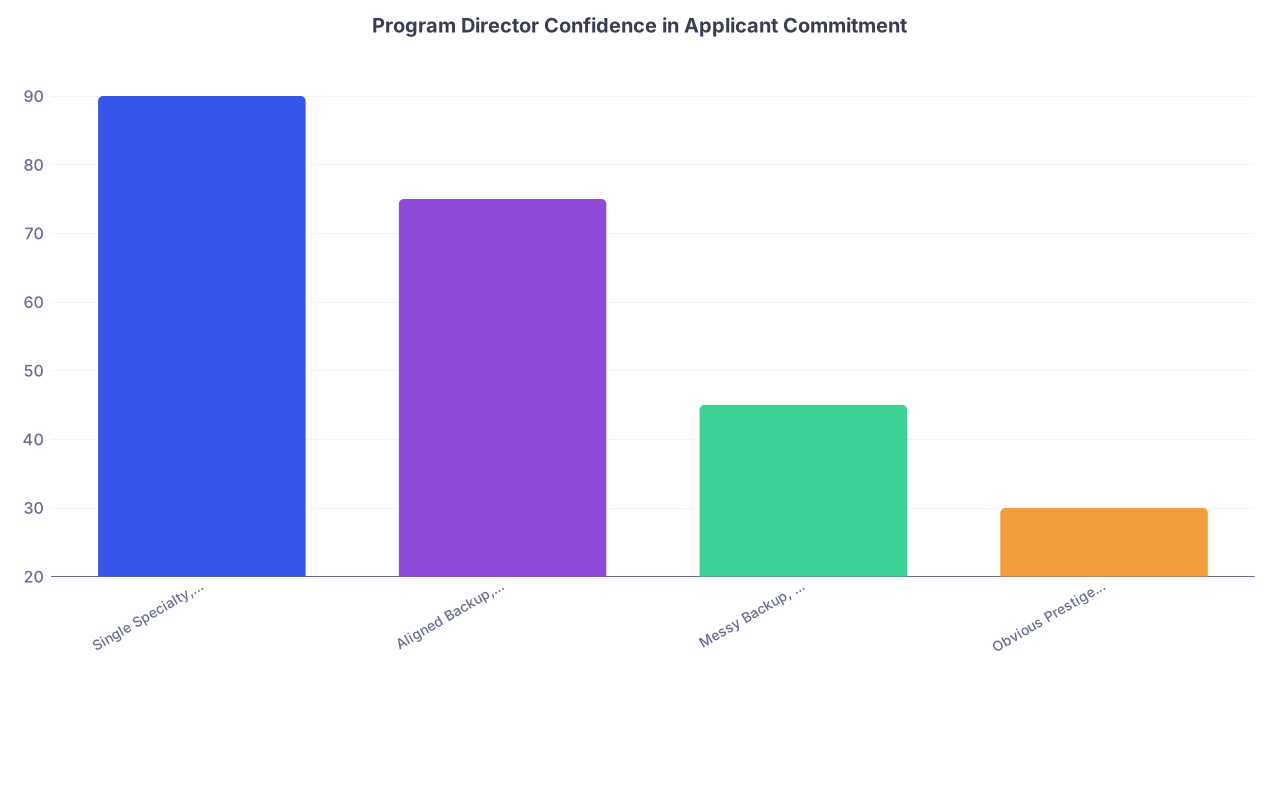
| Category | Value |
|---|---|
| Single Specialty, Clear Story | 90 |
| Aligned Backup, Honest | 75 |
| Messy Backup, Late Pivot | 45 |
| Obvious Prestige Chasing | 30 |
Those numbers aren’t from a paper. They’re from years of watching how PDs talk.
- The first group gets ranked aggressively.
- The second group gets ranked solidly, sometimes just a shade lower.
- The third group gets ranked with hesitation and usually lower than their raw scores would suggest.
- The last group? They still match. But not at the places that had other options.
You can’t always control which bucket PDs put you in. But you have far more influence than you think through your timing, your honesty, and your narrative coherence.
The Bottom Line
On rank day, PDs don’t see your whole rank list. But they absolutely infer — and quietly judge — your backup specialty choices.
Three things to carry out of this:
Coherence beats performance. Your primary and backup specialties should make sense together based on your rotations, letters, and personality. If you have to pretend to be two different people to sell them, you picked the wrong backup.
Being a backup is fine. Being a rebound is not. PDs are okay ranking someone who clearly considered other fields. They’re wary of someone who sees their specialty as a consolation prize or temporary stop.
Your backup specialty is part of your narrative, whether you like it or not. Treat it that way. Build real experience, get real letters, and speak about it with the respect you’d want if the roles were reversed.
If you do that, the conversation in that closed conference room when your name comes up is short and boring. And boring, on rank day, is exactly what you want.