
The copy‑paste backup personal statement is residency suicide dressed up as “being efficient.”
You think you are saving time. Programs think you are confused, unserious, or worse—dishonest. And they are usually right.
Let me be blunt: programs can smell a generic backup personal statement from three sentences away. When you recycle your primary specialty essay and “swap out a few words” for your backup, you are not fooling anyone. You are just quietly killing your chances in both specialties.
This is the mistake I see every application season. Smart students. Strong scores. Solid letters. Then I open their “backup” PS and think: “Did they really just Ctrl+F ‘internal medicine’ → ‘PM&R’ and hit submit?”
Do not be that applicant.
The Core Problem: Programs Know When They Are Your Backup
Programs do not need you to say, “This is my backup specialty.” Your writing does it for you.
Here is how copy‑pasted backup statements usually betray you:
- They sound 80% like the primary specialty
- They describe cases, skills, and goals that do not match the backup field
- They use the wrong language, wrong values, wrong future plans
- They feel…lazy
And programs have developed a very sensitive “backup radar.” They may not articulate it, but they feel it:
- “This reads like a generic ‘I like teamwork and continuity of care’ essay.”
- “All their stories are surgical, but they are applying to psychiatry here?”
- “They say they want to be in the OR full‑time… in our outpatient‑heavy program?”
Once that radar pings, three bad conclusions follow fast:
- You are not genuinely interested in their specialty
- You do not understand what the field actually does
- You are using their program as insurance, nothing more
And backup applicants who look like flight risks are the first to be filtered out.
How Copy‑Paste Kills You in Both Specialties
This is the part applicants underestimate. They think: “Worst case, my primary PS is great, and the backup one is just okay.”
Wrong. A sloppy backup strategy can damage both.
1. Your backup PS exposes your real priorities
Faculty talk. Across specialties. Across programs in the same hospital.
I have sat in meetings where someone said, “We interviewed her for anesthesia. Her IM personal statement sounded completely different—she told us this was her dream since M1. Something is off.”
Once you send out:
- One essay saying lifelong dream = Surgical subspecialty
- Another essay saying lifelong dream = Psychiatry
- Another saying lifelong dream = PM&R
You have created a credibility problem, not a passion problem. Programs do not care that your interests evolved. They care when your story feels manufactured.
2. Your narratives do not match the field
Here is what a bad copy‑paste looks like in practice:
- Primary: General Surgery
- Stories: trauma laparotomy, surgical ICU, scrubbed in for Whipple
- Themes: operating, decisive action, technical skill, acute care
- Backup: Internal Medicine (copied PS)
- Same stories, same themes, you just replaced “surgeon” with “internist”
Any internist reading that will think, “This person wants to be in the OR. Why are they here?”
Reverse it:
- Primary: Psychiatry
- Stories: longitudinal work with SMI, motivational interviewing, psychotherapy
- Backup: Emergency Medicine (copied PS)
- Still heavy on talk therapy, introspection, long‑term relationships
The EM reader thinks, “They are not built for our tempo, acuity, or chaos.”
Not only do you look like a poor fit for the backup. You also unintentionally reveal that you never took the time to understand what they actually do.
3. You torpedo your “coherent story”
Admissions committees love a coherent narrative:
- “This person’s experiences, skills, and goals all align with our specialty.”
- “Their letters, PS, and CV tell the same story.”
Copy‑paste ruins that.
Suddenly:
- Your CV shows mostly surgical rotations + research
- Your primary PS screams surgery
- Your backup PS is a surgery statement with the word “medicine” forced in
Everything becomes disjointed and confused. Instead of looking like a thoughtful applicant balancing two related interests, you look like someone thrashing around trying not to go unmatched.
The Most Common Copy‑Paste Disasters (And Why They Are So Obvious)
Let me walk you through the patterns I see repeatedly. If you recognize yourself in any of these, you need to stop and fix it now.
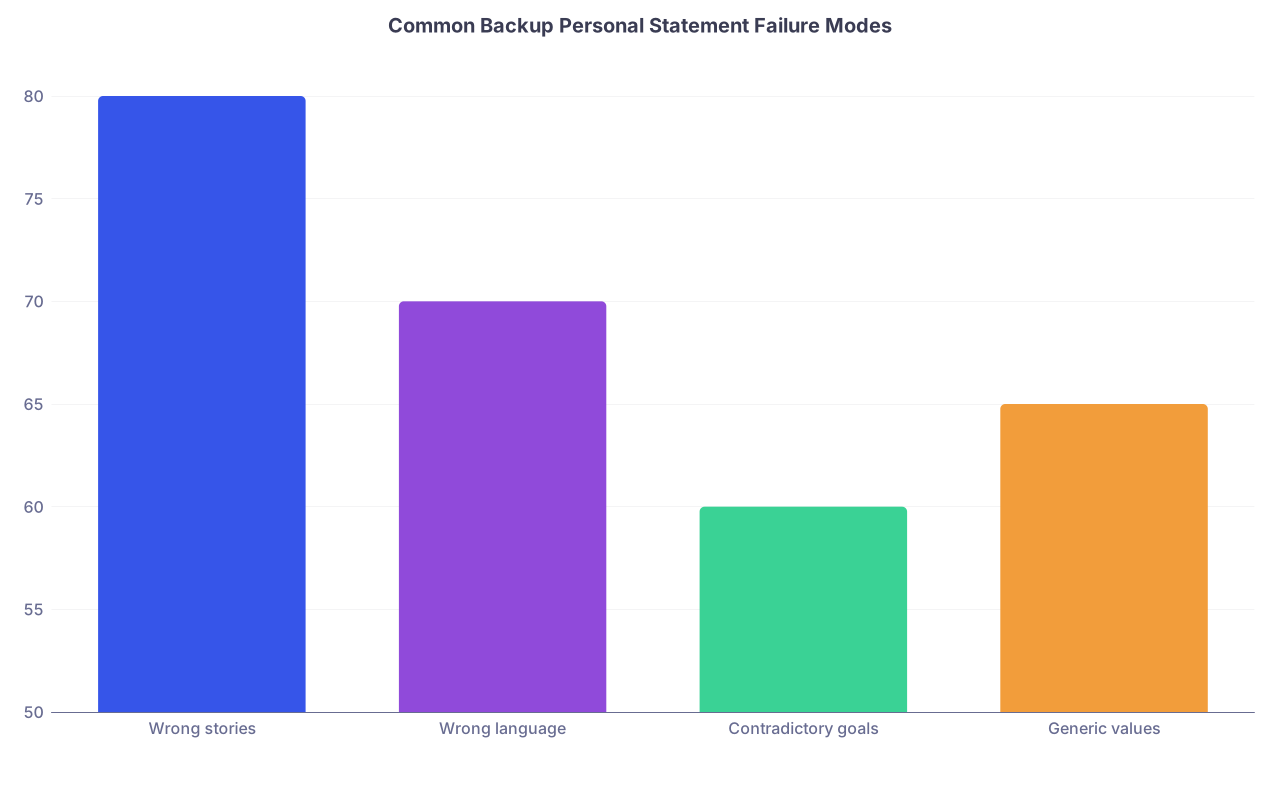
| Category | Value |
|---|---|
| Wrong stories | 80 |
| Wrong language | 70 |
| Contradictory goals | 60 |
| Generic values | 65 |
Disaster #1: Same stories, wrong specialty
You use:
- The same main clinical anecdote
- The same mentor name
- The same “pivotal moment”
- The same skills emphasized
Examples:
- Using your neurosurgery tumor resection story for neurology
- Using your peds ED intubation story for family medicine
- Using your OB operative delivery story for psychiatry
Programs read hundreds of essays. They know what “belongs” to their specialty. When your stories lean obviously surgical, procedural, or inpatient‑heavy, and the field is outpatient, cognitive, or chronic‑care focused, the mismatch is glaring.
Disaster #2: Specialty‑specific language misused
Every specialty has its own jargon and philosophy. Copy‑paste PS writers:
- Keep talking about “clinic panel continuity” in EM applications
- Keep talking about “procedural mastery in the OR” in psych applications
- Keep talking about “team leadership in codes” in pathology applications
It does not just sound wrong. It screams, “I wrote this for someone else.”
Disaster #3: Contradictory long‑term goals
Another recurring pattern:
- Primary PS: “I cannot imagine a career without being in the operating room several days a week.”
- Backup PS: “I am drawn to outpatient continuity and long‑term relationships in clinic.”
Same applicant. Same cycle. Two completely different “I cannot imagine my career without X” lines.
When a faculty member reads one and later hears about the other, they do not think, “Look at this wonderfully flexible candidate.” They think, “What is true here, if anything?”
Disaster #4: Copy‑pasted “why this specialty” paragraph
The worst offender: the “just swap the names” paragraph.
It looks like this:
“I am drawn to [SPECIALTY] because of its combination of patient‑centered care, teamwork, and opportunities in both inpatient and outpatient settings. The breadth of pathology and the chance to build long‑term relationships make [SPECIALTY] the perfect field for me.”
You can put almost any specialty in that bracket. Which makes it useless. And obvious.
Faculty see this generic filler constantly. When they hit that paragraph, they mentally lower your interest level by two points.
Why Programs Care So Much: Risk, Retention, and Reputation
You might be thinking: “If I am competent and will show up, why do they care if they are my backup?”
Because from their side, taking a backup‑only applicant is expensive.

Programs are terrified of early attrition
When residents leave a program or switch specialties:
- Call schedules explode
- Remaining residents burn out harder
- The program’s reputation takes a hit
- The PD spends months replacing them (if they can)
Who is more likely to leave?
- The applicant who wrote a thoughtful, specific PS clearly invested in the field
- Or the applicant who mailed in a recycled generic backup essay?
They know the answer. They will protect their program and their current residents every time.
Faculty want trainees who want their job
Attendings in a field want to see:
- Reflections that show you understand the hardships of their specialty
- Enthusiasm for both the fun and the grind of their daily work
- Long‑term goals that plausibly end up looking like some version of their career
Copy‑paste backup essays usually show none of that.
They show someone trying to keep doors open without making real choices. That is not reassuring to a selection committee planning a three‑year investment in you.
When Backups Make Sense (And How to Do It Without Lying)
I am not saying “never apply to a backup specialty.” That is unrealistic and, for some applicants, dangerous.
I am saying: there is a right and wrong way to do it.
| Approach | Outcome |
|---|---|
| Copy-paste PS with word swaps | High rejection risk |
| Vague, generic shared essay | Seen as low interest |
| Honest, thoughtful dual-interest narrative | Credible, safer |
| Late panic addition with no new PS | Almost always backfires |
The only defensible backup strategy
A backup specialty application is defensible when:
- There is a real, explainable connection between the two fields
- You have authentic exposure to both (rotations, electives, mentors)
- You can articulate different but coherent reasons for each choice
- Your stories, mentors, and letters are not all from only one specialty
The personal statement must reflect that:
- It is specific to that specialty
- It uses that specialty’s language, cases, and challenges
- It has a believable “why this field” section that does not contradict your other PS
- It is honest about your interests without declaring them a backup
That last part is tricky but doable.
How to Write a Backup Personal Statement Without Hanging Yourself
Here is the part you actually need: how to avoid the copy‑paste trap and still meet deadlines.

| Step | Description |
|---|---|
| Step 1 | Decide on backup specialty |
| Step 2 | Confirm real interest and exposure |
| Step 3 | List specialty specific experiences |
| Step 4 | Draft unique Why this specialty |
| Step 5 | Check for contradictions with primary PS |
| Step 6 | Review with mentor in that field |
| Step 7 | Finalize and upload to ERAS |
Step 1: Admit that backup = separate essay
Non‑negotiable rule:
- If you are applying to two specialties, you need two distinct personal statements
- That means separate documents, separate central stories, separate “why this field” sections
Do not anchor on your primary PS and try to “adapt.” Start from scratch for the backup:
- New opening anecdote (or at least a different angle)
- Different patients or moments that illustrate the backup field
- Different mentors, if you have them
You can share a bit of origin story (“I have long valued X in medicine”), but the core specialty reasoning must be unique.
Step 2: Build a specialty‑specific experience list
Before writing, force yourself to outline:
- 3–5 concrete experiences in the backup specialty:
- Rotations
- Electives
- Sub‑Is
- Longitudinal clinics
- Research projects
- Mentorship relationships
If your list is empty or embarrassingly thin, that is the real problem—not the essay. Fix that before you apply widely.
Step 3: Define a believable “why this specialty” that does not contradict the primary
You cannot say “lifelong dream” for both. Stop trying.
Instead, for your backup PS:
- Acknowledge honestly but subtly that your interests are broad:
- “During my core clerkships, I found myself drawn to both the diagnostic complexity and the continuity of care in internal medicine.”
- Emphasize the genuine aspects of the backup that fit you:
- Your personality
- Your skills
- Your values
You do not need to mention the other specialty at all. You just need to avoid writing something that clearly negates what you told them.
Step 4: Scrub out all traces of the primary specialty
After you draft, go hunting for:
- Primary specialty jargon
- OR obsession in a non‑surgical field
- Clinic obsession in a shift‑based field
- Research niche that only exists in the other specialty
If you find:
- “Ever since my first day in the OR…” in a psych PS
- “The thrill of rapid procedures and immediate results…” in IM
- “Longitudinal therapeutic alliance over years…” in EM
Delete and replace with what the backup field actually does.
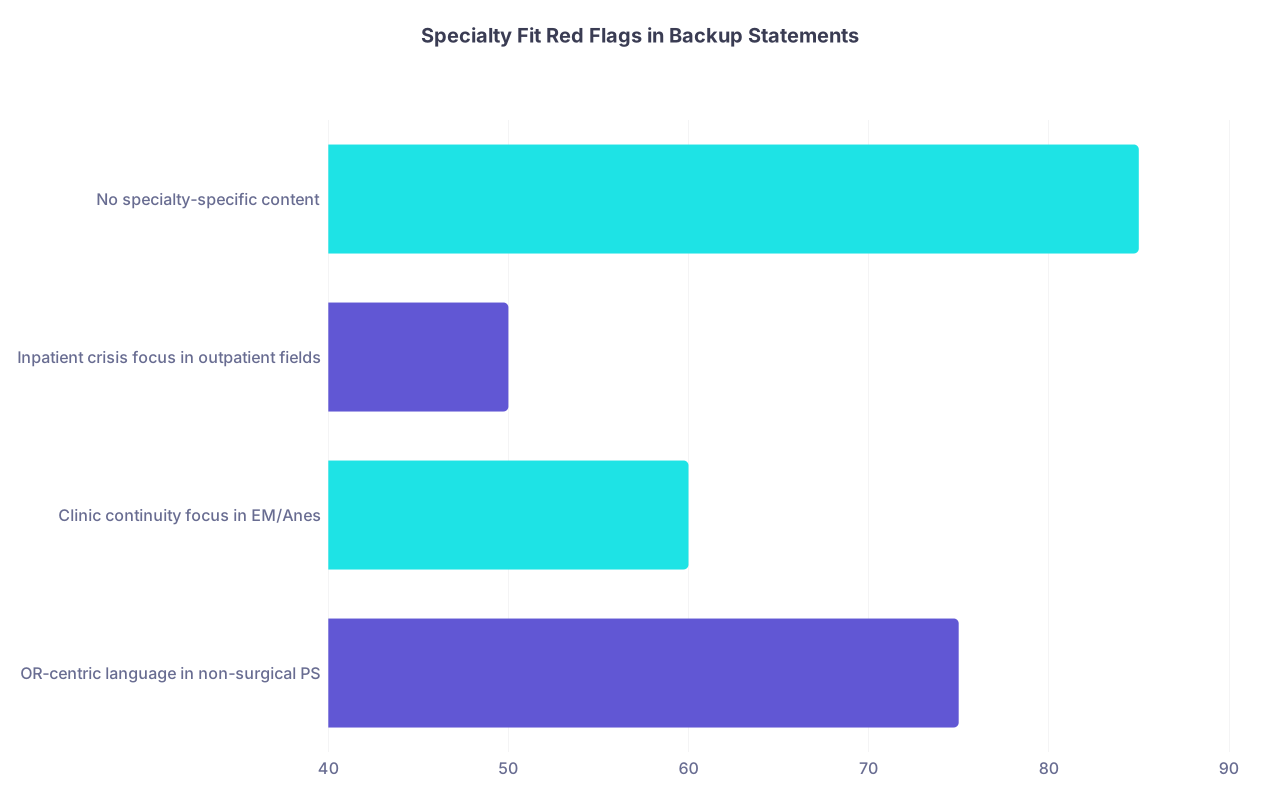
| Category | Value |
|---|---|
| OR-centric language in non-surgical PS | 75 |
| Clinic continuity focus in EM/Anes | 60 |
| Inpatient crisis focus in outpatient fields | 50 |
| No specialty-specific content | 85 |
Step 5: Have someone from that field read it
Do not trust your own specialty bias. If you are a surgery‑minded person writing an IM backup PS, you will instinctively lean procedural and acute unless someone stops you.
Find:
- A resident or attending in the backup specialty
- Ask one specific question:
- “Does this read like it was actually written for your field, or does it sound like a repurposed essay?”
Listen carefully. If they hesitate, you have work to do.
The Quiet Red Flag: “Too Many” Specialties on One ERAS
Here is another mistake entwined with the copy‑paste trap: the multi‑specialty shotgun.
Some applicants panic and apply to three or more unrelated specialties with minor PS edits for each. On paper, it looks like a hedge. In reality, it looks like you do not know who you are.
Patterns that scare programs:
- EM + Pathology + Psychiatry with very thin, similar essays
- Neurosurgery + Dermatology + PM&R with no coherent bridge
- IM + Radiology + Anesthesia with the same generic “I like procedures and complex patients”
Two adjacent specialties can be explained. Three wildly different ones, all with similar personal statements? That screams risk.
If you are going to apply to multiple fields:
- Cap it at two specialties for most people
- Only add a third if there is a clear, truthful, explainable connection (and separate, high‑quality essays)
- Do not let copy‑paste be the only way you are holding the whole mess together
The Hidden Psychological Trap: Backup as Emotional Crutch
One last danger: the backup PS becomes a security blanket.
I have watched students:
- Spend 70% of their writing time tinkering with backup essays
- Rationalize weak performance or limited networking in the primary field with “It is okay, I have my backup”
- End up with two mediocre applications instead of one strong and one acceptable
You are not required to have a backup specialty. For some highly competitive fields, it is wise. But the goal is not to feel less anxious. The goal is to match. Those are not the same thing.
Sometimes the strongest move is:
- Go all‑in on one well‑chosen field
- Make that single personal statement excellent and focused
- Use your energy to strengthen that application instead of half‑baking two
Actionable Checklist: Are You About to Submit a Copy‑Paste Disaster?
Before you upload anything to ERAS, run your backup PS through this brutal filter. If you answer “yes” to any of these, you need to revise.
- Same opening story as your primary PS
- Same mentor quoted or highlighted in both statements
- Same “lifelong dream” or “I cannot imagine doing anything else” line in both
- Primary‑specialty‑specific jargon appears in the backup essay
- You could swap the specialty name in the first paragraph and it would still make sense
- You have zero unique patient stories from the backup field
- Your long‑term career goals section would make more sense in your primary specialty
- A resident in the backup field has not read and approved it as “for us”
If any of those are true, stop. You are about to send programs a bright red “backup only” signal.
FAQ (Exactly 3 Questions)
1. Is it ever okay to use the same story in both personal statements?
Yes, but only if you use it differently and it truly connects to both fields. For example, a patient with both complex medical and psychiatric issues could reasonably inform interest in IM and psych, if you highlight different aspects in each essay. The danger is not the shared event; it is the identical interpretation and copy‑pasted wording. If you cannot rewrite it from a genuinely new angle, pick a different story for one of the specialties.
2. Should I explicitly mention that I am applying to another specialty in my backup PS?
Usually no. Dropping “I am also applying to X” into the essay rarely helps you. It draws attention to divided interests without adding value. What matters more is that your explanation for choosing this specialty is coherent, honest, and not directly contradicted by your other statement. If someone asks in an interview, you answer directly. The personal statement is not the place to pre‑emptively defend your rank list strategy.
3. What if I decided on my backup late and have limited experiences in it—do I still write a full separate PS?
If you do not have enough real experiences to fill a genuine specialty‑specific essay, that is your warning sign that you probably should not be applying widely to that field this cycle. Forced, shallow backup applications with thin exposure and recycled statements almost always underperform. If you must proceed, then yes, you still need a separate PS—but you should be brutally realistic about your chances and seriously consider focusing your energy on strengthening your primary specialty or planning a stronger reapplication year.
Open your ERAS document list right now and look at your backup personal statement. If you can recognize your primary essay underneath a few word swaps, delete it and start a real, specialty‑specific draft today.