
It’s late August. You have one shot at the Match, and you’re staring at your ERAS draft thinking:
“Do I admit I’m also applying to prelim medicine? To anesthesia? To family? Is that going to tank me with my primary field?”
You’ve probably heard both extremes:
“Never show a backup, it makes you look weak.”
and
“You absolutely need a backup, the Match is brutal.”
Both are half-truths. And the real game is more subtle.
Let me tell you what actually happens in program director meetings, rank-list sessions, and back-channel emails when you declare (or hide) a backup specialty.
Because sometimes declaring a backup can help you in your primary field. But only in very specific scenarios—and if you do it with precision.
The quiet reality: PDs already assume you have a backup
Here’s the first secret: almost every program director assumes you’re hedging your bets.
You’re applying to ortho? They assume you also flirted with prelim surgery or TY.
Derm? They assume you have internal med or transitional years on the side.
EM these days? They assume you’ve at least thought about FM or IM.
So the question in their heads is not “Does this student have a backup?” It’s:
“Is this person actually committed to us, or are we the backup?”
And that’s where declaring a backup—strategically—can flip from liability to asset.
The trick is understanding which specialties, which programs, and which stories make you look:
- realistic, not desperate
- committed, not scattered
- coachable, not delusional
Let’s break down the specific situations where openly having a backup can help your chances in your primary field.
Scenario 1: Hyper-competitive specialties and the “rational adult” signal
This mostly applies to things like:
- Dermatology
- Plastic surgery
- Ortho
- ENT
- Neurosurgery
- Integrated vascular, CT, etc.
These PDs see delusion all the time. Step 1 pass, mediocre Step 2, no meaningful research, and the applicant’s personal statement reads like they’re the second coming of Mayo.
Behind closed doors, what they say is:
“This kid has no idea how competitive this is. No backup, nothing. Are we going to be responsible for them going unmatched?”
Now picture a different applicant. Still a reach. Not an automatic lock. But the dean’s letter and personal statement make clear:
- They’re applying primarily to plastics
- They have a parallel IR or general surgery or prelim surgery plan
- Their advisors know the numbers and are backing a realistic dual strategy
You know what a lot of PDs say about that second applicant?
“At least they’re grounded. They understand the risk. They listened to advice.”
That matters.
It makes it easier for a borderline applicant to get ranked because:
- The PD does not feel morally responsible if they don’t rank you high. They know you likely have an off-ramp.
- You read as someone who can assess risk and plan accordingly—exactly the kind of judgment they need in a surgical field.
- You’re less likely to spiral mentally if things don’t go perfectly. They care about that more than you think.
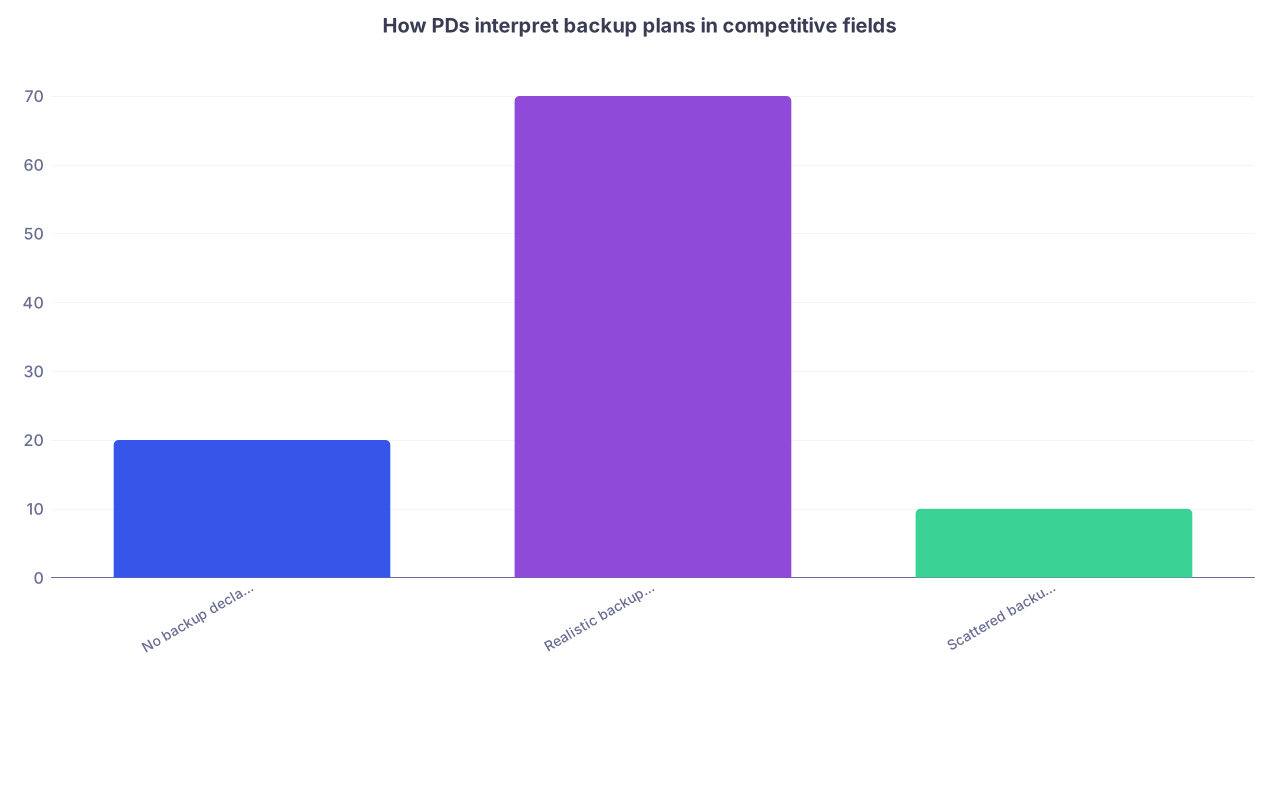
| Category | Value |
|---|---|
| No backup declared | 20 |
| Realistic backup declared | 70 |
| Scattered backups declared | 10 |
Those percentages are not exact data; they’re the rough mental weighting I’ve seen when PDs decide whether to see your backup as a red flag or a green flag.
When this helps you
Declaring a backup helps in highly competitive fields when:
- Your stats are borderline but not hopeless
- Your backup specialty is plausible and aligned (surgery → prelim/TY/gen surg; derm → IM; ENT → surgery or TY)
- Your narrative is: “I’m committed to [primary], but I respect the Match and prepared a rational alternative”
Where do you show this?
- MSPE / Dean’s letter language that references “dual application strategy advised by the school”
- Subtle mentions in your personal statement (one sentence, not a paragraph)
- Conversations on interview day if they bring it up
Done well, that doesn’t weaken you. It marks you as a grown-up.
Scenario 2: Fields with prelim or advanced years — your backup can be leverage
Radiology. Anesthesia. PM&R. Neuro. Some path.
These specialties often require or accept a separate intern year. This creates one of the weirdest quiet dynamics in the Match:
Your “backup” (prelim medicine, prelim surgery, TY) is also part of the same ecosystem as your primary field.
Here’s the piece nobody explains properly:
Being open and smart about your backup intern year can make you more attractive to both sides.
I’ve seen this play out again and again:
- Anesthesia PD calls the IM prelim PD: “We’re ranking this person high; they’ll need a solid prelim year. You’ll like them.”
- Radiology PD emails a TY PD: “Strong applicant, good team player, we’re likely to get them.”
If you’ve been clear, consistent, and sane about your backup year, those calls go smoother. And they happen more often than students realize.
How declaring the right backup helps
In advanced-match fields, PDs worry about:
- Are you going to be competent and not unsafe during intern year?
- Are you likely to crumble if intern year is heavy on floor medicine but you’re techy/radiology-minded?
- Do you have enough buy-in to whatever prelim you’re doing so they don’t get constant attitude of “I’m just here until my real job starts”?
When you’ve structured your application so that:
- Your letters from IM/Surg rotations are strong
- You’ve shown interest in actually learning medicine, not just surviving it
- And you’ve actually told people: “I’m applying anesthesia with a prelim IM backup, and I care about being a good intern”
You move from “question mark” to “safe bet.”
And PDs love safe bets.

Scenario 3: When your primary field is under pressure or in flux
Some specialties go through rough cycles:
Emergency medicine in the last few years. OB-GYN in some regions. Even some IM subspecialties as the job market shifts.
In those fields, PDs are painfully aware that the job market and residency positions are not perfectly aligned. They don’t say this loudly on recruitment day, but in closed meetings it sounds like:
“We need residents who are here for the right reasons. Not people who panicked into this because their dream field was collapsing. And not people who will burn out or bail when they see the reality.”
If you walk in pretending you’ve never considered anything else and you’re obviously not competitive for your dream specialty, you trigger their “this is going to be a problem” sensor.
But if you’re in one of these pressured fields and:
- You’ve got a realistic backup that still fits your narrative (EM ↔ FM or IM with a critical care bent, OB-GYN ↔ FM with women’s health focus)
- You show that you understand the realities but still choose the field
- You can articulate why you’d still practice in your backup field and not be miserable
You look much more stable.
PDs in volatile fields are looking for residents who:
- Won’t quit
- Won’t tank morale
- Won’t become professionalism disasters when the job market or lifestyle bites them
Demonstrating you had a thought-out backup route can actually reassure them that you’ve done the homework and still picked them.
That reads as commitment, not hesitation.
Scenario 4: When your record has a serious flaw, but your judgment doesn’t
Here’s something I’ve heard in more than one rank-list meeting:
“Look, their Step 2 is 214 and they want ortho. I respect that they swung for the fences. But they also applied prelim surgery and IM like we told them to. They’re not reckless.”
That’s the distinction:
Reckless vs. realistic.
If you’ve got warts on your application—failed Step, leave of absence, weak third-year evals—and you still go after a competitive field without a visible backup strategy, the conversation behind the scenes usually goes:
“They learned nothing from medical school. They do not understand risk or feedback. This will not go well.”
If instead your advisor letter, dean’s note, or even your own essay hints at:
- Career counseling you received
- Explicit acknowledgment of competitiveness
- The fact that you’re simultaneously applying to a related, more attainable field
Now the PD sees someone who has been told “this is a stretch” and responded rationally.
No program wants to be the one to crush your dream. If they can tell themselves:
“This person has another viable path they’ve set up; we’re not destroying their life by ranking them lower”
they feel a lot freer to be honest. And sometimes that honesty means:
- Taking a chance on you anyway
- Calling a colleague in your backup field to advocate for you
- Or at least not blackballing you as “unrealistic and unsafe”
When declaring a backup absolutely backfires
Now the other side of the knife.
There are very clear ways to talk about backup specialties that instantly damage you in your primary field. PDs can smell this from a mile away.
The scattered, “I just want a job” pattern
You’re applying:
- EM
- IM categorical
- Anesthesia
- TY
- FM
And your story is… nothing. No coherent thread.
Behind closed doors, the phrase I’ve heard more than once is:
“They just want to be a doctor. Any doctor. I don’t want that.”
Harsh, but real.
What they mean is: if you haven’t done the work to figure out your core interests, your learning style, your long-term practice picture, you’re a risk. Residents like that bounce between specialties, burn out, and blow up team dynamics.
The “This is my backup” slip
If, on interview day, you say anything close to:
- “Yeah, [this specialty] is kind of my backup if [primary] doesn’t work out”
- “Honestly I’m really more into [primary field], but I could see myself being okay here too”
You’re done.
Nobody wants to be your consolation prize. They’ll rank someone slightly less “impressive” on paper who actually wants to be there.
The trick is this: you can have a backup. You can even allude to it. But you never frame the program or specialty in front of you as “backup.” You frame it as “another field I’d be happy in, for specific reasons.”
If you cannot say that with a straight face, don’t apply there. PDs can read the lie.
How to structure a backup that helps instead of hurts
You need three things: coherence, honesty, and consistent messaging.
1. Coherence: your specialties need a believable through-line
The best pairings sound like this:
- “I’m applying orthopedic surgery and also prelim surgery. I like procedural work, team-based OR environments, and longitudinal MSK care.”
- “I’m applying dermatology and internal medicine. I’m drawn to complex medical disease, chronic disease management, and longitudinal outpatient relationships.”
- “I’m applying EM and FM. I like undifferentiated complaints, acute care, and community-based medicine.”
Your narrative focuses on shared aspects, not opposites.
| Primary Specialty | Backup That Often Helps | Why It Sounds Rational |
|---|---|---|
| Derm | Internal Medicine | Chronic disease, complex medical management |
| Ortho | Prelim/Gen Surgery | OR-based, procedural, team care |
| Rad/Anesthesia | Prelim IM or TY | Requires solid intern foundation |
| EM | FM or IM | Acute care, broad differential, systems work |
| ENT/Plastics | Prelim/Gen Surgery | Overlapping operative skill set |
If you’re pairing two fields no one in their right mind would group together, you better have a convincing personal argument. Otherwise you just look unfocused.
2. Honesty: calibrated, not confessional
You do not walk into an interview saying, “I’m really afraid I won’t match, so I’m applying to [backup].”
You say something more like:
“I’m primarily drawn to [primary] because of X, Y, and Z. Given the competitiveness and advice from my mentors, I’m also applying to [backup] which fits me for A, B, and C reasons. I’d be happy in either—just with different day-to-day lives.”
That signals:
- You know the numbers
- You respected your mentors
- You’re not here to game them; you’re being a rational adult
You’d be surprised how many PDs find that refreshing.
3. Consistent messaging: your documents should not contradict each other
Primary field personal statement: “I’ve wanted to be a neurosurgeon since I was six. There’s nothing else I can imagine doing.”
Backup PS: “I’m passionate about primary care and longitudinal relationships.”
Then the same PD sits on two different committees (yes, it happens), sees both statements, and you just got branded as “performance, not authenticity.”
If you’re going to do a backup that you actually want to keep hidden from the other side, at least don’t be theatrical or absolute in your primary PS. Keep language like:
- “I’m particularly drawn to…”
- “I see myself long-term in…”
- “I’m most excited by…”
Not: “I cannot possibly do anything else.”
Because the second you write that, you’ve left yourself no honest room for a backup.
Where and how to “declare” a backup without shooting yourself
There are a few safe containers for showing that you have a backup specialty without poisoning the well.
Advising and MSPE/Dean’s Letter
Some schools explicitly mention that a student pursued a dual-application strategy based on faculty advice. When it’s framed as “advisable, thoughtful, data-informed,” PDs respond well.Letters from overlapping fields
An IM letter that says: “While [Name] is applying primarily to radiology, they approached this rotation with full engagement because they understand how crucial a strong intern year is” — that’s gold.Interview conversations, if they ask directly
Some PDs will bluntly ask: “Are you applying to other specialties?”
Lying is risky. Getting defensive is worse.
The best answer is calm, brief, and integrated with your narrative:
“Yes, I’m also applying to [field] because it shares [X] with [primary], and my mentors felt it was a reasonable parallel path. I’d be very happy here, which is why I’m interviewing.”
Notice the structure: brief acknowledgment, clear rationale, explicit statement of genuine interest.
What you do not do: volunteer your backup in the first 60 seconds, or apologize for it like you’re guilty.
A quick reality check: when you should not declare a backup
There are times when declaring or even hinting at a backup specialty does nothing for you and can hurt:
- You’re a very strong candidate in your primary field with no obvious red flags
- The field isn’t hyper-competitive for your stats
- Your advisor, who actually knows the PDs you’re applying to, tells you not to muddy the waters
In those cases, sure, you quietly submit a couple IM applications as personal insurance if you want. But you don’t go around building a “dual” narrative you don’t need.
Over-declaring your backup when you’re actually solid in your primary just makes people wonder what you’re so anxious about.
FAQs
1. Should I ever write about my backup specialty in my primary personal statement?
Rarely, and only briefly. One line acknowledging that you’ve considered other paths is fine if it supports your maturity narrative, e.g., “After exploring internal medicine and recognizing its overlap with my interests, I found myself consistently drawn back to the operative, team-based environment of general surgery.” Anything longer starts to dilute your signal.
2. What if my advisor tells me not to reveal my backup, but my gut says I should?
Listen carefully to why they’re saying that. If you’re a strong candidate and they know the local PD culture, they might be right. If their advice is generic and you’re borderline for an ultra-competitive field, a carefully framed, advisor-endorsed backup strategy usually does more good than harm. Push them for specifics: “How will Program X read this if they see I also applied to Y?”
3. Will PDs actually see that I applied to another specialty?
Not directly through ERAS lists. But they often infer it through shared letter writers, dean’s letters, word of mouth, and your rotation pattern. In smaller specialties, they absolutely talk. “Are you seeing this applicant too?” happens all the time. Assume cross-visibility, especially at places that share faculty across departments.
4. Is a TY year a ‘safer’ backup than a full categorical IM or FM application?
It’s different, not safer. TY or prelim years are good backups when your primary is an advanced specialty and you’re confident you’ll reapply or SOAP into something later. Categorical IM/FM as a backup is more of a “this is a permanent career I can live with” move. PDs can tell which one you’re really aiming for, so do not pretend a TY is your dream if it obviously isn’t.
5. What if I matched my backup and still want my primary down the line?
Then your behavior in that backup field matters more than ever. Crush your intern year, be transparent but respectful with your PD about long-term interests, and do not treat the program as a temporary inconvenience. The residents who successfully reapply to their “original” dream specialty are the ones whose backup PD will go to bat for them, not the ones who sulked their way through the year.
Key takeaways:
First, PDs already assume you have a backup; what they care about is whether your plan looks rational or chaotic. Second, in competitive or advanced-match fields, a well-structured backup can make you safer and more appealing, not weaker. Third, your story has to be coherent—two (or more) specialties connected by a believable thread, expressed consistently, without ever labeling any of them as “just my backup” to their face.