
The way most students pick “backup specialties” is backward and dangerous.
You think you are adding safety. In reality, you are quietly destroying interview chances and wasting rank list spots you will wish you had back.
Let me walk you through the common traps I see every single match cycle – and how to avoid blowing your shot at both your dream specialty and your backups.
The Core Delusion: “I’ll Just Add a Backup Specialty Later”
The first and biggest mistake: treating backup specialties as a last‑minute patch rather than a strategic plan.
Here is how this usually looks in real life:
- MS3: “I’m 100% ortho. No need for a backup.”
- Late MS4: Step 2 lower than expected, no home ortho program, a handful of interviews, panic.
- October: “Maybe I’ll add FM and IM as backups. I’ll just write a couple more personal statements and be fine.”
You are not fine. You are late and under‑prepared. Programs can smell it.
The ugly reality:
- Backup specialties are not a sticker you slap on your ERAS in October.
- They require:
- Thoughtful letters
- Targeted rotations
- A coherent narrative
- Specialty‑appropriate experiences
- If you do not plan for that by early MS4, the “backup” often becomes a time‑sink that produces few if any genuine options.
You must decide early if you are dual‑applying and which combination actually makes sense for your profile. Waiting until after you have already realized your primary specialty is in trouble is how you waste both interview invitations and rank positions.
Mistake #1: Picking a Backup With Zero Narrative Alignment
The worst backup choice is not “too competitive.” It is “completely incoherent with your story.”
Example I see constantly:
- Primary: Dermatology with tons of bench research, no longitudinal primary care, no inpatient heavy rotations beyond the minimum.
- Backup: Categorical Internal Medicine at academic programs.
- Personal statement #1: “I am passionate about chronic inflammatory skin disease and translational research.”
- Personal statement #2 (rushed): “I have always loved whole‑patient care and managing complex hospital cases.”
Programs read both. Faculty talk. Your letters cross‑pollinate. And suddenly nobody believes either story.
You look like what you are: a desperate applicant who just sprayed applications at whatever was left.
If your Step 2 is 215 and you are applying ortho with a backup in neurosurgery “because you love the OR,” you are not adding safety. You are just doubling your rejection rate.
Good backup combinations share at least one of the following:
- A believable common thread (e.g., surgery + anesthesia + EM = acute care; psych + neurology = brain/behavior).
- Shared experiences you already have (e.g., strong primary care clinic experience → FM, IM, peds).
- Letters that can reasonably serve both without sounding absurd.
Terrible pairings are the ones that force you to pretend you “always loved X” when nothing in your file supports that claim.
If you cannot explain your combination in two clear, non‑cringy sentences, it is probably a bad pairing.
Mistake #2: Underestimating How Much Backup Applications Dilute Your Primary
Dual‑applying is not free. The hidden cost is divided time, attention, and credibility.
Here is what usually gets sacrificed when students add a second specialty late:
- A polished, specialty‑specific personal statement
- Tailored experiences and descriptions that highlight the right skills
- Thoughtful, personalized program signals or geographic targeting
- Time for Step 2 CK study and score improvement
- Interview prep for your actual top choice
Instead, you cram:
- Second (or third) personal statement
- Extra programs to research
- Additional letters to chase
- More interview dates to juggle
- Extra logistics and travel or online scheduling mess
The result is rarely, “Strong in both.” It is usually:
“Average, unfocused, slightly desperate in two.”
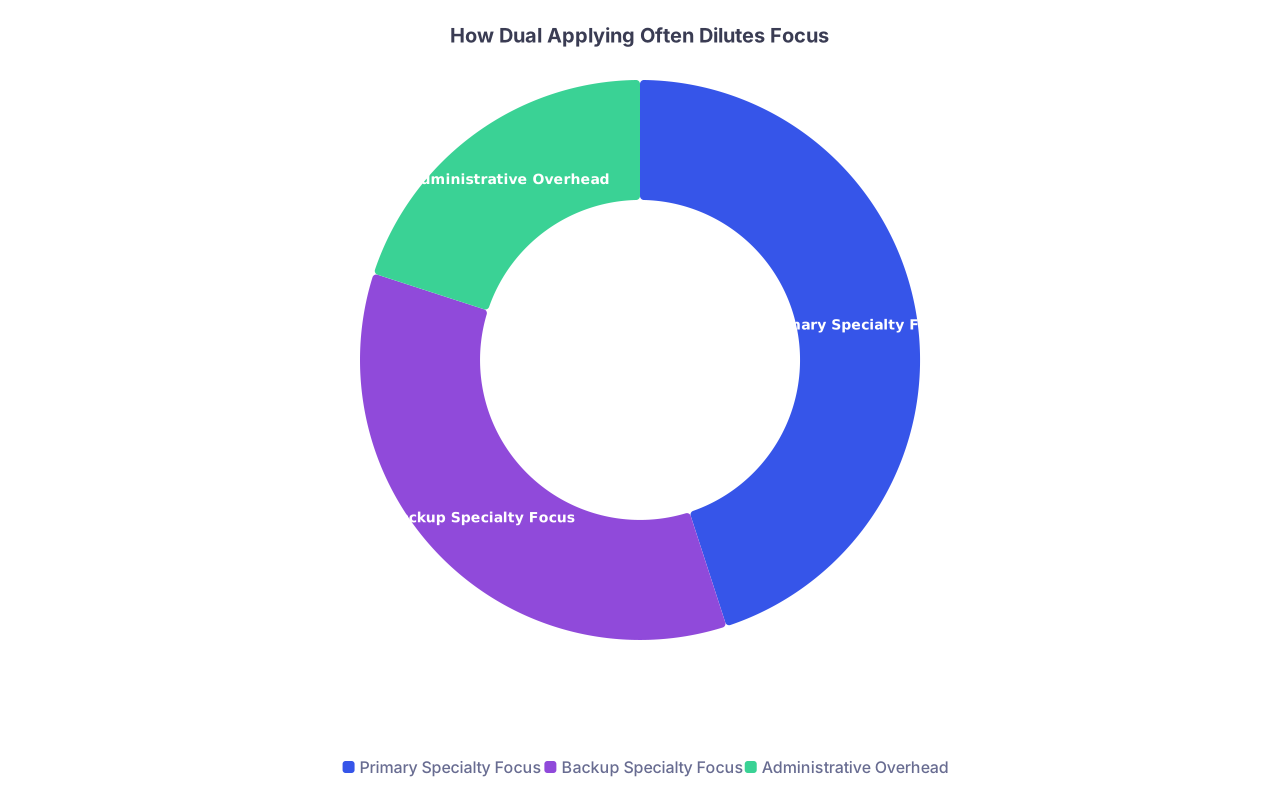
| Category | Value |
|---|---|
| Primary Specialty Focus | 45 |
| Backup Specialty Focus | 35 |
| Administrative Overhead | 20 |
If your primary specialty is already a reach, you cannot afford to show up halfway. Spreading yourself thin to chase an incoherent backup can drop you below the line in both pools.
Dual‑apply if you must. But do it with a hard rule:
If saying “yes” to a backup step clearly worsens your primary application, you either picked the wrong backup, or you waited too long.
Mistake #3: Treating “Less Competitive” as Automatically “Safe”
Another common fantasy: “I’ll just pick a less competitive specialty, so I’m guaranteed a spot.”
No. You are not.
Programs do not accept “anyone above a certain score.” They look for:
- Genuine interest in the specialty
- Evidence that you understand the day‑to‑day work
- Clinical performance that matches their priorities
- Letters from people they trust in that field
You might think Family Medicine or Psychiatry are “backup specialties.” The programs do not. They see plenty of highly qualified applicants who actually want those fields.
If you show up with:
- A vague personal statement
- Generic experiences
- No meaningful sub‑I or elective in that specialty
- A resume that screams “I’m here because I failed at something else”
you will get filtered out, even in a so‑called “less competitive” field.
Here is another trap: assuming the competitiveness for U.S. seniors is what you face when you have red flags.
If you have:
- Step failure
- Big leave of absence
- Very low scores
- No home program
- Poor clinical comments
you are not in the same bucket as the “average U.S. senior.” Your competitiveness is specialty‑specific and context‑specific.
| Backup Idea | Wrong Assumption | Reality Check |
|---|---|---|
| EM as backup for Surgery | “Both acute care, EM is easier” | EM is very competitive in many regions |
| Psych as backup for Derm | “Psych takes everyone” | Psych now screens hard for real interest |
| Anesthesia as backup for Ortho | “Still OR, easier match” | Anesthesia tightened dramatically recently |
| IM as universal backup | “IM always has room” | Strong IM programs reject obvious backups |
| FM as last‑minute catch‑all | “FM will save me” | FM wants real commitment and fit |
You cannot treat any specialty like a garbage bin for failed applicants and expect it to save you.
Mistake #4: Copy‑Pasting Application Materials Between Specialties
Program directors read more personal statements than you read progress notes on a gen med day. They can spot recycled language in two lines.
Scenario I saw last cycle:
- Student applied EM and FM.
- EM PS: “…fast‑paced, resuscitations, team‑based critical care, rapid decision making.”
- FM PS (tweaked in a rush): “Fast‑paced, resuscitations, team‑based chronic disease management…”
That last phrase? It made zero sense. The rest of the file backed EM. The FM programs interviewed them grudgingly. The faculty quietly ranked them low. Why? Because everything screamed, “You do not understand what we actually do.”
You must avoid these lazy errors:
- Reusing “excitement about procedures” in a field that hardly does them.
- Talking about “inpatient pathology” in a largely outpatient specialty.
- Using the wrong vocabulary (“clinic list” vs “panel”; “list” vs “service”; “shift” vs “call”).
- Leaving in specialty names from the other PS. Yes, this happens.
Your backup specialty needs:
- Its own, coherent personal statement
- At least one letter from that specialty (preferably two)
- Descriptions of experiences that use proper language and priorities
- A believable explanation of why that field fits you
Do not assume you can “lightly edit” your primary materials and get away with it.
Mistake #5: Ignoring Geography and Program Type in Backup Planning
Another silent killer: picking a backup specialty without rethinking your geography or institution type.
If you apply to competitive academic IM programs in the same cities you used for your primary derm or ortho list, you have essentially created two competitive lists, not a primary plus backup strategy.
You must adjust:
- Academic vs community
- Big city vs mid‑size vs rural
- University‑based vs community‑based vs hybrid
- Highly desired regions vs more open regions
Here is what smart vs sloppy backup strategy looks like:
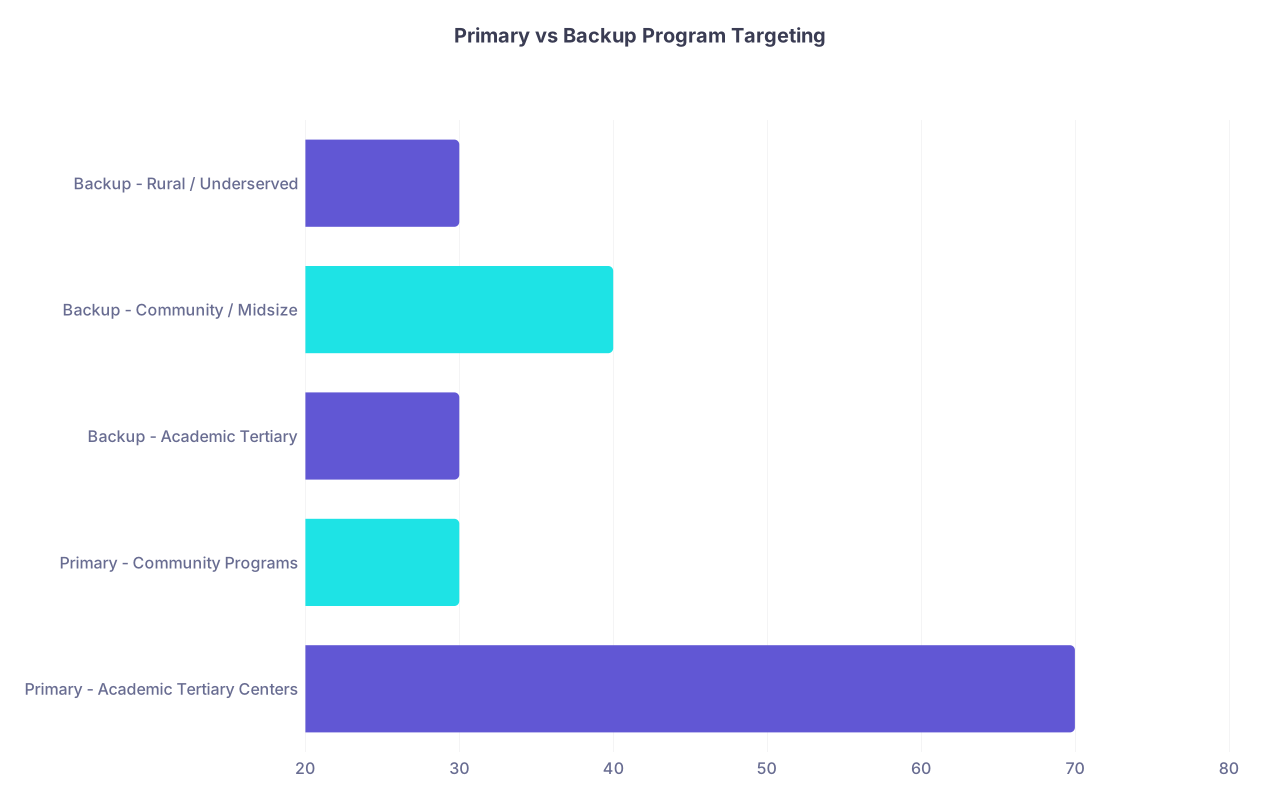
| Category | Value |
|---|---|
| Primary - Academic Tertiary Centers | 70 |
| Primary - Community Programs | 30 |
| Backup - Academic Tertiary | 30 |
| Backup - Community / Midsize | 40 |
| Backup - Rural / Underserved | 30 |
If your “backup IM” list is 90% coastal academic centers in competitive cities, you did not pick a backup. You picked another reach.
You want your backup specialty list to skew more toward:
- Community and hybrid programs
- Less saturated regions
- Programs that historically take more varied applicants
That does not mean low quality. It means less saturated with hyper‑competitive, research‑heavy applicants.
Do not just copy your geography for the second specialty. That destroys most of the safety you thought you were adding.
Mistake #6: Wasting Rank List Spots on Programs You Will Not Actually Attend
This one hurts people every March.
You panic in February. You stuff your rank list with:
- Programs in specialties you do not respect or understand
- Locations you said you would “never” live in
- Programs you walked away from on interview day thinking, “Absolutely not”
Then you match there. And you are shocked that you are miserable.
The mistake is psychological: believing “any match is better than no match.”
That is not always true.
You can absolutely:
- Burn out early
- Fail to complete residency
- Be stuck in a field that does not fit you, with limited exit options
because you ranked programs out of fear instead of intent.
Your rule should be simple:
If you would rather reapply than spend three or four years at this place, in this specialty, do not rank it.
That means you might rank:
- Fewer programs total
- Only one specialty
- Only locations where you can realistically build a life
That is not reckless. That is adult decision‑making.
Mistake #7: Mis‑Timing the Decision to Dual‑Apply
Timing is everything. Many students blow it by making the dual‑apply call at the worst possible moment.
Classic bad timelines:
- Deciding after ERAS submission to add a second specialty.
- Waiting for interview numbers to tank before you consider alternatives.
- Hoping Step 2 will “save everything,” then getting the score late.
Here is a more rational approach:
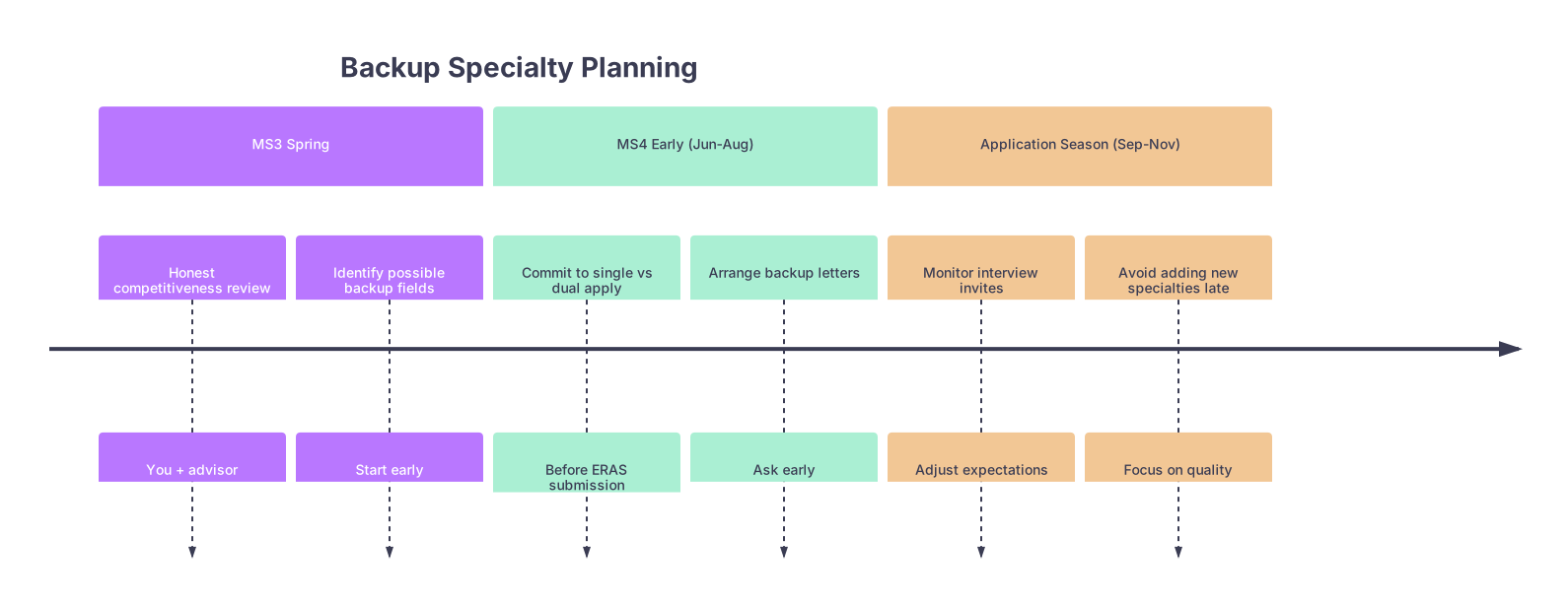
| Period | Event |
|---|---|
| MS3 Spring - Honest competitiveness review | You + advisor |
| MS3 Spring - Identify possible backup fields | Start early |
| MS4 Early (Jun-Aug) - Commit to single vs dual apply | Before ERAS submission |
| MS4 Early (Jun-Aug) - Arrange backup letters | Ask early |
| Application Season (Sep-Nov) - Monitor interview invites | Adjust expectations |
| Application Season (Sep-Nov) - Avoid adding new specialties late | Focus on quality |
If you are in one of these groups, you should seriously consider backup planning before ERAS opens:
- Primary specialty is very competitive (ortho, derm, plastics, ENT, neurosurgery, rad onc).
- You have a Step failure.
- You are at a lower‑tier or newer medical school with poor match history in that specialty.
- You have limited or no home program in your target field.
- Your clinical evaluations are weak or mixed.
- You are geographically rigid (only 1–2 regions for family reasons).
The dumb move is waiting until October to accept that reality. By then, it is mostly too late to do a backup well.
Mistake #8: Choosing a Backup That Demands a Different Applicant Identity
Some specialties require fundamentally different strengths and values. Trying to be both at once can make you look inauthentic in both.
Obvious example:
- Primary: Neurosurgery – you sell yourself as the intense, procedure‑obsessed, research‑heavy, long‑hours person.
- Backup: Psychiatry – suddenly you are talking personal narratives, therapeutic alliances, deep listening, and no comment on procedures.
Do those identities ever overlap? Sure. But ERAS does not show your nuance well. It shows patterns. The more your primary and backup require clearly different personalities, the more your file looks fractured.
Better pairings share an identity core. For example:
- Surgery + Anesthesia: Procedure‑oriented, OR‑based, high acuity.
- EM + Anesthesia: Acute care, critical resuscitation.
- IM + Neurology: Complex, thinking‑heavy internal medicine.
- IM + Peds (med‑peds): Chronic disease, longitudinal care.
- FM + Psych: Outpatient, whole‑person, longitudinal relationships.
If you can maintain the same fundamental “who I am as a physician” across both specialties, your file feels coherent instead of opportunistic.

Ask yourself plainly:
Does this backup specialty allow me to be the same person I am in my primary? Or does it force me to fake it?
If it is the latter, you will leak insincerity all over your files and interviews.
Mistake #9: Ignoring How Letters Expose Your Real Priority
Letters are where your real plan gets exposed.
Programs know how to read between the lines:
- “He is an excellent student who will succeed in any field he chooses” = generic, possibly backup signal.
- “She is fully committed to a career in dermatology and has oriented her training toward this path” = not helpful if you are applying IM as backup.
- A brilliant letter from your primary specialty but a weak, vague one from your backup = obvious priority.
If your backup specialty never gets a strong, specific letter, you are dead in that pool. You look like someone who did not bother to show up.
The reverse also happens: your backup letters are glowing, but your primary letters are half‑hearted. Programs in the primary field think, “They are not all‑in on us,” and move on.
You must manage this:
- Plan dedicated time on a rotation in your backup field early enough to earn a real letter.
- Tell your letter writers honestly if you are dual‑applying and ask them to keep the letter specialty‑neutral only if that helps, not harms.
- Avoid letters that scream one field while you are trying to match another.
If your IM letter spends three paragraphs praising your surgical skills and says nothing about your diagnostic reasoning, your IM backup application is undercut.
Mistake #10: Using Backup Applications as an Emotional Crutch Instead of a Strategy
Here is the subtle one most people do not talk about.
Students often add backup specialties not because the data say they need them, but because they are terrified of the idea of not matching.
So they:
- Add a backup they never examined seriously
- Refuse to cut obviously wrong programs from their rank list
- Send out a ridiculous number of applications “just in case”
What they are really doing is avoiding a hard conversation with themselves:
- What type of life do I actually want?
- What kinds of patients and problems do I enjoy?
- Where am I realistically competitive?
- Would I be better off strengthening my profile and reapplying next year than rushing into the wrong field?
Backup applications cannot solve a lack of clarity about your own career goals. They just cover it with expensive noise.
Use backups as a deliberate safety net, not as an emotional blanket.
FAQ (Exactly 5 Questions)
1. How many backup specialties is too many?
More than two is almost always a mistake. For 99% of applicants, it should be one specialty or, at most, a primary plus one logically aligned backup. Three or more makes you look scattered and prevents you from executing a strong application in any field. If you feel tempted to apply to three or more, the real issue is lack of direction, not lack of options.
2. When should I definitely consider dual‑applying?
You should strongly consider it if: your primary specialty is highly competitive, your Step 2 is significantly below the typical matched range, you have a failed board attempt, your school has a poor match record in that field, you lack a home program in the specialty, or you are geographically very constrained. If two or more of those apply, you are playing with fire if you apply to only one very competitive field.
3. Can I switch specialties after matching into my backup?
It is possible but difficult, and you should not rely on it as a plan. Switching usually requires strong performance in your current program, open positions in the desired specialty, and support from your current PD. Many never manage it. If you would be miserable spending your career in your backup specialty, do not treat it as a harmless stepping stone.
4. How do I explain dual‑applying in interviews without sounding flaky?
You do not walk into interviews and announce that you are dual‑applying unless asked directly. If it comes up, you frame it as a realistic assessment of competitiveness and geography, not a lack of interest. Emphasize that for each specialty you applied to, you can genuinely see yourself training and practicing there. Then back that up with actions (rotations, letters, narrative) that prove it.
5. What if I start the season with one specialty and realize mid‑cycle I chose wrong?
Mid‑cycle specialty changes almost always hurt. If you have already submitted ERAS, it is usually better to fully commit to doing the current season as well as possible, then reassess after Match if you end up unmatched or unhappy. The exception is if you are very early, with few or no applications submitted, and the new specialty aligns much better with your existing experiences. But last‑minute pivots in October or November usually just give you two mediocre, confusing applications.
Two points to remember.
First: A “backup specialty” that does not match your story, geography, or identity is not a backup. It is a sink for time, money, and credibility.
Second: It is better to have one well‑executed plan than three scattered, panicked ones. Pick your combination with brutal honesty, commit early, and stop pretending that more applications automatically equals more safety.