
The dangerous backup pairings that confuse residency programs are exactly the ones most applicants think are “smart” and “strategic.”
Let me be blunt: the wrong backup specialty can quietly wreck your whole application story. Not because programs are mean. Because your choices scream, “I don’t really know what I want, I just want something.” And no serious program wants “just something.”
You’re not just picking a safety net. You’re telling programs what kind of physician you think you are. Or worse—telling them you have no idea.
The Core Problem: Backup Pairings That Contradict Your Identity
Programs don’t just read your CV. They infer your professional identity from patterns:
- Which specialties you applied to
- What your letters talk about
- How your personal statements line up (or don’t)
- Your research and leadership focus
When those pieces point in two opposite directions, you look:
- Uncommitted
- Confused
- Or worse, desperate
Backup specialties aren’t the issue. Bad pairings are.
Here’s what programs actually see in their inbox:
“Applied to 60 EM programs and 40 anesthesia programs. Letters: 2 EM, 1 anesthesia, 1 generic IM. Two personal statements. ERAS activities: mixed EM/ICU/anesthesia shadowing. None dominant.”
What the PD reads between the lines:
“They have no clear internal compass. If we invest in them for 3–4 years, will they be trying to leave in 6 months?”
That’s the risk you’re playing with.
The Most Dangerous Backup Pairings (And Why They’re a Problem)
These pairings aren’t always fatal. But they’re consistently confusing when executed poorly—which is most of the time.
| Primary Specialty | Backup Specialty | Confusion Risk |
|---|---|---|
| Dermatology | Internal Med | High |
| ENT / Ortho / Uro | Family Med | High |
| Emergency Med | Anesthesia | High |
| Radiology | Neurology | Moderate |
| Surgery (Gen) | Psych | Very High |
| EM or Surgery | PM&R | High |
1. Hyper-Competitive + Generic Medicine
Example: Dermatology + Internal Medicine (or Family Med)
Programs’ thought process:
- Derm PD: “So you want outpatient procedural lifestyle with heavy aesthetics and research… but also maybe broad inpatient medicine on wards?”
- IM PD: “You did tons of derm research, derm electives, derm letters… and we’re Plan B if that fails?”
The mistake:
You create a credibility gap. You claim deep passion for a highly specific field—then pair it with a completely different day-to-day reality.
Where this goes really wrong:
- You recycle your derm-heavy CV without clearly building a parallel internal medicine identity
- Your IM personal statement reads like, “I love continuity and complex medical decision-making,” while your experiences are 90% dermatology clinic and skin cancer research
What IM PDs fear:
- You’ll try to reapply derm from their program
- You’ll be disengaged during residency
- You see them as consolation prize, not a calling
If you truly want IM as a backup to derm, you need to overcorrect:
- At least one strong IM-focused letter
- A clearly IM-focused personal statement (not “I love derm but also like IM”)
- Evidence of actual IM interest: wards, clinic, QI, mentor, maybe some IM research
Most people don’t do that. They just “add IM.” And programs see right through it.
2. Procedural Surgical Field + Broad Primary Care
Example: Orthopedic Surgery + Family Medicine
Example: ENT + Family Medicine
This pairing screams, “I love the OR, high acuity, tech, and procedures… but my backup is full-spectrum outpatient/OB clinic and chronic disease management.”
What PDs hear:
- You don’t understand what these specialties actually do day to day
- You’re driven by competitiveness odds, not fit
- Your specialty choice process was shallow and rushed
Family Med PDs especially are sensitive to this. They’ve heard too many applicants say in interviews:
“I really wanted ortho, but I realized I also like everything and continuity.”
It sounds fake when:
- Your entire CV is surgery-heavy
- No meaningful family medicine or primary care continuity work
- You use vague phrases like “whole patient” and “longitudinal care” with no real stories
If you insist on this pairing, you must prove you’re not just panicking:
- A separate FM personal statement with FM-specific motivations
- Real FM experiences: continuity clinic, underserved primary care, not just one random MS3 rotation
- At least one FM letter from someone who can say, “No, they’re genuinely good for this field”
Most don’t bother. They hope programs won’t notice. They do.
3. EM + Anesthesia – The Classic Mixed Message
Emergency medicine and anesthesia attract the same student profile all the time: “I like critical care, airways, procedures, and acuity.”
So people think they’re interchangeable backups. They’re not.
Key issue: the culture and workflow are totally different.
- EM: undifferentiated patients, rapid decisions, shift work, no ownership beyond ED
- Anesthesia: controlled environments, OR-based, pre-optimization, high procedural density, long-case focus
What PDs see when you apply to both:
- You can’t distinguish between where and how you want to practice acute care
- You might burn out if the day-to-day mismatch hits you later
- You’re just chasing “cool critical care stuff” without nuance
Anesthesia PD red flags:
- Mostly EM letters, EM leadership, EM research, EM interest group
- Last-minute anesthesia elective
- Personal statement full of airway, codes, and trauma bay stories
EM PD red flags:
- All your away rotations are anesthesia or ICU
- Your talk track: “I want to be in the OR and do procedures all day” (that’s anesthesia)
- You describe EM like “a great stepping stone to anesthesia or ICU” (they hate that)
This is one of the most salvageable pairings if you’re disciplined:
- Build two distinct narratives:
- EM: Undifferentiated care, first-contact diagnosis, shift-based intensity
- Anesthesia: Perioperative physiology, precision in hemodynamics, team role in OR/ICU
- Make sure each field has:
- At least 2 strong field-specific letters
- Field-consistent rotations and activities
If you can’t do that cleanly? Don’t pair them.
4. Surgery (Any) + Psychiatry – Maximum Whiplash
I’ve watched this pairing sink otherwise strong applications. Not because people aren’t allowed to change their mind. Because the story is incoherent.
Contrast:
- Surgery: physical intervention, OR time, hierarchical structure, long high-stress days, tactile problem solving
- Psychiatry: longitudinal relationships, conversational work, cognitive/emotional focus, fewer procedures
When you apply to both, programs wonder:
- Did you actually reflect on what you enjoy in patient care?
- Are you running from something (surgical lifestyle, call, competition) more than running toward psych?
- Will you be satisfied with the much slower, talk-based nature of psych work?
Psych PDs are especially wary of “late converts” from surgery who:
- Have 3+ surgery letters, 2 surgery away rotations, surgery research, and then 1 last-minute psych rotation and one psych letter
- Use the psych personal statement to talk mostly about why they left surgery
The wrong move:
Telling a psych program, “I realized I needed more work-life balance and surgery was too intense.” That’s not a passion story. That’s a burnout story.
If you really are between these two (rare, but I’ve seen it):
- Do an early psych elective, not one tacked on in October
- Get multiple psych mentors who can vouch that this wasn’t just a panic pivot
- Build a consistent psych narrative: interest in mental health, longitudinal experiences, not just one epiphany on a night float
Otherwise, pick one. Seriously.
5. Radiology + Neurology – The “Sort-Of Related” Trap
On paper, this looks “logical” to students:
- Both brain-heavy
- Both deal with imaging
- Both analytical
But residency life is nothing alike:
- Radiology: behind the scenes, image interpretation, minimal direct patient contact
- Neurology: clinic and inpatient, core diagnostic exams, following patients, lots of difficult conversations
The subtle problem: programs worry you don’t actually know if you like people or pictures more.
Red flags:
- You have a radiology-heavy CV but explain neurology interest by saying, “I love reading MRIs and solving puzzles.” Neurology is much more than MRI puzzles.
- Neurology PDs see no actual sustained neuro experiences besides required rotations
- Radiology PDs see you spending more time on clinical neuro projects than imaging ones
To keep this pairing from looking lazy:
- In rads narrative: emphasize your love of image-based diagnosis, pattern recognition, efficiency, and multidisciplinary consult roles
- In neuro narrative: emphasize bedside exams, ongoing management, complex pathophysiology over years
- Don’t let both statements read like variations of “I like the brain and problem-solving”
If both stories sound the same, they’ll both sound weak.
6. EM or Surgery + PM&R – “I Just Want Procedures” Syndrome
Physical Medicine & Rehabilitation gets abused as a backup by people who think:
“I like procedures and MSK. If I don’t get EM/ortho/surgery, I’ll just do PM&R.”
PM&R PDs are very used to being someone else’s backup. They don’t love it.
The confusion:
- PM&R: function, disability, rehab, long-term recovery, team-based, lots of counseling and coordination
- EM/surgery: short-term acute intervention, limited long-term relationships, different culture entirely
Red flags for PM&R:
- Your experiences: mostly EM or OR, trauma, surgical ICU, ortho consults
- No continuity with patients recovering from injury
- Personal statement lists “procedures” as a main draw but barely mentions function, disability, or rehab
They’re asking:
“Will this person be happy in a rehab hospital doing team rounds on stroke/TBI/spinal cord injury patients for years?”
If you want PM&R as a real option, your application must show:
- Rehab units, spinal cord clinics, amputee care, sports rehab, pain, etc.
- True interest in function, not just injections
- At least 2 PM&R letters from people who actually see you in this field
Otherwise, it reads as, “I’ll take anything procedural.”
The Structural Mistakes That Make Any Pairing Dangerous
Even reasonable pairings become dangerous when you do these things.
Mistake 1: One-Size-Fits-All Personal Statement
Programs can tell when:
- Your statement is vague enough to apply to multiple specialties
- You just swapped specialty names in the first and last paragraph
- Your “why this field” paragraph could easily describe 3–4 specialties
You think you’re being efficient. Programs think you’re unfocused.
At minimum:
- One distinct personal statement per specialty
- No recycled language like “I realized this specialty combines procedures, continuity, and teamwork” for both IM and anesthesia
If you can’t articulate a unique reason you belong in each field, that field should not be on your list.
Mistake 2: Letter Imbalance That Exposes Your Real Priority
Classic pattern:
- 3 strong letters in your dream field
- 1 tepid generic letter for your backup
- All your mentors talk about you as “a future [primary specialty] doctor” in their letters
You might think: “Well, at least I have something for the backup.”
Programs think: “We are the consolation prize, and everyone around you knows it.”
You want a safer backup? You need to show at least:
- Two strong, field-specific letters
- A mentor who can say something like, “We discussed this specialty carefully. They’re genuinely excited to pursue it.”
If nobody in that field sees you as one of them—you’re not convincing any PD.
Mistake 3: ERAS Activities That Clump Around One Field
Programs scan your ERAS activities in about 30 seconds. They’re asking:
“What’s this person’s center of gravity?”
If 80–90% of your:
- Research
- Leadership
- Volunteering
- Shadowing
- Presentations
…are clearly for one field, your backup looks like a late-stage panic move.
Fixable? Sometimes. But only if:
- Your backup field has at least a few deep, longitudinal activities
- You can talk clearly in interviews about how and when you considered each field—and not make it sound like pure odds-gaming
Mistake 4: Sloppy Interview Story That Contradicts Your Paper Story
Programs ask some version of:
- “How did you decide on this specialty?”
- “Did you consider other fields?”
If your answer in an IM interview is:
“I originally really wanted derm, but I realized I might not match and I do like medicine too…”
You just told them you’re not fully committed.
The safer—and honest—version:
- Describe an initial interest in derm
- Talk specifically about what you discovered you didn’t like
- Then make a strong, detailed case for what you do love in IM that’s independent of competitiveness
If you can’t do that without sounding like you’re rationalizing, the pairing is probably wrong for you.
How to Pick Backup Specialties Without Sabotaging Yourself
Let’s be practical. You might need a backup. The solution isn’t always “just don’t.” It’s “do it intelligently.”
Step 1: Group by Day-to-Day Reality, Not Just Organ System
Better backup pairings:
- Internal Medicine ↔ Neurology / Cards-hopeful / Heme-Onc-hopeful
- Pediatrics ↔ Med-Peds
- General Surgery ↔ Some surgical subs with clear pathway logic (e.g., vascular, CT after gen surg)
- EM ↔ IM with critical care interest (if your story is coherent and you’ve done both)
Riskier ones (unless meticulously built):
- Surgery ↔ Psych
- Derm ↔ FM/IM with no true primary-care evidence
- EM ↔ Anesthesia without distinct narratives
- Ortho ↔ FM as a “sports med path” but zero FM credibility
Step 2: Use a Simple Sanity Check
Ask yourself, honestly:
“If I only showed this application to my backup field, would they believe they’re my first and only choice?”
If the answer is “Absolutely not,” your pairing is dangerous.
Step 3: Build Two Real Stories—or Don’t Split at All
You need:
- Distinct personal statements
- Legit field-specific letters
- At least some activities clearly anchored in each specialty
- A believable timeline of exploration (not “I decided in November”)
If you can’t do this in time, it is often safer to commit to one field than send a schizophrenic signal to two.
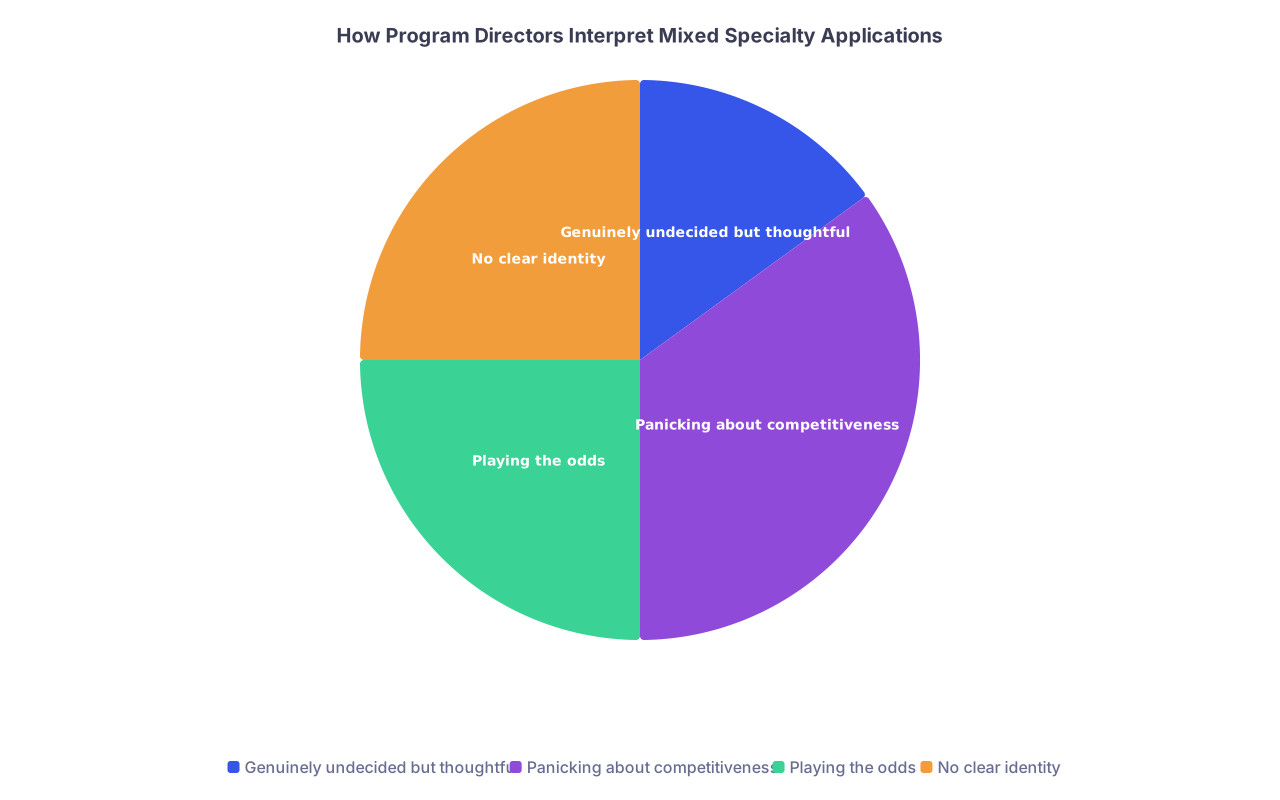
| Category | Value |
|---|---|
| Genuinely undecided but thoughtful | 15 |
| Panicking about competitiveness | 35 |
| Playing the odds | 25 |
| No clear identity | 25 |
Step 4: Be Honest With Yourself About Why You Want a Backup
There are two healthy reasons:
- You truly could see yourself happy in either field
- You have a realistic understanding of your competitiveness and want a responsible safety plan
And two toxic ones:
- You can’t tolerate uncertainty, so you’re spraying applications
- You’re chasing prestige or lifestyle and trying to keep every door open
Programs can sniff the second pair a mile away.

| Step | Description |
|---|---|
| Step 1 | Start |
| Step 2 | Pick 1 specialty |
| Step 3 | Get more exposure before applying |
| Step 4 | Apply thoughtfully to both |
| Step 5 | Do you truly like 2 fields? |
| Step 6 | Do you have real experiences in both? |
| Step 7 | Can you get strong letters in both? |
| Step 8 | Can you explain 2 distinct stories? |

Quick Reality Check: What Programs Actually Want to See
Programs are not allergic to backup specialties. They’re allergic to:
- Being obviously ranked below your dream field
- Training someone who will try to leave
- Taking on someone who has not truly thought through their fit
They’re reassured when they see:
- Clear, consistent narrative within their specialty
- Letters reflecting real fit with their day-to-day practice
- Evidence that you understand the work
- A mature explanation of how you explored other fields but landed here decisively
You can absolutely say:
“I explored both EM and IM seriously. Over time, I realized I prefer longitudinal relationships and complex inpatient medicine rather than undifferentiated acute care. That’s why I’m committed to internal medicine.”
What you can’t do is:
- Tell EM one story
- Tell IM a totally different one
- And expect no one to notice when your paper trail contradicts both.

FAQs
1. Is it ever okay to apply to two very different specialties?
Yes, but only if you can fully commit to either one and build two complete, honest applications. That means separate statements, solid letters in each, and a believable exploration path. If you’re just hedging because you’re afraid of not matching, and one field clearly dominates your experiences, you’re more likely to hurt yourself than help.
2. How many programs can I apply to in a backup specialty before it looks bad?
There’s no magic number, but extremes look suspicious. If your “backup” equals or exceeds your primary field in program count, PDs will assume you’re not actually committed. Think in ranges: if you’re truly using something as a backup, it typically shouldn’t dwarf your primary in applications, interviews, or visible energy.
3. Can I re-use parts of my personal statement between two specialties?
You can reuse specific patient stories or life experiences, but the “why this specialty” section must be fundamentally different. If you’re changing only the specialty name and two adjectives, programs pick up on that vagueness. Treat each statement like you’re writing to someone who sees only that version and must believe they’re your first choice.
4. What if my letters are mostly in my primary specialty but I really do like my backup?
Then your job is to prove that with every other tool you have: rotations, experiences, personal statement, interview story. You should still try to get at least one strong letter from the backup field. If you can’t get even that, you need to ask whether this backup is real interest or just fear-driven.
5. Is it better to apply broadly to one specialty or split between two?
If your profile is reasonable for your primary specialty (based on honest data, not wishful thinking), it’s usually safer to apply broadly and coherently to one. Splitting between two without building two full stories often makes you look unfocused and reduces your interview yield in both. Only split if you can create two convincing, self-contained applications—and you’d accept a spot in either field without resentment.
Bottom line:
- Backup pairings don’t just “help your odds”—they rewrite your identity in PDs’ eyes.
- Dangerous combinations aren’t about organ systems; they’re about conflicting day-to-day realities and lazy narratives.
- If you cannot tell a clean, convincing story for each specialty you apply to, you’re better off not applying to that specialty at all.