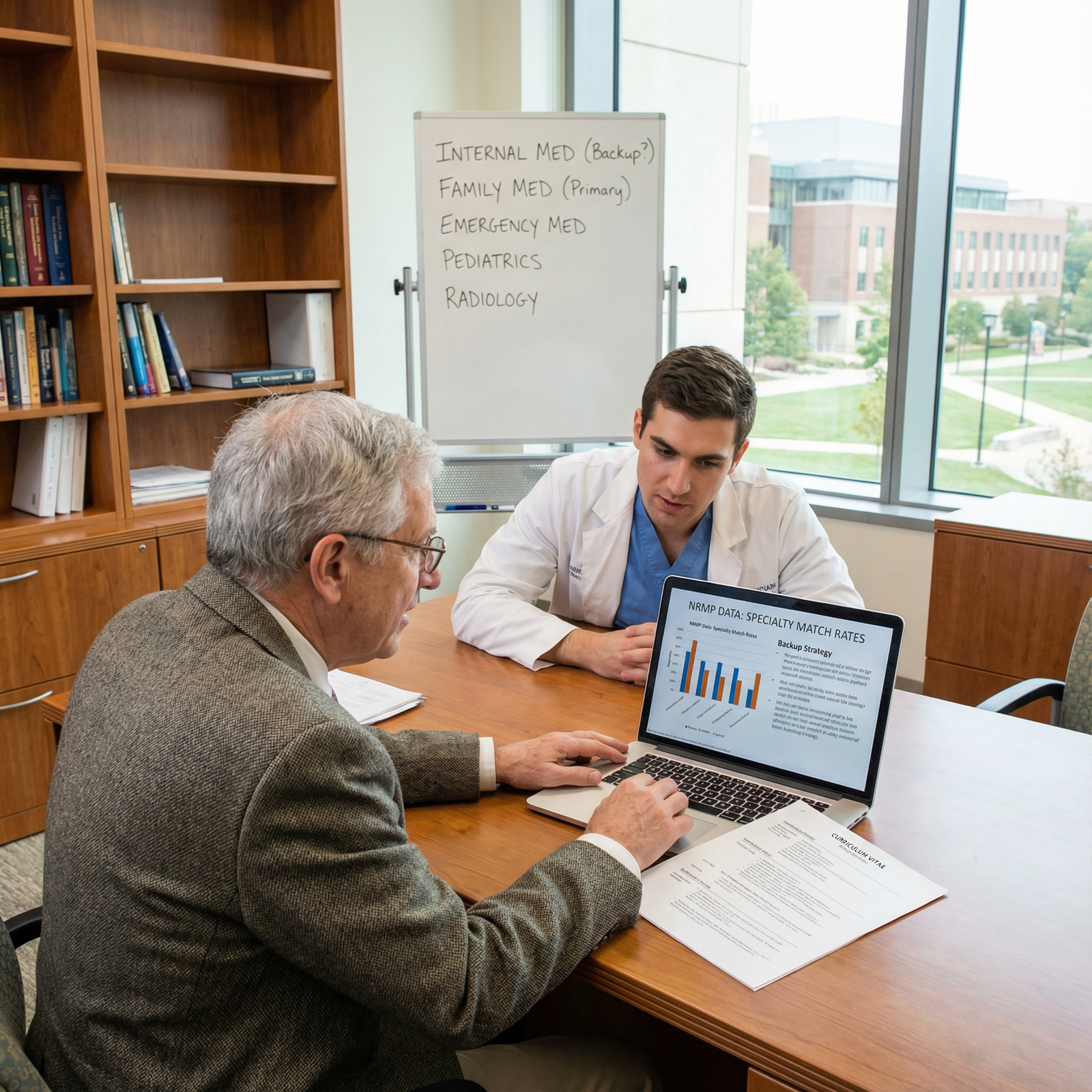
You’re three days from certifying your rank list. Your “dream” specialty is on top. Underneath it is a weird mix of stuff you threw together in a panic: a few prelim medicine spots, a random family med program someone on Reddit mentioned, a last‑minute anesthesia application “just in case.”
And now you’re staring at it thinking:
“If I match my backup, will they think I actually want to be there? Or that I’m just hiding from a failure?”
This is exactly where people make judgment‑flagging mistakes. Program Directors notice. And they absolutely question your judgment when your backup plan looks sloppy, desperate, or dishonest.
Let’s walk through the red‑flag backup choices that scream, “I didn’t think this through,” and how to avoid looking like that applicant.
The Core Mistake: Treating “Backup” as the Garbage Drawer
The biggest error is simple: you treat backup specialties like a catch‑all for “stuff I might tolerate if things go badly,” instead of a coherent, defensible plan B.
PDs talk. They compare notes. They also see your ERAS history, your letters, your prior applications. When there’s a mismatch, it shows.
The pattern that worries PDs:
- You applied late to a backup specialty with weak letters.
- Your personal statement is obviously repurposed.
- Your CV is laser‑focused on a different field.
- You can’t answer “Why this specialty?” without tripping.
They don’t just think, “Oh, they changed their mind.”
They think, “This person either can’t commit or can’t plan. Do I want that as my resident?”
How to avoid this big-picture screwup
Do not wait for your first wave of rejections to start thinking about backups. By then, your options are narrower, your story looks reactive, and your application feels like damage control.
Before you even submit ERAS, you should be able to answer:
- If I miss in my primary specialty, what is my real plan?
- Can I see myself actually finishing residency and practicing in this backup field?
- Does my application already show any evidence that this backup makes sense?
If the honest answer to that last one is “no,” you have work to do. Not panic mode later—now.
Red-Flag #1: Incompatible Primary and Backup That Make Zero Narrative Sense
Some backup pairs make PDs pause. Others make them raise an eyebrow and keep talking about you after you leave the room.
The problem isn’t “having a backup.” The problem is having a backup that contradicts the story your entire file is telling.
Classic questionable pairs (when done wrong):
- IR‑obsessed, ortho‑research heavy applicant suddenly backing up with Psychiatry.
- Derm candidate with zero continuity-of-care experience backing up with Family Medicine at the last minute.
- Neurosurgery‑only rotations and research, then “backup” is PM&R with no exposure, no letters, nothing.
Is it impossible to want both? Of course not. But if your whole file shouts one thing and your backup looks like a random specialty generator picked it, PDs assume:
- You’re not actually interested in the backup.
- You’re chasing perceived lifestyle or competitiveness.
- You make big career decisions impulsively.
Fix: Build a believable bridge between primary and backup
If your primary and backup are very different, you must show intentional overlap:
- At least one meaningful experience in the backup specialty (rotation, sub‑I, longitudinal clinic).
- A dedicated letter from faculty in the backup field.
- A personal statement that doesn’t read like “I wanted X, but now I’m settling for you.”
Example that works:
- Primary: Neurosurgery
- Backup: Neurology
Believable if:
- You’ve done a neurology rotation.
- You have a neurology letter.
- Your research or experiences touch neuro disease broadly, not just skull base surgery.
Example that raises red flags:
- Primary: Dermatology
- Backup: General Surgery
Believable only if:
- You have serious surgery exposure, letters, and can explain a coherent trajectory.
Most people do not. They just panic‑apply.
If you can’t explain the connection in two clear sentences without sounding like PR, PDs will hear the same confusion during interviews.
Red-Flag #2: “Fake Commitment” Personal Statements That PDs Can Smell a Mile Away
PDs read hundreds of personal statements. They know when you wrote your “backup” statement in one exhausted midnight session and changed two sentences.
The biggest tells:
- Same opening story as your primary specialty statement with different nouns.
- Vague, generic praise: “I love continuity of care and teamwork,” “I value communication,” etc.
- Internal contradictions: you spent your whole derm statement selling your love of procedures and aesthetics, then your FM statement says longitudinal psychosocial care has always been your main passion. No.
This doesn’t make you look adaptable. It makes you look insincere and opportunistic.
How to avoid this
- Write separate, truly distinct statements if you’re seriously applying to multiple specialties.
- For the backup:
- Anchor it in real experiences in that field (patient stories, rotations, mentors).
- Avoid language that makes it sound like “second choice” or “fallback.”
- Don’t overcorrect with cheesy passion lines. Ground it in what you’ve actually done.
If you don’t have a real experience to anchor that statement? That’s your clue: you’re applying to a specialty you’ve barely touched. PDs notice.
Red-Flag #3: Non-Categorical Tracks Used as a Sloppy Backup
This one gets people in trouble constantly.
They apply to:
- Prelim medicine
- Prelim surgery
- Transitional year
As “backup” to a competitive categorical specialty (e.g., radiology, anesthesia, derm, ophtho), but with zero plan beyond “I’ll figure it out later.”
PDs see right through this.
Why this bothers PDs
Internal medicine PDs are not thrilled when you show up clearly using their prelim spot as a pit stop. They’re not stupid; they know you’re trying to backdoor into something else.
Red flags:
- You only applied to prelim programs but no credible categorical options for the relevant advanced specialties.
- Your letters and statement scream radiology or anesthesia and barely mention internal medicine.
- You cannot articulate what happens if you don’t secure the advanced spot you’re hoping for.
They question:
- Are you going to do the bare minimum and leave chaos behind?
- Are you going to check out mid-year when you reapply?
- Are you going to constantly say, “Well, in [my real specialty] we do it differently…”
Better approach to prelim / TY backup
Use prelim/TY as part of a structured, realistic path, not as a vague “I’ll just exist for a year.”
You should be clear with yourself (and able to articulate to PDs):
- What advanced specialty are you aiming for next?
- How will this prelim/TY year make you a stronger candidate?
- What’s your plan if you still don’t match into that advanced specialty after the prelim year?
If your whole answer is “I just need any job,” you’re not ready to explain this to a PD without sounding like a liability.
Red-Flag #4: Last-Minute Backup Applications That Scream Panic
There’s a very obvious pattern PDs see every year:
- Initial application: single competitive specialty.
- October/November: surge of late applications to backup fields.
- No home rotation, no prior interest, weak or generic letters.
They look at your file and it’s like you appeared out of thin air in that specialty.
And yes, they correlate this with one thing: you’re scrambling because your primary plan is collapsing.
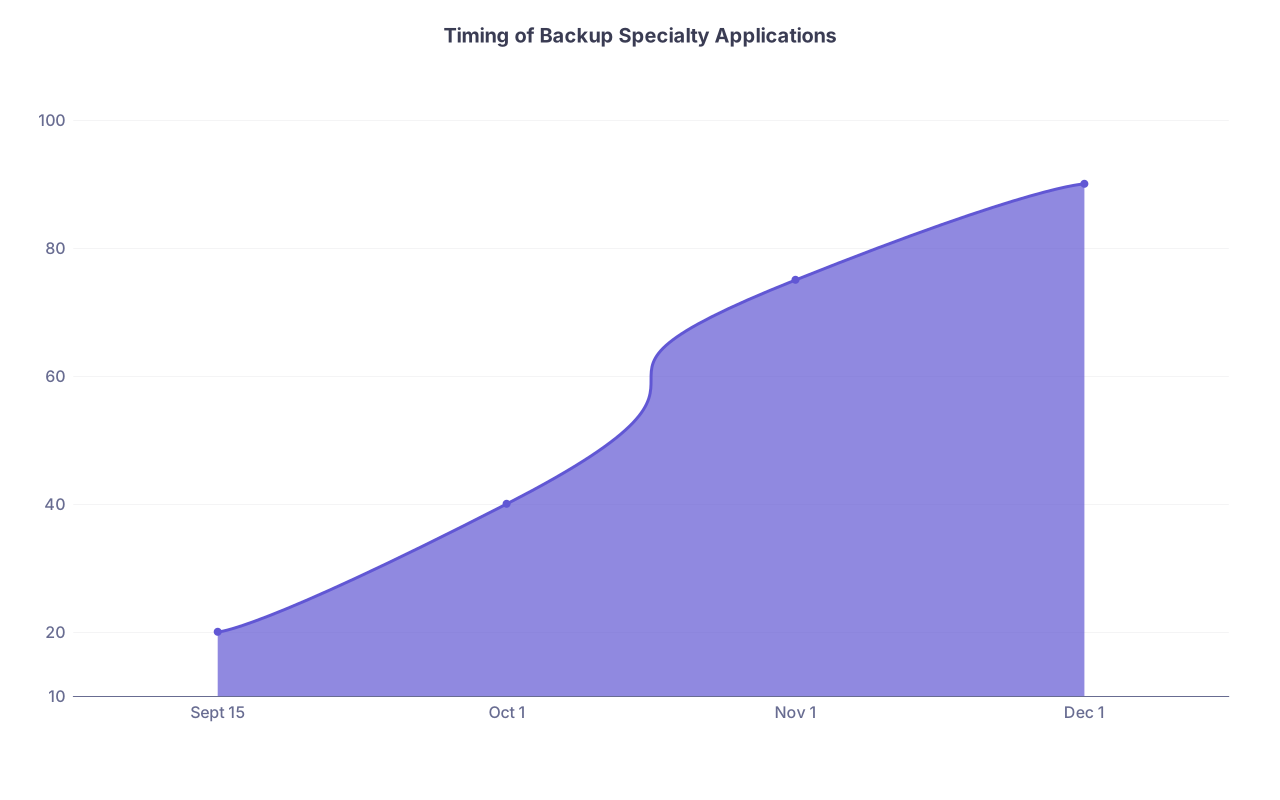
| Category | Value |
|---|---|
| Sept 15 | 20 |
| Oct 1 | 40 |
| Nov 1 | 75 |
| Dec 1 | 90 |
This doesn’t automatically kill your chances, but it raises suspicion about:
- Your planning skills.
- Your genuine interest.
- How you’ll respond to stress and setbacks.
How to look like an adult who can plan
You want your backup specialty to appear in your story early:
- A third‑year rotation with strong evals in that field.
- A letter obtained before ERAS opens.
- Maybe a small project, QI, or case report involving that specialty.
You don’t have to apply to both fields from day one if that’s not your strategy, but you should have the raw materials ready in case you pivot.
If your first email to a potential backup letter writer is in November that reads, “Hi, can you write a letter for my X application this week?”—that’s already a bad sign.
Red-Flag #5: Applying to Backup Specialties You Actively Dislike
This one’s less talked about, but PDs feel it during interviews.
You applied to something you:
- Think is “easy” to match into.
- Have openly spoken badly about to classmates.
- Have no real interest in practicing long‑term.
Then you get an interview. And you try to fake enthusiasm.
I’ve watched this in real time. The resident interviewer comes out and says, “They clearly don’t want to be here. They want plastics.” That comment gets written down.
Why this is dangerous
If you match that backup:
- You’re likely to be miserable.
- You’re at high risk of burnout or quitting.
- Your PD inherits a resident who doesn’t want their career.
That’s not “being flexible.” It’s professionally irresponsible.
Test for whether a backup is acceptable
Ask yourself, bluntly:
- If I never match into my dream specialty and I have to actually be a [backup field] attending for 30 years, can I live with that?
- Could I see myself putting in the work to be good at this, not just “get through it”?
- Would I be ashamed or resentful telling people, “I’m a [backup field] doc”?
If the honest answer is “absolutely not” and you apply anyway, PDs may not catch it on paper—but it leaks out in your tone, your answers, your body language.
They’re trained to read that.
Red-Flag #6: Backup Choices That Don’t Match Your Performance Profile at All
Another subtle but important issue: the mismatch between your objective data and your chosen backup.
Example:
- You struggled massively with Step exams and core clerkships.
- Your backup plan? Emergency Medicine at hyper‑competitive urban programs.
Or:
- You hated inpatient work, did poorly on busy wards, and your evals mention struggling with multitasking.
- Your backup is General Surgery or OB/GYN—because “I like procedures.”
PDs read your MSPE. They see patterns:
- Performance trends
- Professionalism comments
- Strengths and weaknesses
If your backup choice runs directly against documented weaknesses, they wonder:
- Does this person have insight?
- Do they understand what this job actually entails?
- Are they going to sink on my service?
Align backup with who you actually are on paper
Look at:
- Your clinical comments: what do they say you’re good at?
- Your exam performance trends.
- Your stamina for call, high acuity, or outpatient continuity.
Then pick backups that:
- Use your strengths.
- Don’t amplify your weaknesses.
- Are realistic with your metrics.
That doesn’t mean you can’t grow. But pretending your record doesn’t say what it says is how you get labeled as lacking insight.
Red-Flag #7: Confusing PDs With Too Many Specialties at Once
Yes, people do this.
You apply:
- 20 programs in your competitive primary.
- 25 in IM.
- 20 in FM.
- 15 in PM&R.
And on interview day, you confidently tell each PD, “This is where I see myself.”
They compare notes. Faculty have friends in other fields and institutions. Someone literally says, “Oh, I interviewed them too—for PM&R.”
You instantly move from “flexible” to “unfocused,” or worse, “desperate.”
Two-specialty rule of thumb
If you’re going to apply to backups:
- Try to keep it to 1 primary + 1 backup most of the time.
- Very specific exceptions exist (e.g., anesthesia + IM prelim + advanced spots), but those are structured, not random.
And if you truly must apply to more than two, you’d better have:
- A crystal‑clear way to explain your reasoning.
- Coherent letters and experiences for each.
- An honest understanding that this will hurt your perceived commitment.
Scattershot is not a strategy. It’s a neon sign that you’re flailing.
Smarter Backup Pairings That Don’t Raise the Same Red Flags
Let me be clear: having a backup is not the problem. Badly chosen, poorly executed backups are.
Here are examples of pairings that can be done cleanly if you plan ahead and commit to a coherent story:
| Primary | Backup | Risk Level | Key To Avoid Red Flags |
|---|---|---|---|
| Ortho | General Surgery | Medium | Show real gen surg exposure |
| Neurosurgery | Neurology | Low | Strong neuro letters |
| Derm | Internal Med | Medium | Continuity + IM story |
| Radiology | Internal Med | Low | Clear diagnostic focus |
| Anesthesia | Internal Med | Low | ICU/airway experience |
The difference between “reasonable” and “red flag” is how intentional you look.
If you’ve obviously thought about:
- Why this backup fits your personality and skills.
- How you’ll be okay if it becomes your permanent field.
- What in your file backs up that claim.
Then PDs may still ask questions—but they won’t immediately assume poor judgment.
Practical Steps: Building a Backup Plan That Doesn’t Embarrass You
Here’s how to do this like someone who knows what they’re doing.
1. Decide on your realistic risk tolerance early
By early fourth year, you should know:
- How competitive your desired specialty actually is for your stats.
- Whether your application is average, strong, or weak for that field.
If your advisors quietly say things like, “You should have a parallel plan,” don’t ignore that. They’re trying to save you from a SOAP horror story.
2. Get one solid rotation in your potential backup before ERAS opens
Not an observership. Not a one-week elective. A real, graded rotation.
Then:
- Ask for one good letter from that field.
- Actually engage—patients, residents, conferences—so you get more than a checkbox experience.
3. Build a non-cringey explanation
You should be able to say something like:
“I’ve always been drawn to [shared element]—whether in [primary] or [backup]. I pursued [primary] because of [specific reason], but my rotation in [backup] showed me another way to practice that same core interest. I applied to both this cycle, knowing I’d be happy building a career in either.”
That’s honest. It doesn’t sound like you’re pretending both have been your “lifelong dream.”
4. Write separate, real personal statements
No copy‑paste jobs.
If you can’t fill a full page with:
- Real stories
- Real reflections
- Real experiences
in that backup field, you probably shouldn’t be applying to it.
5. Run your backup plan past someone who will tell you the truth
Not a classmate. Not your mom.
An advisor, PD, or attending who actually knows how this looks from the other side.
Ask them bluntly:
- “Does this backup plan make sense?”
- “Would this raise red flags for you as a PD?”
- “Am I overestimating my chances in my primary field?”
Listen. If three different people tell you your combo looks chaotic, believe them.

| Step | Description |
|---|---|
| Step 1 | Assess Competitiveness |
| Step 2 | Apply Primary Only |
| Step 3 | Identify Backup Specialty |
| Step 4 | Do Rotation in Backup |
| Step 5 | Get Backup Letter |
| Step 6 | Write Backup Statement |
| Step 7 | Apply to Primary + Backup |
| Step 8 | Prepare Honest Explanation |
| Step 9 | High Risk of Not Matching? |
FAQ (Exactly 5 Questions)
1. Is it always a red flag to apply to more than one specialty?
No. It’s common in competitive fields. The red flag comes when your second (or third) specialty appears suddenly, without prior exposure, letters, or a believable narrative connecting it to who you are and what you’ve actually done.
2. Can I tell a backup specialty PD that they’re my “backup”?
Do not. You don’t need to lie, but you also don’t need to volunteer that they’re second choice. Focus on why you’d be happy and fulfilled in their field and their program. Anything that makes them feel like a consolation prize will hurt you.
3. What if I genuinely changed my mind mid-application cycle?
Then own that story. Explain what changed: a specific rotation, mentor, or experience that shifted your perspective. Update your materials as much as you can (statement, letters) and be ready to talk about it convincingly. Sudden, unexplained switches look flaky; thoughtful pivots can be respected.
4. Is prelim internal medicine a safe backup for almost anything?
It’s common, not automatically “safe.” If your whole attitude is “I’ll just survive a year then bounce,” PDs pick up on that and won’t rank you highly. Use prelim spots as part of a clear, realistic plan, not as a generic escape hatch.
5. How do I know if my primary is risky enough to need a backup?
Look at hard data: your Step scores, class quartile, research output, and home institution support for that specialty. Compare that to NRMP data for matched applicants. Then ask at least one honest advisor in the field, “If I were your kid, would you tell me to have a backup?” If they hesitate, that’s your answer.
Key points, so you do not blow this:
- Backup choices themselves are not the problem. Chaotic, last-minute, or incompatible backups make PDs question your judgment.
- Every specialty you apply to must be one you’d be genuinely willing to practice long‑term—and your file needs at least some real evidence that it makes sense for you.
- Think early, plan intentionally, and get someone experienced to sanity‑check your strategy before your “backup” becomes your biggest red flag.