
The Hidden Signal Your Backup Specialty Sends About Your Professionalism
It’s late November. Your ERAS is already out, you’ve gotten a mixed bag of interview invites from your dream specialty, and now you’re staring at a spreadsheet titled “Backup Plans” that you swore you’d never make.
You’ve heard rumors. “Just throw in a few FM or IM apps as backup.” “Programs don’t really care, they know everyone has backups.” “Apply to anesthesia as a backup to derm, they’re chill.”
Let me tell you what really happens on the other side of that screen.
Program directors, department chairs, and senior faculty sit in a room with your application open. Someone says the quiet part out loud:
“Is this person actually interested in us, or are we just their safety net?”
And then they look for proof. Your backup specialty strategy is that proof. It is a very loud, very underappreciated signal about your professionalism, maturity, and how you will behave when you do not get what you want.
Not just whether you match. Who is willing to train you.
Let’s pull back the curtain.
What PDs Actually See When You “Spray and Pray”
First thing you need to understand: programs can’t see your entire ERAS list, but they see enough to infer your story.
They see:
- Your personal statement to them
- Your experiences pattern
- Your letters (and what specialty they’re from)
- Your transcript and MSPE language
- And sometimes, they quietly ask your dean’s office, “What is this person really going for?”
They absolutely talk.
In one selection meeting I sat in, we had this exact applicant:
- 3 ortho away rotations
- Ortho chair letter
- Ortho research x3
- Last-minute “backup” IM application with a generic “I love internal medicine” statement
The IM PD glanced at it and said, “He’ll bolt the second ortho gives him a prelim spot. Pass.” No debate. That was it.
Your backup specialty choice is not just about “chance of matching.” It’s a behavioral readout:
- Do you respect that specialty as a legitimate career, or treat it like a consolation prize?
- Do you understand what that specialty actually does, or are you obviously clueless?
- When your first choice doesn’t love you back, will you sulk, be toxic, or get to work?
That’s the hidden signal.
](https://cdn.residencyadvisor.com/images/articles_svg/chart-how-pds-perceive-backup-specialty-use-5974.svg "How PDs Perceive Backup Specialty Use")
| Category | Value |
|---|---|
| Thoughtful backup | 70 |
| Obvious desperation | 55 |
| Random mismatch | 60 |
| [No backup at all](https://residencyadvisor.com/resources/backup-specialties-residency/the-unspoken-rule-how-many-backup-specialties-is-too-many) | 40 |
(Values represent approximate “professionalism concern level” on a 0–100 scale based on PD comments I’ve heard. Informal, but very real.)
The Three Types of Backup Applicants (PDs Know Which One You Are)
I’ve heard PDs describe applicants in almost these exact categories. Not in public. In closed-door meetings.
1. The Professional Realist
This is the person applying neurosurgery + neurology, or ortho + PM&R, or EM + IM. Their file tells a coherent story.
Example: A student applies EM as first choice, IM as backup.
- Third-year narrative: Solid across the board, best comments in acute care settings, teams describe them as calm in chaos.
- EM application: EM sub-I, EM letter, EM-specific PS.
- IM application: IM sub-I, genuine PS talking about considering both due to interest in acute care and longitudinal relationships, with evidence of outpatient interest.
Behind the scenes, what I’ve heard:
“They’re shooting for EM but I’d be happy to have them in IM. If EM doesn’t work out, they’ll show up and do the job.”
Signal: Professional. Grounded. Respectful of both fields. This person understands they’re not entitled to their first choice.
These people almost always match somewhere good. Either in their dream specialty or in a backup that actually wants them.
2. The Obvious Gambler
This is the derm applicant who also applies to general surgery and psychiatry. The radiology hopeful who randomly throws in pediatrics. No logical thread. No real backup planning until late October when panic hits.
We had someone like this once:
- Primary push: ENT. Multiple ENT rotates, ENT research, ENT letters.
- Panic phase in late season: applied to FM and OB/GYN.
- FM PS: generic, obviously reused derm/ENT language about “procedures” and “head and neck anatomy.”
- OB/GYN PS: Copy-paste job with “women’s health” dropped in twice.
FM PD’s comment: “They hate clinic. Look at their evaluations. Why would we take them just so they can resent us?”
OB/GYN PD: “If we rank them, they will SOAP back into surgery or ENT. Hard pass.”
Signal: Unprofessional. Immature. They treat entire specialties like a holding pattern until they can “escape.”
These people match less than they should given their scores, because no one trusts them.
3. The Silent Idealist (with no backup at all)
This is the “I’m only applying plastics” or “I’m only applying derm, no prelim, no TY, no backup” applicant. Sometimes it works. But when it doesn’t, the fall is brutal.
PDs know this type. I’ve heard it said:
“They didn’t even give themselves a parachute. That kind of magical thinking worries me.”
Signal: Sometimes admirable conviction. Sometimes poor judgment and weak advice. The message: “I don’t plan for failure, even in a probabilistic system like the Match.”
Do some PDs respect the all-in strategy? Yes, especially in ultra-competitive fields when the application is truly elite. But they also recognize who’s been counseled and who’s just delusional.
How Your Backup Choice Reflects Your Understanding of Medicine
This is the part students consistently underestimate: faculty evaluate how you think about the profession as a whole, not just “do you want my specialty.”
When your primary and backup specialties are wildly mismatched, the unspoken question is: Do you actually understand what doctors do in these fields?
A few pairings and what they quietly signal:
| Primary | Backup | How PDs Often Read It |
|---|---|---|
| Derm | IM | Thoughtful, shared cognitive core |
| Ortho | PM&R | Realistic, understands MSK continuum |
| EM | IM | Logical, acute vs longitudinal |
| Neurosurg | Neurology | Coherent brain-focused interest |
| Plastics | General Surgery | Grounded, procedural focus |
Now the ugly pairings:
- Dermatology + Pediatrics + Anesthesia
- Ortho + Psychiatry
- Radiology + FM + OB/GYN
When a PD sees that pattern of letters, research, and statements across fields that have nothing in common, they do not think “Wow, versatile.” They think:
“This person applied wherever they thought the door might be open. No real identity. No real understanding of the work.”
That erodes confidence in your professionalism. Because professional adults make constrained, rational backup choices based on their skills, interests, and the realities of the system. Not chaos.

The Hidden Test: Are You Willing to Fully Commit to Your Backup?
PDs know who is “using” their specialty as a backup. They’re not stupid. The thing they care about is whether you are willing to fully commit if you match there.
They look for three signals of commitment:
1. Did you invest any real time in this field?
- A single elective
- A meaningful longitudinal clinic experience
- A piece of research or QI project
- Volunteering or leadership tangentially related
You don’t need an entire CV in the backup field. You do need enough to convince them you spent more than 20 minutes thinking about what that career looks like.
If you’re applying IM as backup to EM and have zero outpatient, inpatient, or chronic disease interest anywhere in your file, they notice. They say things like:
“They’re here for airway and codes, not diabetes follow up.”
2. Did you write a real personal statement?
Program directors can smell a backup PS from three sentences away.
Red flags:
- Vague “I love teamwork and patient care in all settings” statements
- Heavy use of “in whichever field I end up” language
- Generic copy that doesn’t clearly match the day-to-day reality of the specialty
I once saw an IM PD slam a backup PS printed in front of him and say:
“If you can’t even Google what internists do beyond ‘coordinating care,’ I’m not interested in teaching you for three years.”
You don’t have to pretend your backup is your childhood dream. But you absolutely must communicate: “If I match to you, I am all in. Here’s why this field genuinely fits me.”
3. Did you get at least one credible letter from the backup specialty?
Not always possible for everyone, but when it’s absent, PDs infer. They ask:
- Did no one in that field think highly enough of you to write a letter?
- Did you not even bother to rotate with them?
- Are you trying to ride your derm or ortho letters into IM or FM? That goes over very poorly in some rooms.
A strong, honest letter from your backup field that basically says “Yes, they came to us somewhat late, but they showed up, worked hard, and we’d be happy to train them” is far more powerful than most students realize.
Bad Backup Strategies That Scream “Unprofessional”
Let’s call out the self-sabotage I’ve watched in real time.
1. Panic Applying in November With Zero Coherence
You miss earlier interview waves. Your dream specialty invites are underwhelming. So you open ERAS and carpet-bomb a completely new field with no tailored materials.
I’ve seen students:
- Upload the same personal statement to three different specialties
- Skip getting a letter in the backup field
- Apply to programs in cities they’d never seriously live in “just in case”
Programs absolutely get these late, sloppy applications. PDs have said, word for word:
“If we’re your panic backup, you’re going to be bitter here. No thanks.”
The signal: You plan poorly. You don’t respect people’s time. You want a safety net without doing the work to build it.
2. Talking About Your Primary Specialty in Backup Interviews
This one kills people.
You walk into an IM interview and spend half the time talking about how much you love EM or ortho “but you could see yourself happy in IM too.” Or worse, you answer “Where do you see yourself in 10 years?” with something like:
“Well, best case I later transition into EM, but I’d be grateful to match here.”
Interviewers will smile politely. Then they will remove you from the rank list the second you leave. Because you just told them “You’re my rebound.” No one wants that.
3. Acting Like the Backup Field Is “Easier”
This one is poison.
- Saying out loud that you chose FM, IM, or psych as a backup “because it’s less competitive”
- Writing personal statements that frame your primary specialty as “more intense” or “more demanding”
- Joking that you went with a cognitive field backup because “at least you’ll have a life”
Those jokes and subtle digs do leak back to PDs. Faculty talk. Residents talk. And those specialties already feel disrespected enough by med students who only value lifestyle or procedures.
The signal: You don’t respect your colleagues. Immature, arrogant, unprofessional.
Building a Backup Strategy That Actually Makes You Look More Professional
Here’s how the students who impress PDs handle this.
Step 1: Accept Early That You Are Playing Probabilities, Not Destiny
The people who handle backups well start thinking 6–12 months before ERAS, not 6 weeks after it opens.
They admit early: “I want plastics/derm/ortho, but my scores and application put me in the ‘maybe’ zone. I need a parallel track that I can genuinely live with.”
That mindset alone signals maturity.
Step 2: Pick a Backup That Shares a Real Foundation With Your Primary
You want to be able to say, with a straight face:
“I was drawn to X for these reasons. Y shares a lot of that same DNA, just with different emphasis.”
Examples that pass the sniff test from PDs:
- EM primary → IM backup (acute care skills + longitudinal medicine)
- Ortho primary → PM&R backup (MSK focus, function, rehab)
- Neurosurg primary → Neurology backup (brain, neuro exam, complex decision-making)
- Derm primary → IM or rheum backup (systemic disease, immunology, chronic care)
- Gen surg primary → Anesthesia or EM backup (OR environment, acute physiology, procedures)
Step 3: Do at Least One Real Rotation in the Backup Field
Not a token 2-week elective at the end of fourth year that everyone knows was a checkbox.
An honest, engaged rotation where:
- You let the team know you’re truly considering this field
- You ask questions beyond “How hard is your call?”
- You request feedback and approach it as a potential home, not a rest stop
Then, if it’s not a disaster, you ask for a letter. You don’t pretend you’ve been dreaming of them since M1. You say:
“I’m applying to [primary] and also to [backup]. I want to give myself the best chance to train in a field where I can thrive. Would you feel comfortable writing a letter speaking honestly about how I’d do in this specialty?”
That level of candor is rare. And respected.
Step 4: Write a Backup Personal Statement That Tells the Grown-Up Version of the Truth
Here’s the version that works:
- Acknowledge you explored multiple fields
- Articulate clearly what you like about your backup, grounded in real experiences
- State directly that if you match there, you will commit fully and happily
- Do not you over-sell some fake lifelong passion; you sell fit, values, and skills
Something like:
“During third year, I found myself torn between emergency medicine and internal medicine. I enjoy acute decision-making and stabilizing critically ill patients, but I also found deep satisfaction in following complex patients over time, managing chronic disease, and building longitudinal trust.
As my interests evolved, I realized I would be happy and fulfilled building a career in internal medicine. The opportunity to think broadly, coordinate care across settings, and develop long-term therapeutic relationships aligns with the kind of physician I want to be. If I have the privilege of training in your program, my commitment will be complete.”
That reads as adult. Honest. Professional.
Step 5: Be Consistent in How You Talk About It
Residents and attendings will probe you during interviews. PDs are not the only ones whose opinions matter.
If your story about why you’re in their applicant pool changes between conversations, people notice. They compare notes. They always do.
Your line has to be stable, believable, and not self-pitying.
Something like:
“I applied more broadly within [X-related fields] because I see myself thriving in several possibilities. I’d be very happy training here; your [specific feature] fits me well.”
Not:
“I mean, yeah, this is my backup, but I’d still be grateful.” That’s death.
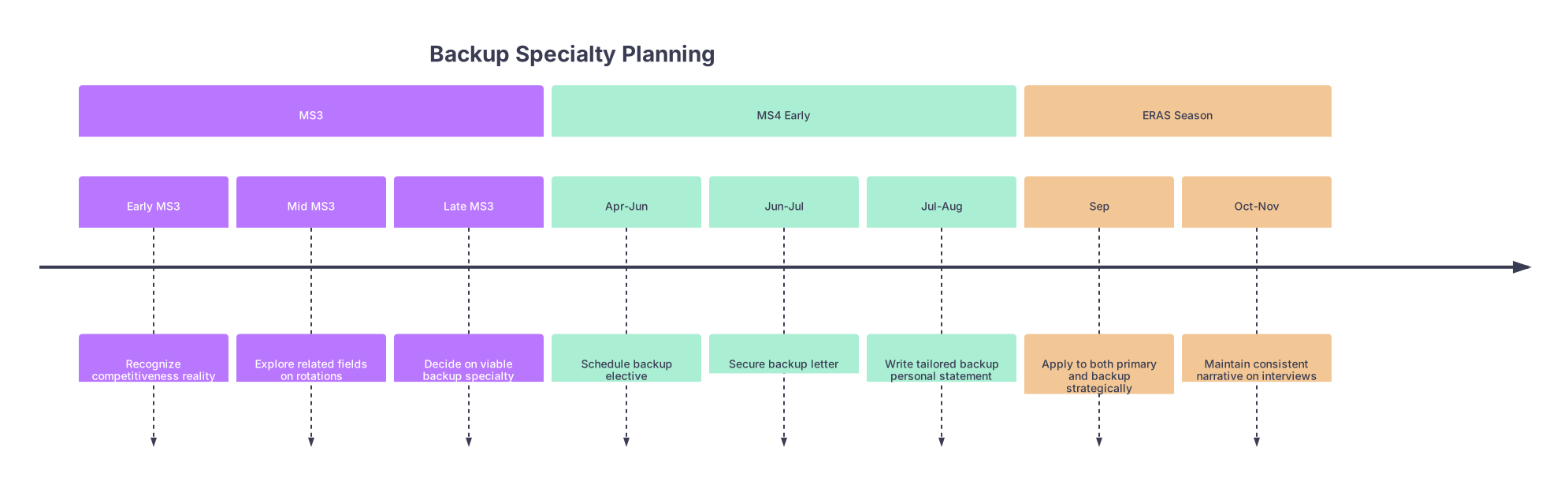
| Period | Event |
|---|---|
| MS3 - Early MS3 | Recognize competitiveness reality |
| MS3 - Mid MS3 | Explore related fields on rotations |
| MS3 - Late MS3 | Decide on viable backup specialty |
| MS4 Early - Apr-Jun | Schedule backup elective |
| MS4 Early - Jun-Jul | Secure backup letter |
| MS4 Early - Jul-Aug | Write tailored backup personal statement |
| ERAS Season - Sep | Apply to both primary and backup strategically |
| ERAS Season - Oct-Nov | Maintain consistent narrative on interviews |
The Real Question PDs Are Asking Themselves
Strip away the forms, committees, and score spreadsheets. In almost every PD meeting I’ve been in, one unspoken question sits under the table:
“If this applicant ends up here after not getting what they wanted, are they going to be a professional colleague or a problem?”
Your backup strategy is one of the strongest visible tests of that.
- Did you plan ahead or panic late?
- Did you treat another specialty with respect or as a dumping ground?
- Did you show any humility about your own odds?
- Did you take the time to learn what that specialty actually is, or did you just label it “easier”?
That’s why two applicants with identical scores and research can have very different outcomes. One sends the signal: “I’m a grown adult who understands risk and still shows up fully wherever I am.” The other sends: “If I’m disappointed, everyone around me will pay for it.”
Guess which one faculty want to spend three to seven years with.
FAQs
1. Is it ever okay to have no backup specialty at all?
Yes, but only in specific scenarios. If you’re a truly competitive applicant for a very competitive field (top scores, honors-heavy MSPE, strong letters from big-name faculty, meaningful research), some PDs actually respect going all-in. But if your application is clearly borderline and you still refuse to consider any backup, people on your home side (deans, advisors) quietly question your judgment. No backup is a valid choice only if you fully accept the risk of not matching and having to SOAP or reapply without blaming everyone else.
2. Can I reuse some content between my primary and backup personal statements?
You can reuse themes about your values, personality, and how you work. You should not reuse specialty-specific paragraphs. PDs pick up on generic language fast. The moment a statement reads like “I could see myself in a variety of fields…” with no concrete evidence you understand their field, you’ve lost credibility. Better to have one sharp, tailored page for each than two vague pages that feel copy-pasted.
3. How many programs should I apply to in my backup specialty?
There’s no magic number, but here’s the insider threshold: enough that your backup looks real, not performative. If you apply to 70 in your primary and 4 in your backup, every PD who hears that will roll their eyes. For most borderline applicants, 15–30 well-chosen backup programs in a coherent, related field sends a solid professional signal. Quality and fit matter more than chasing a giant number just to calm your anxiety.
4. What if I discover late that I actually like my backup more than my primary?
Then say that. Clearly and unapologetically. I’ve seen students start out gunner-ing for surgery and then, late in MS4, realize they are genuinely happier in anesthesia or IM. When they own that evolution honestly in their application narrative and interviews, PDs usually receive it very well. The key is to stop hedging. If you’ve truly shifted, commit your story, your PS, and your interview answers to that new direction instead of half-chasing both. That pivot, done openly, looks far more professional than hanging onto an old dream out of ego.
You’re at a crossroads right now: decide whether your backup specialty will be a quiet embarrassment you try to hide, or a visible example of your maturity and professionalism.
If you build it intentionally, it becomes less “backup” and more “parallel path I’d genuinely accept.” That’s the version faculty respect.
With that mindset locked in, you’re ready to start shaping not just where you match, but how people will think about you once you get there. The next step is learning how to talk about your story in interviews without sounding rehearsed or desperate. But that’s a story for another day.