It’s late. Your ERAS is in, your personal statement is written for a specialty you never imagined you’d choose, and you’re staring at the screen thinking: “I was supposed to be a surgeon / derm resident / ortho bro / neurosurgeon / whatever. How did I end up here?”
You’re scrolling through Instagram seeing your classmates posting “So excited to apply ortho!” or “Neurosurgery or bust” and instead of feeling happy for them, your stomach drops. Because you had that dream too. And now you’re trying to convince yourself you’re “totally fine” with a backup specialty that still feels like a consolation prize.
Let me answer the question bluntly:
Yes. It is absolutely, painfully, 100% normal to feel grief about letting go of a dream specialty.
Not disappointment. Not “mild regret.” Actual grief. Like something died. Because in a very real way, something did: the story you’d been telling yourself about who you were going to be.
Let’s walk straight into this instead of pretending it’s no big deal.
Why It Feels So Bad (You’re Not Overreacting)
You’re not just changing specialties. You’re dismantling an identity you’ve been building for years.
You didn’t just “like” your dream specialty. You built a whole internal life around it:
- You imagined yourself in that coat, with that badge: “Anesthesiology,” “Emergency Medicine,” “Dermatology.”
- You picked rotations and research to “fit the narrative.”
- Attendings literally said to you, “You’re totally an [insert specialty] person.”
- Family and friends know you as “the future surgeon” or “the psych person.”
So when reality hits—Step scores not high enough, research didn’t line up, not enough interviews, changing priorities, burnout, family reasons—it’s not just a scheduling change. It’s losing a future you were emotionally attached to.
That knot in your stomach? The tears you feel stupid about? The way you flinch when someone else casually says “Oh yeah, I’m applying [your dream specialty]”?
That’s grief.
And I’m telling you as someone who has watched a lot of people go through this: the ones who deny that it hurts tend to struggle longer. The ones who admit “yeah, this feels like a loss” actually move forward better.
The Unspoken Truth: Backup Specialty ≠ Failure
Let’s address the ugliest thought you’re probably having but not saying out loud:
“If I go into a backup specialty, it means I wasn’t good enough.”
I hate how common this is. I’ve seen people with 250+ Step 2 scores sob because they didn’t match ortho or derm or plastics and genuinely believe they’re garbage.
Here’s the part no one tells you on Reddit:
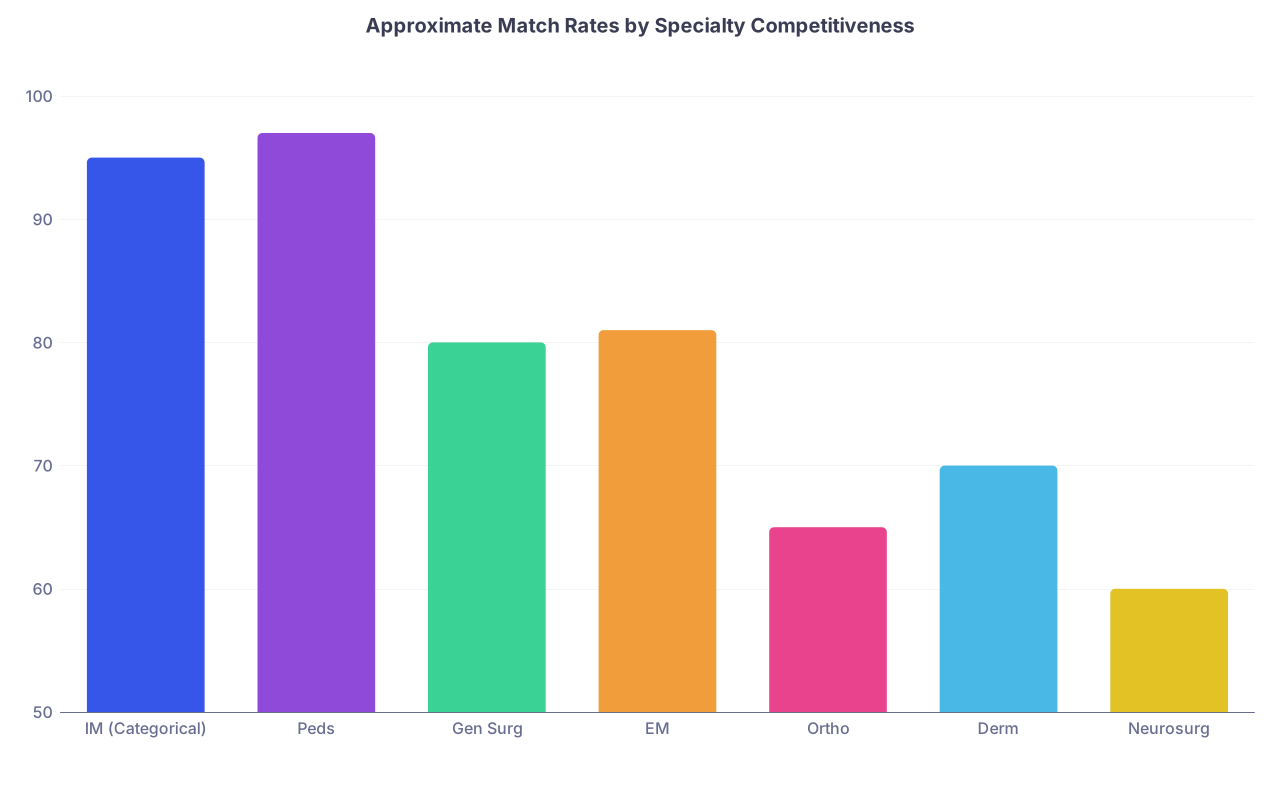
Residency spots are not a moral judgment. They’re a math problem with bad odds and a ridiculous amount of randomness.
| Category | Value |
|---|---|
| IM (Categorical) | 95 |
| Peds | 97 |
| Gen Surg | 80 |
| EM | 81 |
| Ortho | 65 |
| Derm | 70 |
| Neurosurg | 60 |
Those numbers? That’s not “who deserves it.” That’s overcrowded fields, weird program preferences, geography, visa limitations, random vibes from PDs who met you for 15 minutes on Zoom.
And then there are the quiet reasons people change course that don’t show up on spreadsheets:
- Realizing you can’t do q3 call nights forever without breaking.
- Having a partner, kids, or sick parents who actually matter more than being a “cool” specialty.
- Burnout so bad that a 7-year surgical path might literally wreck your mental health.
- Being an IMG or at a low-prestige school where certain doors just don’t open the same way, even if you’re talented.
But your brain doesn’t say, “Ah, complex systemic factors.” It says, “You failed. Everyone else figured it out. You didn’t.”
That voice is lying to you. It’s loud. But it’s wrong.
What Grief Over a Lost Specialty Actually Looks Like
If you’re wondering whether what you’re feeling is really “grief,” watch this and see what hits:
- You avoid talking about applications because you don’t want to say your backup specialty out loud.
- You find yourself irrationally irritated at classmates who got your dream field, even if you like them.
- You keep re-running “If I’d just gotten X score / Y paper / Z LOR, I’d be fine right now.”
- Looking at old photos from your dream rotation hurts.
- You still check that specialty’s residency pages “just to see,” even though you’re not applying there.
- When you enter your specialty in ERAS, there’s this sense of betrayal, like you’re cheating on your younger self.
Yeah. That’s grief.

The worst part is the narrative you build:
“If I were stronger / smarter / more dedicated, I wouldn’t be in this situation.”
I’ve watched absolute rockstars change course. People with “perfect” applications. People whose lives just changed. People who realized the lifestyle they thought they wanted at 22 doesn’t fit their body or mind at 28.
Changing specialties isn’t weakness. It’s data and self-awareness. It just feels like failure because your ego is bruised and medicine as a culture is toxic about anything that isn’t “straight line, top specialty, no doubts.”
How to Actually Grieve It (Without Getting Stuck)
Here’s the trap: if you don’t let yourself feel this grief now, it leaks out later.
It shows up as bitterness, as “my specialty is beneath me,” as contempt for co-residents, as chronic second-guessing.
If you want to actually move on, you have to do a few uncomfortable things.
1. Say the loss out loud
Not in vague terms. Literally say it:
“I wanted to be an ENT surgeon. I’m not going to be.”
“I wanted EM to work. It’s not going to.”
Write it. Tell a close friend. Say it in therapy. Tell your mentor: “I’m grieving the loss of this dream.”
Yeah, you might cry. That’s kind of the point.
2. Separate “I wasn’t chosen” from “I’m not enough”
Your brain is going to fuse these into one sentence. Break it apart. For example:
- “I probably won’t match derm” becomes
“I’m statistically unlikely to match derm based on my current app and the competitiveness of the field. That doesn’t mean I’m a bad physician or a bad person.”
It sounds cheesy. But there’s a huge difference between, “The system didn’t pick me for one slot,” and “I’m a failure.”
One is situational. The other is an identity wound.
3. Mourn the specifics
You’re not just sad “in general.” You’re sad about specific images and expectations:
- The way you imagined introducing yourself on day one as “the ortho intern.”
- The fellowship you thought you’d do afterward.
- The kind of procedures you pictured doing every day.
- The respect or “status” you associated with that field.
Write down what you’re losing. It feels worse for a bit, then less confusing. Because now you can also ask: what parts of this can I still get in other ways?
Sometimes the thing you actually loved was:
- Longitudinal relationships → that exists in IM, FM, psych, peds.
- Acute care/adrenaline → EM, ICU paths, hospitalist, trauma consults.
- Procedures → IR, GI, pulm/crit, pain, EM, even certain primary care clinics.
The specialty label was one way, not the only way.
Making Peace with a Backup Without Gaslighting Yourself
Here’s the hard balance: you don’t have to pretend your backup specialty was your “true love all along.” That’s fake and your brain will reject it.
You can be honest: “This wasn’t plan A. And I’m still allowed to build a good life inside plan B.”
Let’s talk about some “backup” specialties and what people actually end up liking in them, once they drop the shame.
| Dream Specialty | Common Backup | What People Quietly Realize Later |
|---|---|---|
| Ortho | IM/FM | They like using their brain more than their body and having fewer injuries and night calls |
| Derm | IM/Allergy | They still get chronic disease management, outpatient life, and often better work-life balance than they expected |
| EM | IM/FM | They enjoy continuity, less chaos, and not living in constant night-shift jet lag |
| Gen Surg | Anesthesia | They get tech/procedures, OR culture, but less brutal call and shorter training |
| Neurosurg | Neurology | They enjoy thinking deeply about the same diseases with more time and fewer 100-hour weeks |
No, this doesn’t mean everyone “learns to love” their backup and magically never looks back. Some keep a faint ache for what might’ve been. That’s allowed.
But I’ve also seen a lot of people surprised by how relieved they feel later. Especially:
- When their friends in their dream specialty are on their 6th 24-hour call that month.
- When they see burnout and divorce stories in those fields.
- When they watch their own stress level normalize in residency.
How to Talk About It (Without Falling Apart)
Another awful part? Having to explain it to other people while you’re still raw.
You’ll get questions like:
“Wait, I thought you were going into ortho?”
“What happened?”
“So you didn’t match derm?”
Here’s the thing: you don’t owe anyone your trauma dump. You really don’t.

| Step | Description |
|---|---|
| Step 1 | Someone asks about your specialty change |
| Step 2 | Give simple honest summary |
| Step 3 | Share brief context |
| Step 4 | Change subject |
| Step 5 | Do you want to share details |
Some scripts you can steal:
“Yeah, I really liked ortho, but after looking at my scores and priorities, I realized I’d be happier and have more options in IM.”
“I loved EM, but lifestyle and family stuff made me rethink. I’m actually pretty excited about [backup] now.”
“Match data was rough this year, and I decided I didn’t want to gamble my whole future on one ultra-competitive field, so I made a more secure choice.”
If they pry further, it’s okay to shut it down:
“I’m still processing it, to be honest. I’d rather not get into all the details right now.”
You are allowed to have boundaries while you’re grieving. You’re not a public podcast episode.
Building a Real Future in a Backup Specialty
Here’s the pivot: you’re not just “surviving” a backup choice. You’re building an actual career and life.
At some point, you need to ask a better question than “Why didn’t I get my dream?”
The better question is: “Given where I am, how do I build a life I don’t dread waking up to?”
That includes:
- Finding aspects of your backup specialty that genuinely interest you, even if they’re different than your original dream.
- Talking to attendings in that field who like their jobs (not just the burned-out ones).
- Remembering you can sub-specialize, change practice settings, move toward procedures or clinics or inpatient as you learn your own preferences.
| Category | Value |
|---|---|
| Specialty Label | 15 |
| Work Environment | 25 |
| Colleagues | 20 |
| Schedule/Lifestyle | 25 |
| Autonomy/Control | 15 |
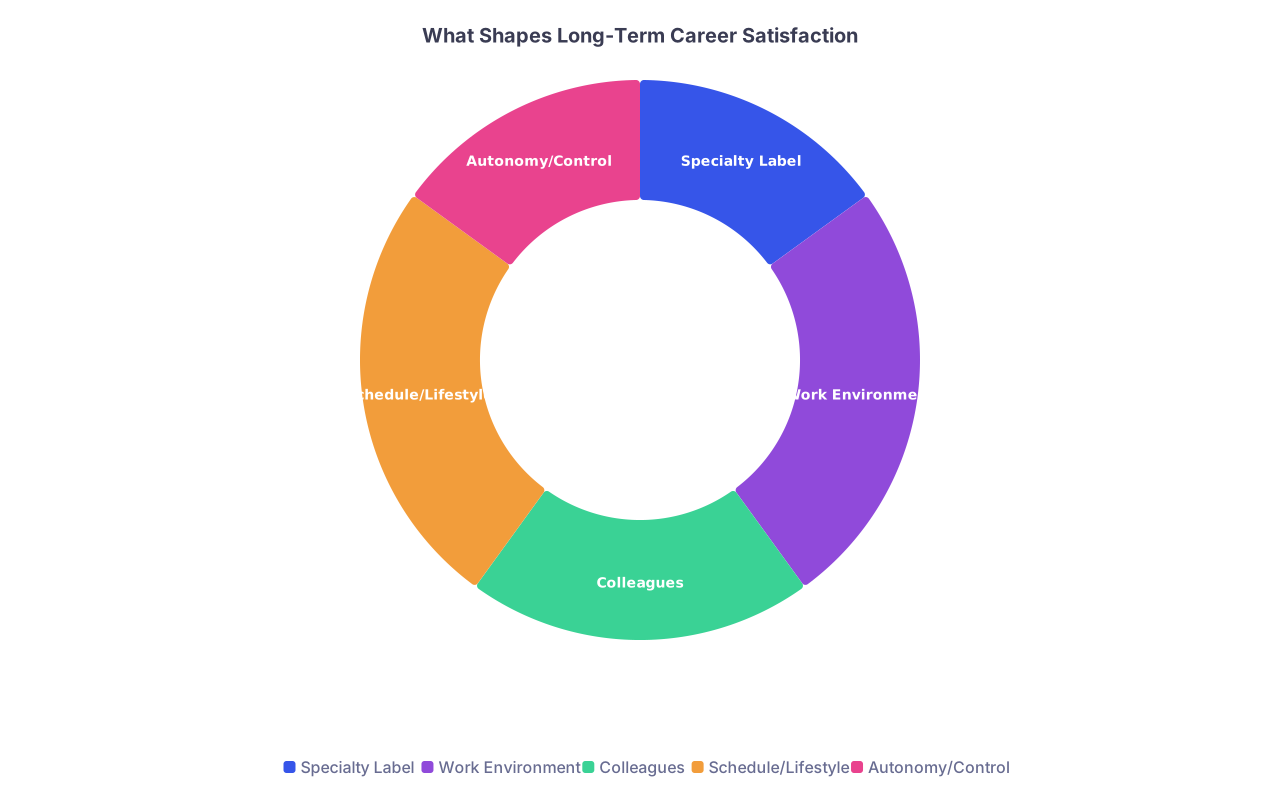
Notice how small “Specialty Label” actually is in the long run. The field matters, obviously. But being in a malignant program with 80-hour weeks and toxic seniors in your “dream specialty” is way worse than being in a solid, supportive program in your “backup.”
I’ve literally heard people say: “I got my dream specialty but not my dream life.”
You’re trying to build a life. Not a flex for your med school reunion.
You’re Allowed to Be Sad And Move Forward
You don’t have to pick one:
- Grieve the path you’re not taking
or - Be grateful for the path you are
You can do both. At the same time.
You can look at your future specialty and think, “This is good, and I can see myself thriving here,” while a part of you still aches for the version of you that wore a different badge.
Grief doesn’t mean you made the wrong choice. It just means you’re human.

One day, you’ll be rounding or in clinic or signing out your patients, and someone will say, “I can’t imagine you doing anything else.”
And it’ll sting a little. But also feel a little true. Bit by bit.
You don’t have to believe that today. Just don’t lock yourself into the story that you “ruined” your life because one version of your career didn’t happen.
You’re writing a different version now. Messier, less linear, but still valid.
FAQs
1. What if I always secretly wonder “what if” about my dream specialty?
You probably will. Most people do, at least a little. That doesn’t mean you chose wrong. It just means you’re aware there were other possible lives you could’ve lived. Try to be curious about that feeling instead of hostile toward it. “Yeah, that path looked interesting. But here’s what I have now that I wouldn’t have had there.” Over time, the “what if” usually gets quieter.
2. Should I reapply to my dream specialty later or just commit to my backup?
Honest answer: it depends on how realistic a reapplication actually is and what your life will look like while you’re “keeping the dream alive.” If reapplying means years of prelim spots, no income stability, and constant uncertainty, you need to be brutally honest about whether that’s worth it for you. Talk to PDs and mentors in that field, not just Reddit. Get real odds and real pathways. Then decide like an adult, not from panic.
3. How do I stop feeling ashamed when I tell people my backup specialty?
Practice a neutral, matter-of-fact script and stop over-explaining. Shame loves long, defensive explanations. Something like: “I’m applying internal medicine—I’m really interested in complex chronic disease and keeping some future flexibility.” Say it like it’s normal. Because it is. The more you say it, the less it’ll feel like a confession and the more it’ll feel like a fact.
4. What if I end up hating my backup specialty?
Then you’ll be like a decent percentage of physicians who realize their first pick wasn’t the right fit. People switch fields. People pivot their practice type (inpatient to outpatient, procedures to clinic, academic to private). Residency isn’t prison. It’s harder to change once you’re deep into training, but it’s not impossible. Also, don’t judge the whole specialty by your worst rotation or your most burned-out attending.
5. How do I know if I’m grieving a dream vs. actually choosing the wrong specialty?
Ask yourself: “If I’d never had that dream specialty in my head, and I just looked at the day-to-day life, patients, and long-term lifestyle of this backup—would it seem reasonable? Maybe even pretty good?” If the answer is yes but you still feel sad, that’s grief. If the answer is a hard no—you hate the patient population, the work, the culture—then you might be forcing yourself into something that isn’t you. That’s when it’s worth pausing and getting serious, non-sugar-coated advice from attendings who know you.
Years from now, you won’t forget that you once wanted something different. But you also won’t be defined by the specialty you didn’t choose. You’ll be defined by the kind of physician you became in the specialty you did. And how you treated yourself through this painful, in-between part? You’ll remember that most of all.