
You open your email on Match Day, hands shaking, heart in your throat. The word “Congratulations” flashes on the screen… and your stomach drops. It’s not your dream specialty. It’s the backup. The one you swore you’d “be fine with” but never really believed you’d actually end up in.
And then the thought hits like a truck: “What if I hate this? What if I regret this for the rest of my life?”
Let’s stay there for a minute, because that’s the fear, right? Not just “I matched my backup.” It’s “I ruined my life, my career, my identity, and I can’t escape.”
I’m going to walk straight into the worst-case scenarios you’re obsessing over and sort out what’s real, what’s distorted, and what you can actually do next.
First: Are You Actually Screwed If You Match Your Backup?
The brain loves absolutes when it’s terrified: “forever,” “never,” “ruined,” “trapped.”
Reality is messier. Which is good. Messy means options.
There are basically a few different “backup situations” people end up in:
- You matched your backup specialty at a solid program you like “okay,” but you’re mourning your dream.
- You matched your backup specialty at a program you’re not excited about at all.
- You matched a backup specialty you’re now realizing you might actually dislike.
- You matched prelim in one thing but wanted categorical in another.
They all feel catastrophic in the first 24–72 hours. Your brain doesn’t differentiate shades of gray when it’s in survival mode. It just screams: “Wrong specialty. Wrong life.”
Here’s the part no one says out loud: every year, people match their backups. And every year:
- Some end up genuinely happy and never look back.
- Some stay in the backup specialty but change programs or carve a niche that makes it fulfilling.
- Some switch specialties after PGY-1 or later.
- Some grieve hard for a while, then quietly build a really good life anyway.
The “regret forever” story is the loudest in your head right now. That doesn’t make it the most likely.
What Changes Once You’re Actually IN a Backup Specialty
Matching a backup looks one way in your imagination and another way in real life. Your internal monologue right now is based on:
- Rotations you did as a student (which are a tiny, curated slice of reality)
- What attendings, residents, or Reddit told you
- Identity stuff (“I’m a surgery person,” “I’m too ‘X’ for Y specialty”)
When you actually start residency, three big things tend to happen:
Your sense of identity shifts.
As an MS4, your “specialty” feels like your entire personality. Once you become “Dr. So-and-so,” your identity broadens: team member, resident, future attending, human with a non-hospital life. That loosens the grip of “I MUST BE X OR I’M NOTHING.”You see the full specialty, not the highlight reel.
Cards isn’t just STEMIs and cool caths. Derm isn’t just rashes and 4-day weeks. Psych isn’t just therapy and meds. You see the call structure, the culture, the admin drama, the lifestyle impact. A specialty you romanticized can lose its shine; a backup you discounted can feel surprisingly right.You start to care less about what others think.
Right now, you might be haunted by “What will my classmates think?” or “Everyone knows I didn’t want this.” By late PGY-1, your energy goes into surviving, learning, and maybe sleeping. You have less capacity to obsess about everyone else’s opinion of your Match outcome.
Does that magically fix everything? No. Some people genuinely realize: “This isn’t my fit.” But at least then it’s based on real experience, not fear.
Short-Term Coping: What To Do in the First 30–90 Days
I’m not going to throw toxic positivity at you. You’re allowed to be gutted. But you also can’t live in that place indefinitely. You need a game plan.
1. Name the specific fear
“Regret forever” is too big and vague. Break it into concrete worries:
- “I’ll hate the day-to-day work.”
- “I’ll never get to do [procedure/field] I love.”
- “I’ll burn out and be stuck.”
- “I’ll feel like a failure compared to my friends.”
Concrete fears can be problem-solved. Vague dread just sits on your chest.
2. Separate grief from actual misfit
Right now, you’re probably grieving The Dream. That’s different from your backup actually being wrong for you.
Ask yourself:
- On rotations, what parts of my dream specialty did I actually enjoy?
- Are any of those elements present in my backup? (patient population, acuity, procedures, continuity, team structure)
- Am I upset because I don’t like this specialty—or because I didn’t get what I wanted?
You can absolutely both grieve and give your matched specialty a real chance.
3. Set a “no huge decisions” rule
Decide in advance: “I won’t make any major career change decisions until at least [month 6–9 of PGY-1].”
Why? Because:
- The first few months are brutal in any specialty.
- You’re adjusting to being a doctor, not just to the field.
- Early misery looks the same whether or not you’re in the right specialty: tired, overwhelmed, impostor syndrome, constant pages.
Promise yourself you’ll collect data before you decide your entire career is a failure.
What If I Really Do Hate It? (The Exit Routes)
You want to know the nuclear options. Fair.
There are several actual paths people take when they match their backup and it doesn’t feel right long-term.

1. Switching specialties after PGY-1
This is the most common real-world move.
You complete intern year, get solid evaluations, and then:
- Apply to open PGY-2 spots in your desired field (they exist every year in many specialties).
- Or re-enter the Match for that specialty (less efficient but sometimes necessary).
Programs care about:
- Your performance in your current residency
- Letters from your PD and faculty
- A clear, non-dramatic explanation for the switch
Is it easy? No. Is it rare? Not really. I’ve seen people go from IM → Neuro, IM → Anes, Surgery → Radiology, Psych → Neuro, etc.
2. Switching within a related or adjacent field
Sometimes you realize: “Ok, not this exact niche, but something nearby.”
Examples:
- IM → Cards, GI, ICU, hospice/palliative, allergy, etc.
- Peds → Peds EM, palliative, adolescent medicine
- Psych → Consult-liaison, addiction, sleep
- FM → Sports med, palliative, urgent care, academic med
You might stay in your “backup” residency but steer your career toward a subfield that scratches more of your original itch.
3. Finishing your training and designing a life-heavy practice
Another truth no one tells you as a student: a lot of physicians don’t “love” every aspect of their specialty. They like it enough. And then they make their real joy come from:
- Where they live
- Their schedule (outpatient vs hospital, part-time vs full-time)
- Their side interests (teaching, admin, QI, advocacy, entrepreneurship)
- Their actual life outside medicine
You’re allowed to say: “This specialty is… fine. I’m going to optimize the rest of my life instead of endlessly chasing the perfect field.”
4. Leaving clinical medicine earlier than planned
This is the very dark fear you probably don’t want to say out loud: “What if this makes me quit medicine entirely?”
Some people do eventually step back: medical writing, industry, consulting, admin, tech, etc. That’s real. But almost always, those choices come after years of accumulating data, not because of one mismatch at age 26.
You don’t have to pre-decide your entire exit story on Match Day.
The Cold, Practical Stuff: How Transfer-Friendly Is Your Backup?
Some specialties make switching slightly easier; some make it harder. It’s not hopeless in any direction, but there are patterns.
| Current Specialty | Relative Ease to Switch | Common Targets |
|---|---|---|
| Internal Medicine | Easier | Neuro, Anes, PM&R, Psych |
| Transitional/Prelim Year | Easier | Anes, Radiology, Neuro |
| Family Medicine | Moderate | Psych, Palliative, Sports |
| General Surgery | Moderate | Anes, Radiology, IM |
| Psychiatry | Moderate | Neuro, FM, IM |
| Neurology | Moderate/Harder | IM, Psych |
Not a law of physics—just rough patterns I’ve seen.
The big levers that matter if you might want to switch:
- Get good evals in PGY-1 (even if you’re unsure about staying).
- Don’t trash your current specialty publicly. Word travels.
- Build relationships and ask for honest mentorship about switching once you’ve done some time in the program.
Which brings me to…
How To Approach Your PD If You’re Thinking About Switching
This is the part that probably makes you sweat: “If I tell my PD I want to switch, they’ll hate me / sabotage me / think I’m ungrateful.”
Reality is mixed. Some PDs are incredibly supportive. Some are… not.
Here’s how to not blow yourself up:
Wait until you have enough experience.
Not week 2. Usually mid-to-late PGY-1 (or at least after several months) unless there is something acute and dangerous going on.Frame it as: “I want to make the right long-term fit.”
Not “I hate this” or “I never wanted to be here.” More like:
“I’m noticing that my interests and strengths seem to align more with [X]. I want to talk honestly about whether long-term that might be a better fit.”Make it clear you’re committed to doing good work while you’re there.
Programs will be more supportive if they know you won’t mentally check out:
“Regardless of what happens, I’m committed to giving my best to this program and our patients while I’m here.”Ask for guidance, not demands.
“How have you seen residents successfully transition in the past?”
“What would you need from me if I were to explore this path?”
Is there risk? Yes. Some PDs won’t love it. But a surprising number will help you quietly explore options.
If You’re Still in the Application Stage: Picking Backup Specialties Without Destroying Your Soul
Maybe you’re not matched yet. Maybe you’re spiraling about backups now: “What if I pick the wrong one and doom myself?”
You’re not crazy for stressing. Backup choices are high-stakes. But there’s a smarter way to pick them than “whatever seems kinda OK.”
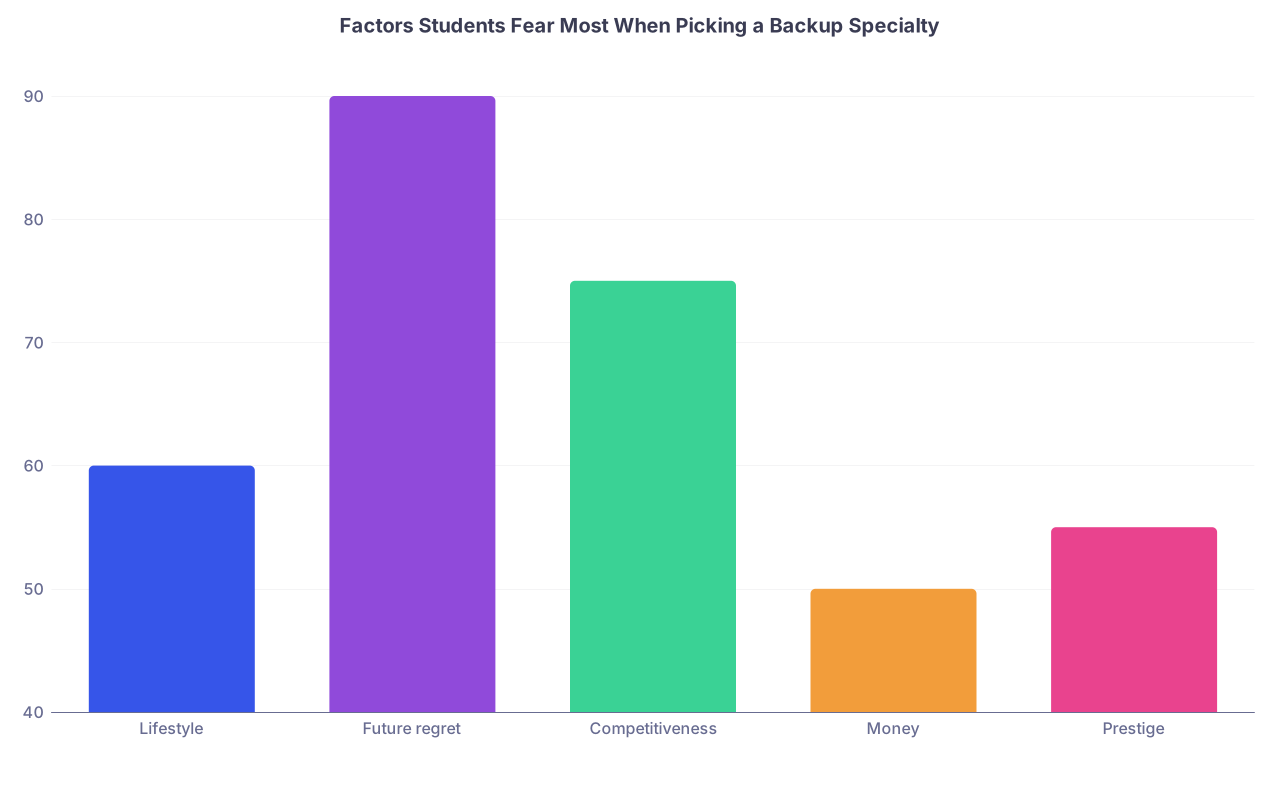
| Category | Value |
|---|---|
| Lifestyle | 60 |
| Future regret | 90 |
| Competitiveness | 75 |
| Money | 50 |
| Prestige | 55 |
Here’s how I’d approach it if I were in full-anxious mode (which, honestly, I would be):
List what you actually enjoy day-to-day.
Not what sounds impressive. Examples: procedures vs talking, acute vs chronic, continuity vs variety, kids vs adults, etc.Identify adjacent specialties to your dream.
Surgical → maybe Anes, EM, Radiology.
IM → maybe Neuro, Psych, FM, PM&R.
Peds → FM with strong peds, peds neuro, peds psych.Do at least a short rotation in the backup.
Not a random 3-day exposure. A real block. Notice: do you leave the day completely drained and hating everything, or “tired but okay”?Test your “I’d rather do nothing than this” line.
If you genuinely believe: “I would rather not match than match this,” then it’s not a real backup. Don’t gaslight yourself. Rank it accordingly.
Most people know, deep down, 1–2 specialties they’d be “okay” with. Not in love with. Not starry-eyed about. But okay. That’s a valid backup.
Building a Life You Don’t Regret, Even If The Path Isn’t Perfect
Here’s the part that sounds cheesy but ends up being true: regret isn’t just about what you matched into. It’s also about how you show up once you’re there.
I’ve watched people with “perfect matches” end up miserable because they clung to a fantasy version of their field and refused to adapt. I’ve watched backup-match people quietly build beautiful lives because they:
- Allowed themselves to grieve without staying stuck
- Stayed open to being surprised by what they liked
- Talked to mentors instead of spiraling alone
- Made deliberate choices after they had real data, not while panicking
Your specialty is one big piece of the puzzle. It’s not the whole picture.

| Step | Description |
|---|---|
| Step 1 | Match Backup Specialty |
| Step 2 | Consider switching |
| Step 3 | Give it more time |
| Step 4 | Stay and optimize |
| Step 5 | Talk to PD and mentors |
| Step 6 | Apply to other specialties |
| Step 7 | Adjust expectations and routines |
| Step 8 | Subspecialize or shape practice |
| Step 9 | First 6-12 months |
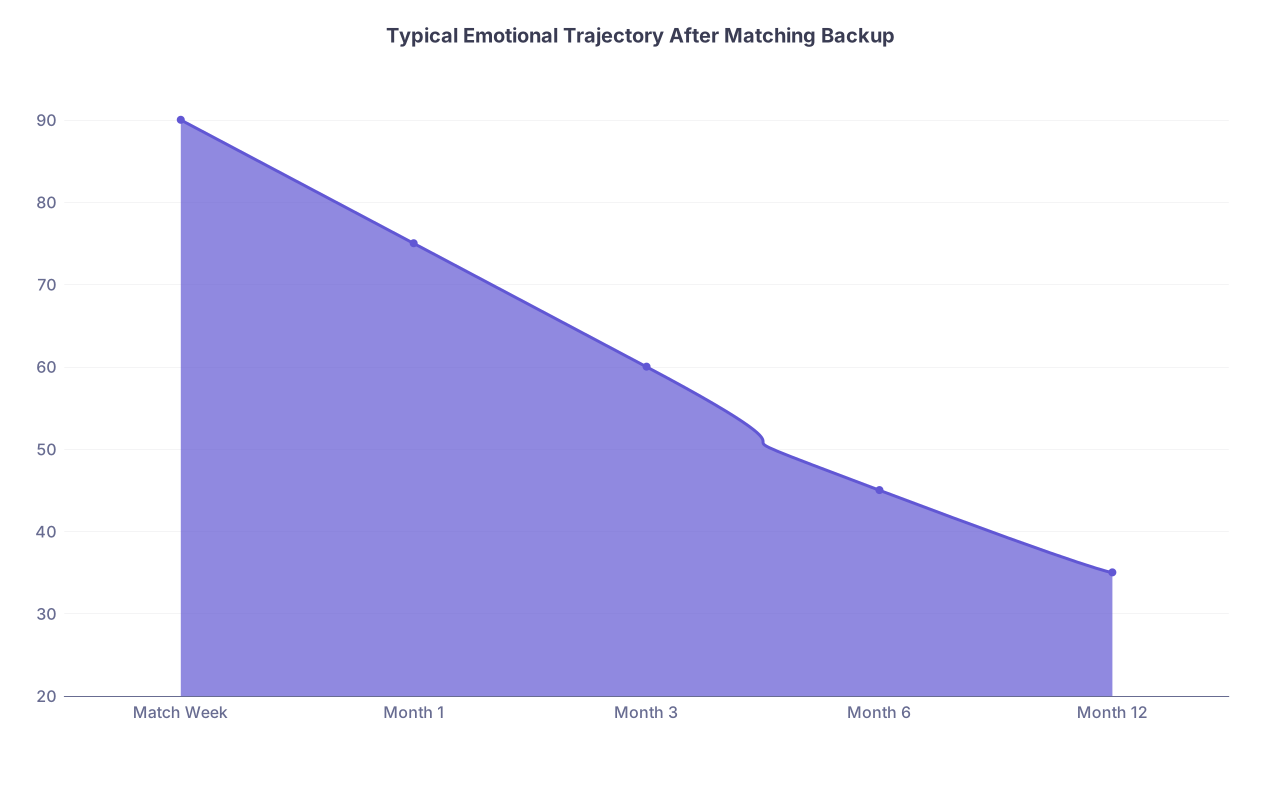
| Category | Value |
|---|---|
| Match Week | 90 |
| Month 1 | 75 |
| Month 3 | 60 |
| Month 6 | 45 |
| Month 12 | 35 |
(Where 100 = “maximum panic/regret.” It usually drops. Slowly. Unevenly. But it drops.)

FAQ: The 5 Questions That Keep You Up at 3 a.m.
1. What if I know before starting residency that I already regret my backup?
Then:
- Let yourself grief-dump privately (journal, therapist, trusted friend).
- Still start the program. You need real exposure.
- Quietly track what you like/hate on rotations.
- After a few months, talk to a trusted attending or chief about your concerns.
Pre-start regret is usually 80% fear, 20% data.
2. Will programs in other specialties judge me for matching a backup first?
They’ll judge your story, not the word “backup.” If you come in with:
- Honest narrative: “I thought X, I learned Y, now I know Z about myself.”
- Strong performance in your current role
- Respectful attitude toward your original program
You’re fine. People switch. Faculty know this. The “you’re damaged goods” narrative is mostly in your head.
3. How long should I stay before deciding to switch specialties?
Most people need at least 6–12 months of real residency time to know. The first few months are chaos in any field. If you still feel a consistent, baseline misalignment around month 9–12—even on your “better” rotations—then a switch conversation makes sense.
4. What if I stay in my backup specialty and always feel like I settled?
Hard truth: you might always have a tiny “what if” corner in your brain. Lots of people do—about careers, partners, cities, everything. But that’s different from active regret. Over time, that voice usually softens if you’re intentional about:
- Carving a niche you enjoy
- Building a life outside work that actually feels good
- Not constantly comparing yourself to some imaginary alternate universe
5. Is it ever reasonable to not rank backups and risk going unmatched?
Yes—but only if you’re brutally honest with yourself. If a specialty truly feels like a trap you’d resent every day, it may be better to go unmatched and re-apply more strategically than to enter training you know you’ll want to escape. That said, most people’s “I’d hate this” prediction is less accurate than they think. Talk to mentors who know you before making that call.
Years from now, you probably won’t remember the exact wording of your Match letter or how hard your hands shook opening it. You’ll remember what you did with the hand you were dealt—whether you stayed, switched, or reinvented your path. The fear of “regret forever” feels huge right now. But forever is built out of a lot of small, imperfect choices, and you still have more of those left than your anxiety wants you to believe.