
What if the person you trust most for career advice is also the person you’re most afraid to disappoint?
That’s the heart of this, right? You’re staring at your ERAS list, your dream specialty feels like a lottery ticket (derm, ortho, ENT, plastics, neurosurg, or honestly even EM and peds in some regions now), and every time you think “I should talk to my mentor about a backup,” your brain screams:
“They’ll think I’m weak.”
“They’ll give up on me.”
“They’ll stop advocating for me.”
“They’ll tell everyone I’m not serious.”
I’ve watched people freeze at this exact point and quietly tank their chances because they were more afraid of an awkward conversation than of going unmatched. That sounds dramatic, but it happens. Every. Single. Year.
Let’s talk about how to approach this without blowing up the relationship, sabotaging your primary specialty, or sounding like you’ve given up on yourself.
First, what’s actually scaring you?
You’re not just “nervous.” You’re game-theory-level worried. The fear usually breaks down into a few specific nightmares:
- Your mentor sees you as “one of their people” in their specialty, and you’re scared they’ll see any doubt as betrayal.
- You think if you even say the word “backup,” you’ll jinx your main specialty.
- You’re worried they’ll tell other faculty, “This one doesn’t really want it,” and there goes your letter power.
- You don’t know how honest to be about your stats: low Step 2, average clerkship grades, no research, or a late discovery of the field.
Here’s the uncomfortable truth: the match doesn’t care how loyal you are to a specialty. It only cares about your application, the numbers, and how many chairs exist. You can be the most committed ortho applicant on earth and still not match if your application doesn’t clear the bar.
Being “all in” without a backup isn’t brave. It’s just risky. And your mentor—if they’re any good at their job—cares more about you having a residency spot than about you worshipping their specialty.
When do you actually need a backup specialty?
You’re probably trying to answer this alone in your head. Stop. It’s like diagnosing yourself off UpToDate without seeing a patient.
But let’s be blunt. If any of these sound like you, you should at least be thinking about a backup:
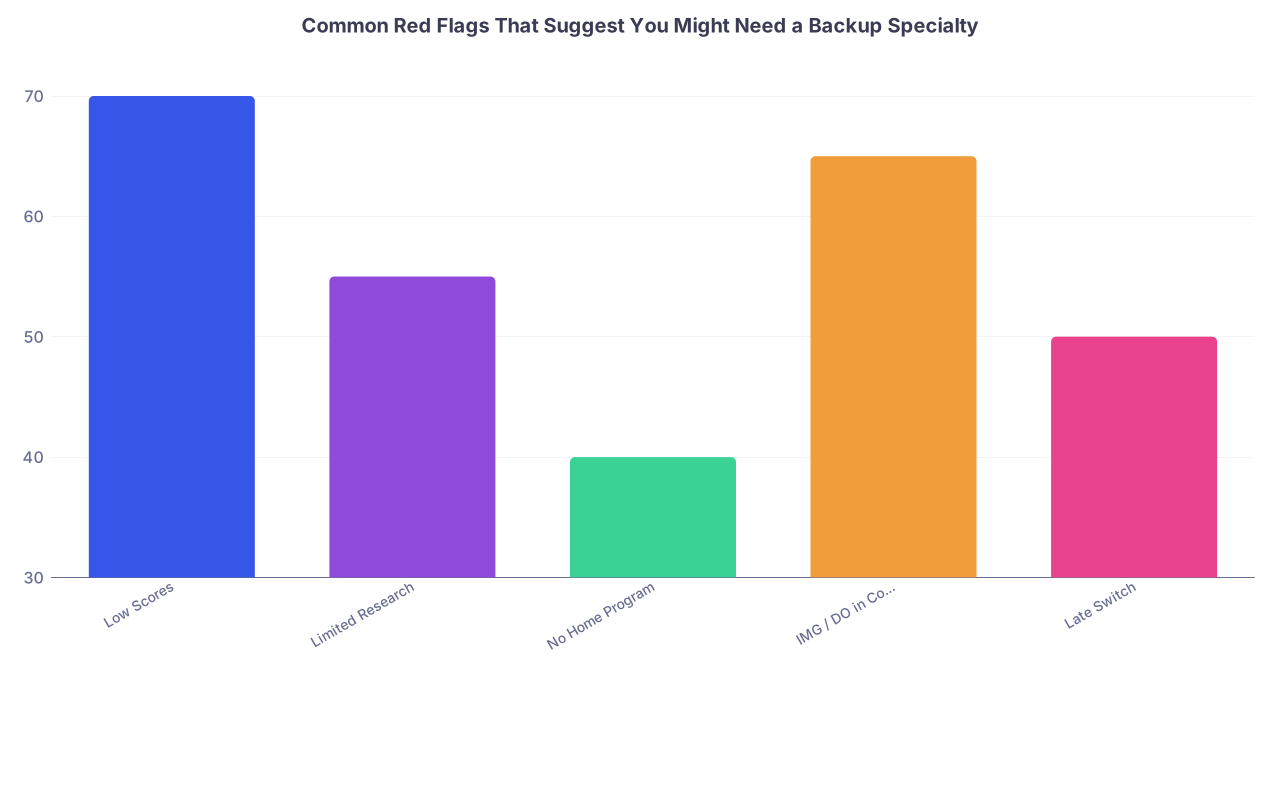
| Category | Value |
|---|---|
| Low Scores | 70 |
| Limited Research | 55 |
| No Home Program | 40 |
| IMG / DO in Competitive Field | 65 |
| Late Switch | 50 |
Not all red flags are equal, but if you stack a couple of these together—say a 232 Step 2, 1 ortho letter, no home ortho program—going all-in on a hypercompetitive specialty is… ambitious. Let’s call it that.
You don’t have to decide your backup first. You just have to be brave enough to say: “I might need one. Can we talk about it?”
That’s the conversation your mentor should help you with.
How to frame the conversation so you don’t sound like you’re quitting
The biggest mistake I see: people come in hot with, “I don’t think I’ll match, I’m panicking, should I just switch to IM?” Mentors hear that as: this person isn’t stable, isn’t committed, and I’m not sure I can put my name on them.
You want to sound realistic, not defeated.
Think of it as three parts:
- Reaffirm your commitment to your primary specialty
- Ask for an honest risk assessment
- Then bring up backup strategy as a plan, not a panic move
You can literally script this. Something like:
“I want to start by saying I’m still really committed to [primary specialty]. Working on [rotation / research / project] with you has made that even stronger.
At the same time, I’ve been looking at my application realistically—my Step 2 is a 234, my research is limited, and I know [specialty] has gotten more competitive. I really value your honest opinion: how risky do you think it is for me to apply only to [primary specialty]?
If there’s a significant risk I might not match, I’d really like your help thinking through a backup plan that still fits my interests but protects me from going unmatched.”
You’re doing three important things there:
- You’re not backing away from the specialty, you’re doubling down on your genuine interest.
- You’re inviting them to be blunt without you falling apart.
- You’re putting “backup” in the frame of planning, not surrender.
Mentors respond better to, “I want to be thoughtful and responsible,” than to, “I’m freaking out and want to bail.”
What if your mentor is in your dream specialty?
This is usually when the anxiety spikes. Like, “how do I tell the cardiologist who’s been emailing PDs for me that I might also apply to anesthesia?”
There’s a difference between:
“I don’t really want your field anymore,”
and
“I want your field, but I also want a job and a future if it doesn’t work out.”
You’re not cheating on them. You’re protecting yourself.
With a mentor who’s deep in your dream specialty, I would be extra explicit:
“I want to be very clear: [specialty] is still my top choice by far. My plan is to build the strongest [specialty] application possible.
At the same time, based on my [scores/grades/research], I’m worried about the real possibility of not matching. I don’t want to blindside myself in March. Would you be comfortable helping me think about what a smart backup might be—one that I’d still be happy in, but that’s more realistic as a safety net?”
Most attendings, especially in competitive fields, have seen heartbreak. They’ve seen excellent students not match. The good ones hate that. Many will actually respect you more for being proactive.
If they react poorly—“Well, if you’re thinking backup, maybe you’re not cut out for this”—that’s not a you problem. That’s a them problem. And it’s a big clue you might need more than one mentor.
How honest should you be about your fear?
You can be honest about being worried without sounding unstable. The line I try not to cross is making the mentor feel like they have to talk you off a ledge.
Saying:
“I’m anxious given how competitive this is, and I want to make sure I don’t end up unmatched.”
is fine.
Saying:
“I’m having daily panic attacks and refreshing Reddit for doom posts, and I’m thinking about switching to psych, gas, IM, literally anything that will take me,”
is… a bit much for a career meeting. That’s for therapy, friends, or student counseling. Mentors can support you, but they’re not mental health providers, and if they feel emotionally responsible for stabilizing you, they may pull away.
You want to project: “I’m anxious but still functional and planning-oriented.”
How to actually choose a backup specialty (without feeling like you’re “settling”)
I know, you’re thinking: “How do I even pick a backup? Do I just go to IM by default? Is that what everyone does?”
No. And also, sometimes yes. Depends.
Here’s the reality: good backup choices usually share something with your primary—patient population, procedures, acuity level, lifestyle vibe, or intellectual focus.
| Primary Specialty | Common Backup(s) |
|---|---|
| Dermatology | Internal Med, Pathology |
| Orthopedic Surg | General Surg, PM&R |
| ENT | General Surg, FM |
| Neurosurgery | Neurology, IM |
| Plastics | General Surg, IM |
| EM (in tight markets) | IM, FM, Psych |
Is this table perfect? No. But it’s closer to how people actually do this than the fantasy of “I’ll just do something totally unrelated.”
When you talk to your mentor, you can say:
“These are the backup fields I’ve been considering because [specific reasons: I like procedures, I like longitudinal care, I like ICU-type patients]. I’d really value your perspective on which might make the most sense given my application and what you’ve seen others do.”
That signals: you’ve thought about this, you’re not flailing, and you’re still asking for their expertise.
Will talking about a backup hurt your letters?
This is the knife at your throat, right? The nightmare is:
You: “I might need a backup.”
Mentor (internally): “Cool, then I won’t stick my neck out.”
In reality, strong mentors separate “this person is realistic” from “this person doesn’t care.”
The letters that hurt you aren’t from people who know you’re considering a backup. They’re from people who think:
- You’re not reliable
- You’re not actually interested in their field
- You’re a mediocre team member
- You’re emotionally volatile
Notice what’s not on that list: “is aware that matching is hard.”
You can even preempt this subtly:
“If you feel comfortable continuing to support me in [primary specialty] with a strong letter, I’d be incredibly grateful. My hope is still to match there. I just don’t want to ignore the numbers and wind up without a spot anywhere.”
You’re telling them directly: I still need you in my corner for this field.
If someone pulls their support because you responsibly asked about backups, that’s about their ego, not your worth.
What if your mentor basically says “yeah, you need a backup”?
That can sting. It feels like, “I don’t believe in you.” But usually, it’s more like, “I’ve seen a lot of people with your stats go unmatched in this field, and I don’t want that for you.”
Here’s how to survive that moment without crumbling:
- Take a breath. This isn’t them calling you a bad future doctor.
- Ask very direct questions:
- “If you had to guess a rough percent chance of me matching in [primary specialty] as-is, what would you say?”
- “What could I realistically do this year to improve those odds?”
- “What backup specialty would you consider if you were in my shoes?”
You’re turning a painful truth into actual strategy. That’s how adults handle bad odds.
And sometimes mentors will say the quiet part out loud: “Honestly, if you were my kid, I’d tell you to dual apply.” That’s not cruelty. That’s protection.
Structuring a dual-application strategy (without blowing yourself up)
If you end up dual applying—say, OB/GYN + IM, or Ortho + PM&R—your next fear is: how do I not look flaky in both?
A few rules that keep people out of trouble:
- You do NOT need to tell every program you’re dual applying. You only need to be honest if they directly ask, and even then, you can be measured.
- Keep your personal statement and letters tailored to each specialty. No “I love surgery and also continuity of care in clinic and also psych and also radiology” essays.
- With mentors, you can say:
“My plan is to apply to around [X] programs in [primary specialty] and [Y] programs in [backup]. I’ll still approach this cycle as if my primary goal is [primary specialty], but I want that safety net.”
That sounds strategic, not desperate.
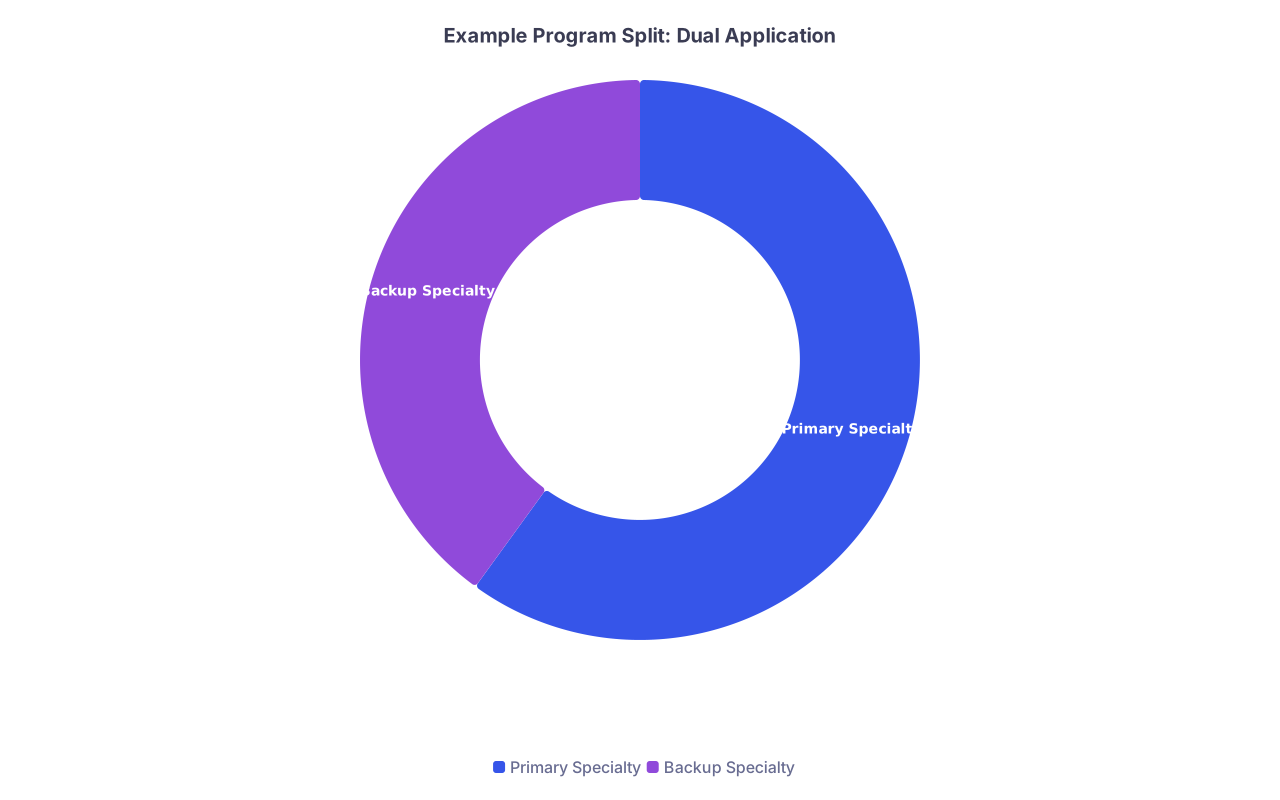
| Category | Value |
|---|---|
| Primary Specialty | 60 |
| Backup Specialty | 40 |
You don’t have to share exact numbers with your mentor if that feels weird, but having a rough framework shows you’re not just flipping tables emotionally.
How to start the conversation without spiraling
If the idea of booking the meeting alone makes you nauseous, script even that part.
Email version:
“Hi Dr. [Name],
I was hoping to schedule 20–30 minutes to talk about my residency application strategy. I’m still very interested in [primary specialty], and I’d really value your honest assessment of my chances and whether a backup plan might make sense. Your perspective would mean a lot as I’m finalizing my approach for this cycle.
Thank you,
[Your Name]”
You’re flagging the topic ahead of time, so it doesn’t feel like you sprung a career crisis on them in a 10-minute hallway chat.
And if you’re someone who blanks out in stressful conversations? Bring a very short bullet list of what you want to cover. You don’t have to show it to them. It’s just there so you don’t walk out having said nothing you meant to say.
You’re not disloyal for wanting a safety net
This whole mess is built on one toxic myth: that “true passion” for a specialty means you’re willing to risk going unmatched for it.
That’s nonsense.
You can love ortho and still want a paycheck. You can be obsessed with derm and still not want to scramble into a prelim year at a place you hate. You’re allowed to care about your life more than your brand.
The mentors who are truly in your corner will get that. The ones who don’t… you’ll outgrow them.

| Step | Description |
|---|---|
| Step 1 | Realize primary is competitive |
| Step 2 | Self assess scores and CV |
| Step 3 | Schedule mentor meeting |
| Step 4 | Apply only primary |
| Step 5 | Consider dual apply |
| Step 6 | Primary as reach, strong backup |
| Step 7 | Identify backup fields |
| Step 8 | Tailor PS and letters |
| Step 9 | Submit applications |
| Step 10 | Mentor risk assessment |
FAQ (Exactly 6 Questions)
1. Should I ever hide my backup plans from my primary specialty mentor?
If they’re your main letter writer and advocate, hiding it usually backfires on you. They can’t advise you properly if they don’t know your actual risk tolerance or plans. That said, you don’t have to give them a program-by-program breakdown. Share the big picture: “I’m applying broadly in [primary], and also a smaller number in [backup] as a safety net.” If your gut screams that they’d punish you for even considering a backup, that’s a red flag about the mentorship, not you.
2. What if my mentor says, “You’ll be fine, don’t worry,” but my stats are clearly below average?
That’s not a plan. That’s vibes. Push back (respectfully): “I really appreciate your confidence. Would you feel comfortable comparing my application to typical matched applicants in this field? I want to be sure I’m not underestimating the risk.” If they still hand-wave it, find a second opinion: a PD, another attending, a senior resident in the specialty who knows recent match outcomes. Blind reassurance is not your friend.
3. Can I ask one mentor to support me for two specialties?
Yes, but be specific. “Would you be comfortable writing a [specialty]-focused letter, and potentially a more general letter that could support [backup specialty] as well?” Some attendings are totally fine with this, especially if your strengths (work ethic, teamwork, clinical reasoning) translate across fields. Just don’t send a deeply [primary]-centric letter to your backup specialty. That looks lazy and confused.
4. What if my mentor gets visibly disappointed or cold when I bring up a backup?
That sucks, but don’t immediately backtrack just to appease them. Stay calm. “I want you to know this isn’t about losing interest in [specialty]. It’s about not wanting to go unmatched if things don’t work out. I really value your guidance and hope we can plan for both the best and worst case.” If they continue to pull away, it’s time to quietly diversify your support network—residents, other attendings, maybe a different letter writer.
5. Am I hurting my primary specialty chances by spending time on a backup application?
There’s a tradeoff, yes. Time is finite. But going unmatched is worse. The trick is sequencing: front-load your primary specialty (strong letters, home rotation, research if possible) and build the core of your backup later in the summer/fall once your primary elements are solid. You don’t need a perfect backup app; you need a credible one that gives you a non-zero shot at matching somewhere you can live with.
6. What if I’m late in the cycle and just now realizing I may need a backup?
You’re not the first. Or the last. Tell your mentor exactly that: “I’m realizing later than I should have that my risk may be higher than I thought. Is there still a realistic way to build a backup option at this stage?” Even a partial backup—fewer programs, maybe not the most competitive locations—is better than nothing. You may have to hustle on short notice for letters and PS, but scrambling now beats scrambling in March.
Key points: You’re not a traitor for wanting a backup. You do need to talk about it directly and early with your mentor. And you’re allowed to protect your future, even if it makes for one uncomfortable conversation.