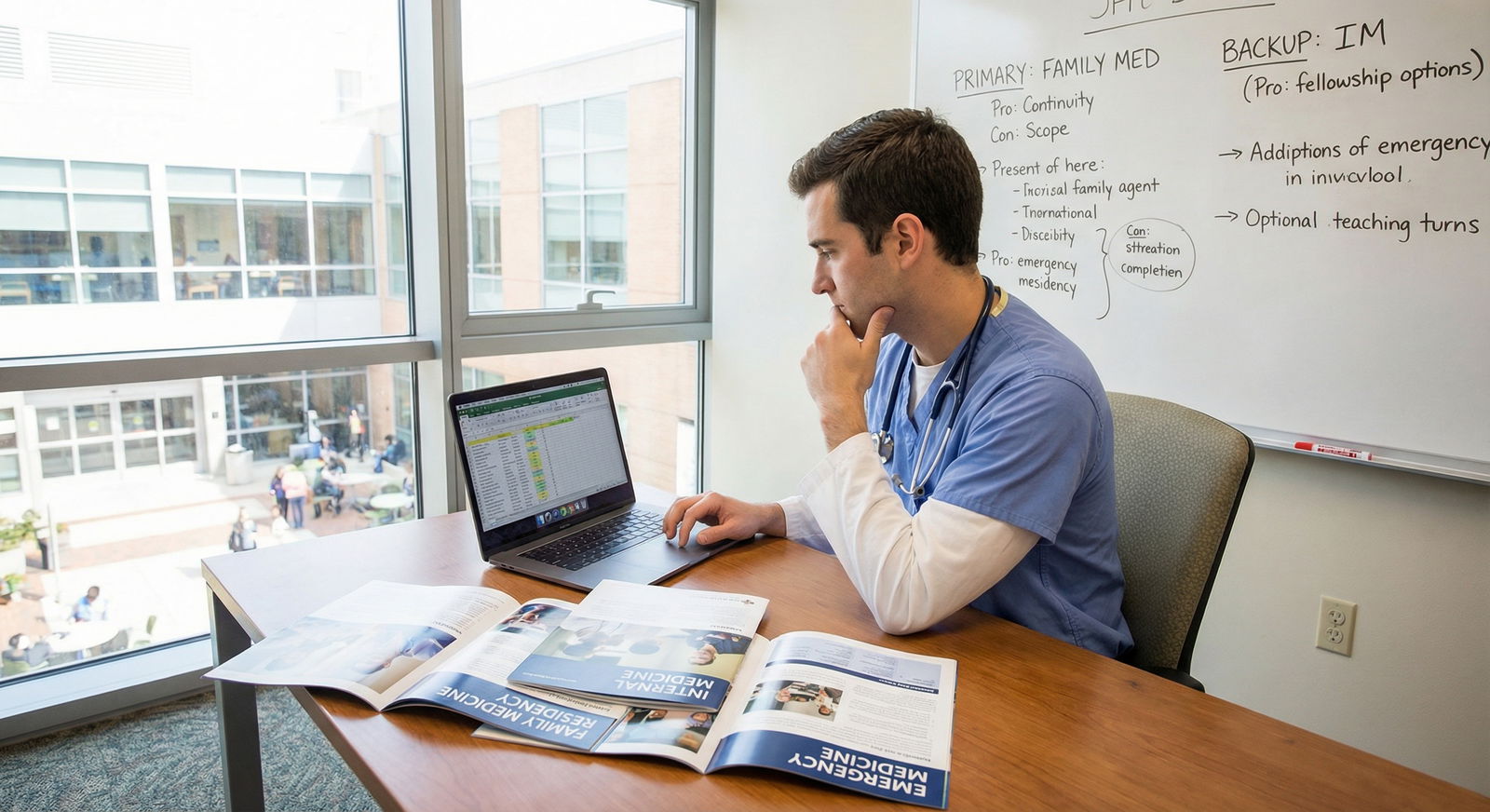
Last night I stared at my ERAS spreadsheet until the rows blurred. Main specialty list on one tab, “backups???” on another, mostly blank. My brain just kept looping: “You’re too late. Everyone else already has this figured out. You screwed this up.”
If that sounds even a little like you, keep reading. Because you are probably later than you wanted to be. But you’re not as doomed as your 2 a.m. brain is telling you.
First: Are You Actually Too Late?
Let me be blunt: yes, starting backup planning at the end of the application season is not ideal. Programs have their vibes, their shortlists, their “we liked them on paper” piles.
But “not ideal” is not the same thing as “game over.”
Here’s the real question you should be asking:
“Given where I am right now, what actions still move the needle, even a little?”
Because there are things that still help—even if:
- Your personal statement is already submitted
- You’ve certified your ERAS
- You’ve received very few invites in your main specialty
- Your friends already have interview spreadsheets with 12+ programs
You’re not going to magically turn into a heme/onc superstar applicant overnight. But you can absolutely make yourself a stronger, more coherent candidate for carefully chosen backup specialties. And you can stop doing the things that are just anxiety-disguised-as-productivity.
Let’s anchor this in reality.
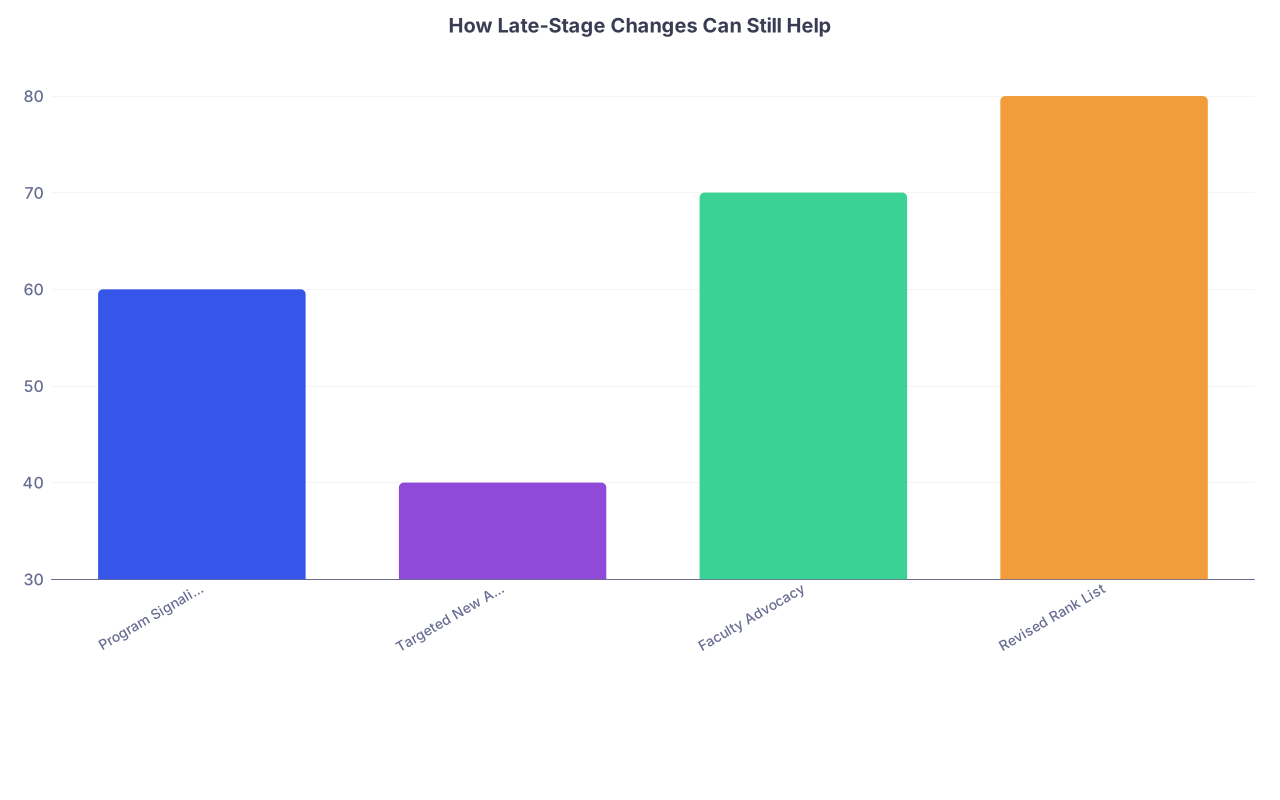
| Category | Value |
|---|---|
| Program Signaling Emails | 60 |
| Targeted New Applications | 40 |
| Faculty Advocacy | 70 |
| Revised Rank List | 80 |
(Those percentages are my rough sense of relative impact late in the game, not exact data. But you get the idea: some levers still matter a lot.)
Step 1: Get Honest About Your Risk Profile
You can’t pick smart backups until you admit how much risk you’re actually carrying. And no, “maybe it’ll be fine” is not a plan.
Ask yourself a few uncomfortable questions:
- Did you apply to a hyper-competitive specialty with:
- Mid or low board scores,
- Average or weak letters, and
- No strong home department advocate?
- Are you getting significantly fewer interview invites than your classmates in the same specialty?
- Is your main specialty historically unforgiving to red flags (leave of absence, prior career, visa needs, Step fails, etc.)?
- Did you apply to too few programs because of money, error, or optimism?
If you’re nodding at multiple of these, you’re not being “negative.” You’re being realistic. The match is ruthless with numbers.
And that’s where backup specialties still help—if you’re willing to do this next part properly, not halfway.
Step 2: Stop the Random Panic-Applications
The worst late-stage move is what I see people quietly do every year:
Spraying random applications to whatever’s left on ERAS because “more is better.”
It usually goes like this:
- “I’ll just toss some apps to IM, FM, psych, maybe peds?”
- No tailored personal statement
- No updated experiences
- No explanation of why your entire application screams “ortho” but you suddenly “love” primary care
- Letters all from surgeons while you’re applying to psych
Programs can smell panic a mile away.
Instead, you need one or at most two backup specialties that actually make sense for your story and timeline.
How to sanity-check a backup choice (fast)
Your backup specialty should ideally:
- Overlap with your existing experiences
- Have at least one potential letter writer who knows you decently well
- Be realistic relative to your scores, school, and red flags
- Still have some interview movement late in the season most years (e.g., IM, FM, psych, prelim medicine)
Not all backups are truly “backup” for everyone. An IMG with a 210 trying to pick derm as a backup for plastics… that’s not a backup, that’s a second fantasy.
Step 3: Pick Backups That Actually Fit Your Application
Here’s where being late hurts—but doesn’t kill you. You don’t have time to reinvent your entire narrative, so you need specialties that your existing record can plausibly support.
Some common combos I’ve actually seen work:
| Main Specialty | More Realistic Backup | Often Bad Backup |
|---|---|---|
| Ortho | IM, FM, PM&R | Derm |
| Derm | IM, Path, FM | Ortho |
| ENT | IM, Neuro, FM | Derm |
| Gen Surg | IM, Anesthesia, FM | Derm |
| Neuro | IM, Psych | ENT |
Key point:
Your backup doesn’t have to be some perfect “true second love.” It has to be defensible:
- Your rotations line up
- Your letters can be repurposed or supplemented
- Your Step scores and academic record are within range
- You can explain your pivot without sounding like you just gave up
If you’re thinking, “But I don’t want any of those backups,” that’s the actual core anxiety. You’re grieving the vision you had for yourself. That’s real. But do it after you secure a job and a license pathway.
Right now, you’re picking between:
- An imperfect but realistic Plan B
- Hoping your Plan A magically works out while you do nothing to hedge
You know which one your future self will resent less.
Step 4: What Still Helps Right Now (Chronically Late Edition)
Let’s talk concrete moves you can still make—even late in the season.
1. Draft a tight backup personal statement (1–2 hours, max)
No, you don’t need a soul-stirring manifesto. You need something:
- Coherent
- Specific enough to sound real
- Consistent with your CV
If your main specialty is gen surg and your backup is IM, lean on:
- Complex inpatient care you liked
- Longitudinal care of complicated patients
- Interest in hospital medicine, critical care, etc.
If your main is psych and backup is FM, pull in:
- Interest in whole-person care
- Behavioral health in primary care
- Continuity with families
You’re not lying. You’re choosing which true parts of your experience to put under the microscope.
2. Identify which letters are salvageable
You’re late—so chasing all new letters might not be realistic. But some existing letters are more “convertible” than others.
You want letters that:
- Speak to your work ethic, team skills, and clinical reasoning
- Don’t spend the whole time praising some super niche procedural skill in your main specialty
- Are from people with recognizable academic or clinical roles
You can also still do this—yes, even now:
Email a prior attending in your backup field:
“Dr. X, I know this is late in the season, but I’m adding [backup specialty] to my application list. Working with you on [rotation] was one of the main reasons I’m considering this path. Would you feel comfortable writing a brief letter speaking to my clinical abilities and fit for [backup specialty]?”
Is it awkward? A bit.
Can it absolutely still happen in a week or two? Yes. I’ve seen it.
3. Update your ERAS strategically
If ERAS is already certified, you can’t rewrite your entire experiences section, but you can still:
- Add new experiences if allowed (research updates, leadership, new rotations)
- Adjust which letters go to which programs
- Build a program list that actually matches your profile
Don’t waste time re-polishing things programs have already downloaded. Focus on levers that still move.
Step 5: Build a Real Backup Program List (Not a Fantasy One)
This is the part everyone half-asses. They pick a backup specialty and then apply mostly to coastal, name-brand, highly desirable programs… as if backup logic stops existing at the program level.
If a program is:
- In a major city everyone wants
- Attached to a big academic name
- Or in a lifestyle haven (California, Colorado, PNW)
…it’s probably not a true “backup” program for you.
You want programs that:
- Are community-based or university-affiliated but not top tier
- Are in smaller cities or less “hot” locations
- Historically take a range of applicants (look at residents’ med schools, scores if available, IMG presence)
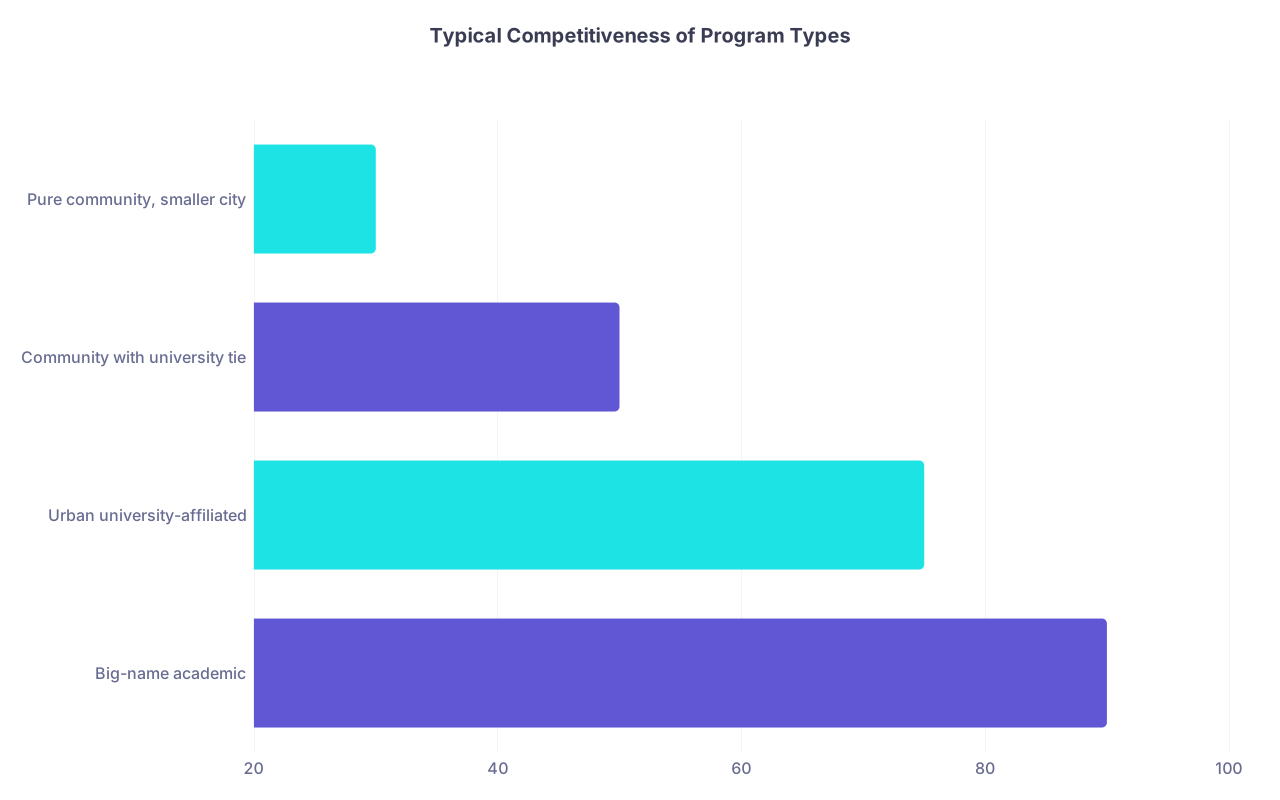
| Category | Value |
|---|---|
| Big-name academic | 90 |
| Urban university-affiliated | 75 |
| Community with university tie | 50 |
| Pure community, smaller city | 30 |
Again, not exact numbers, but the pattern holds.
If you only have the bandwidth or budget to send 20–30 backup apps, they should be heavily skewed toward the last two rows in that chart.
Step 6: Use Your Home Institution Like a Lifeline (Because It Is)
This is the part late planners often skip because it’s uncomfortable: asking for help, explicitly.
You need to talk to:
- Your dean or career advisor
- A faculty member in your main specialty who likes you
- A faculty member in your potential backup specialty
- If you’re an IMG, your main institutional mentor or program director
Say the quiet part out loud:
“I’m worried I started backup planning too late. Here’s my current interview count. Here’s my board scores. Here’s my school. If you were me, how aggressive would you be about a backup specialty right now?”
Then shut up and let them answer.
They can:
- Make a phone call or send an email to programs
- Suggest realistic programs where they have connections
- Tell you if your main specialty hopes are completely delusional vs. borderline
- Help you not massively under- or overreact
Is it humiliating to admit you’re scared? Yes.
Is it worse to silently tank a match because you were too proud or ashamed to say anything? Much worse.
Step 7: If It’s Really Late (Post-interview / Pre-rank)
Let’s say you didn’t do backups early enough, and now you’re staring at:
- Very few interviews in your main specialty
- Maybe one or zero in a “backup” you halfheartedly applied to
- Rank list deadline approaching
There are still moves. Limited, but not zero.
1. Get brutally honest with the match math
Look at historical match data and ask:
- “How many interviews do people at my competitiveness level usually need to feel reasonably safe in this specialty?”
- “Where do I fall relative to that?”
If you have 3 interviews in a competitive specialty and nothing else, you’re not “fine.” You’re gambling. Sometimes it works. Often it doesn’t.
2. Consider SOAP-prep as a backup strategy
Yeah, nobody wants to think about SOAP. It feels like admitting defeat before the match even happens. But SOAP is where late planners often end up—either prepared or blind.
You can still:
- Make a draft SOAP personal statement tailored toward realistic fields (IM, FM, psych, peds, prelim)
- Talk to your dean about their SOAP plan and how they support students
- Mentally expand your “acceptable” list of options—prelim year, transitional, FM as a path to hospitalist, etc.

| Step | Description |
|---|---|
| Step 1 | Low Interview Count |
| Step 2 | Add Realistic Backup Now |
| Step 3 | Optimize Current List |
| Step 4 | Talk to Dean and Mentors |
| Step 5 | Start Residency |
| Step 6 | Enter SOAP |
| Step 7 | Target IM FM Psych Peds Prelim |
| Step 8 | Competitive Specialty? |
| Step 9 | Match Outcome |
Planning for SOAP doesn’t make you matchless. It makes you less shattered if that happens.
Step 8: The Emotional Part Nobody Wants to Admit
Under all the logistics, this is what’s actually spinning in your head:
- “If I pivot to a backup now, am I giving up on my dream?”
- “What if I end up miserable in a specialty I never really wanted?”
- “What if everyone can tell I ‘settled’?”
- “What if I match nothing and all of this was pointless?”
Here’s the uncomfortable truth:
All paths forward from here involve risk. Staying with Plan A only is risky. Adding a backup is risky in a different way (ego, identity, uncertainty).
But not choosing is still a choice. It just happens to be the riskiest one.
I’ve seen:
- People match their backup and end up genuinely loving it 3 years later
- People not match, SOAP into something they never considered, and still build solid, meaningful careers
- People cling only to their dream specialty, not match, and spend years recovering emotionally and logistically
You’re not choosing “dream vs failure.” You’re choosing between different versions of your future stress.
Backup planning late doesn’t feel good because you’re grieving and scrambling at the same time. That doesn’t mean it’s the wrong move.
What You Can Do Today (Not Next Week)
Don’t try to fix everything at once. Tonight or this afternoon, just do this:
- Open a blank document.
- At the top, write: “If my main specialty doesn’t work out, my most realistic backup is probably ______.” Fill it in. Even if you hate that answer.
- Then, list 5–10 programs in that backup that:
- Are not in superstar cities
- Are not top-tier academic centers
- Actually take people with profiles like yours
Once you have that small list, you can:
- Email one faculty mentor and ask, “Can I run a backup plan by you?”
- Ask about a letter in that field
- Draft a short, honest backup personal statement
You don’t have to love this path yet. You just have to stop pretending you don’t need one.
Open that document right now and write down the name of a backup specialty that you could live with. Not your dream. Just “I could live with this.” That single line is the first real step out of panic and into a plan.