
The way most applicants handle backup specialties screams “I don’t really know what I want” to program directors.
The Core Problem: Backup ≠ Afterthought
Everyone tells you, “Have a backup specialty.”
Almost no one tells you how to do that without looking flaky, unfocused, or—worst of all—uncommitted to the programs reading your file.
Here’s what program directors actually see when you mishandle backup planning:
- An applicant who “just wants to match anywhere”
- A personal statement that could be used for three specialties with find/replace
- Letters that read like, “Nice student, unclear where they’re going”
- A CV that looks like a specialty tourist brochure
They won’t usually say this to your face. But I’ve heard the hallway comments:
- “So… are they applying to everything this year?”
- “Backup for derm? Or legit interested in IM?”
- “Great stats, weird application strategy. Pass.”
Let me walk you through the major mistakes that kill your credibility when picking and presenting backup specialties—and what to do instead.
Mistake #1: Treating Your Backup Like a Secret Side Project
This is the most common and most damaging mistake: you sort of apply to a backup specialty, but you don’t really commit to preparing for it like a real option.
Typical pattern:
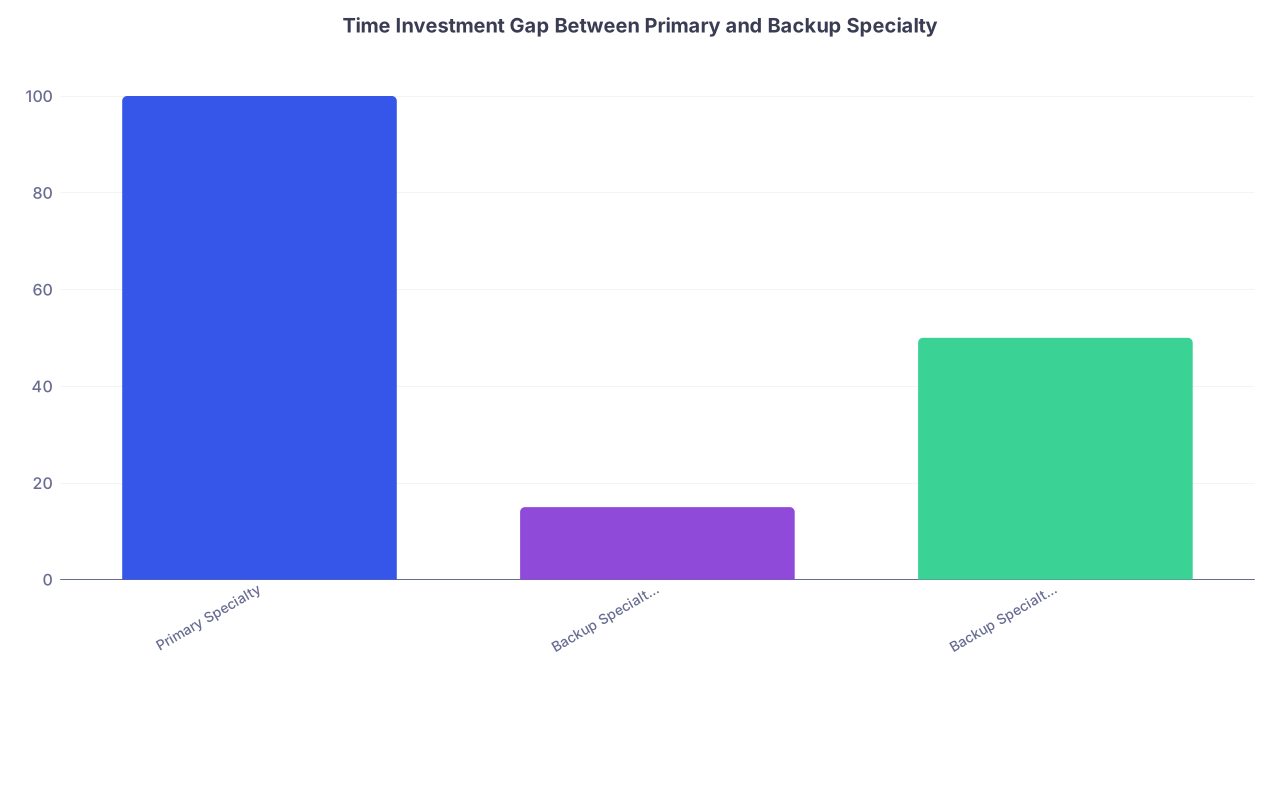
- Your primary specialty: 2+ home rotations, 1–2 aways, 3 strong letters, targeted research.
- Your backup: one random inpatient month, no tailored letters, and a personal statement you typed at midnight the day before ERAS opened.
Programs in your backup specialty can smell this a mile away.
Here’s how this plays out:
- You rank a solid number of backup programs.
- You still don’t match into your primary field.
- You also don’t match into your “backup” because you never built a serious application there.
You didn’t have a backup.
You had a fantasy.
How to avoid this: You do not need the same depth of commitment as your primary, but you do need:
- At least one meaningful clinical experience in the backup field (ideally a rotation where attendings can actually observe you).
- At least one letter from that specialty.
- A personal statement written for that field, not rebranded from your primary.
If you’re not willing to invest at least that much, it’s not a backup. Drop it and rethink your plan.
| Category | Value |
|---|---|
| Primary Specialty | 100 |
| Backup Specialty (Typical Mistake) | 15 |
| Backup Specialty (Done Right) | 50 |
Mistake #2: Picking a Backup That Totally Contradicts Your Story
You say you’ve “always been passionate about surgical problem-solving”…
Then your backup is psychiatry. With zero psych rotations, zero psych letters, and no behavioral health work.
That kind of mismatch tells programs one thing:
“I just want a job. Any job.”
Does switching fields happen? Yes. Do people legitimately discover a better fit late? Also yes. But your application still has to tell a coherent story.
Huge red flag patterns:
- Primary: Neurosurgery; Backup: Pediatrics, with no pedi exposure beyond core clerkship.
- Primary: Dermatology; Backup: Emergency Medicine, but all your CV is outpatient derm and basic science benchwork.
- Primary: Ortho; Backup: Family Medicine, with only ortho aways and a sports research line.
The issue isn’t the combination; it’s the complete lack of bridge between them.
You need visible connective tissue. Something like:
- A shared patient population (e.g., sports medicine in FM vs. ortho).
- A shared style of practice (procedure-heavy IM vs. anesthesiology).
- A genuine, describable shift in what you value (from OR time to continuity, from outpatient to acute care).
If you cannot explain in two plain sentences why both of your chosen fields make sense for you, one of them is wrong or underdeveloped.
Mistake #3: The Copy-Paste Personal Statement Disaster
Program directors and faculty read hundreds of personal statements.
They know when you wrote one “generic medicine” essay and are sending it to IM, EM, and FM.
Dead giveaways:
- “I am interested in working with acutely ill patients over time.” (What does that even mean? Acute and over time?)
- Paragraph 1 is about the OR; paragraph 3 is about continuity clinic; paragraph 4 is about systems-level care in the ED.
- You clearly swapped the specialty name: “I am excited about a career in [Internal Medicine/Emergency Medicine]…” (Yes, people have submitted that.)
This screams lack of commitment.
You need distinct statements that:
- Name the field clearly and early.
- Tie your experiences, skills, and values to that specific practice pattern.
- Do not “hedge” by constantly referencing your other love.
Wrong approach for backup IM when your primary is Cardiology-bound EM dream:
- “While my experiences in emergency medicine have shaped my desire to care for critically ill patients, I am also open to internal medicine as a field where I can care for those same patients.”
This reads like: “You are my understudy.”
Better:
- “Working on the CCU service, I realized I was most engaged when following patients over several days, adjusting therapies, and seeing their trajectory change. Internal medicine gives me the variety and diagnostic complexity I enjoy, but also the satisfaction of iterative problem solving over time.”
You do not need to confess your primary specialty in your backup personal statement. That’s not honesty; that’s self-sabotage.
Mistake #4: Assuming “Less Competitive” = “They Don’t Care”
Dangerous myth:
“I’ll just apply to [insert supposedly less competitive specialty]. They’ll be happy to have me.”
No. They won’t.
Every field has pride. Every program has options. And they’ve seen the “fallback crowd” before.
Where this bites people:
- Applying to community programs thinking, “They’ll take whoever.”
- Sending sloppier materials to backup programs (typos, missing updates, mismatched specialty mentions).
- Recycling generic letters for both primary and backup because “they’re not as picky.”
Here’s the uncomfortable reality:
Some backup specialties are highly sensitive to being treated like second-class choices. Anesthesia, FM, psych, PM&R—these fields have had years of being the “Plan B” for people who didn’t match something else. PDs are hypersensitive to red flags of non-commitment.
What they look for:
- Evidence you actually chose the field (electives, shadowing, mentors).
- At least one letter from someone known in that specialty.
- A rank list that isn’t obviously “10 ultra-competitive primary + 3 random backups tacked on.”
If you’re going to ask a field to be your safety net, you at least owe them a real, respectful application.
Mistake #5: Weak or Misaligned Letters for Your Backup
Letters will absolutely expose you if you fake a backup.
- Using only letters from your primary specialty for a completely different backup.
- Asking a non-specialist letter writer to “mention that I’d also be great in X field.”
- Using a generic “good student, worked hard” letter for your backup without any specialty-specific content.
Letter readers notice when:
- Your supposed passion for their field never comes up in your letters.
- You’ve never actually been supervised in that specialty.
- A letter subtly implies you’re all-in on some other field.
I’ve watched an attending say after reading an application:
“Great student, but her letter literally says she’s going into surgery. Why is she applying here?”
Minimum standard for a backup:
- One real clinical letter from that specialty.
Not “He’d be great at anything.”
Something that describes you functioning in that environment. - A letter mix that doesn’t scream “I had to scramble.” Ideally, two from primary field, one from backup, plus one general (e.g., medicine or surgery) if allowed.
| Scenario | Primary Letters | Backup Letters | Risk Level |
|---|---|---|---|
| All from primary specialty | 3–4 | 0 | High |
| Mix with 1 backup letter | 2–3 | 1 | Moderate |
| Balanced & strategic | 2 primary, 1 backup, 1 core | Low |
If you can’t get a specialty-specific letter for the backup, you’re late. You need to fix that now with a rotation or at least a focused experience.
Mistake #6: Over-Scattering Your Applications
Trying to apply to three or four specialties “just in case” is usually a mess.
What it looks like:
- 40 apps to primary, 25 to backup A, 20 to backup B.
- No coherent pattern to where you applied.
- Program directors can see (via whispers and shared applicants) that you’re in multiple interview pools.
This does two bad things:
- Dilutes your effort. You’re writing half-baked essays, rushing letters, and wasting interview prep time.
- Makes it obvious to everyone that you don’t have a clear direction.
Programs do not want to gamble on someone who might be lukewarm on their field and bail later.
A more disciplined approach:
- One primary specialty.
- One carefully chosen backup that you can honestly defend.
- Rarely, a third highly overlapping option (e.g., IM + neurology where much of your profile applies to both).
If you’re tempted to apply to four or five specialties, your problem isn’t backup strategy. Your problem is that you don’t yet know what kind of doctor you want to be. That’s a different crisis.
Mistake #7: Lying or Over-Confessing During Interviews
This is where people panic and blow themselves up.
Two opposite errors:
Over-honesty in a self-destructive way
Example in a backup interview:- “Honestly, I’m really committed to ortho, but I need a backup, so I applied here too.”
Translation: “You are my consolation prize.”
Do not expect a rank from that program.
- “Honestly, I’m really committed to ortho, but I need a backup, so I applied here too.”
Translation: “You are my consolation prize.”
Blatant lying that doesn’t match your ERAS
- “I’ve always dreamed of family medicine.”
While they’re looking at 4 ortho aways, 3 ortho letters, and 2 ortho publications.
- “I’ve always dreamed of family medicine.”
They’re not stupid. They see your whole record.
The middle road:
- Acknowledge reality without making them feel second-tier.
- Focus on genuine fit for their field, not your failure to get your first choice.
Something like:
- “I explored several fields seriously, including surgery, but over time I realized I’m most engaged by longitudinal care and complex medical management. That’s what led me to apply in internal medicine.”
or - “I considered both EM and anesthesia early on. As I did ICU and OR rotations, I found that I enjoyed being in the procedural environment, carefully managing physiology over time. That’s why I’m here.”
You don’t need to narrate your entire specialty crisis. You just need a plausible, honest arc that ends in their field.

| Step | Description |
|---|---|
| Step 1 | Core Rotations |
| Step 2 | Primary Specialty Focus |
| Step 3 | Explore 2 Fields Deeply |
| Step 4 | Add 1 Real Backup |
| Step 5 | Primary Only |
| Step 6 | Take Extra Time or SOAP |
| Step 7 | Clear Primary Choice |
| Step 8 | Match Risk High? |
| Step 9 | Two Fields Reasonable? |
Mistake #8: Ignoring How Programs Read Your Entire Package
Too many applicants optimize each component in isolation:
- “This personal statement sounds good.”
- “These letters are strong.”
- “These programs are decent backups.”
But program directors don’t read one piece in a vacuum. They read the pattern.
They will especially notice if:
- Your primary and backup are geographically all over the map with no common sense (primary: coastal academic centers; backup: random Midwest rural programs you’ve never mentioned an interest in).
- Your CV activities don’t match your claimed interests.
- Your research, leadership, and volunteering are 100% aligned with one specialty and basically irrelevant to the other.
To avoid this:
- Make sure there is at least one narrative thread that makes sense across both specialties: underserved care, procedures, chronic disease, acute care, particular patient populations, etc.
- Don’t stack your rank list with 12 hyper-competitive programs in your primary and then 3 backup programs you don’t actually want. That’s not strategy; it’s denial.
- If you have advisors in both specialties, let them know your full plan. People talk. It’s better they’re not blindsided.
Mistake #9: Using a Backup to Avoid Hard Decisions
Sometimes a backup isn’t really a backup. It’s a way to avoid committing.
I’ve seen this with:
- Students who are equally interested in two fields but refuse to rank one as primary in their own head.
- People chasing prestige: “I’ll apply to derm, but my backup is radiology, and if not that, anesthesia.”
- Folks afraid to admit their preferred specialty has a lower perceived status.
What happens?
Your application reads scattered.
Half-committed to each field.
Not all-in anywhere.
Program directors can smell indecision. They’ll usually choose the person who is 90% sure they want that field over the person who is 60% sure in three directions.
If you find yourself stacking backup specialties to avoid choosing, you may be better off:
- Taking an additional research year.
- Doing a prelim year in medicine or surgery.
- Using that time to get honest clinical exposure and make a grown-up choice.
Mistake #10: Pretending a Backup Is Risk-Free
Final problem: people treat backups like insurance policies. They’re not. They’re alternative lives.
Choosing a backup field means:
- A different day-to-day job for the rest of your career.
- Different fellowship routes.
- Different patient populations, hours, cultures, incomes, and burnout patterns.
You can’t treat all of that as a checkbox on ERAS.
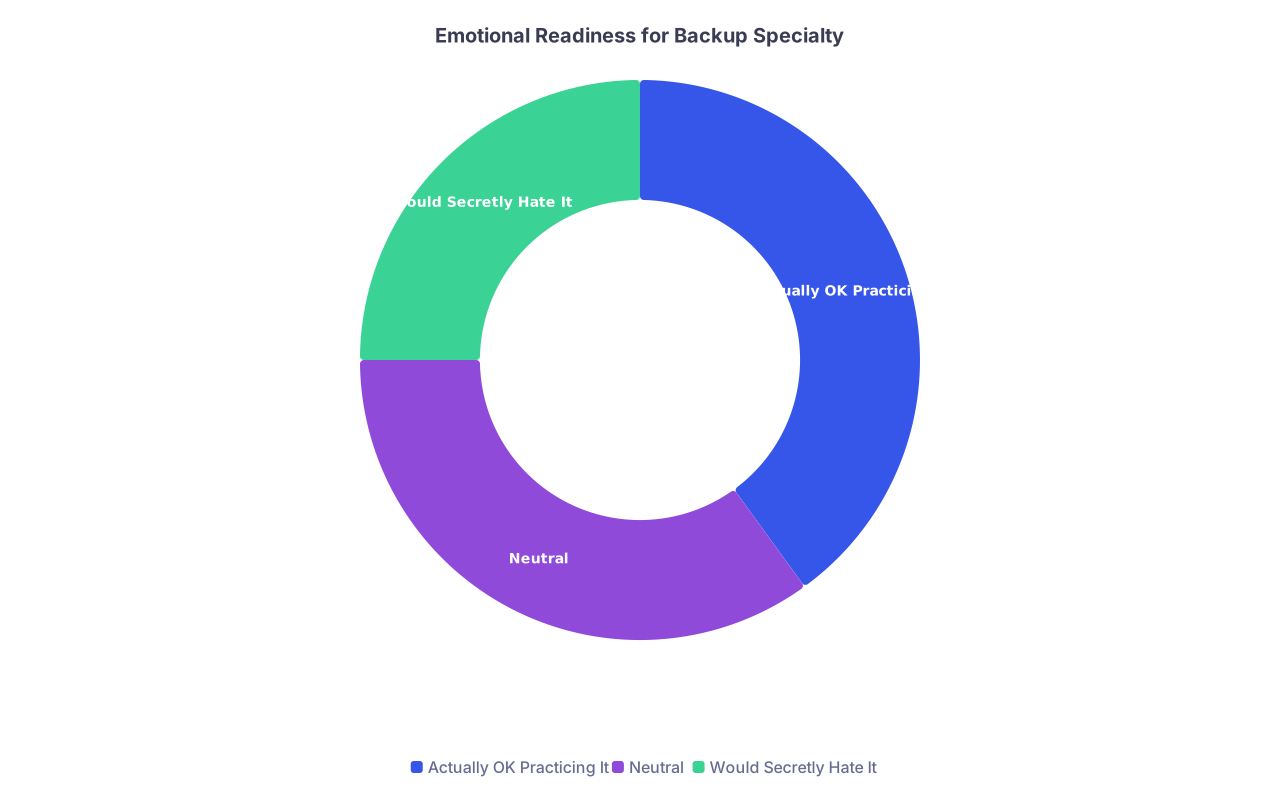
You do not need to love your backup as much as your dream field, but you do need:
- To have met real attendings in it and asked them blunt questions.
- To picture yourself happy in that work style 5–10 years ahead.
- To know—not hope—that you wouldn’t be miserable if you end up there.
If your honest reaction to the idea of practicing your backup field for 30 years is dread, it’s not a backup. It’s a trap you’re setting for yourself.
| Category | Value |
|---|---|
| Actually OK Practicing It | 40 |
| Neutral | 35 |
| Would Secretly Hate It | 25 |
FAQs
1. Is it a mistake to tell my primary specialty programs that I’m also applying to a backup?
Most of the time, yes. Volunteering that information rarely helps you and often hurts you. If directly asked (which is uncommon), you can answer honestly without over-sharing: “I explored both X and Y seriously, but I’m particularly excited about the kind of work done in [their field], which is why I’m here.” Don’t give a full list of every specialty and program you applied to. That just highlights your uncertainty.
2. Can I use the same personal statement for my primary and backup if they’re closely related (like IM and neuro)?
You can, but you probably shouldn’t. Even closely related specialties have different cultures, priorities, and patient care styles. At minimum, have two versions: one clearly oriented to internal medicine, one clearly to neurology. You can reuse some core themes (critical thinking, complex disease, etc.), but each should explicitly match the field, not feel like a generic “I like brain and body” essay.
3. Is it better to apply broadly to one specialty or split my applications between a primary and a backup?
If your primary specialty is reasonably attainable for you (based on scores, letters, and advisor feedback), it’s usually better to commit strongly to that one and apply broadly within it. A backup becomes smart when there’s a real risk of not matching—ultra-competitive field, weaker parts of your application, late decision. But if adding a backup will obviously weaken both applications and make you look unfocused, consider either strengthening your primary with a research or prelim year, or choosing a single, realistic field and owning it.
Key takeaways:
- A backup specialty must look like a genuine choice, not a panic button—clinical exposure, at least one real letter, and a specialty-specific narrative are non-negotiable.
- Scattered, copy-paste, or contradictory applications make you look uncommitted everywhere; pick one primary, one honest backup, and build a coherent story for both.
- Don’t treat backups as harmless insurance. If you wouldn’t accept that field as your real career, it’s not a backup—it’s a mistake.