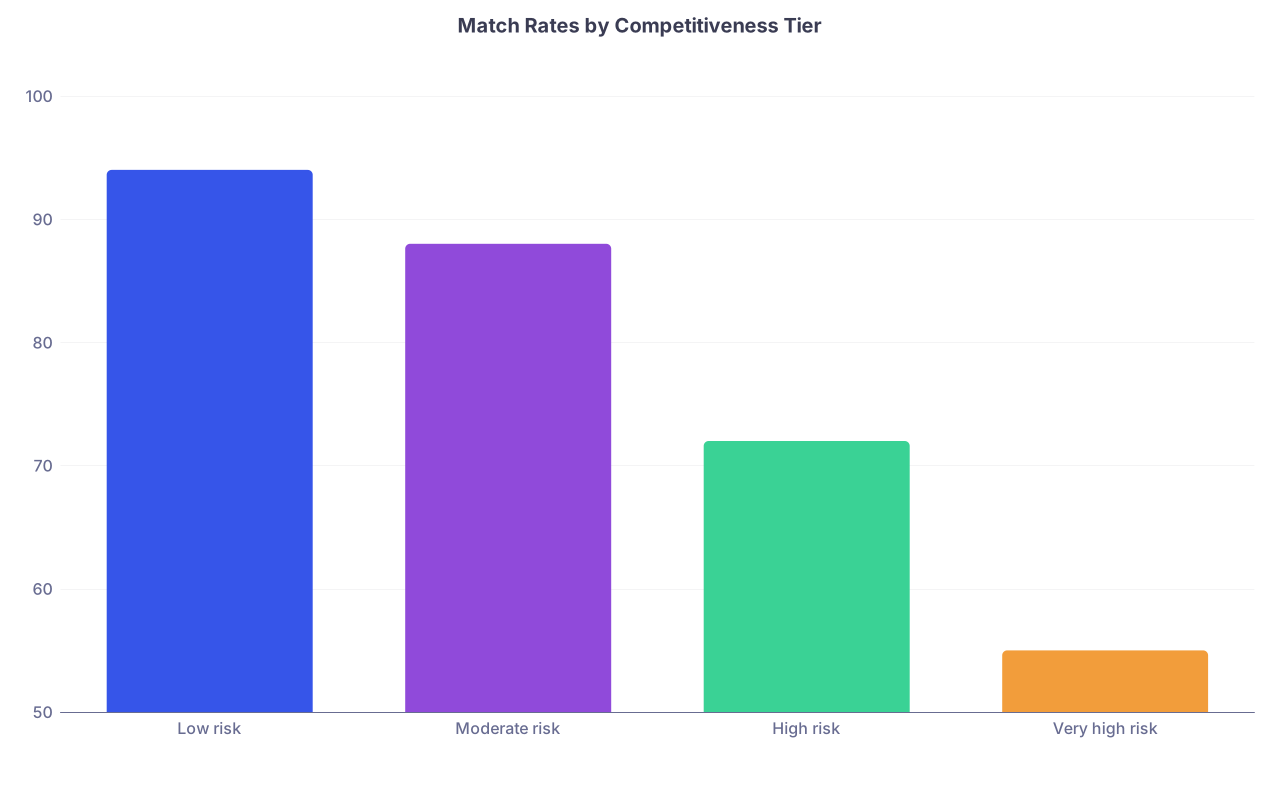
Choosing a medical specialty is one of the most defining decisions in your medical education and early physician career. Yet the residency match is inherently uncertain—especially if your primary choice is highly competitive. Thoughtfully choosing backup specialties is not a sign of doubt or failure; it is a strategic way to protect your future, reduce anxiety, and keep multiple fulfilling paths open.
This guide expands on how to select backup specialties in medicine, with practical frameworks, real-world examples, and strategies to help you navigate the residency match process with clarity and confidence.
Why Backup Specialties Matter in the Residency Match
Residency applications are influenced by many variables that extend beyond your control—even for strong applicants. Understanding why backup specialties are important can help you approach this process proactively rather than reactively.
The Reality of Residency Match Uncertainty
Several factors make the residency match unpredictable:
Competitive primary specialties:
Fields like dermatology, orthopedic surgery, plastic surgery, neurosurgery, and otolaryngology (ENT) routinely have more qualified applicants than available spots. Even excellent candidates can go unmatched.Institutional and geographic preferences:
Programs may heavily favor:- Home institution students
- Regional applicants
- Students from certain schools or with particular research backgrounds
Even if you’re a strong candidate on paper, you may not fit a program’s subjective “profile.”
Application trends and applicant volume:
Each year, trends shift—sudden spikes in interest (e.g., in certain lifestyle specialties) or changes in reimbursement can suddenly alter competitiveness.Personal and academic surprises:
Illness, family crises, delayed exams, or a single poor clerkship evaluation can influence your application strength at key moments.
Backup specialties provide a structured safety net: rather than scrambling if your primary choice doesn’t work out, you walk into application season with a realistic, intentional plan that acknowledges uncertainty.
Emotional and Strategic Benefits of Having Backup Options
Thoughtfully chosen backup specialties:
- Reduce anxiety during ERAS submission and interview season
- Help you preserve momentum in your training instead of delaying graduation or reapplying
- Allow you to frame your application story positively (e.g., “I’m excited about both X and Y, and here’s why”) rather than defensively
- Keep your broader physician career goals on track—such as working in a specific setting (academic, community, rural) or serving a certain patient population
Many physicians ultimately discover that their “backup” specialty was actually a better fit for their values, strengths, and desired lifestyle than their original first choice.
Core Factors to Consider When Selecting Backup Specialties
The best backup specialties are not simply “easier to match into.” They are specialties where you can realistically see yourself building a satisfying, sustainable physician career. To identify those, you’ll need to assess multiple dimensions.

1. Aligning Backup Specialties With Your Interests and Strengths
Start from who you are—not from what seems “least competitive.”
Ask yourself:
Clinical content and patient population
- Do you enjoy acute care or longitudinal relationships?
- Are you energized by procedures or by diagnostic puzzles?
- Do you prefer working with children, adults, older adults, or a specific population (e.g., underserved communities)?
Rotations that resonated with you
- Which rotations made time pass quickly and left you energized rather than drained?
- In which settings did you feel like a valuable member of the team?
- Where did attendings or residents comment positively on your natural fit?
Core skills you enjoy using
- Hands-on technical skills (procedures, operations, interventions)
- Communication and counseling (e.g., primary care, palliative care, psychiatry)
- Systems thinking and complexity (e.g., internal medicine, critical care)
- Visual pattern recognition (e.g., dermatology, radiology, pathology)
Example:
If you love the OR but are concerned about matching into orthopedic surgery, you might consider:
- General surgery
- Vascular surgery (integrated programs)
- Anesthesiology (still OR-based and procedure-heavy)
Each preserves key elements you love: high-acuity cases, procedures, and team-based perioperative care.
2. Work–Life Balance and Lifestyle Considerations
Your satisfaction as a physician will be shaped not only by what you do, but how you do it and how much of your life it occupies.
Reflect on:
Schedule predictability
- Do you tolerate nights and rotating shifts well, or do you value a consistent schedule?
- Are you okay with frequent call (e.g., obstetrics, surgery), or would shift-based work (e.g., emergency medicine) suit you better?
Intensity and emotional load
- Emergency medicine and critical care involve frequent high-acuity situations and life-or-death decisions.
- Oncology, palliative care, and some subspecialties involve sustained exposure to grief and chronic illness.
- Consider your coping mechanisms and emotional resilience.
Long-term lifestyle goals
- Do you plan to have significant non-clinical commitments (family, research, leadership, global health)?
- Do you envision part-time work or flexible scheduling later in your career?
Example:
If your primary interest is emergency medicine for its acuity, but you’re concerned about long-term shift work, a backup like internal medicine with a plan for critical care or hospitalist medicine might offer a strong balance: acute inpatient care with more flexible scheduling options in some practice environments.
3. Match Rates, Competitiveness, and Data-Driven Decisions
Your backup strategy should be grounded in real data:
Review NRMP data:
- Specialty-specific match rates
- USMD/DO vs international graduate match outcomes
- Average Step scores, number of research experiences, and publications by matched applicants
- Ratio of positions to applicants
Assess your application profile honestly:
- Board scores (USMLE/COMLEX), if applicable
- Clinical grades and honors
- Research output (particularly in your primary specialty)
- Letters of recommendation strength and relevance
A strong strategy often pairs:
- One very competitive primary specialty (e.g., dermatology), with
- One or two less competitive but still meaningful backup specialties that share overlapping interests (e.g., internal medicine with a plan for rheumatology; family medicine with a focus on dermatologic procedures).
Be careful not to assume a specialty is “easy” based on stereotypes alone; always validate with current NRMP and specialty organization data.
4. Overlap Between Primary and Backup Specialties
Look for “adjacent” specialties where your existing experiences and interests transfer well. This can strengthen your residency application and preserve your long-term goals.
Common examples of strategic overlap:
Surgical pathway applicants:
- Primary: Orthopedic surgery
Backup: General surgery, anesthesiology - Primary: Neurosurgery
Backup: Neurology (with an interventional or stroke interest), radiation oncology (depending on interests)
- Primary: Orthopedic surgery
Medicine pathway applicants:
- Primary: Cardiology-focused from early on
Backup: Internal medicine (with intent to subspecialize) - Primary: Hematology/oncology
Backup: Internal medicine or pediatrics (if interested in heme/onc in children)
- Primary: Cardiology-focused from early on
Outpatient-focused applicants:
- Primary: Dermatology
Backup: Internal medicine or family medicine with strong derm exposure (clinic electives, skin procedures focus) - Primary: PM&R (Physical Medicine & Rehabilitation)
Backup: Neurology or family medicine with a sports medicine interest
- Primary: Dermatology
When your primary and backup specialties share clear thematic connections, it becomes easier to craft a coherent application narrative for both.
5. Long-Term Job Market and Career Flexibility
Consider the broader outlook beyond residency:
- Specialties with persistent workforce needs:
- Family medicine, internal medicine, psychiatry, and pediatrics often have robust job markets, especially in non-urban and underserved regions.
- Geographic flexibility:
- Some specialties (e.g., primary care, anesthesia, general surgery) offer more opportunities in diverse settings (urban, suburban, rural).
- Opportunities for niche career paths:
- Academic medicine, research, leadership, global health, telemedicine, and administrative roles may be more abundant in some specialties than others.
A good backup specialty should:
- Offer stable employment prospects
- Allow for further subspecialization or diversification
- Align with settings you are comfortable working in (academic vs community, inpatient vs outpatient)
Practical Strategies for Selecting and Preparing Backup Specialties
Once you’ve identified potential backup specialties, you need a practical plan to explore and strengthen them without diluting your primary specialty application.

1. Build a Structured Ranking and Reflection System
Instead of relying on vague impressions, create a simple but systematic approach:
List all serious specialty options (primary and backup).
Rate each on key dimensions (e.g., 1–5 scale):
- Interest in clinical content
- Lifestyle fit
- Competitiveness relative to your application strength
- Overlap with long-term goals
- Geographic flexibility/job prospects
Use this to:
- Narrow down to 1–2 realistic backup specialties
- Clarify trade-offs (e.g., higher interest vs higher competitiveness)
Revisit your rankings after:
- Additional rotations or electives
- Conversations with mentors
- Reviewing updated match data
2. Leverage Rotations, Electives, and Sub-Internships Strategically
You can explore backup specialties without undermining your commitment to your primary choice.
Consider:
Early exposure:
During third year, pay close attention to how you feel on each rotation—not just the grading or evaluations. Keep brief notes after each block on what you liked and disliked.Targeted fourth-year electives:
- Do at least one audition/sub-I in your primary specialty (if applicable).
- Add one or two electives in potential backup specialties, enough to:
- Obtain at least one strong letter of recommendation
- Confirm genuine interest
- Understand the day-to-day reality of the field
Demonstrating sincerity to both fields:
It is possible to be honest and strategic:- For your primary specialty, emphasize your specific passion and depth of engagement.
- For backups, highlight overlapping interests and the aspects of the field that genuinely excite you.
3. Seek Honest Feedback From Mentors and Advisors
You cannot accurately assess your competitiveness alone.
Engage:
Specialty-specific mentors:
Ask faculty in your primary and backup specialties:- “Given my current application, how do you see my chances in this field?”
- “What backup specialties do you commonly see applicants consider?”
- “What would strengthen my application most in the next 6–12 months?”
Student affairs/dean’s office advisors:
They often have:- Internal data on prior match outcomes from your institution
- Insight into how similar applicants have fared historically
- Advice on application breadth (number of programs, regions)
Residents and fellows:
Their perspective is invaluable for:- Lifestyle realities
- Hidden pros and cons of each specialty
- Common regrets or things they wish they’d known while applying
Be prepared for frank feedback, especially if your primary choice is extremely competitive relative to your metrics. Early, honest input allows more time to build a strong backup plan.
4. Optimize Your ERAS Strategy for Multiple Specialties
If you apply to more than one specialty, your application must be tailored carefully and ethically.
Separate personal statements:
- Write a distinct, sincere personal statement for each specialty.
- Avoid generic language that could apply to any field. Programs can detect this quickly.
Selective experience emphasis:
- On ERAS, you can choose which experiences to highlight in each application.
- Emphasize dermatology-related experiences for derm, for example, and primary care or continuity-of-care experiences for internal medicine if it’s your backup.
Letters of recommendation:
- Aim for at least 2–3 letters in your primary specialty.
- Secure at least 1–2 strong letters in each backup specialty.
- Use specialty-specific letters for the appropriate programs; some letters can be broadly applicable (e.g., medicine sub-I, strong general clinical performance).
Program lists and numbers:
- Extremely competitive specialties often require broad geographic applications.
- Backup specialties may allow for more geographic restriction—but if your primary is very competitive, casting a wide net in your backup specialties is usually wise as well.
5. Maintain Flexibility and an Open Mind
Rigid attachment to a single specialty can make the application process more stressful than it needs to be.
Cultivate:
Intellectual openness:
It is possible to love more than one specialty. Many physicians realize that their backup specialty aligns more closely with their personality and lifestyle once they start residency.Narrative coherence:
When interviewing for either specialty, frame your story as:- A journey of exploration
- A sincere interest in the field you’re interviewing for
- A focus on underlying themes (e.g., continuity of care, procedural work, working with underserved communities) that are shared across your options
Resilience planning:
Ask yourself:- “If I don’t match into my primary choice, can I imagine feeling proud and fulfilled in this backup specialty 5–10 years from now?”
If the answer is consistently “no,” then that specialty may not be an appropriate backup.
- “If I don’t match into my primary choice, can I imagine feeling proud and fulfilled in this backup specialty 5–10 years from now?”
Putting It All Together: Example Pathways
To make this more concrete, here are brief sample strategies:
Case 1: Highly Competitive Surgical Applicant
- Primary: Neurosurgery
- Profile: Solid but not exceptional scores and research output
- Backup Strategy:
- Explore neurology with an interest in stroke or neurocritical care
- Consider radiation oncology only if genuinely interested and market conditions are acceptable
- Obtain:
- Neurosurgery letters
- Neurology elective + letter
- Apply widely geographically in both specialties
Case 2: Lifestyle-Focused Applicant
- Primary: Dermatology
- Profile: Strong academic record, moderate research
- Backup Strategy:
- Internal medicine or family medicine with a strong dermatology emphasis
- Secure:
- 2 dermatology letters
- 1–2 internal medicine/family medicine letters
- Highlight interest in skin disease and procedures in both applications, adjusting the narrative to explain why you’d be content in either role.
Case 3: Broadly Interested Medicine Applicant
- Primary: Internal medicine (academic track)
- Profile: Solid but not top-tier credentials
- Backup Strategy:
- Family medicine and/or transitional year/preliminary medicine programs
- Focus on:
- Strong inpatient evaluations
- 2 IM letters + 1 FM letter
- Emphasize your interest in complex medical management (IM) and comprehensive, community-based care (FM) in distinct statements.
FAQ: Backup Specialties, Residency Match, and Specialty Selection
Q1: What if I genuinely have no idea what backup specialty I’d be happy in?
Start by revisiting your real clinical experiences rather than abstract ideas:
- List all your core clerkships and briefly note what you liked and disliked about each.
- Ask: “Which days on rotation did I feel most like myself?”
- Schedule short electives or shadowing in 1–2 fields you’re curious about.
Then, speak with advisors and mentors; they often see patterns in your interests and strengths that you may not.
Q2: Will applying to a backup specialty hurt my chances in my primary specialty?
In most cases, no—if managed thoughtfully:
- Programs generally do not see where else you applied.
- Issues arise only if:
- Your personal statement or letters appear generic or insincere.
- You’re visibly unfocused during interviews.
If you create clear, specialty-specific application materials and genuinely engage with each field during interviews, applying to backups is seen as responsible, not disloyal.
Q3: How many backup specialties should I apply to?
For most applicants:
- One well-chosen backup specialty is sufficient if:
- Your primary choice is competitive but not ultra-competitive relative to your profile.
- Two backup specialties may be appropriate if:
- Your primary field is extremely competitive (e.g., neurosurgery, dermatology) and your metrics are borderline.
More than two often fragments your application too much and can make it difficult to appear genuinely committed in any single field.
- Your primary field is extremely competitive (e.g., neurosurgery, dermatology) and your metrics are borderline.
Q4: How can I strengthen my backup specialty application late in medical school?
Focus on high-yield steps:
- Do at least one sub-I or elective in the backup specialty.
- Obtain 1–2 strong letters from faculty who can speak to your performance in that field.
- Highlight relevant experiences (research, volunteer work, leadership) in your ERAS application tailored to that specialty.
- Attend specialty interest group events or national meetings (even virtually) to show engagement and learn more.
Q5: Is it common to end up loving your backup specialty more than your original choice?
Yes. Many practicing physicians will tell you:
- They matched into a backup specialty after missing their first choice—or deciding late to pivot—and ultimately found the field to be a better fit for their skills, personality, and lifestyle.
The key is to choose backup specialties that you can realistically imagine being proud to practice in for decades, not just as a default if “Plan A” falls through.
Thoughtful backup specialty planning is not about abandoning your dreams—it is about protecting them in a broader sense. By approaching specialty selection with honesty, data, mentorship, and openness, you give yourself multiple viable paths to a meaningful, durable physician career, regardless of how the residency match unfolds.