
The way most students add a backup specialty is backward—and borderline self-sabotaging.
They panic in August. They throw a couple of token electives at a “less competitive” field. They hope the backup saves them while still acting like their primary specialty is the only one that matters. Then they wonder why they did not match either.
You can do better. You have to be more deliberate.
If you are adding a backup specialty late, your electives are not just “extra experience.” They are currency. They buy you:
- Letters
- Face time
- Narrative credibility in ERAS
- A real chance at a second path
Here is how to use them wisely instead of wasting the last real leverage you have.
Step 1: Get Honest About Your Risk Profile
You cannot plan electives intelligently until you are brutally clear on your actual risk of not matching your primary specialty.
Skip the vague “I feel nervous.” Put numbers and categories on it.
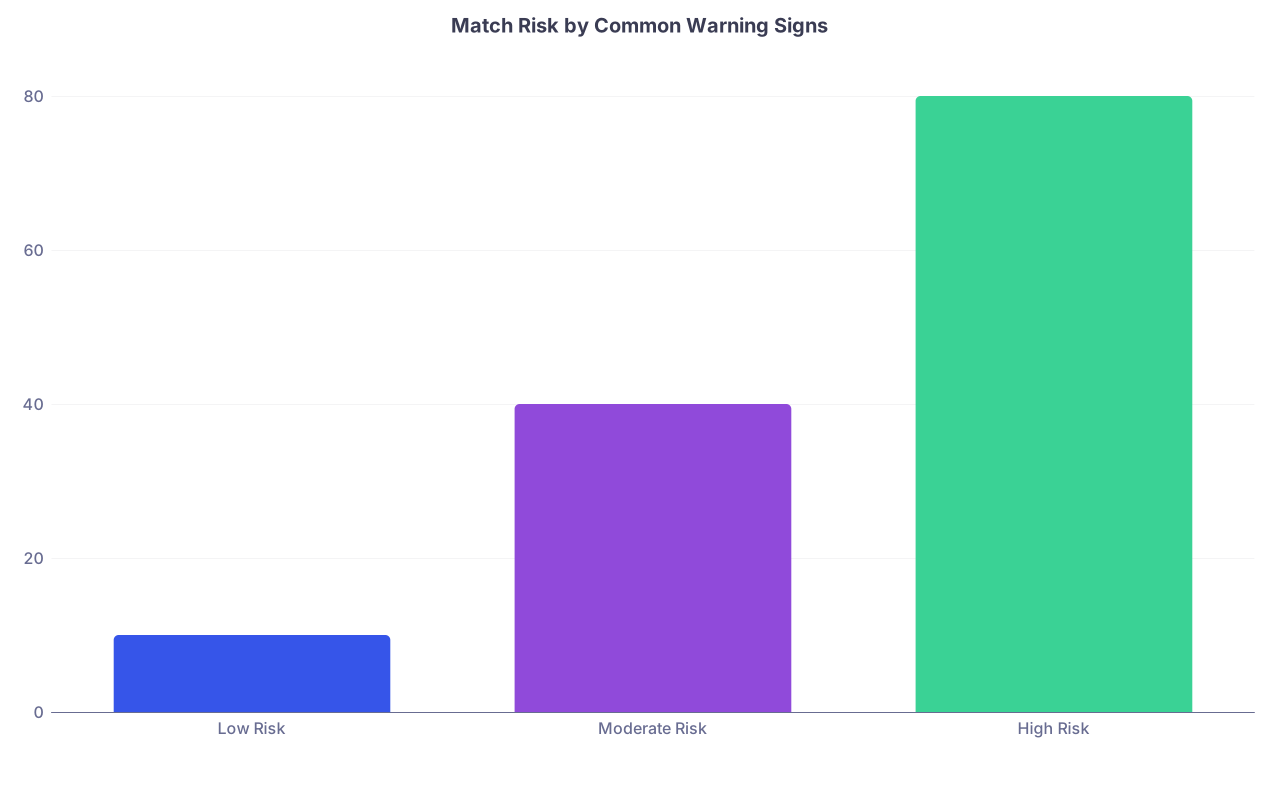
| Category | Value |
|---|---|
| Low Risk | 10 |
| Moderate Risk | 40 |
| High Risk | 80 |
Here is a simple, no-BS risk sort:
High-risk primary specialty
- You are aiming at: Derm, Ortho, Plastics, ENT, Neurosurgery, IR/DR, Integrated Vascular, etc.
- Or: Mid-competitive field (EM, Anes, Gen Surg, OB, some IM subs) with serious dings:
- Step/COMLEX barely passing or below average for the field
- No meaningful research in that area
- Weak or generic letters
- Red flags: leave of absence, professionalism concern, failed exam
Moderate-risk
- You are applying to a competitive or mid-competitive field but:
- Scores are average or slightly below typical, not catastrophic
- Some research or home department support
- No big red flags, but you are not a slam dunk
- You are applying to a competitive or mid-competitive field but:
Low-risk
- Strong metrics for the field
- Department chair knows you by name and likes you
- You already have 2–3 solid letters
- You are only adding a backup because you are risk-averse, not because everyone is warning you
If your advisors, PDs, and honest residents are quietly saying “You should have a solid backup,” you are not low-risk. Stop pretending you are.
This risk level will drive:
- How many electives go to primary vs backup
- How much you “declare your allegiance” in each field
- How you explain your schedule on interviews
Step 2: Clarify What You Actually Need From Electives
Fourth-year electives are not all created equal. At this stage, you do not need “exploration.” You need deliverables.
Your electives must produce:
Letters of recommendation that count
- From specialty-aligned attendings
- From people who actually saw you work more than 1 day
- From institutions that residency PDs recognize
Evidence you understand the specialty
- ERAS personal statement content
- Interview examples: cases, role, clinical reasoning appropriate to that field
- Your ability to talk like you have actually done this work
Signaling commitment (without boxing yourself in)
- A schedule that looks coherent, not chaotic
- Enough exposure that PDs in both fields believe you would actually show up and stay
Everything below is about extracting those three outcomes from a limited number of elective slots.
Step 3: Build a Realistic Elective Allocation Strategy
You cannot be in two places at once. Your calendar has to pick sides, at least on paper.
General Allocation Rules (Late Addition Scenario)
Assume you realize you need a backup in late MS3 or early MS4 and still have 3–5 elective blocks you can adjust.
If your primary specialty is very high risk (and you are serious about not going unmatched):
- Aim for something like:
- 40–50% of your remaining time to primary specialty
- 50–60% to backup specialty
If your primary is moderate risk:
- More like:
- 60–70% to primary
- 30–40% to backup
If your primary is genuinely low risk (verified by someone who is not your mom):
- You may only need:
- 75–80% to primary
- 20–25% to backup
Do not pretend you are low risk if your scores are marginal and you are applying Derm “because you love skin.”
Step 4: Map Out a Concrete 3–6 Month Elective Plan
Let’s get tactical. Here is what an actual late-add backup strategy looks like on a calendar.
| Month | Elective | Target Field Primary/Backup | Main Purpose |
|---|---|---|---|
| July | Home Sub-I Primary | Primary | Core letter, face time |
| August | Away Primary | Primary | Audition, second letter |
| September | Inpatient Backup Sub-I | Backup | Core backup letter |
| October | Home/Away Backup Elective | Backup | Second backup letter |
| November | ICU / General Medicine | Neutral | Universal letter option |
You will not match off vibes. You will match off a schedule that creates at least:
- 2 strong letters in your primary specialty
- 2 strong letters in your backup or 1 strong + 1 “neutral but very strong” (IM, ICU, chief letter) that backup PDs accept
If you do not see where those letters will come from on your schedule, fix it now.
Step 5: Decide What Kind of Backup You Are Actually Adding
Not all backups are equal. The way you handle electives depends heavily on the relationship between your primary and backup.
A. “Adjacent” Backup (Overlapping Clinical World)
Examples:
- Primary: Ortho → Backup: PM&R
- Primary: EM → Backup: IM or FM
- Primary: Gen Surg → Backup: Anesthesia
- Primary: Neurosurgery → Backup: Neurology
Upside: It is easy to make your story coherent. You can share letters more safely. Clinical skills overlap.
Downside: You might be tempted to be vague and “keep doors open” in a way that satisfies no one.
Elective strategy for adjacent backups:
- Do at least one Sub-I or heavy inpatient month squarely in the backup field.
- Do one “hybrid” elective that either field can appreciate:
- ICU
- Trauma surgery / SICU
- Neuro ICU
- Hospitalist medicine
- ED observation unit (for EM/IM interface)
On ERAS, those hybrid rotations can be talked up to either side.
B. “Distant” Backup (Different Clinical Universe)
Examples:
- Primary: Derm → Backup: IM
- Primary: Ortho → Backup: FM
- Primary: Plastics → Backup: Gen Surg or ENT
- Primary: Radiology → Backup: IM
Here, you must be more surgical (no pun intended) with your time.
Elective strategy for distant backups:
- Your backup needs at least 2 rotations that scream, “I actually tried this specialty”:
- One Sub-I / core rotation in that field
- One additional month that shows genuine engagement (outpatient clinic, subspecialty within it)
- You probably can not share letters cleanly. A plastic surgeon letter does not help you in Internal Medicine much. Plan for distinct letter pipelines.
Step 6: Prioritize the Right Electives in the Backup Field
When you add a backup late, you do not have time for fluff. No “Nephrology of Pregnancy” 2-week curiosities unless it gets you a killer letter.
Here is what you want for a backup specialty—ranked:
Sub-Internship / Acting Internship in the backup field
- This is non-negotiable for most core fields (IM, FM, Peds, Surg, OB, EM).
- You want:
- Admit responsibility
- Cross-cover or some version of it
- Real notes, real orders, real presentations
- Protect this month. No Step studying. No vacations. Show up early, leave late.
High-yield inpatient or core experience
- Example:
- For IM backup: General medicine ward, ICU
- For FM: Inpatient FM or a busy primary care clinic with continuity
- For EM: High-volume ED, trauma center EM
- You want a setting where:
- PDs recognize the environment as demanding
- One or two attendings can actually see your progression
- Example:
A second, letter-generating month
- Ideal: Same institution where you might apply heavily.
- Could be:
- A subspecialty within the backup (e.g., Cardiology consult month for IM, Sports Med for FM)
- A second general month that allows a different attending to see you closely
Letter-neutral but performance-heavy rotations
- ICU, CCU, or similar units:
- PDs across many fields respect these
- Good option if you are late-late (September/October) and cannot get dedicated backup spots
- ICU, CCU, or similar units:
What you do not want to do with backup time this late:
- Random 2-week electives with 5 attendings and no one who really knows you.
- Niche consult services that never see you present on rounds.
- Pure observership-type experiences.
If you cannot clearly answer “Who will write my letter from this month?” then that elective is probably a waste as a late backup.
Step 7: Handle Away Rotations Without Burning a Bridge
Away rotations are where people blow up their narrative. They try to audition for both fields at once and look indecisive in both.
Here is the rule: Each away rotation must have a “primary audience.”
If the away is for your primary specialty:
- Show up as if you were not backing up at all.
- Do not spend half the month talking about your interest in the backup.
- At most, mention backup if asked directly, and frame it as “maximizing chances to train at a strong program, even if in a related field.”
If the away is for your backup:
- You must demonstrate genuine interest.
- Do not say: “I am really more interested in X but doing Y as a backup.” That is suicide.
- Instead:
- Be specific: “I am drawn to [specific aspects] of this field and am applying to both X and Y. I would be extremely happy to train in either.”
- Show your work: read the field’s literature, know their bread-and-butter cases, ask targeted questions.
Mixed-signal mistake to avoid
I have seen students rotate on, say, PM&R as a “backup” but:
- Never read note templates
- Do not know the common inpatient rehab diagnoses by week 2
- Say in rounds, “In ortho, we do it this way…”
Those students do not get strong PM&R letters. And then their “backup” is not a real backup. They just wasted 4 weeks.
Step 8: Engineer Strong Letters Out of Short Timelines
You are late. You need letters fast. That means you cannot be passive about the process.
Here is the playbook:
Front-load performance in week 1–2
- Show up early. Every day.
- Volunteer for notes, discharges, follow-up calls.
- Ask for feedback by the end of week 1: “Is there anything I can do differently to be more helpful?”
Target specific attendings
- On day 3–4, identify:
- Who seems to notice student performance?
- Who writes detailed evaluations?
- Make sure you are assigned to or round with them frequently.
- On day 3–4, identify:
Ask for the letter early—by week 3
- Script:
- “Dr. Smith, I have really enjoyed working with you this month. I am applying in [backup specialty] and would really value a strong letter from someone who has seen me on the wards. Would you feel comfortable writing a strong letter on my behalf?”
- Use the word “strong.” If they hesitate, pivot to someone else.
- Script:
Arm them with specifics
- Send an email with:
- CV
- Draft personal statement (for that specialty)
- Brief bullet list: “Here are a few patients/cases we worked on together that I found meaningful…”
- Make it easy for them to write about your performance and commitment.
- Send an email with:
You cannot afford tepid letters in your backup. They will read as “This student is hedging and not that excited to be here.”
Step 9: Make Your Story Coherent in ERAS and Interviews
Your electives and backup strategy only work if your narrative hangs together.
You are going to be asked some version of: “So, I see you applied to [other specialty] as well. Tell me about that.”
You need a prepared, honest, non-apologetic answer that incorporates your elective choices.
Use your electives as evidence, not excuses
Bad version:
- “I did a couple of IM rotations just in case I did not match EM.”
Better version:
- “I have always been drawn to acute care and high-acuity medicine. That is what led me first to EM, where I did my home and away rotations. I also did an IM Sub-I and an ICU month because:
- I genuinely enjoy longitudinal thinking about complex patients.
- I wanted to be sure I explored both paths deeply. If I train in IM, I see myself working in [hospitalist/ICU setting], which still aligns with how I like to practice.”
Then, when they look at your schedule, it matches:
- EM Sub-I
- EM away
- IM Sub-I
- ICU
- Maybe a hospitalist elective
You look thoughtful, not desperate.
Do not trash one field to please the other
If you walk into a backup interview and say:
- “I really wanted Ortho but did not think I would match, so I am here,”
you are done.
Focus on what you like about the backup. Use specifics from your electives:
- “On my FM Sub-I, I realized how much I value longitudinal relationships and being the first call for undifferentiated concerns.”
- “On my IM ICU month, I found I really enjoy complex physiology and ongoing critical management, not just procedural moments.”
Step 10: Protect Yourself Against a Total Miss
You want the truth? Even with a backup, you can still go unmatched if you play this badly.
So, use your electives to build a floor, not just a plan A and B.
Here is how:
Include at least one “universal” high-yield rotation
- ICU, general medicine wards, or similar.
- These rotations generate letters that almost any program in a broad range of fields respects.
- Worst-case scenario, if you SOAP into something else, that ICU letter still helps.
Avoid ultra-niche, non-transferable rotations late in the season
- A hyper-subspecialized 2-week elective in a tiny field no one outside that niche cares about is a luxury, not a late-game move.
Have one letter writer outside both primary and backup
- Someone who:
- Knows you as a worker and colleague
- Can talk about your professionalism, reliability, and growth
- Could be IM, surgery, psych—anything, as long as they are effusive.
- Someone who:
That way, if you pivot in SOAP or next cycle, you are not starting from zero.
Step 11: Adjust Timing With the Application Calendar in Mind
Late is not the same for everyone. Late in June is one thing. Late in September is another.
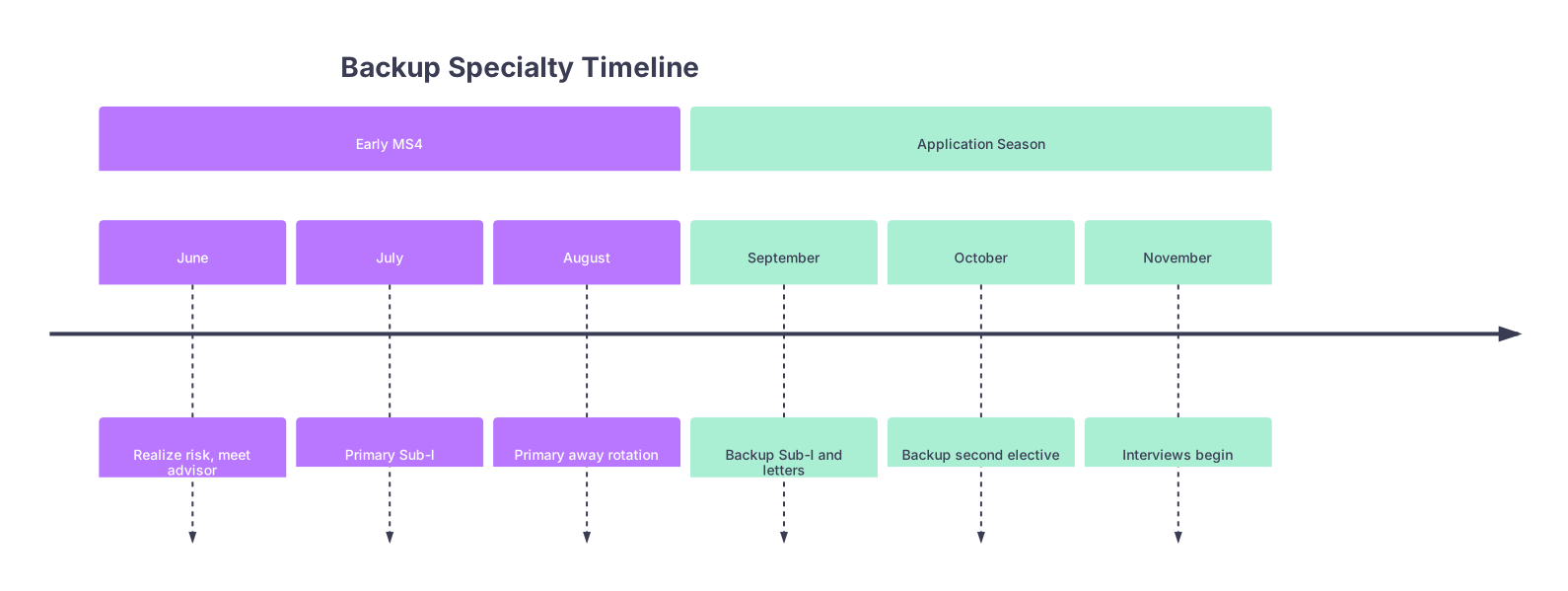
| Period | Event |
|---|---|
| Early MS4 - June | Realize risk, meet advisor |
| Early MS4 - July | Primary Sub-I |
| Early MS4 - August | Primary away rotation |
| Application Season - September | Backup Sub-I and letters |
| Application Season - October | Backup second elective |
| Application Season - November | Interviews begin |
Here is the reality:
Electives done by August
- Can generate letters that are uploaded by ERAS opening or shortly after.
- Ideal for both primary and backup.
Electives in September
- Letters may arrive after applications are submitted, but:
- PDs still read late-arriving letters.
- You can email programs to flag new, strong backup letters.
- Letters may arrive after applications are submitted, but:
Electives in October or later
- These are more about:
- Interview talking points
- Late-added letters that may help at programs reviewing into December/January
- For a backup specialty, this is still better than nothing, but do not pretend it equals a July Sub-I.
- These are more about:
So, if you are now in August or September and just realizing you need a backup:
- Front-load backup Sub-I ASAP.
- Accept you might have to submit ERAS with fewer letters initially, then “patch in” better backup letters as they are written.
- Communicate proactively with programs once backup letters post.
Step 12: Avoid the Three Classic Elective Mistakes With Late Backups
I have watched these sink otherwise decent applicants.
1. Trying to split a single month between two specialties
- Example: 2 weeks EM, 2 weeks IM, hoping to impress both.
- Result:
- Neither side sees enough of you.
- No strong letters from either.
- Fix: Commit each block to one field. Depth beats breadth now.
Being vague or dishonest with attendings
- Some students hide that they are applying to two fields.
- Then PDs talk, and the student looks slippery.
- Fix: Be honest but framed:
- “I am applying to both EM and IM because I am drawn to acute care in both environments and would be happy in either. This month I am really trying to show you what I can do in IM.”
Letting “fear” completely strip time from the primary
- Overreacting and dumping all remaining electives into backup.
- Then primary apps look weak and half-committed.
- Fix: Use the risk framework from Step 1 to set proportional time, not emotional time.
Step 13: Put It All Together in a One-Page Plan
Do not leave this swirling in your head. Write it out.

| Step | Description |
|---|---|
| Step 1 | Assess Match Risk |
| Step 2 | Allocate 50 to 60 percent time to backup |
| Step 3 | Allocate 30 to 40 percent time to backup |
| Step 4 | Allocate 20 to 25 percent time to backup |
| Step 5 | Schedule backup Sub I next open block |
| Step 6 | Identify 2 potential backup letter writers |
| Step 7 | Add at least 1 ICU or general medicine month |
| Step 8 | Draft narrative explaining 2 specialties |
| Step 9 | High Risk Primary |
| Step 10 | Moderate Risk |
By the end of an hour, you should have on paper:
- Risk level: high / moderate / low
- Primary specialty: __________
- Backup specialty: __________
- Remaining elective blocks: dates + open slots
- Target rotations for each open block:
- Block 1: __________ (primary or backup?)
- Block 2: __________
- Block 3: __________
- Planned letter writers:
- Primary: Dr. ___, Dr. ___
- Backup: Dr. ___, Dr. ___
- Universal/neutral: Dr. ___
- One 3–4 sentence explanation of why you are applying to both that uses your actual electives as proof.
Print that page. Or at least have it open whenever you are emailing coordinators.
Your Move Today
Do not “think about this later.” Your schedule is one of the few levers you still control.
Today, before you do anything else:
- Open your school’s online scheduling system (or your current 4th-year calendar).
- Identify the next three elective blocks that are still flexible.
- For each of those three blocks, assign:
- Primary specialty, backup specialty, or neutral (ICU/gen med).
- Then, write down the name of at least one attending per block who could plausibly become a strong letter writer.
If you cannot fill those blanks, your backup plan is still fantasy. Fix the calendar first. The match will not wait for you to sort it out.