
The worst time to realize you need backup specialties is after everyone else already applied. But you can still turn a late decision into a functional, realistic backup list—if you stop hand-wringing and start moving systematically.
You do not have time for vibes, fantasy choices, or “maybe this would be interesting” thinking. You need a controlled crash landing that still gets you into a residency where you will not be miserable.
Here is how to fix it.
Step 1: Get brutally honest about why you need backups
Before you start throwing specialties at the wall, you must be clear on the “why.” Otherwise you will create a fake safety net that does not hold.
Ask yourself, and write this down:
What exactly is the risk?
- Board scores borderline or low
- Weak clinical grades or no honors in the target specialty
- Minimal or late research
- Limited away rotations / letters in the field
- Late switch (e.g., from surgery to psych in October)
- Geographic constraints (must stay in one region)
- Personal factors (visa, couples match, leaves of absence)
What are the realistic consequences?
- Might not match at all in primary specialty
- Might only match in very undesirable locations
- Might be screened out by many programs before they read anything else
You are not doing this to punish yourself. You are doing it so your backup plan is tailored to your actual risk profile, not imaginary or generic risk.
Quick rule: If your primary specialty is one of the “ultra-competitive four” (Derm, Plastics, Ortho, ENT) and you are not in the top 20–25% of your class with strong research, you need a serious backup strategy. Not a symbolic one.
Step 2: Define your non‑negotiables and your “absolutely nots”
You cannot meaningfully pick backups until you know your red lines.
Take 15–20 minutes and write two short lists:
Non‑negotiables:
- Examples:
- “I need a path that allows a reasonable clinic-based lifestyle.”
- “I want to have some procedures.”
- “I strongly prefer adult over peds.”
- “I need a specialty that sponsors H‑1B.”
- “I need to be in or near the Midwest.”
- Examples:
Absolutely nots:
- Examples:
- “I will not do primary care clinic 5 days a week.”
- “I cannot handle 80‑hour weeks long term.”
- “I do not want to be in the OR all day.”
- “I will not move to the West Coast under any circumstance.”
- “I do not want to work mostly nights.”
- Examples:
This is not about designing a dream job; it is about drawing hard boundaries so you do not accidentally “back up” into a life you will hate.
Two things I see students forget all the time:
- Geography. If you are restricted to one metro area or one state, your “backup” cannot be something with 4 programs total in that region. That is fantasy, not a plan.
- Visas. If you are an IMG on a visa, cross-check every backup idea with visa realities. Some fields/programs are much more H‑1B friendly; others are almost entirely J‑1 only or avoid visas altogether.
Step 3: Map your primary specialty to logical backups
Your backup list is not random. It should be structurally and politically aligned with where you already invested time.
Start with your primary specialty and ask:
- What are the closest “cousin” fields based on:
- Patient population (adult vs peds)
- Inpatient vs outpatient balance
- Procedure intensity
- Organ system focus
- Usual match competitiveness
- Where can my existing letters and experiences still look relevant?
Here is a quick comparison chart to get your brain moving:
| Primary Target | Typical Competitiveness | Common Backup Directions | Why It Works |
|---|---|---|---|
| Dermatology | Ultra-high | Internal Medicine, Pathology | Overlap in complex medicine, clinic, and diagnostic thinking |
| Orthopedic Surgery | Ultra-high | General Surgery, PM&R | Musculoskeletal focus, procedures, shared attendings |
| ENT | High | General Surgery, Anesthesia | OR environment, head & neck overlap, shared letters |
| Plastic Surgery | Ultra-high | General Surgery, ENT | Surgical mindset, reconstructive overlap |
| Neurosurgery | Ultra-high | Neurology, IM | Neuro focus, ICU / complex patients, shared research themes |
| EM | High-moderate | IM, FM | Acute care; letters from ED often translate well |
This table is not prescriptive, but it gives you a starting framework.
Three guiding rules:
- Leverage existing capital. If half your CV says “ortho” (research, letters, rotations), then PM&R or General Surgery can absorb that story. Psychiatry cannot.
- Avoid “competitiveness lateral moves” as your only backup. Switching from Ortho to Urology in October is not a backup plan. It is just a different version of high risk.
- Think in tiers, not “primary vs backup.” You want:
- Primary specialty
- “Near peer” backup(s) (similar feel but more slots / slightly less competitive)
- A true safety tier (broad-based, more programs, more geographic reach)
Step 4: Reality check the competitiveness gap—fast
You do not have time to guess. You need a 1–2 hour data sprint to confirm which specialties are realistic for you.
Use:
- NRMP “Charting Outcomes” (latest edition)
- NRMP “Program Director Survey”
- Specialty-specific applicant guides (many are online, even if ugly PDFs)
- Talk to: your dean’s office, a trusted PD, or an honest senior resident
Focus on a few things only:
Step 2 scores / pass-fail reality
- Where do your scores fall relative to matched applicants in that specialty?
- Are most programs now screening by Step 2 thresholds instead?
Your applicant category
- US MD vs US DO vs IMG
- Your school’s reputation in that field
- Whether your school even has a department/program in that field
Your actual application readiness
- Do you have at least:
- 2 letters in the specialty (or close neighbor)
- 1–2 relevant research experiences or projects
- Honest interest that you can articulate without sounding fake?
- Do you have at least:
Rank your candidate backup specialties into three bins:
- Green light: You are near/above the median on stats, can plausibly get 2 letters quickly, and there are enough programs in your desired geography.
- Yellow light: You are a bit below median, or letters will be weak / generic, or geography is tight but not impossible.
- Red light: You are significantly below median, letters do not exist, or there are <10 programs you would realistically apply to.
You are allowed maybe one “yellow” in your backup list. The rest must be green. Red options are off the table; they waste time and money.
Step 5: Design a tiered backup strategy, not a single “Plan B”
A single backup specialty is fragile. If that door closes, you are done.
You want layers:
Tier 1 – Primary specialty
You still apply. You just stop pretending it is guaranteed.Tier 2 – Adjacent backups (2–3 specialties)
These should:- Be reasonably aligned with your CV and interests
- Have moderate competitiveness
- Give you overlapping letter-writers or rotations where possible
Tier 3 – Safety net
A specialty (or two) that:- Has a lot of programs nationally
- Historically has higher match rates
- You can live with as a career, not just tolerate for one year
To make this concrete, let me show you an example structure.
Say you are a late EM applicant with mediocre Step scores, no away rotation in EM, and your school has weak EM connections. It is October.
A functional strategy could be:
Tier 1: EM
- Apply broadly, focus on community and mid-tier academic programs
- Lean on strong IM/FM letters that emphasize your acute care skills
Tier 2: Internal Medicine + Family Medicine
- Comfortable with hospitalist or urgent care work eventually
- Use similar personal statement themes (acute care, undifferentiated complaints, broad medicine)
Tier 3: Transitional Year or Preliminary Medicine
- As pure safety only if desperate, and only if you have a real plan for PGY‑2+
Do not skip Tier 3 if your overall risk is high. That is how people end up in the SOAP every year with nothing suitable.
Step 6: Build a fast, honest self‑inventory to steer your list
A lot of late backup decisions go wrong not because the student misjudged competitiveness, but because they misjudged themselves.
You do not have time for a months-long “find your passion” journey. But you do have time for a 45-minute, brutally honest self-inventory across four axes:
Cognitive style
- Do you enjoy ambiguity and long-term relationships? (Psych, FM, some IM)
- Do you like concrete problems and clear endpoints? (Surgery, EM, Anesthesia)
- Do you like pattern recognition and diagnostics? (Path, Radiology, Derm)
Tolerance for procedures and bodily fluids
- Comfort with blood, OR, invasive lines, or the complete opposite.
People intensity
- How much face-to-face patient/family time you can handle before you are drained.
Workload preference
- Bursty and intense vs steady and predictable.
Once you finish that, cross out backup ideas that obviously clash. For example:
- If you hate chronic complexity and long family meetings, you do not back up into Hem-Onc-heavy IM programs as your “safe” choice.
- If you get energy from procedures and immediate fixes, pure outpatient clinic FM as your primary backup will slowly crush you.
Step 7: Decide program counts and distribution—on paper
You are now choosing a deployment pattern, not just specialties. This is where late planners usually under- or over-shoot.
Use a simple grid like this and fill with numbers, not vibes:
| Tier | Specialty | Number of Programs |
|---|---|---|
| 1 | Primary (e.g., Ortho) | 40 |
| 2 | Backup A (e.g., General Surgery) | 60 |
| 2 | Backup B (e.g., PM&R) | 40 |
| 3 | Safety (e.g., IM categorical) | 50 |
Is this overkill? For some people, yes. But for:
- Late switchers
- Applicants with significant risk factors
- People geographically flexible
…this kind of spread is often what actually prevents a SOAP disaster.
General principles:
- If your primary is ultra-competitive:
- It should probably not be more than 40–50% of your total applications.
- Each backup tier should have more total realistic interview opportunities than your primary (based on your school’s historical match data and your stats).
- If you need to stay in one region, you may need to:
- Focus your primary on that region, and
- Let backups be more geographically flexible, or vice versa.
Step 8: Synchronize letters, personal statements, and ERAS quickly
This is where late decisions sink people. They realize they need backups, then do not align their documents. Programs smell that instantly.
Here is the minimal viable document strategy:
Personal statements
- One primary specialty PS
- One PS for each major backup family:
- Example: IM/FM/EM-adjacent can share one core PS with minor edits.
- Do not write 5 totally unique PSs. You will not maintain quality. Group by similarity.
Letters of recommendation
- Identify:
- 2 letter writers in primary specialty
- 2 in backup Tier 2 (if possible)
- Ask explicitly if they can:
- Comment on qualities that translate (work ethic, clinical reasoning, team function)
- Adjust letters for multiple specialties if needed
Be direct:
“Dr. Smith, I am applying primarily to EM but adding IM as a backup due to competitiveness concerns. Would you be comfortable writing a letter that would support both EM and IM applications?”- Identify:
ERAS experiences and descriptions
- You do not need to rewrite your whole CV.
- You may need to:
- Slightly reframe some bullets from niche-specialty-focused to broader competencies.
- Avoid making your primary specialty sound like your “only love” if backups are completely different. Tone down the “lifelong dream” language.
Program signaling (if applicable)
- If your specialty uses signaling, be strategic:
- Use your highest-value signals on the most realistic programs in your primary specialty, not pure reaches.
- If backups also use signaling, reserve some for strong realistic programs in those fields.
- If your specialty uses signaling, be strategic:
Step 9: Create a 2–3 week execution sprint plan
Late decision means you are now in sprint mode. You cannot just “work on applications” in a vague way.
Lay out a 14–21 day plan with concrete deliverables. For example:
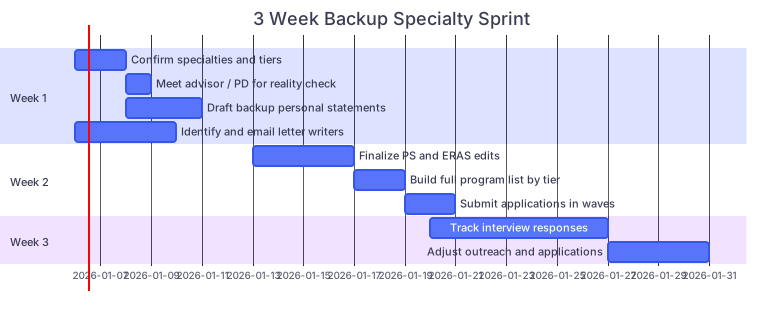
| Task | Details |
|---|---|
| Week 1: Confirm specialties and tiers | a1, 2026-01-06, 2d |
| Week 1: Meet advisor / PD for reality check | a2, after a1, 1d |
| Week 1: Draft backup personal statements | a3, after a1, 3d |
| Week 1: Identify and email letter writers | a4, 2026-01-06, 4d |
| Week 2: Finalize PS and ERAS edits | b1, 2026-01-13, 4d |
| Week 2: Build full program list by tier | b2, after b1, 2d |
| Week 2: Submit applications in waves | b3, after b2, 2d |
| Week 3: Track interview responses | c1, 2026-01-20, 7d |
| Week 3: Adjust outreach and applications | c2, after c1, 4d |
Refuse to keep everything in your head. Use a simple spreadsheet or task manager. Color code by:
- Documents
- Programs
- Letters
- Follow-ups
This is project management now, not “exploration.”
Step 10: Use your school’s data and people ruthlessly
You are not the first person to be in this position. Someone at your school knows which backup paths tend to work.
You should be doing all of this:
Meet with:
- Your dean or advising office
- A faculty member in your primary specialty
- A faculty member in a backup specialty you are strongly considering
Ask concrete questions:
- “Where have people like me matched in the last 3–5 years?”
- “For an applicant with my stats and this late start, how many programs should I realistically apply to in this specialty?”
- “Are there programs in this field that are historically friendlier to our students?”
Do not be vague. Do not say “What do you think?” Say: “Here is my proposed tiered list and program counts. Where is this naive?”
You will get much better help if you show that you already did the hard thinking.
Step 11: Fix the ranking mindset now (future-proofing your backup plan)
Doing backups late creates a psychological trap: you keep treating your primary specialty as the only “real” option and mentally dismiss your backups.
That mindset will push you to rank badly. Or ignore interview offers you should value. Or give half-hearted interviews that programs can feel.
Reframe:
- Every specialty on your backup list must be something you can honestly say:
- “If I match here, I can build a good life and a satisfying career.”
- You are not ranking “primary vs consolation prizes.” You are ranking a portfolio of acceptable futures, some of which may even be better for you long term than the original plan.
Here is how you keep yourself honest:
- After each interview (primary or backup), write:
- 3 concrete things you liked
- 3 realistic downsides
- How you honestly felt walking out: “Could I see myself here?”
When you build your rank list, do not give automatic priority to primary specialty interviews if you left them feeling uneasy and had backup interviews where you felt at home. The Match does not care about your ego. It cares about your ordered list.
Step 12: Keep one eye on the SOAP, but do not plan to live there
If you are doing all of this very late (e.g., closer to rank list time), you also need a contingency plan for the SOAP.
That does NOT mean “I will fix everything in SOAP.” That is magical thinking.
It means:
- Know which specialties commonly have unfilled spots
(Historically: prelim medicine, prelim surgery, family medicine, some IM, psych, peds—varies by year.) - Have a “floor” line ahead of time:
- “I will go SOAP into these specialties if needed.”
- “I will NOT SOAP into these, even if it means a reapplication year.”
Think of SOAP as the emergency fire escape, not your main door. A strong backup plan reduces the odds you will need it at all.
A quick visual of how a late backup decision stabilizes your match odds
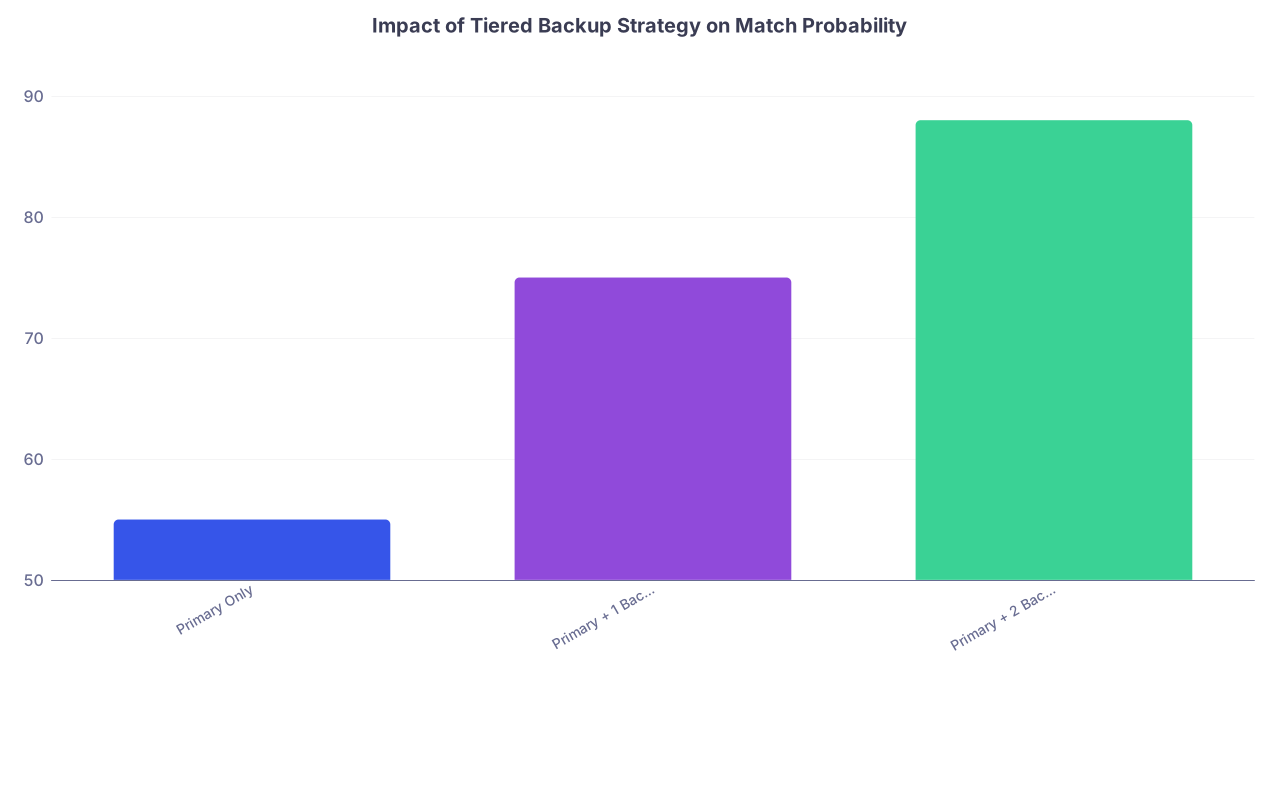
| Category | Value |
|---|---|
| Primary Only | 55 |
| Primary + 1 Backup | 75 |
| Primary + 2 Backups | 88 |
This is illustrative, not exact. But the point holds: a structured, multi-tier backup strategy dramatically reduces the chance of going unmatched—much more than just “adding one more similar specialty.”
Putting it all together: a concrete example
Let me walk through one realistic case so you can model from it.
Scenario:
US MD, mid-tier school. Initially aimed for Neurosurgery. Step 2: 233. No significant neurosurgery research. One neurosurgery rotation, good but not glowing letter. It is October. Reality is setting in.
What they do wrong if they panic
- Keep Neurosurgery as primary.
- Add Neurology as a “backup” with:
- No neurology letters.
- Generic PS that screams “I wanted Neurosurgery but settled.”
- 15–20 Neurology programs. All academic. All in big cities.
- Submit late. Hope.
Very high risk of not matching anywhere.
What a functional backup strategy looks like
Step 1: Honest risk assessment
- Neurosurgery with 233 and weak research is extremely unlikely.
- Staying in “brain” fields is emotionally appealing but not required.
Step 2: Non-negotiables
- Wants some complexity, enjoys inpatient.
- Okay with procedures but not obsessed with OR.
- Prefers adult over peds.
- Willing to move for training.
Step 3: Map viable backups
- Tier 1 (primary): Neurosurgery (but now sized correctly)
- Tier 2 backups:
- Neurology (fits complexity, neuro interest)
- Internal Medicine (ICU, hospitalist, cards/crit care possibilities)
- Tier 3 safety:
- Categorical IM in a broader range of locations
- Possibly prelim medicine as extreme safety
Step 4: Numbers
- Neurosurgery: 20–25 programs max (only realistic ones per advisor)
- Neurology: 40–50 programs (mix academic and strong community)
- IM (Tier 2/3 combined): 70–80 programs across multiple regions
Step 5: Documents
- Neurosurgery PS: honest, but toned down “lifelong only dream” language.
- Neurology/IM PS: combined core emphasizing:
- Enjoyment of complex inpatient care.
- Fascination with neuro + systemic disease.
- Letters:
- 1 Neurosurgery letter.
- 1 Medicine letter (sub‑I).
- 1 Neurology letter from a short elective hurriedly arranged but still valuable.
- Choose combinations in ERAS based on specialty.
Result:
Instead of living and dying by a fantasy Neurosurgery outcome, this student now has a robust shot at Neurology and IM, with a slim but not zero shot at Neurosurgery. That is a functional backup list.
Final words
Three points, then you can get to work:
- Stop thinking in binaries. You do not have “primary vs backup.” You need a tiered, realistic portfolio of specialties that you can live with.
- Speed does not mean sloppiness. A late decision can still become a functional plan if you are ruthless about priorities, documents, and program counts.
- Every specialty on your list must be one you can honestly rank. If you would rather reapply than do it for 30 years, it does not belong on your backup list.