
You are staring at your ERAS specialty list.
Your primary choice is locked in. But your gut is screaming: “What if I do not match?”
Your advisor says, “You should have a backup specialty.”
You nod. Then realize you have no idea how to actually pick one. Or worse—you have five ideas and no way to choose: IM? Psych? Path? Anesthesia? Transitional year?
This is where people usually panic, apply half-heartedly to three random fields, and end up with a messy, unfocused application that convinces no one.
You are not doing that.
You have one weekend. You can build a clear, rational backup plan if you stop hand-wringing and run a structured process.
Here is the step-by-step framework to narrow backup specialties in one weekend—without blowing up your primary plan or your sanity.
Ground Rules Before You Start
You are going to be tempted to overthink this. Do not.
You are not choosing your forever for the next 40 years this weekend. You are choosing:
- One or at most two realistic backup specialties
- That fit your credentials and personality well enough
- That you can sell coherently in your application and interviews
You are optimizing for:
- Match probability
- Personal tolerability (you do not need “soulmate specialty,” just “I can do this and not hate my life”)
- Application coherence
You are not optimizing for:
- Prestige
- What your classmates think
- Perfect lifestyle, perfect salary, perfect everything
You have 48 hours. Here is how to use them.
Step 1: Lock Your Constraints in Writing (Saturday Morning, 60–90 minutes)
Before you look at any specialty list, you need your non‑negotiables on paper. Otherwise you will twist yourself into knots justifying anything.
Open a blank document or spreadsheet. Create three sections:
- Hard Constraints
- Strong Preferences
- Dealbreakers
1. Hard Constraints (objective stuff)
Be brutally honest. No “but maybe if I…” fantasy scenarios.
Include:
- USMLE/COMLEX:
- Step 1: P/F but if you failed once, write it.
- Step 2 CK / Level 2: exact score.
- Red flags:
- Any fails, LOA, professionalism issues, remediation.
- Visa status:
- US citizen / permanent resident / visa (which type).
- Geography constraints:
- Must be near partner/family in [region/state]?
- Absolutely cannot live in rural / certain states?
- Application timing:
- Are you applying this cycle on time, or late?
- Current profile:
- Research? (Yes/No; how strong; any pubs in primary specialty?)
- AOA / GHHS / class rank if your school provides it.
You want something like:
- Step 2 CK: 224, one Step 1 fail
- No AOA, no major research, one poster in primary specialty
- Need to stay in the Northeast (partner job)
- US citizen, no visa issues
- No professionalism red flags
This will matter later when you assess competitiveness.
2. Strong Preferences (subjective but real)
These are not absolute, but they drive happiness.
Examples:
- Prefer or avoid:
- OR
- ICU
- Nights
- Heavy procedures
- Chronic continuity vs episodic care
- Lifestyle:
- Can live with 60–70 hr weeks in training, but not 90+
- Long-term want ~45–55 hr weeks
- Patient type:
- Adults vs kids
- Surgical vs medical
- Acute vs chronic
- Lots of talking vs minimal talking
Force yourself to rank these. For example:
- Hate the OR
- Can handle night float, but not q3 trauma call
- Prefer adults
- Like longitudinal relationships but can give that up if needed
3. Dealbreakers
Line in the sand items:
- Will not do:
80 hr weeks long-term
- Surgical residency
- Pediatrics
- Predominantly clinic-based work
- Fields with poor job market in my region
Write them plainly.
You now have a sanity filter before you start fantasizing about ENT as a backup with a 220 Step 2.
Step 2: Build a Shortlist of Possible Backup Fields (Saturday Late Morning, 60 minutes)
Now you create an initial universe of plausible backup specialties. This is where most people either go way too broad or fixate on one thing.
You are going to use a structured filter.
2A. Start from the default backup pool
For most primary choices, the realistic backup pool is small. A typical set of generalist or broadly employable fields:
- Internal Medicine
- Family Medicine
- Psychiatry
- Pediatrics
- Pathology
- Neurology
- PM&R
- Emergency Medicine (borderline backup depending on your metrics and year)
- Anesthesiology (again, depends heavily on scores and cycle)
Surgery subs (ortho, plastics, ENT, urology), derm, radiology subs, ophthalmology—these are not backup fields for you this weekend unless your metrics and faculty backing are very strong.
2B. Eliminate obvious non‑fits using your dealbreakers
Quick pass. For each field, ask:
- Does it completely violate a hard dealbreaker?
- Is it structurally incompatible with my constraints?
Example:
- Hate kids? Remove Peds.
- Hate clinic? Remove FM (or at least flag it as low preference).
- Visa issues + want highly academic neuro? Probably unrealistic.
Do not overcomplicate. If you are viscerally disgusted by the idea of a specialty, drop it.
You should end with 4–7 “maybe” specialties.
Example shortlist:
- IM
- Psych
- Path
- Anesthesia
- PM&R
Good. That’s workable.
Step 3: Run a Quick Competitiveness Check (Saturday Early Afternoon, 90 minutes)
Now you sanity‑check each shortlisted specialty against your objective metrics.
You are not trying to predict exact match probability. You are asking: “Is this specialty reasonably realistic for someone with my numbers this year?”
Pull up three data types per specialty:
- Recent NRMP “Charting Outcomes” style data
- Program director surveys (what they value)
- Your school’s match list + internal advising (if available)
To structure this, use a simple table like this.
| Specialty | Typical Step 2 Range | Your Fit | Overall Competitiveness |
|---|---|---|---|
| IM | 225–245 | Slightly below | Moderate |
| Psych | 220–240 | Within range | Lower-Moderate |
| Path | 215–235 | Within range | Lower |
| Anesthesia | 235–250 | Below | Moderate-High |
| PM&R | 225–240 | Slightly below | Moderate |
Be honest and a little conservative. If you are below median for a field, do not label it “good fit.” Call it what it is.
Now assign each specialty one of three labels:
- Green: Realistic with your numbers and history
- Yellow: Possible but will require smart list building and strong application
- Red: High risk as a backup; too close to your primary in competitiveness
If you end up with:
- 0 greens → You are probably overreaching or being unrealistic about dealbreakers. Revisit Step 2.
- Only 1 green → That is probably your main backup. You can keep 1–2 yellows as stretch backups if you are willing to go broad geographically.
- 2–3 greens → Excellent. You will narrow further based on personality fit and application coherence.
Step 4: Do a Hard “Day in the Life” Fit Test (Saturday Late Afternoon, 2–3 hours)
Now you switch from stats to reality. A lot of bad backup choices come from people never having pictured themselves in the day‑to‑day.
For each remaining specialty (greens and maybe your top 1–2 yellows):
Spend 20–30 minutes per specialty on:
- A solid “day in the life” article or video from a reputable source
- Program websites describing rotation schedules
- PGY-1 or PGY-3 call schedules, if posted
Ask five concrete questions:
- How much time is in:
- Clinic
- Hospital wards
- OR/procedure areas
- ICU
- How much night/weekend work in residency?
- What proportion of the job is:
- Talking and thinking
- Doing procedures
- Documentation/notes
- Does the patient population match what I can tolerate?
- Long-term: What do attendings in this field do all day?
- How much time is in:
For each specialty, rate on a 1–5 scale:
- “I can realistically see myself doing this for 5–10 years”
- Not “Would I love every second?” but “Can I live with this?”
You might end up with something like:
- IM: 4 (broad, lots of talking, some clinic, ok)
- Psych: 5 (fits temperament, lifestyle decent)
- Path: 3 (intellectually interesting, but misses patient contact)
- Anesthesia: 2 (hate OR hours, dislike the idea of constant vigilance without talking)
- PM&R: 4 (mix of neuro/musculo, procedures, okay clinic)
At this stage, you drop anything ≤2 unless you have no other options.
Step 5: Match Your Existing Story to Each Specialty (Saturday Evening, 1–2 hours)
Backup choices fail when your application tells three different stories that contradict each other.
You need to ask: “Can I plausibly explain, on paper and in person, why I am applying to this specialty?”
Look at your:
- MS3 rotations (what you did well in, any honors)
- Electives and sub‑Is
- Research
- Volunteering
- Personal interests
For each remaining specialty, write three bullet points:
- One plausible reason you are drawn to that field
- One prior experience that supports that interest
- One way you can connect it back to your overall “I like X type of medicine” theme
Example for a psych backup for someone applying neurology primarily:
- Reason: Deep interest in brain, behavior, and how disease changes personality and function
- Experience: Neurology clerkship project on post‑stroke depression; volunteer work in a crisis hotline
- Connection: “I am drawn to fields that sit at the intersection of brain, function, and patient narrative—neurology and psychiatry both live there, in different ways.”
You are testing for coherence, not perfection.
If you literally cannot produce even one semi‑honest reason you might be interested in a field beyond “I heard it is easier to match,” that is a weak backup.
Step 6: Force-Rank and Cut Down to 1–2 Backups (Sunday Morning, 60–90 minutes)
You should now have usable data:
- Competitiveness (green/yellow)
- Lifestyle and temperament fit (1–5)
- Coherence with your story (bullet points)
Time to be ruthless.
6A. Build a simple scoring sheet
Give each specialty 0–2 points in each category:
- Competitiveness:
- Green: 2
- Yellow: 1
- Red: 0
- Fit:
- Rating 5: 2
- 3–4: 1
- 1–2: 0
- Story coherence:
- Strong, obvious narrative: 2
- Reasonable, can explain: 1
- Contrived, weak: 0
Add them. Maximum 6.
Then:
- Any specialty with total ≤2 → cut.
- 3–4 → borderline. Keep only if you need options.
- 5–6 → strong candidate.
6B. Decide: one backup vs two
General rule of thumb:
If your primary is very competitive (derm, ortho, ENT, plastics, neurosurg, rad onc):
- One strong generalist backup (IM, FM, psych, path, etc.) is usually enough if you are really willing to go anywhere and apply broadly.
- Two backups if you are geographically restricted or have red flags.
If your primary is moderately competitive (EM, anesthesia, OB/GYN, radiology, PM&R, some IM subs):
- One backup is sufficient for most.
- Two if your metrics are below average and you are determined to also apply to primary field.
You should end up with:
- 1 primary specialty
- 1–2 backup specialties, ranked by preference
No more than two backups. Three or more and your application starts looking unfocused and desperate.
Step 7: Map Out Concrete Application Logistics for Each Backup (Sunday Late Morning, 2 hours)
Now you translate this into real actions, not just theory. This is where people often bail—“Yeah I like psych as a backup” with zero plan to actually apply effectively.
For each backup, make explicit decisions on:
- Number of programs to apply to
- Geographic scope
- Letters of recommendation
- Personal statement strategy
- Interview handling
7A. Program numbers and geographic scope
Be realistic, not stingy.
Common rough ranges (adjust based on your scores and red flags):
Highly competitive primary + generalist backup:
- Primary: 40–60+
- Backup: 30–60, depending on risk tolerance
Moderately competitive primary + one backup:
- Primary: 30–50
- Backup: 20–40
Use a simple chart to sanity‑check time and cost.
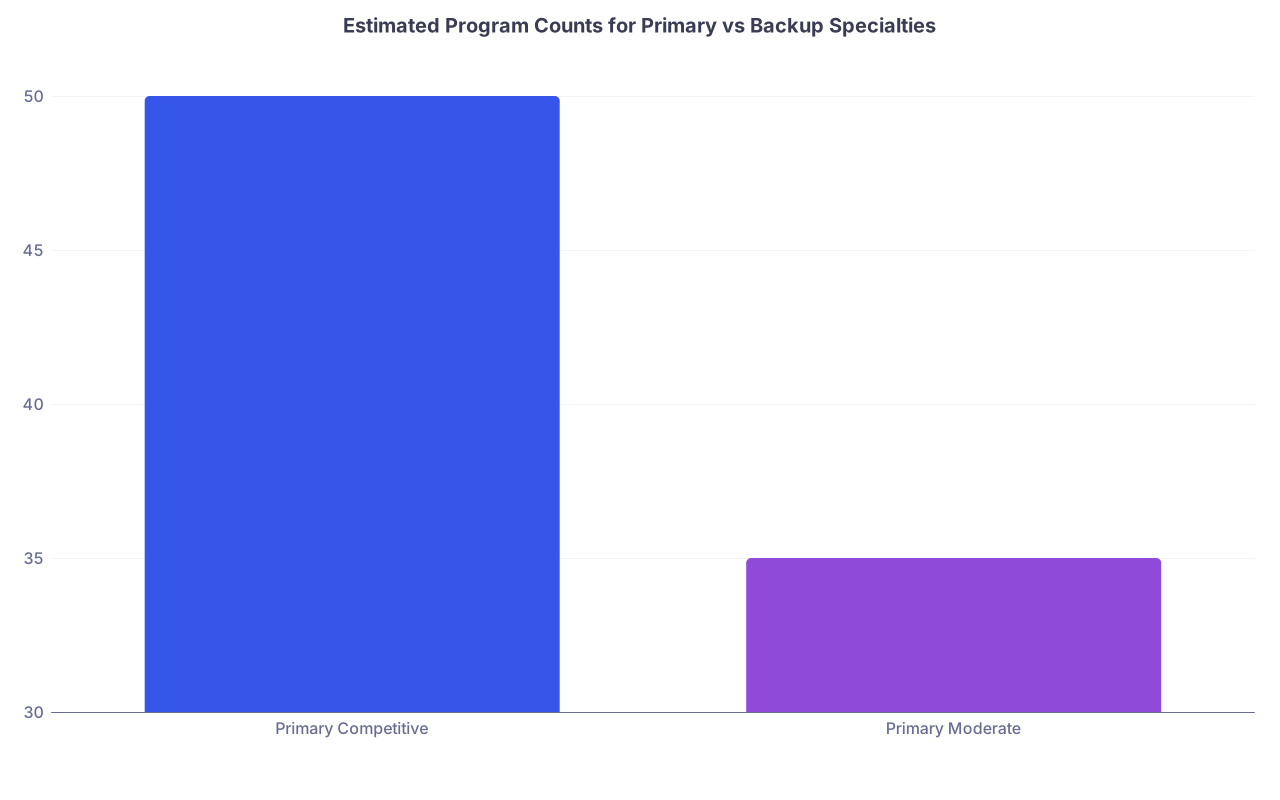
| Category | Value |
|---|---|
| Primary Competitive | 50 |
| Primary Moderate | 35 |
Then pick regions for each backup:
- Are there regions you are willing to go for backup but not for primary?
- Are there community programs more likely to favor backup applicants?
Write this out. “Psych backup: will apply everywhere in Midwest + South + Northeast; no West Coast due to family.”
7B. Letters of recommendation
This is where timelines can kill you.
For each backup:
- Identify:
- 1–2 letters you already have that can flex (e.g., IM letter that works for heme-onc or cards interest)
- 1–2 letters you still need specifically in that specialty
Create a mini‑plan:
- Who to ask
- When
- What to tell them (that you are applying to X as primary, Y as backup)
If you are late in the game and cannot get specialty‑specific letters, pick backups that tolerate strong general letters (e.g., IM, FM, psych) better than highly competitive subs.
7C. Personal statement strategy
You have maybe 2–3 options:
- Separate statements for each specialty
- A primary-focused statement and a more general medicine statement that can be used for a related backup
- In rare, well‑aligned cases, a single statement that works for primary + backup (e.g., neuro + psych, IM + FM)
Do not be lazy here. If psych is your backup, your “I have always wanted to be an orthopedic surgeon” essay will not cut it.
Outline:
- 1–2 paragraphs you can tweak per specialty to match that field’s core themes
- A consistent “why medicine, why this patient population, why this style of practice” story that links them
Step 8: Create a One-Page Backup Specialty Playbook (Sunday Afternoon, 60 minutes)
You are almost done. Now you consolidate everything so that in a week you do not forget what you decided in this caffeine‑fueled weekend.
Make a single one‑page summary with:
Primary Specialty
- Short rationale
- Programs target range
Backup #1
- Key reasons it fits you
- Competitiveness label (green/yellow)
- Target program number and regions
- LOR plan: who + when
- Personal statement plan
Backup #2 (if any)
- Same items as above
Application coherence notes
- 2–3 sentences you can use in any interview when they ask, “So I see you also applied to X—tell me about that.”
Something like:
“My primary interest has been neurology for years because of my fascination with brain and function. Psychiatry emerged as a strong secondary interest as I worked with patients where disease, behavior, and narrative intersected. I applied to both fields intentionally, focusing on programs that value that overlap, and I would be satisfied training in either path.”
You will thank yourself later when interviews start.
Step 9: Pressure-Test with One Human (Sunday Late Afternoon, 30–60 minutes)
Find one person who actually understands residency:
- Specialty advisor
- Core clerkship director
- Trusted senior resident
- Not your panicking classmate
Walk them through:
- Your primary specialty
- Your 1–2 backups
- How many programs you plan for each
- How you are handling letters and statements
Ask them one direct question:
“Does this plan make sense given my scores, my application, and what you know about the match this year?”
If they say “No” or “I would be worried about X”:
- Do not trash everything.
- Identify the exact weak link (too few programs? backup still too competitive? letters impossible?)
- Adjust that piece only.
Visualizing the Weekend Workflow
Here is what the full weekend looks like as a process.

| Step | Description |
|---|---|
| Step 1 | Start Saturday |
| Step 2 | Write constraints and dealbreakers |
| Step 3 | Shortlist 4-7 specialties |
| Step 4 | Check competitiveness data |
| Step 5 | Drop unrealistic fields |
| Step 6 | Day in the life fit check |
| Step 7 | Story coherence bullets |
| Step 8 | Score and rank specialties |
| Step 9 | Select 1-2 backups |
| Step 10 | Plan programs LORs statements |
| Step 11 | Create one page playbook |
| Step 12 | Review with advisor |
| Step 13 | Finalize application plan |
Pin this in your head. You are not just “thinking about backups.” You are running a defined pipeline and exiting with a real plan.
Quick Reality Check: What If You Truly Have No Good Backup?
Sometimes the honest answer is: you picked a hyper‑competitive primary, your scores are low, and you cannot stomach any realistic backup that fits your numbers.
Here is how I have seen people handle that without blowing up their careers:
- Apply this year only to realistic specialties (no fantasy derm + 10 FM programs combo).
- Or, if you are dead‑set on the ultra‑competitive primary, consider:
- Research year, improve credentials, reapply next cycle
- SOAP/Match this year into a generalist specialty, then later consider fellowship or switch routes
But the worst thing you can do is:
- Throw in a token set of backup apps to fields you do not understand, with terrible fit and no coherent story. Programs see right through that.
If you run this weekend process honestly and still feel stuck, that itself is an answer: you may need a bigger strategic reset than “just add a backup.”
A Brief Example: Putting It All Together
Let me walk through a compact real‑world style case.
- MS4, primary: Emergency Medicine
- Step 2: 231, no fails, US MD
- Loves acute care, hates clinic, fine with nights, wants West Coast ideally but can move
- Hard dealbreakers: no surgery, no peds primary field
Step 2 shortlist after filtering:
- IM, Psych, FM, Anesthesia, Path
Competitiveness check:
- Anesthesia: yellow/red with 231
- Path: green
- IM: green
- Psych: green
- FM: green
Fit check (1–5):
- IM: 4 (likes inpatient, ok with some clinic)
- Psych: 3 (likes some aspects, slower pace feels off)
- FM: 2 (too much clinic/primary care, hates it)
- Path: 2 (no patient contact bothers them)
Drop ≤2: FM, Path gone.
Now:
- IM: competitiveness 2, fit 2 (rated 4 → 1point), story 2 → 5/6
- Psych: competitiveness 2, fit 1, story 1 → 4/6
End result:
- Primary: EM
- Backup #1: IM
- Backup #2: Psych (smaller number of apps)
Application plan:
| Specialty | Program Count | Geographic Scope |
|---|---|---|
| EM | 45 | Nationwide |
| IM | 40 | Nationwide |
| Psych | 20 | Less competitive regions |
Letters:
- 2 EM letters (primary)
- 1 IM letter from wards
- 1 general “medicine” letter that can flex to psych
Personal statements:
- EM statement
- IM/Psych general medicine statement customized slightly per field
That is a coherent, defensible backup plan built in a weekend.
One More Visual: Balancing Fit vs Competitiveness
Sometimes seeing the tradeoff helps.
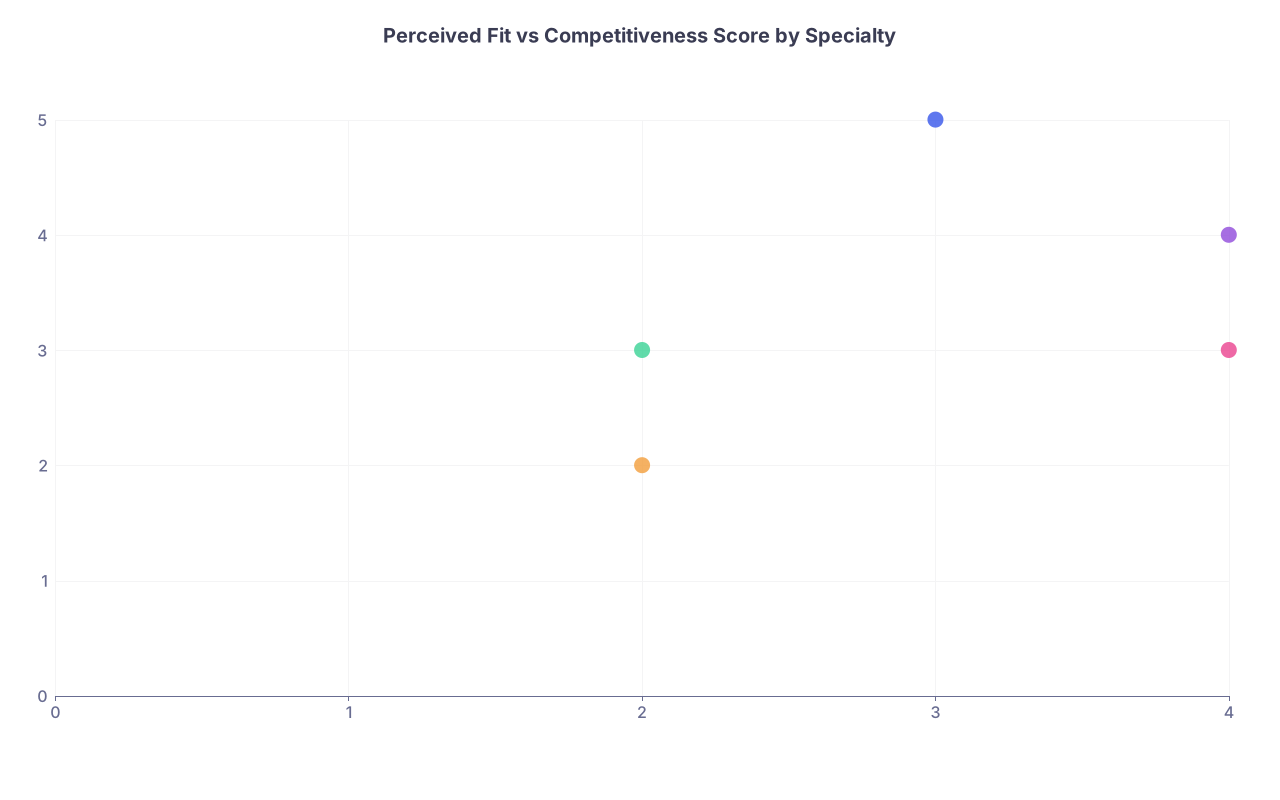
| Category | Value |
|---|---|
| IM | 3,5 |
| Psych | 4,4 |
| Path | 2,3 |
| Anesthesia | 2,2 |
| PM&R | 4,3 |
- X-axis (first number): Competitiveness score (higher = better for you)
- Y-axis (second number): Fit score (higher = better for your preferences)
You want backups clustered in the upper-right: good fit and realistic competitiveness. The weekend framework is about identifying those.
Final Check: Emotional vs Rational
By Sunday evening, expect some emotional backlash:
- “But I never imagined myself as an internist.”
- “Psych as a backup means I am giving up on [primary].”
- “Path seems too different from what I thought I wanted.”
Let that noise run in the background. Focus on:
- Will this field let me train as a physician, earn a living, and build a career with options?
- Am I reasonably likely to match here with a strategically built application?
- Can I explain, with a straight face, why I am genuinely willing to do this specialty?
If yes, it is a valid backup.
Key Takeaways
- Do not “feel your way” to a backup. Use a structured, time‑boxed weekend process: constraints → shortlist → competitiveness → fit → coherence → final 1–2 choices.
- A good backup specialty is not your dream field. It is a realistic, tolerable, and coherent path that protects you from an unnecessary no‑match.
- Finish the weekend with a one‑page playbook and a concrete plan for programs, letters, and statements, then pressure‑test it with one knowledgeable human before you hit submit.