
It is October. Your first wave of interview invites just hit your inbox.
You open ERAS. Refresh. Twice.
Your categorical surgery invites: zero.
Your prelim invites: one questionable community program you only added at 1:30 a.m. after a bad call night.
You start doing the math. Your Step scores are solid but not elite. Your letters are “strong” but not from big names. Meanwhile, people around you are posting “So grateful!” updates about 10+ invitations.
You were all-in on surgery. No true backups. Maybe you threw in two IM applications “just in case,” but you did not mean it. And now your dean, your advisor, and your more honest friends are saying the same thing:
“You need a real backup plan. Fast.”
This is where a lot of people panic and make terrible decisions. They shotgun-apply to random specialties. They write frantic, incoherent emails. They pretend they still “love” surgery on half their apps while trying to sell an entirely different personality to medicine or anesthesia on the others.
You do not have time for that.
Here is how you pivot from a surgical dream to medical backups in a way that is:
- Strategic, not desperate
- Honest, not self-sabotaging
- And actually improves your odds in BOTH directions
Step 1: Get Ruthlessly Clear on Your Actual Risk
Before you blow up your whole plan, you need a hard, unemotional read of your risk level.
1.1. Reality check your competitiveness
Grab your data:
- Step 1 (P/F but still matters in context: fail attempts, timing)
- Step 2 CK score
- Number of programs applied to
- Geographic limits (family, visa, etc.)
- Research output (especially surgery-related)
- Class rank / AOA / honors in surgery
Now compare against actual numbers, not vibes.
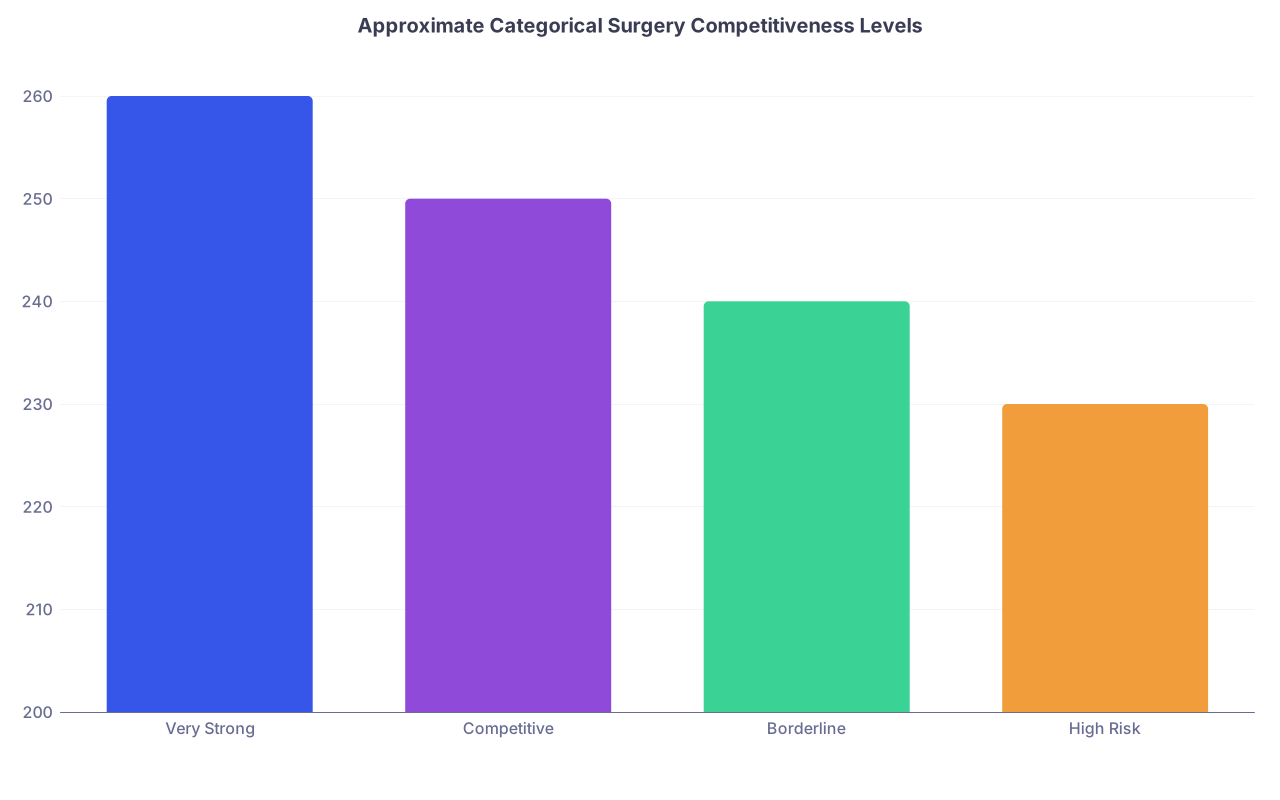
| Category | Value |
|---|---|
| Very Strong | 260 |
| Competitive | 250 |
| Borderline | 240 |
| High Risk | 230 |
Rough rule-of-thumb bands for categorical general surgery (US MD, single attempt, typical year):
- Very strong: Step 2 ≥ 260, multiple strong surgery letters from academic surgeons, solid research, applied broadly (60+ programs)
- Competitive: Step 2 245–259, good letters, some research, 50+ programs
- Borderline: Step 2 235–244, average letters, minimal research, narrower list
- High risk: Step 2 < 235, red flags, or very limited apps / strict geography
If you are in the borderline or high-risk band and:
- It is late October and you have < 5 categorical interviews
- Or it is mid-November and you have ≤ 3 categorical + a few prelims
You are in real danger. That does not mean you will not match. It means you need an active backup strategy, not “hope.”
1.2. Get external, blunt feedback
You are too close to this. You need:
- One surgery faculty who actually knows you
- One non-surgical advisor (IM, anesthesia, EM, etc.) with program experience
- Your dean’s office / MSPE person if possible
Ask them directly:
- “If I were your own kid, would you tell me to double down on surgery or add real backups right now?”
- “What risk band would you put me in for categorical surgery: low, medium, high?”
- “If I needed a backup in a medical specialty, which would you suggest based on how I present clinically?”
If three independent people say “You need backups,” stop arguing. You pivot.
Step 2: Choose Backup Specialties That Actually Fit a Surgical Personality
The worst move is “any backup is fine.” That is how you end up in a specialty you hate, or obviously mismatched yourself and spook programs.
You want specialties that:
- Genuinely align with how you think and work
- Are believable transitions from a strong surgical interest
- Still have reasonable availability and interview potential in your timeline
Here are the usual suspects for people who were serious about surgery.
| Backup Specialty | Feels Surgical? | Patient Contact | Procedures | Competitiveness (Relative) |
|---|---|---|---|---|
| Anesthesiology | High | Moderate | High | Moderate |
| Emergency Med | Moderate-High | High | Moderate | Moderate (variable) |
| Internal Med | Low-Moderate | High | Low | Lower (but tiered) |
| PM&R | Moderate | High | Moderate | Moderate |
| Radiology (Diag) | Moderate (indirect) | Low-Moderate | Low | Moderate-High |
2.1. Anesthesiology – the cleanest pivot for many
Why it fits:
- You already understand OR workflow and perioperative medicine
- You can credibly say you love the OR but realized you prefer physiology, critical care, airway, and acute management over operating itself
- Programs are used to applicants coming from a strong surgical orientation
Good if:
- You liked ICU, airway, acute hemodynamics
- You did not hate pharmacology
- You can talk about teamwork with surgeons without sounding bitter or resentful
Not ideal if:
- You loathe the OR environment or early mornings
- You want long-term clinic relationships as your main thing
2.2. Emergency Medicine – controlled chaos with procedures
Why it fits:
- Big overlap with acute care, trauma, procedures, resuscitation mindset
- You can be honest: “I realized I love high-acuity initial management more than longitudinal postoperative care.”
Good if:
- You liked trauma call and ED consults
- You enjoy breadth, quick decision-making, handling 5 things at once
- You are okay with shift work and unpredictable rhythms
Caveat: EM has become more competitive and geographically distorted in recent years. Some markets are flooded, others are desperate. You must talk to actual EM folks in your regions of interest.
2.3. Internal Medicine – the utility backup (if you are smart about it)
Why it fits:
- Almost every hospital has IM slots, so numerically it is the most accessible backup
- Broad platform for later fellowships (cards, GI, pulm/crit) that feel more “procedural” and close to critical care / perioperative medicine
But the trap:
- A generic IM application that screams “failed surgeon” is a problem.
- You need a coherent narrative that says: “I care about complex medicine, not just cutting.”
Best angle for surgery-leaning people:
- Emphasize interest in:
- ICU and perioperative medicine
- Complex inpatient care
- Procedural subspecialties you might consider later (cards, GI, pulm/crit)
If you hated your IM rotation and thought all of it was “endless notes and CHF tune-ups,” do not fake it. Programs can tell.
2.4. PM&R, Radiology, others
These can be smart pivots in specific situations:
- PM&R if you liked functional outcomes, MSK, neuro trauma, long-term rehab
- Diagnostic Radiology if you love imaging, pattern recognition, and consultative roles (this read is very personality-dependent)
The key: do not randomly pivot into a field you know nothing about or have zero exposure in. If you have literally never done a radiology elective, applying there out of nowhere in October looks like desperation.
Step 3: Build a Coherent Application Story (Without Lying)
This is the part that makes people freeze. They think: “How do I explain switching from surgery to medicine/anesthesia/EM without sounding indecisive or like I failed?”
You need one clear story that:
- Is true
- Is consistent across specialties
- Does not trash surgery
- Explains what you learned about yourself, not what is wrong with the field
3.1. Core narrative structure that works
Use this backbone and adjust the details:
- You had a long-standing attraction to acute care / procedures / OR.
- You committed to surgery early and worked hard in that lane.
- Through rotations, sub-Is, and time in the hospital, you realized what energizes you most is [X] rather than [Y].
- That realization logically led you to [backup specialty], where you can:
- Use the same strengths (work ethic, acute care mindset, team-based care)
- Avoid the aspects of surgery that did not fit you long term (but do not vilify them)
- You still respect surgery deeply and get along with surgeons, which is a plus in many backup specialties.
You are not saying, “I failed, so I pivoted.”
You are saying, “I learned more about myself, quickly enough to adjust intelligently.”
3.2. Tuning it by specialty
For Anesthesia:
- “I realized I was more engaged by managing physiology in real time, coordinating care with the team, and working through complex airways and hemodynamics, rather than performing the operations themselves.”
For EM:
- “What consistently drew me in was the front end of care – initial resuscitation, trauma activation, rapid diagnostics, and disposition decisions – more than longitudinal postoperative management.”
For IM:
- “Over time I found myself more intrigued by complex multisystem medicine, ICU-level decision-making, and the broader internal medicine framework around surgical patients, than by the technical aspects of the operation.”
You avoid sounding flaky by:
- Emphasizing continuity: same patient population, same acuity level, same systems
- Showing you are not running from hard work, only aligning with a better-fitting role
Step 4: Re-Tool Your Application Materials Fast (Without Burning It All Down)
You do not have to reinvent everything. You have to surgically modify what you already built.
4.1. Personal statements: triage and rebuild
You will need:
- 1 surgery statement (keep it for categorical and prelims)
- 1 backup specialty statement (tailored but built from the same core story)
Do this:
Copy your surgery statement into a new document.
Strip out:
- “I have always wanted to be a surgeon”
- Overly “cutting is my identity” language
- Any content that would sound bizarre if read by a non-surgeon
Replace with:
- Your core “I learned I am best suited for X type of work” narrative
- 1–2 concrete examples from clinical experiences that match the backup field
- A clear statement of forward-looking commitment to that specialty
You do not need to erase the fact you were strongly considering surgery. You just need to frame it as part of your exploration, not your only possible self.
4.2. Letters of Recommendation: use what you have, but annotate it
Ideal:
- At least 1 letter from someone in the backup specialty
- Plus 1–2 letters from surgical attendings who can vouch strongly for your clinical work ethic
If you do not have a backup-specialty letter:
- Talk to your surgery letter writers.
- Ask if they would be willing to let you send their letter to other specialties.
- Your school can often “retitle” the letter in ERAS (generic instead of “To the General Surgery Selection Committee”).
Then:
- Have your dean’s office / advisor explicitly explain your pivot in your MSPE addendum or a short advisor letter:
- “Student X initially pursued categorical general surgery but, after careful discussion with faculty and advisors, chose to apply to [specialty] where their strengths in acute care, teamwork, and procedural skill are equally well aligned.”
That kind of explicit framing reduces the “What happened?” paranoia from programs.
Step 5: Strategic Application Moves – What To Change, What To Keep
This is where panic leads to stupid shotgunning. You do not need to apply to 120 IM programs and 80 anesthesia programs overnight. You need a controlled pivot.
5.1. Decide your primary vs secondary target
Be honest:
- Are you still primarily trying for categorical surgery, with a genuine backup?
- Or has the data clearly shifted you to “I am now primarily targeting [backup specialty] and will treat surgical prelims as a true fallback”?
You need to pick one as your primary target. Straddling both equally is how you end up with no coherent story.
If surgery stays primary:
Keep:
- All your categorical surgery programs
- A robust list of prelim surgery / transitional year positions
Add:
- A realistic, targeted set of backup specialty programs:
- 20–40 IM or anesthesia programs in regions and tiers where your stats are competitive
- Prioritize community programs, mid-tier academic centers, and places known to take “late pivot” applicants
- A realistic, targeted set of backup specialty programs:
If backup becomes primary:
- Keep:
- Some surgical interviews & a handful of strong prelim options, especially at hospitals that also have your backup specialty
- Add:
- Enough programs in the new specialty to give you a real shot (40–60 for IM or anesthesia is common at this stage, adjusted for your metrics)
5.2. Program selection: choose places that will actually bite
You are not aiming for prestige. You are aiming for:
- Programs that:
- Are not ultra-competitive
- Have reasonable fill rates
- Historically take a mix of US MD / DO / IMGs
- Are in regions less saturated (Midwest, South, some Northeast non-coastal)
Look at:
- FREIDA data
- Program websites—if they list multiple residents with non-linear paths, that is a green flag
- Where your school’s last 5–10 “pivots” matched
Step 6: Communicate With Programs Without Sounding Desperate
There are two communication channels you must handle correctly:
- Your home institution programs
- External programs where you are now applying late
6.1. Your home institution(s)
You have leverage here. They know you.
Do this:
Schedule short, direct meetings with:
- PD or APD of your backup specialty at your home institution
- Possibly your surgery PD if you are still in that lane at all
In the meeting:
- Own the pivot clearly: “I applied in surgery, but based on my data and the fit I have seen clinically, I am now seriously pursuing [specialty].”
- Emphasize what you bring: work ethic, OR/ICU experience, comfort with sick patients
- Ask them explicitly: “Would you consider my application seriously? Is there anything I can do to strengthen it at this point?”
If they are interested, ask (once, not three times):
- “Would a second-look, extra shift, or a brief elective help you get a better sense of me?”
Do not pressure. Just offer.
6.2. Outreach to external programs (backup specialty)
You cannot spam everyone with a copy-paste email saying, “Please interview me.” That reads as noise.
Instead:
- Identify 10–20 realistic backup programs where you have:
- Geographic ties
- Alumni from your school
- Cultural or training fit
Send short, tight messages either through ERAS or email:
- Subject: “Application update – [Your Name], [School], [Specialty] applicant”
Body (example for anesthesia):
- “Dr [PD Name],
I recently applied to your anesthesiology program as a US MD senior from [School]. I initially applied in general surgery, but through multiple OR and ICU rotations I found myself most engaged by perioperative physiology, airway management, and critical care – which led me to pivot thoughtfully to anesthesiology.
I have [Step 2 score], honored my ICU and anesthesia rotations, and have strong letters from OR-based faculty. I would be genuinely excited to train at a program with your case mix and ICU exposure.
I know you receive many applications; I simply wanted to express my specific interest in your program and clarify the context of my file.
Sincerely,
[Name], [AAMC ID]”
You are not begging. You are clarifying and signaling seriousness.
Step 7: Match Strategy – How to Rank Without Playing Games
If you do this right, you may end up with:
- A few categorical surgery interviews
- Several prelim surgery interviews
- A handful (or more) backup specialty interviews
Now the real decision: how do you rank them?
7.1. Be blunt with yourself about what you actually want
Questions to answer honestly:
- If you matched categorical surgery at your weakest program vs categorical [backup specialty] at your strongest program, which would you actually be happy with?
- Would you truly be willing to do a brutal prelim year with no guarantee, just to try again for surgery?
- Are you willing to accept the physical and lifestyle reality of surgery for decades, not just as a badge of honor?
7.2. A sane ranking hierarchy in common scenarios
Here is a typical, logical rank sequence for someone who still loves surgery but is realistic:
- Top categorical surgery programs where you interviewed and would be happy
- Strong categorical backup specialty programs you genuinely like
- Remaining categorical surgery programs (where fit is weaker but still acceptable)
- Remaining categorical backup specialty programs
- Prelim surgery or TY spots at programs with:
- Strong track record of placing prelims into advanced positions
- Your backup specialty in-house with good relationships
What you should not do:
- Rank every prelim surgery above every categorical backup just to “keep the door open” if you know in your gut you would be miserable repeating this cycle. That is how people burn out.
7.3. Future flexibility
One more point that people underestimate:
Switching into surgery later is brutally hard. Switching out of surgery (from a prelim year) is more common but not guaranteed.
On the other hand:
- Anesthesia, EM, IM with critical care pathways, PM&R, and some subspecialties can still keep you very close to the kind of patients and acuity profiles you liked in surgery.
- Many people discover they actually prefer this blend to pure operative life.
So when you rank, you are not choosing “surgery vs a boring desk job.” You are choosing between different kinds of high-acuity, high-responsibility medicine.
Step 8: Keep Your Head Straight While Everything Feels Like It Is Falling Apart
This pivot is emotionally rough. You are grieving a professional identity you have been building for years.
Some concrete guardrails:
- Limit checking your email to fixed intervals (e.g., three times a day). Constant refreshing will make you irrational.
- Set one 60–90 minute block per day to:
- Work on personal statements, emails, and logistics
- Review programs and update your lists
Outside that block, you are in normal life mode: studying, being on rotation, sleeping.
- Talk to at least one person who successfully pivoted specialties. They exist. They are often much happier now, and their perspective will calm you down.
- Do not trash surgery on social media or to your peers. Word moves fast, and you may still need those letters, that PD, or that department down the line.
Key Takeaways
- Stop guessing your risk. Get a blunt assessment of your real odds in surgery, then commit to either doubling down with a structured backup or pivoting your primary target.
- Pick backups that actually fit your clinical personality—anesthesia, EM, IM with a critical care / procedural focus—and build one honest, coherent story that makes sense in both directions.
- Re-tool your application with surgical precision: targeted new personal statements, smart program selection, limited but focused outreach, and a rank list that reflects what you would actually be willing to live with for the next decade.